
An SBA women-owned business is a firm certified under the SBA’s Women-Owned Small Business (WOSB) or Economically Disadvantaged WOSB (EDWOSB) program, giving it legal access to set-aside federal contracts in industries where women are underrepresented. Certification is free through the SBA and opens a procurement channel that general competitors simply cannot touch.
Your three immediate next steps:
- Check eligibility. Confirm you own at least 51% of the business unconditionally, hold U.S. citizenship, and meet SBA small-business size standards for your primary NAICS code.
- Create your accounts. Register on SAM.gov (required for any federal contracting) and set up your profile on the MySBA Certifications portal at certifications.sba.gov.
- Gather your documents. Pull together articles of incorporation or organization, operating agreements, two to three years of signed tax returns, bank statements, and proof of U.S. citizenship before you start the application.
Stat to know: The federal government sets a 5% procurement goal for women-owned small businesses across all prime contract dollars each fiscal year. Certification is what makes your firm countable toward that goal.
Table of Contents
- What qualifies you as an SBA women-owned business?
- Why does WOSB certification actually matter?
- How do you get WOSB or EDWOSB certified?
- WOSB vs. EDWOSB: which one fits your situation?
- How do you turn certification into actual contract awards?
- How does a GSA Schedule fit with WOSB certification?
- Key Takeaways
- The part most guides skip
- Gsascheduleservices can help you move from certified to contracted
- Useful sources and official resources
- FAQ
What qualifies you as an SBA women-owned business?
Eligibility under 13 CFR Part 127 comes down to four tests: ownership, control, citizenship, and size. Pass all four and you qualify for WOSB certification. Meet an additional economic-disadvantage standard and you qualify for EDWOSB.
Control: who actually runs the business
Ownership on paper is not enough. Women must control both the day-to-day operations and the long-term strategic decisions. The SBA looks at who holds the highest officer title, who signs contracts, who manages employees, and who makes financial decisions. If a male spouse or partner holds a formal role that gives him effective control, that is a red flag the SBA will scrutinize.
Citizenship and size standards
Every woman owner whose interest is used to meet the 51% threshold must be a U.S. citizen. Permanent residents do not qualify. On size, the business must qualify as small under the SBA’s size standards for its primary NAICS code. You can look up your size limit at the SBA’s size standards tool, which sets limits by revenue or employee count depending on the industry.
Documents you need to gather
13 CFR § 127.303 specifies that all documents must be submitted electronically, and the SBA may request additional information before making a decision. Core documents include:
- Articles of incorporation, organization, or partnership agreement
- Operating agreement or bylaws, with all amendments
- Stock ledger or membership interest schedule
- Signed federal tax returns (typically two to three years, both personal and business)
- Bank statements showing business accounts
- Proof of U.S. citizenship (passport, birth certificate, or naturalization certificate)
- Government-issued photo ID for each woman owner
- If previously certified by an approved Third-Party Certifier (TPC): original TPC certificate and supporting documentation uploaded to MySBA Certifications
Firms also holding 8(a) or VOSB certification can often reuse supporting documents, which cuts preparation time.
Pro Tip: Check the SBA’s exclusions list before applying. Any owner or the business itself appearing on the SAM.gov exclusions database will block certification until the exclusion is resolved.
Why does WOSB certification actually matter?
The core benefit is access to a procurement channel that non-certified firms cannot enter. Under FAR Subpart 19.15, contracting officers can restrict competition for certain contracts to WOSB or EDWOSB firms, which means your bid pool shrinks dramatically.
Set-aside and sole-source contracts
A set-aside contract limits competition to a specific category of businesses. When a contracting officer designates a procurement as a WOSB set-aside, only certified WOSB firms can compete. EDWOSB set-asides go further, restricting competition to firms that also meet the economic-disadvantage thresholds. Sole-source awards, available under specific conditions, allow an agency to award a contract directly to a WOSB or EDWOSB without any competitive process at all.
5% procurement goal: The SBA’s WOSB Federal Contracting Program exists partly because federal law requires agencies to direct 5% of prime contract dollars to women-owned small businesses each fiscal year. Agencies actively look for certified firms to meet that target, which means your certification creates inbound interest, not just outbound opportunity.
Business-level advantages beyond the contract award
Certification also gives you credibility in teaming arrangements. Prime contractors pursuing set-aside work often need a certified WOSB or EDWOSB as a subcontractor or joint-venture partner to qualify. That opens a second channel to federal revenue that does not require you to win a prime contract yourself.
A small professional services firm, say a management consulting company with five employees, can use WOSB certification to compete for contracts in NAICS codes where women are underrepresented, bypassing the open-market competition from large firms entirely. An EDWOSB in a narrow NAICS category can take that further: the restricted EDWOSB set-aside pool may have only two or three qualified bidders, making a well-prepared proposal nearly impossible to ignore.
The SBA also announced $30 million in grant funding for new Women’s Business Centers, expanding the network of local resources that help certified firms develop proposals and find contracting opportunities. That infrastructure investment signals sustained federal commitment to female entrepreneurship support.
How do you get WOSB or EDWOSB certified?
There are two routes: the SBA’s own MySBA Certifications portal and SBA-approved Third-Party Certifiers (TPCs) such as WBENC (Women’s Business Enterprise National Council) and NWBOC (National Women Business Owners Corporation). Both routes produce the same certification outcome. The differences are cost, speed, and process.
The SBA portal is free. TPCs may charge fees, and their timelines vary. If you already hold a WBENC or NWBOC certification, you can upload that documentation to MySBA Certifications rather than starting from scratch, though you still need to submit proof of citizenship and any other documents SBA requires.
Step-by-step: applying through MySBA Certifications
- Submit and wait for review — The SBA reviews your application and may request additional documentation. Respond promptly to any requests; delays on your end extend the timeline.
For a detailed WOSB certification document checklist specific to professional services firms, that resource walks through each document category with practical notes.
Timeline and maintenance
Application timelines vary. The SBA does not publish a guaranteed turnaround, but straightforward applications with complete documentation typically move faster than complex ones with multiple owners or unusual ownership structures. Budget several weeks from submission to decision.
Once certified, you must maintain your status. Annual attestation is currently in abeyance, but triennial program examinations remain in effect. Check the MySBA Certifications knowledge base for the current status of attestation requirements, since these rules can change. Missing a maintenance deadline can result in loss of certification and ineligibility for set-aside awards.
Common pitfalls to avoid
- Inconsistent ownership records — If your operating agreement says 60% and your tax return shows something different, the SBA will flag it.
WOSB vs. EDWOSB: which one fits your situation?
EDWOSB is a subset of WOSB. Every EDWOSB is also a WOSB, but not every WOSB qualifies as an EDWOSB. The difference is an additional economic-disadvantage test applied to each woman owner whose interest counts toward the 51% threshold.
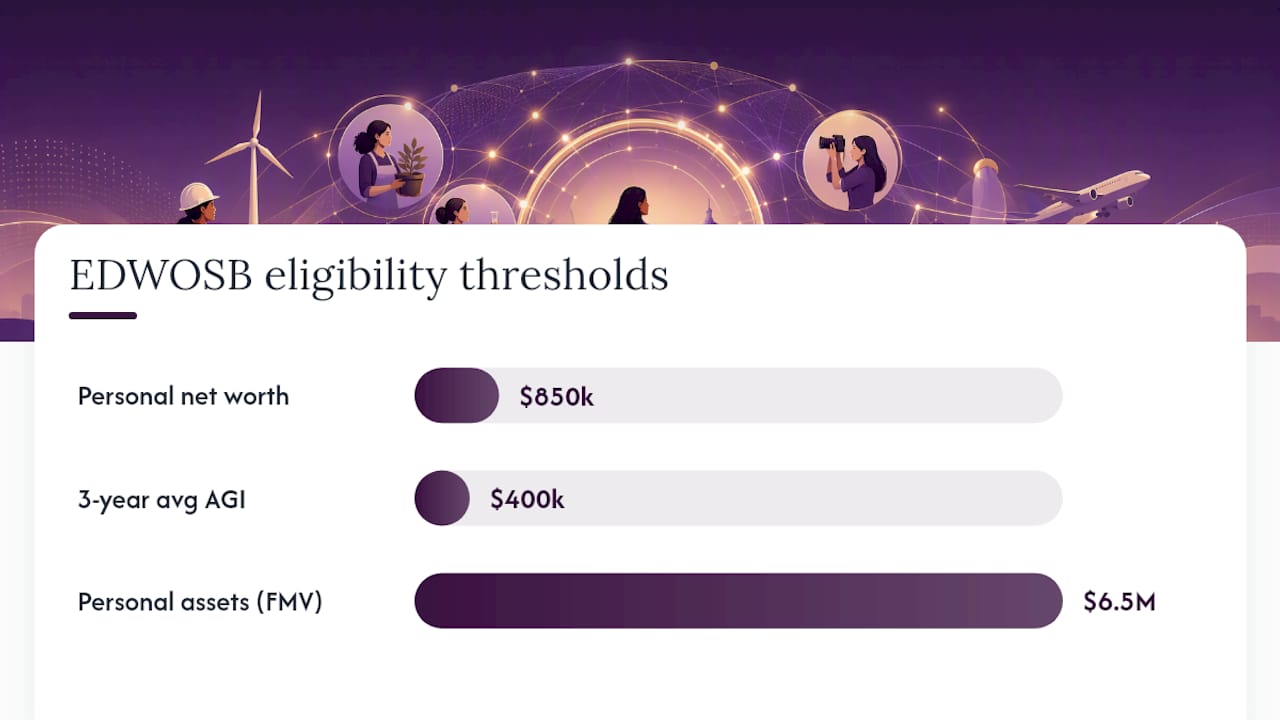
Under 13 CFR Part 127, a woman owner must meet all three of the following thresholds to qualify as economically disadvantaged:
| Threshold | Limit |
|---|---|
| Personal net worth | Less than $850,000 (excluding ownership interest in the business and equity in primary residence) |
| Adjusted gross income (three-year average) | $400,000 or less |
| Personal assets (fair market value) | $6.5 million or less |
These figures come directly from the regulation. If any woman owner whose interest is used to meet the 51% test exceeds any one of these limits, the firm cannot be certified as an EDWOSB, though it may still qualify as a WOSB.
NAICS eligibility and opportunity sets
The SBA maintains two separate lists of NAICS codes: one for industries where WOSB set-asides are permitted, and a narrower list for EDWOSB set-asides. EDWOSB set-asides are available in industries where women are both underrepresented and substantially underrepresented. That narrower list means fewer competitors in those specific codes.
If your primary NAICS code appears on the EDWOSB list and your owners meet the economic-disadvantage thresholds, pursuing EDWOSB certification is almost always the stronger move. The bid pool for EDWOSB set-asides is smaller, and contracting officers can use EDWOSB set-asides in addition to WOSB set-asides, giving you access to both pools simultaneously.
If your owners do not meet the economic-disadvantage thresholds, WOSB certification still provides meaningful access to set-asides in a broader range of NAICS codes. The strategic question is simply whether the additional EDWOSB pool is worth pursuing based on your owners’ financial profiles.
How do you turn certification into actual contract awards?
Certification is the door. Winning contracts requires you to walk through it with a prepared, visible, and competitive presence. Here is what that looks like in practice.
Get your SAM.gov profile right
Your SAM.gov registration is the foundation of your federal contracting identity. Keep it active (it renews annually), and make sure your NAICS codes reflect the work you actually do. Contracting officers search SAM.gov when building their market research lists. An incomplete or outdated profile means you are invisible to them.
Once certified, your WOSB or EDWOSB status will appear in SAM.gov and in the SBA’s certification database, which contracting officers use to verify eligibility before award. You do not need to do anything special to make that happen, but confirm it is showing correctly after your certification is approved.
Where to find set-aside opportunities
Federal contract opportunities are posted on SAM.gov under the “Contract Opportunities” section. When searching, filter by “Set-Aside Type” and select WOSB or EDWOSB to see contracts specifically designated for certified firms. You can also filter by NAICS code to focus on your industry.
Pro Tip: Set up saved searches and email alerts on SAM.gov for your primary NAICS codes with WOSB/EDWOSB set-aside filters. Solicitations can close in as little as 15 days, and manual searching means you will miss opportunities.
Local help that actually moves the needle
SBA resource partners provide free or low-cost support for certification and contracting preparation. Women’s Business Centers offer one-on-one counseling, proposal workshops, and introductions to procurement specialists. SBDCs (Small Business Development Centers) and SCORE mentors can help with financial documentation, business planning, and federal market research. PTACs (Procurement Technical Assistance Centers) specialize specifically in government contracting and can review your proposals before submission.
How does a GSA Schedule fit with WOSB certification?
WOSB and EDWOSB certification and a GSA Schedule are complementary, not competing. Certification gets you into set-aside competitions. A GSA Schedule creates a standing vehicle that agencies can use to order from you directly, often without a full competitive solicitation. Together, they cover two different buying mechanisms.
The strategic fit is real, but the sequencing matters. A GSA Schedule requires documented accounting systems, a defensible commercial price list, NAICS and SIN code mapping, and ongoing compliance work including sales reporting and contract modifications. That is a meaningful operational commitment on top of running a business.
Pro Tip: Get your WOSB or EDWOSB certification first if set-aside contracts are your near-term goal. Pursue a GSA Schedule once you have the back-office infrastructure to support it, specifically a compliant accounting system and at least two years of commercial sales history to support your price list.
Readiness checklist before pursuing a GSA Schedule
- Active SAM.gov registration and current WOSB/EDWOSB certification
- Two or more years of financial statements and tax returns
- Documented accounting system (DCAA-compliant preferred for cost-reimbursable work)
- Commercial price list with discount structure
- NAICS and SIN code mapping completed
- Capacity to handle ongoing reporting, modifications, and price updates
The combination of WOSB certification and a GSA Schedule positions a firm to compete for set-aside task orders under schedule vehicles, which is one of the most efficient paths to recurring federal revenue for a small business. For a broader look at federal contracting opportunities available to certified firms, that resource covers the full range of bid types and vehicles.
Key Takeaways
WOSB and EDWOSB certification is the single most direct way for a qualified women-owned business to access federal set-aside contracts, and the SBA’s MySBA Certifications portal makes the application free.
| Point | Details |
|---|---|
| Core eligibility test | Women must own 51% unconditionally, hold U.S. citizenship, and meet SBA size standards for their NAICS code. |
| EDWOSB advantage | Owners meeting the personal net worth, AGI, and asset thresholds gain access to a narrower, less competitive set-aside pool. |
| Application is free | The MySBA Certifications portal charges no fee; third-party certifiers may charge, but produce the same certification outcome. |
| Maintenance required | Triennial program examinations are required to keep certification active; check MySBA Certifications for current attestation status. |
| Gsascheduleservices next step | Gsascheduleservices helps certified firms build GSA Schedule readiness, from documentation to NAICS/SIN mapping and compliance support. |
The part most guides skip
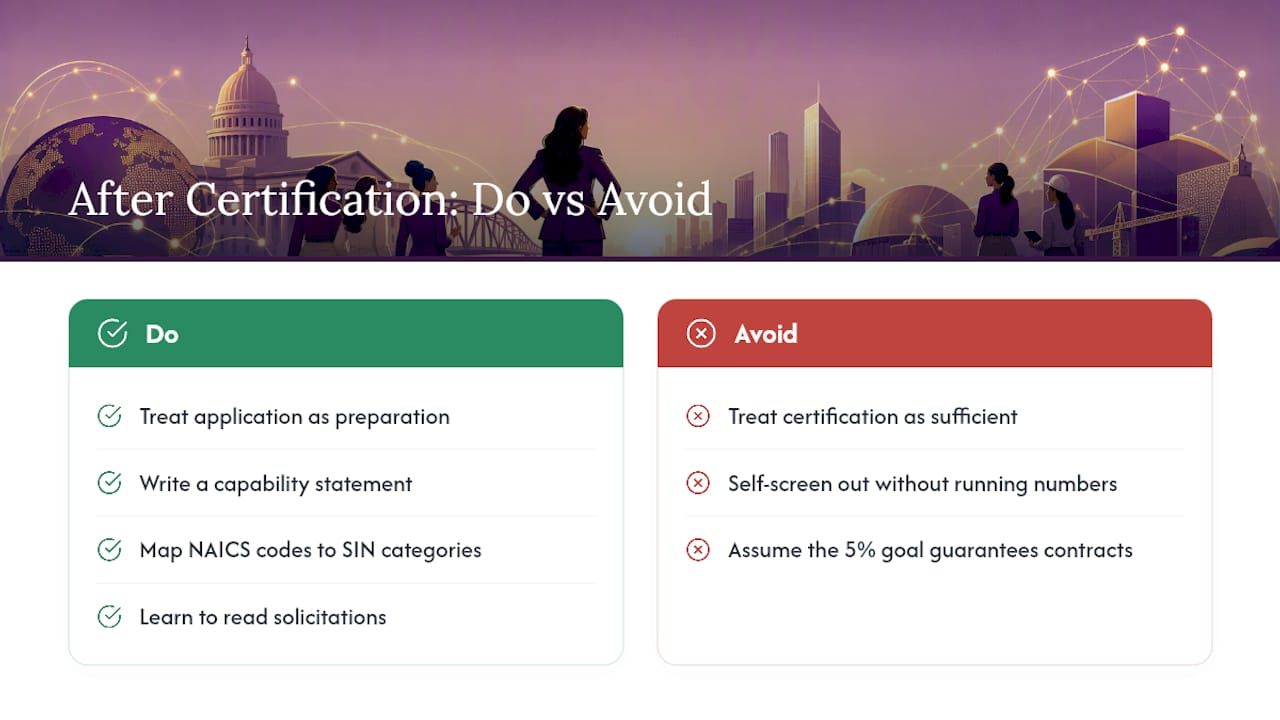
There is a gap between getting certified and actually winning contracts, and it is wider than most women entrepreneurs expect. Certification is a legal status. It does not write your capability statement, map your NAICS codes to the right SIN categories, or teach you how to read a solicitation. The firms that convert certification into revenue quickly are the ones that treated the application process as preparation, not just paperwork.
The EDWOSB thresholds are also worth examining carefully before you assume you do not qualify. The personal net worth calculation excludes your ownership interest in the business and equity in your primary residence. A business owner who looks financially comfortable on the surface may still fall well under the $850,000 net worth limit once those exclusions are applied. Many owners who self-screen out of EDWOSB eligibility would qualify if they ran the actual numbers.
One more thing: the 5% federal procurement goal is a target, not a guarantee. Agencies miss it regularly. But the goal creates institutional pressure that makes certified firms genuinely attractive to contracting officers who are behind on their small-business numbers. Knowing that dynamic changes how you approach agency outreach. You are not just a vendor pitching your services. You are a solution to a compliance problem the agency’s small-business office is actively trying to solve.
Gsascheduleservices can help you move from certified to contracted
Certification opens the door. Getting a GSA Schedule behind it turns that door into a revenue engine. Gsascheduleservices works with women-owned small businesses at exactly this stage: after WOSB or EDWOSB certification, when the next question is how to build the federal contracting infrastructure that actually generates consistent revenue.
The service covers the full GSA Schedule application process, including eligibility assessment, documentation preparation, price-list development, NAICS and SIN code mapping, contract submission, and ongoing compliance support. It is a paid, done-for-you alternative to navigating GSA’s requirements on your own, and it is built specifically for small businesses that cannot afford to spend months learning a procurement system while also running their company.
If you are ready to combine your WOSB certification with a GSA Schedule, request a readiness assessment to find out where you stand and what it takes to get on contract.
Useful sources and official resources
These are the primary sources you need to apply, verify rules, and get local support:
- Certifications — Small Business Administration
- 13 CFR § 127.303 — What must a concern submit for certification? | e-CFR | LII / Legal Information Institute
- CFR-2025-title13-vol1-part127.pdf
- Grow your business — Small Business Administration
- SBA Announces $30 Million in Grant Funding for New Women’s Business Centers
For tax documentation preparation relevant to your certification application, business tax record guidance covers the record-keeping practices that make pulling signed returns and financial statements straightforward.
FAQ
What qualifies you as a woman-owned business for SBA purposes?
A woman must unconditionally own at least 51% of the business, hold U.S. citizenship, control day-to-day operations and long-term decisions, and the business must meet SBA small-business size standards for its primary NAICS code under 13 CFR Part 127.
Is it easier for a woman to get an SBA loan with WOSB certification?
WOSB certification is a contracting credential, not a loan qualification. It does not directly affect SBA loan eligibility or terms, though certified status can strengthen a business’s profile when applying for SBA funding for women through programs like the SBA 7(a) or 504 loan programs.
Can women-owned businesses get grants through the SBA?
The SBA does not typically offer direct grants to individual businesses, but it funds Women’s Business Centers that provide free resources, training, and connections to women business grants from other federal and private sources. The SBA announced $30 million in grant funding for new Women’s Business Centers, expanding that support network.
What are the EDWOSB economic-disadvantage thresholds?
Under 13 CFR Part 127, each qualifying woman owner must have a personal net worth below $850,000 (excluding business ownership interest and primary residence equity), a three-year average adjusted gross income of $400,000 or less, and total personal assets valued at $6.5 million or less.
How does WOSB certification interact with the SBA 8(a) program?
A firm can hold both WOSB and 8(a) certification simultaneously, and many supporting documents overlap between the two applications. However, 8(a) set-asides and WOSB set-asides operate under separate authorities, so holding both certifications expands the types of set-aside contracts your firm can pursue.
Recommended
- How to get SBA Woman-Owned Small Business (WOSB) Certified | GSA Focus
- Will my SBA Designation help get a GSA Contract?
- About the SBA 8(a) Certification Program – GSA Focus
- Woman Owned Small Business Federal Contract Program