

If your business needs a GSA Schedule contract and you want it done right the first time, hire a specialist. The top procurement consulting firms in the federal contracting space are not generalist advisors — they are GSA-specific consultants who handle readiness assessments, NAICS/SIN mapping, Commercial Sales Practice (CSP) narratives, and post-award compliance under FAR and SAM requirements. Gsascheduleservices is a leading option for SMBs that want a structured, compliant path to award without dedicating months of internal bandwidth.
Hire a GSA Schedule consultant when any of these apply:
- You are a first-time applicant with no prior MAS experience
- Your submission spans multiple SINs or involves complex commercial pricing
- Your team cannot commit significant internal staff time over multiple months
Pro Tip: No legitimate consultant can guarantee award. Contracting officers make that decision. Any firm promising “guaranteed approval” is a red flag — walk away.
Table of Contents
- What do GSA Schedule consultants actually do?
- Who should actually hire a GSA Schedule consultant?
- What does the GSA Schedule process look like, step by step?
- How much do GSA Schedule consultants charge?
- How do you choose the right GSA Schedule consultant?
- What happens after your GSA Schedule is awarded?
- How Gsascheduleservices helps SMBs win and manage GSA schedules
- Key Takeaways
- Why SMB focus changes everything in federal contracting
- Ready to move forward? Here is your next step
- Authoritative sources and further reading
- FAQ
What do GSA Schedule consultants actually do?
A good consultant does far more than fill out forms. The core service set covers every phase from eligibility to post-award.
- NAICS/SIN mapping: Matches your offerings to the correct Multiple Award Schedule SINs and NAICS codes — a step where mismatches cause rejections.
The measurable benefit is fewer technical rejections and a shorter time-to-award. Consultants who specialize in federal procurement policy also keep your pricing documentation audit-ready from day one.

Who should actually hire a GSA Schedule consultant?
Not every SMB needs outside help. The honest answer depends on your internal capacity and the complexity of your offering.
Hire a consultant if:
- Your commercial pricing involves tiered discounts, multiple customer segments, or bundled services
- You are pursuing two or more SINs simultaneously
- Your SIN falls in a compliance-heavy category like cybersecurity or healthcare IT
- No one on your team has written a FAR Part 15 proposal or a CSP disclosure before
- Your BD team is already stretched and cannot absorb a multi-month documentation project
Consider doing it internally if:
- You have a proposal manager with FAR Part 15 experience on staff
- Your commercial pricing is simple — one price, one customer segment, no volume discounts
- You can realistically dedicate 80–120 hours over two to three months without disrupting operations
Before signing any consulting agreement, verify your NAICS/SIN fit on GSA’s MAS program page. A consultant cannot fix a fundamentally misaligned offering.
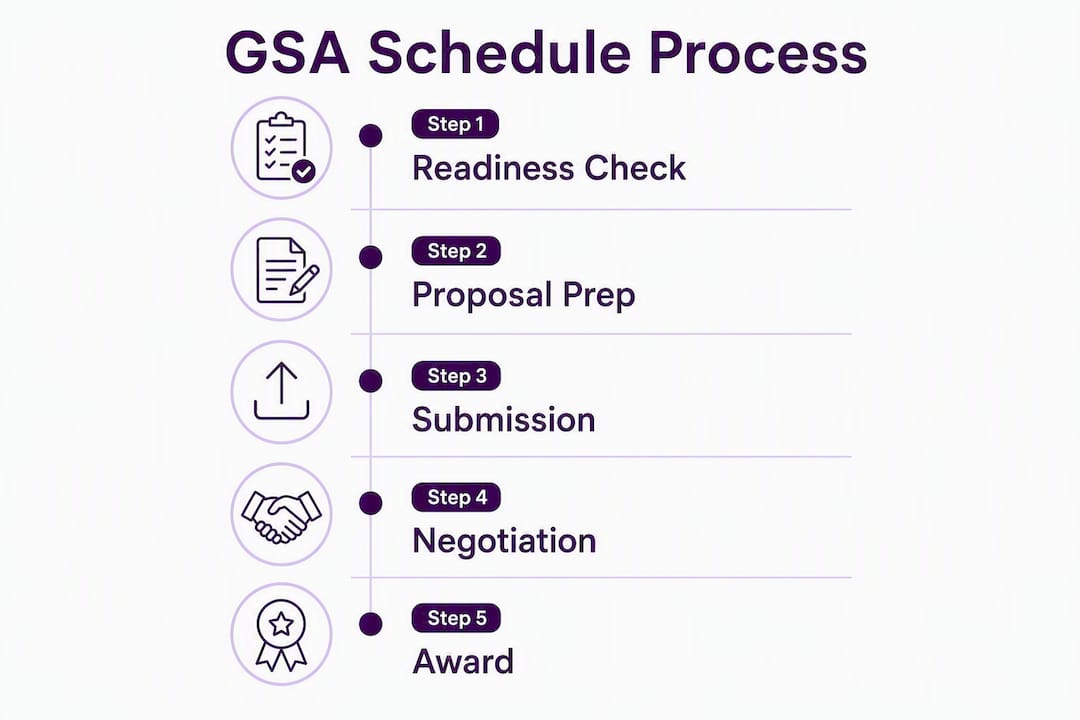
What does the GSA Schedule process look like, step by step?
The path from decision to award follows multiple phases, each requiring various client inputs such as revenue records and pricing data. Timelines for small businesses vary based on complexity and number of SINs, with more involved proposals potentially extending the process significantly.
- Award and onboarding: — Consultant coordinates VSC registration, GSAAdvantage setup, and your first compliance calendar.
Pro Tip: Clarify in writing who owns each deliverable before the engagement starts. Scope creep in the negotiation phase is where SMBs most often face unexpected additional fees.
How much do GSA Schedule consultants charge?
Pricing varies more than most executives expect. Here is how the market breaks down.
- Flat-fee new submission: The most common model for SMBs is a fixed fee for full-service engagements, varying by proposal complexity.
- Modular pricing: Some firms price by phase — assessment, documentation, and submission separately — useful for phased engagements.
- Hourly post-award rates: Maintenance work post-award typically incurs hourly fees for modifications and compliance support.
- Retainer packages: Monthly or annual fees may apply for ongoing services such as reporting and catalog management.
- Percentage or success fees: These are uncommon and may indicate a conflict of interest; avoid consultants paid only upon award.
One cost executives overlook: the Industrial Funding Fee (IFF), which runs 0.75% of all GSA Schedule sales and is an ongoing obligation after award.
A rough comparison: if your team’s fully loaded hourly cost is $75, 120 internal hours equals $9,000 in labor — before accounting for the learning curve, rejected submissions, and delayed revenue. Consultants typically charge $20,000–$60,000 for a full-service single-SIN submission, with market variation by complexity.
How do you choose the right GSA Schedule consultant?
Vetting a consultant takes about two hours of focused effort. These criteria separate credible firms from the rest.
Selection criteria:
- Verified past awards — ask for actual GSA contract numbers and check them on GSA eLibrary
- Documented NAICS/SIN mapping experience in your specific category
- Written deliverables list with defined timelines in the proposal
- Transparent pricing for post-award changes and modifications
- Named client references willing to take a call
Interview questions to ask every finalist:
- Can you provide three contract numbers from clients in my industry that you helped get awarded?
- What does your CSP narrative process look like, and who drafts it?
- What are my obligations during the negotiation phase, and how do you prepare me?
- How do you handle a PCO clarification request that requires pricing concessions?
- What does post-award support cost, and what triggers additional fees?
Red flags that should end the conversation:
- Any guarantee of award
- Vague deliverables (“we handle everything”) with no written scope
- Refusal to provide client references or contract numbers
- No clear answer on what happens if the PCO rejects the submission
Pro Tip: Pull the consultant’s own SAM.gov registration and check their NAICS codes. A firm that cannot navigate SAM for themselves is unlikely to do it well for you.
What happens after your GSA Schedule is awarded?
Award is the beginning, not the finish line. Post-award obligations are real and ongoing.
- IFF reporting and payment: — Quarterly sales reporting and 0.75% IFF remittance to GSA
On the business development side, consultants commonly help with agency outreach strategies, capability statement development, and identifying teaming partners. GSA’s training and outreach resources for small businesses are also worth using once you are on contract.
| KPI | Why It Matters |
|---|---|
| Annual GSA Schedule sales | Primary revenue metric; track against your MAS sales plan |
| Number of agency inquiries | Measures catalog visibility and outreach effectiveness |
| Task order conversion rate | Shows how well your pricing and capability statement compete |
| IFF dollars remitted | Confirms sales reporting accuracy and compliance |
| Days to eMod approval | Tracks responsiveness to contract changes |
How Gsascheduleservices helps SMBs win and manage GSA schedules
Gsascheduleservices is built specifically for small and medium-sized businesses that want a compliant, well-documented GSA Schedule without building an internal contracting team. The service covers every phase: readiness assessment, full documentation and pricing development, negotiation support with the PCO, and post-award administration including eMods and GSAAdvantage setup.
The government contracts consulting approach at Gsascheduleservices centers on transparent scope and defined milestones — clients know what they are getting, when, and at what cost before signing. The blog publishes regular guidance on federal procurement guidelines and policy changes so clients stay current between engagements.
Getting a GSA Schedule should not take a year of trial and error. SMBs that work with a specialist from day one reach their first government sale faster and with fewer compliance gaps — and that head start compounds over the life of the contract.
Pro Tip: Ask Gsascheduleservices for a readiness assessment before committing to a full engagement. It is the fastest way to know whether your pricing and past performance are submission-ready.
To get started, schedule a discovery call at gsascheduleservices.com/discovery. The call covers a quick eligibility check, a realistic timeline estimate, and a ballpark fee range — no obligation.
Key Takeaways
The single most important decision in pursuing a GSA Schedule is whether your internal team can handle a substantial documentation project with FAR-compliant pricing — if not, a specialist consultant pays for itself.
| Consultant fees vary widely | Full-service single-SIN submissions run $20,000–$60,000; post-award hourly rates are $200–$350. |
| Verify before you hire | Check consultant-provided contract numbers on GSA eLibrary before signing anything. |
| Post-award obligations continue | IFF at 0.75% of sales, quarterly reporting, eMods, and IOA visits are ongoing requirements. |
| Gsascheduleservices | Offers full-service GSA Schedule consulting from readiness through post-award for SMBs. |
Why SMB focus changes everything in federal contracting
The conventional wisdom in government contracting circles is that bigger firms win more because they have more resources. That is true for prime contracts over $50 million. For GSA Schedule contracts, it is mostly irrelevant. The MAS program was designed to mirror commercial buying, which means a well-documented small business with clean pricing and a current catalog entry competes on equal footing with firms ten times its size.
What actually separates SMBs that succeed on their GSA Schedule from those that let it sit dormant is not the size of their BD team. It is the quality of their initial documentation and how quickly they get their catalog in front of the right agency buyers. A rushed submission with a weak CSP narrative creates compliance problems that follow the contract for years. A clean submission, negotiated properly, sets up faster task order wins and cleaner IOA reviews.
The firms worth hiring — the best procurement consultants in this specific niche — are the ones who treat the CSP narrative and the pricing spreadsheet as the core of the engagement, not administrative afterthoughts. That is where contracting officers spend their scrutiny, and that is where the real value of a specialist shows up.
Ready to move forward? Here is your next step
Gsascheduleservices offers SMBs a faster path to a compliant, awarded GSA Schedule than any DIY approach — without the months of trial-and-error that sink first-time applicants. The engagement starts with a focused readiness check that tells you exactly where your pricing and documentation stand, what the realistic timeline looks like for your specific SINs, and what a full-service engagement would cost.
No vague proposals, no hidden post-award fees, and no “guaranteed approval” language — just a clear scope and a defined path to award. Executives who move quickly can often compress the standard 4–6 month timeline by starting the readiness assessment before their fiscal year planning locks in.
Schedule your discovery call at gsascheduleservices.com/discovery and get your eligibility and timeline questions answered in one conversation.
Authoritative sources and further reading
Use these official resources to verify consultant claims and stay current on GSA obligations:
- GSA Multiple Award Schedule program: SIN/NAICS listings, program structure, and MAS benefits
- GSA Vendor Support Center (VSC): New Contractor Orientation, PCO/ACO role definitions, and post-award training
- GSA eLibrary: Verify awarded contract numbers and research active MAS contractors
- GSA small business training and events: Pathways, outreach, and networking resources for SMBs
Executives should verify any contract number a consultant provides by searching it directly on GSA eLibrary before signing an engagement agreement.
FAQ
What do top procurement consulting firms charge for a GSA Schedule?
Full-service single-SIN submissions typically run $20,000–$60,000, with post-award hourly maintenance at $200–$350 per hour. Multi-SIN or services-heavy proposals push toward the higher end of that range.
How long does it take to get a GSA Schedule with a consultant?
Most single-SIN submissions take 4–6 months from readiness assessment to award. Complex or multi-SIN proposals can take significantly longer depending on PCO negotiation timelines.
Can a GSA Schedule consultant guarantee my contract will be awarded?
No. Contracting officers make award decisions, and no consultant can guarantee a specific outcome. Any firm that promises guaranteed approval is a red flag.
How do I verify a consultant’s past GSA Schedule awards?
Ask for specific GSA contract numbers from prior clients, then confirm them on GSA eLibrary. This is the fastest way to separate credible firms from those with unverifiable track records.
What does Gsascheduleservices offer that differs from general procurement advisory firms?
Gsascheduleservices focuses exclusively on GSA Schedule contracts for SMBs, covering the full cycle from readiness assessment and CSP narrative drafting through post-award eMods and agency marketing support.
Recommended
- 5 Ways to Leverage GSA’s Federal Supply Schedule to Grow Your Revenue
- Hiring a GSA Schedule Consultant vs. Acquiring a Schedule On Your Own
- GSA Schedule Consulting: A Helping Hand to Securing a GSA Schedule |
- Which GSA Schedules Will Thrive Under Trump?