

A government wide acquisition contract (GWAC) is a pre-competed, multiple-award IDIQ vehicle restricted to IT products and services, designated Best-in-Class by OMB and governed by FAR 16.505. If your business already has documented federal past performance in IT and can respond to task orders quickly, pursuing a GWAC seat is worth serious attention. If you’re still building your first performance record, a GSA Schedule is the right starting point.
The short decision rule:
- You have federal IT past performance at relevant dollar values? Evaluate GWAC competitions actively.
- You’re pre-Schedule or early-stage? Build your Schedule first, then use that record to compete for GWAC seats.
- You lack rapid-response capacity? Subcontract under a prime GWAC holder until you do.
Table of Contents
- What is a government wide acquisition contract and how does it work?
- How do GWACs differ from a GSA Schedule?
- Why do GWACs matter for small and medium-sized businesses?
- What are the key regulatory requirements for GWAC ordering?
- Are you ready to compete? A vendor readiness checklist
- How can your business actually win GWAC work?
- How can a consultant accelerate your GWAC readiness?
- Your 90-day action plan
- Key Takeaways
- The real gap most SMBs miss
- Gsascheduleservices can get you competition-ready
- Useful sources
- FAQ
What is a government wide acquisition contract and how does it work?
GWACs are pre-competed, multiple-award IDIQ contracts for information technology, established by one agency for government-wide use and operated by an OMB-designated executive agent. GSA, NIH/NITAAC, and NASA/SEWP are the primary administrators. The statutory authority comes from the Clinger-Cohen Act (40 U.S.C. 11302(e)), which is why every GWAC requires OMB executive agent designation — a requirement that does not apply to GSA Schedules.
The vehicle works in two phases. First, a base contract competition awards seats to qualified vendors. Then, agencies issue task orders against those seats through fair opportunity competitions under FAR 16.505. Because GWAC holders already pass technical and responsibility evaluations at the base contract level, agencies can award task orders faster than they could through open competition. That’s the core appeal for buyers.
Active programs worth knowing: GSA’s Alliant 3 replaces Alliant 2 with a large ceiling and ordering period through 2035, targeting complex enterprise IT. On the small business side, GSA maintains dedicated GWAC pools including 8(a) STARS III, VETS 2, and Polaris, which serve 8(a), SDVOSB, HUBZone, WOSB, and EDWOSB firms.
How do GWACs differ from a GSA Schedule?
These two vehicles are often confused, but they operate under different statutory authorities and serve different buyer needs.
| Dimension | GWAC | GSA Schedule (MAS) |
|---|---|---|
| Scope | IT and IT-enabled services only | Broad commercial products and services |
| Enrollment | Limited windows, capped awards | Rolling applications, no cap |
| Governing rule | FAR 16.505 (IDIQ ordering) | FAR 8.405 (Schedule ordering) |
| DPA required? | Yes, before any order | No |
| Pricing determination | OCO determines fair/reasonable per order | GSA pre-determines at award |
| Who can use it | Federal agencies only | Federal, state, local, tribal (some SINs) |
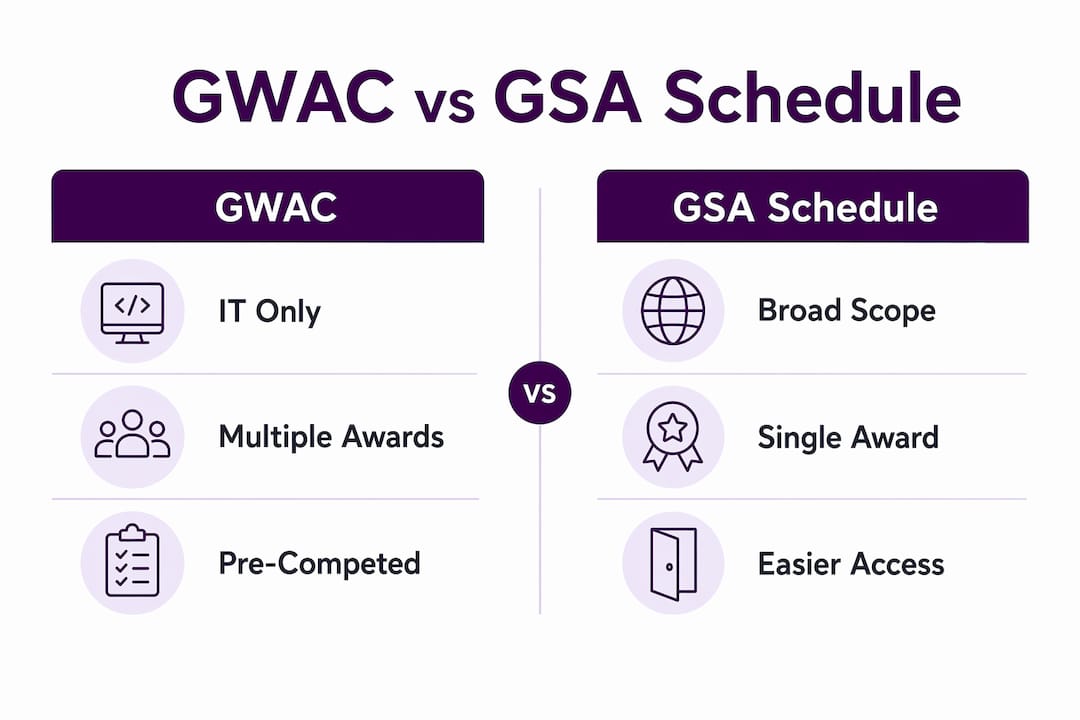
The practical implication: a Schedule is easier to get and maintain, and it generates steady transactional revenue across a wide range of buyers. A GWAC seat opens the door to larger, enterprise-level IT task orders, but the competition is stiffer and the administrative overhead is higher. The differences between FSS and GWAC vehicles are significant enough that treating them as interchangeable is a common, costly mistake.
The smart play for most SMBs: hold a GSA Schedule contract for consistent pipeline, and pursue GWAC seats when you have the past performance and response capacity to compete.
Why do GWACs matter for small and medium-sized businesses?
The upside is real. Government-wide access means any federal agency can place a task order against your contract without running a new full competition. For IT firms, that’s a significant reduction in procurement friction. Repeat task orders from a single agency can build into a predictable revenue stream, and the Best-in-Class designation signals to buyers that you’ve already been vetted.

The limitations are equally real. Task order response windows often close quickly, which demands a standing proposal team, pre-built pricing models, and active agency relationships. Winning the base contract is just the entry ticket. Only a minority of GWAC holders capture the majority of spending — success depends on rapid task-order capture, strong past performance, and sustained relationship management.
Pro Tip: Register for beta.SAM.gov forecast alerts and the GSA GWAC Sales Dashboard before you win a seat. Vendors who monitor agency pipelines before award close task orders faster after award.
For SMBs weighing the investment: the expected return justifies the pursuit when you have at least two or three relevant federal contracts in your past performance record and a business development function that can sustain rapid-response proposals.
What are the key regulatory requirements for GWAC ordering?
Ordering Contracting Officers must obtain a Delegation of Procurement Authority (DPA) and complete specific training before issuing any task order against a GWAC. Only warranted contracting officers appointed under FAR 1.603 can request a DPA. GSA processes DPA certification forms and typically issues delegation letters within two business days.
This matters to vendors for a specific reason: an agency cannot legally place an order against a GWAC without an active DPA. Before investing heavy capture effort on a target agency, confirm that agency’s contracting officer holds a current delegation. The GWAC ordering guide details the seven-step order process and OCO responsibilities in full.
Under FAR 16.505, all GWAC holders must receive fair opportunity to compete for task orders. Orders above $7.5 million require disclosure of evaluation factors, reasonable response periods, and a best value statement. Exceptions to fair opportunity are narrow and must be documented.
On the reporting side, contractors must submit complete reports on contract actions within three business days of award. Contract access fees run approximately 0.75% of sales, and quarterly sales reporting through agency portals is standard. Missed or inaccurate reporting damages your past performance record, which is the asset that wins future task orders.
Are you ready to compete? A vendor readiness checklist
Before investing in a GWAC competition or an aggressive task-order capture program, confirm these baseline items:
- SAM.gov registration: Active, with correct CAGE code, NAICS codes, and size certifications.
- SBA size determination: Verified against the NAICS codes in the target GWAC solicitation.
- Past performance: At least two to three federal contracts in IT at dollar values comparable to the task orders you intend to pursue.
- Cybersecurity posture: NIST SP 800-171 compliance at minimum; CMMC Level 2 certification for contracts involving Controlled Unclassified Information.
- Proposal infrastructure: Templates, pricing models, and a team that can turn a compliant response in 10–15 days.
- Financial systems: Billing and payroll infrastructure capable of handling task-order volume. Firms scaling to support GWAC work often need contractor payroll and bookkeeping support to manage the increased transaction load.
On timing: GWAC competitions open only in limited windows, often every 5–10 years. Missing a solicitation window can delay your prime award opportunity by years. Monitor beta.SAM.gov and GSA forecast pages continuously.
How can your business actually win GWAC work?
Three routes exist, and each fits a different stage of readiness.
Route 1: Compete for a base contract seat. This is the prime award path. It requires a full technical proposal, past performance documentation, and pricing structure. Competitions are expensive to pursue and infrequent. Reserve this route for when your past performance record is solid and your proposal team is ready.
Route 2: Team or subcontract. Partner with an existing GWAC prime as a subcontractor or through a teaming agreement. This is the fastest way to access task order revenue and build the past performance you need to compete for a prime seat later. Many SMBs spend two to three years in this mode before pursuing their own base contract.
Route 3: Use your GSA Schedule as a bridge. Federal past performance on a Schedule improves competitiveness for GWAC seats and task orders. Schedule-derived pricing familiarity also helps when structuring GWAC task order proposals. If you don’t have a Schedule yet, that’s the first step — learn more about leveraging your Schedule for revenue growth while you build toward GWAC pursuit.
Numbered sequence for SMBs pursuing Route 1:
- Confirm all SAM/CAGE/NAICS registrations are current.
- Map past performance gaps against the target GWAC’s evaluation criteria.
- Monitor beta.SAM.gov for solicitation release dates and on-ramp windows.
- Attend agency industry days and pre-solicitation conferences.
- Build or hire a proposal team before the solicitation drops.
- Submit and track your proposal through award.
How can a consultant accelerate your GWAC readiness?
A qualified GSA/GWAC consultant delivers concrete, time-bound work: readiness assessments, Schedule application support, past performance documentation, teaming agreement drafting, rapid task-order proposal support, and ongoing contract administration. The difference between DIY and consultant-supported pursuit usually shows up in two places: the quality of past performance write-ups and the speed of task-order responses.
A typical engagement starts with a gap analysis against the target GWAC’s evaluation criteria. Within 30–60 days, a consultant can have your SAM registration corrected, your past performance narratives drafted, and your first teaming agreement in negotiation. That’s work that takes most SMBs six months to complete on their own, if they complete it at all.
Hire a consultant when: your internal team cannot respond to task orders in 10–15 days, your past performance record has gaps, or you’re approaching a GWAC solicitation window without a proposal team in place.
Your 90-day action plan
Immediately (Week 1–2):
- Audit SAM.gov registration, CAGE code, and NAICS codes.
- Pull your past performance record and identify gaps against target GWAC criteria.
- Register for beta.SAM.gov forecast alerts for relevant GWAC programs.
Short-term (Days 30–90):
- Draft or update two to three past performance narratives at relevant dollar values.
- Identify two to three potential teaming partners and open conversations.
- Attend at least one agency industry day or GWAC-related conference.
- Build a rapid-response proposal template for your core service offering.
- Decide whether to engage a consultant based on your internal capacity assessment.
Key Takeaways
GWACs reward businesses that treat them as active business development assets, not passive contract vehicles. Winning a seat is the beginning, not the finish line.
| Point | Details |
|---|---|
| GWAC definition | Pre-competed, multiple-award IDIQ for IT under FAR 16.505, designated Best-in-Class by OMB. |
| DPA is mandatory | Agencies cannot legally order without a warranted OCO holding an active DPA — verify before investing in capture. |
| Response windows are short | Task order response windows often close in 10–15 days; standing proposal infrastructure is non-negotiable. |
| Schedule first, GWAC second | GSA Schedule past performance directly improves GWAC competitiveness — build it before pursuing a prime seat. |
| Gsascheduleservices | Provides readiness assessments, Schedule application support, and task-order response coaching to accelerate GWAC pursuit. |
The real gap most SMBs miss
Most SMBs I see pursue GWACs the wrong way: they win the base contract seat, celebrate, and then wait for task orders to arrive. They don’t. GWAC seats are marketing assets that require active cultivation — agency relationships, pipeline monitoring, and a proposal team on standby. The businesses that capture meaningful GWAC revenue treat every task order solicitation like a competitive sprint, not a formality.
The other consistent mistake is underestimating reporting obligations. Missing a quarterly sales report or filing late damages the past performance record that your next task order win depends on. The administrative side of GWAC performance is not optional maintenance. It’s the foundation of your competitive position.
If you’re an SMB owner reading this and thinking the Schedule is “enough,” consider this: the GWAC programs available to small businesses like Polaris and 8(a) STARS III exist precisely because Congress recognized that small firms need a dedicated pathway into enterprise IT work. The vehicle is there. The question is whether your business is positioned to use it.
Gsascheduleservices can get you competition-ready
Most SMBs underestimate how much ground work separates a SAM registration from a winning GWAC proposal. Gsascheduleservices closes that gap with a structured consulting process: eligibility assessment, full GSA Schedule application support, past performance narrative development, teaming strategy, and rapid task-order response coaching. In month one, clients receive a gap analysis, corrected registrations, and a prioritized action plan tied to active GWAC solicitation windows. The result is a business that competes for task orders instead of watching them close. If you’re ready to evaluate where you stand, start with a scoped discovery session and get a clear picture of what it takes to compete.
Useful sources
- GSA GWAC Program Page: DPA process, active vehicles (Alliant 3, Polaris, 8(a) STARS III, VETS 2), and ordering guides.
- FAR 2.101 GWAC Definition: Statutory definition and Economy Act exclusion.
- IBEX Small Business GWAC Ordering Guide: Seven-step order process, OCO roles, and DPA requirements.
- GovDash GWAC Complete Guide: Task order timelines, solicitation windows, and capture strategy.
- ASBC FSS vs. GWAC Explainer: Statutory authority differences, ordering rules, and scope distinctions.
- Gsascheduleservices GWAC Essentials: Compact primer on GWAC structure and reporting for SMBs.
FAQ
What does a government wide acquisition contract cover?
GWACs cover information technology products, IT services, and ancillary professional services that require IT use to a significant extent. They do not cover general commercial products or non-IT professional services.
Do small businesses qualify for GWAC contracts?
Yes. GSA maintains small business GWAC pools including 8(a) STARS III, VETS 2, and Polaris, which serve 8(a), SDVOSB, HUBZone, WOSB, and EDWOSB firms specifically.
How long does it take to win a GWAC task order?
Task orders can be awarded in roughly 30 days from solicitation release, but contractor response windows often close within 10–15 days, requiring a standing proposal team and pre-built pricing.
What is a DPA and why does it matter to vendors?
A Delegation of Procurement Authority authorizes a warranted contracting officer to issue task orders against a GWAC. Without an active DPA, an agency cannot legally place an order, so vendors should confirm DPA status before investing in agency capture.
Can a GSA Schedule help you qualify for a GWAC?
Directly, yes. Federal past performance built on a GSA Schedule improves your competitiveness for GWAC base contract seats and task orders. Gsascheduleservices helps SMBs build that Schedule foundation as the first step toward GWAC pursuit.
Recommended
- Government procurement strategies that help SMBs win GSA bids
- Government Contract Opportunities 2026: SME Guide
- SAM.gov: Your Guide to Government Contracting
- GSA Procurement Guide: Streamline Your Buying