

GSA Schedule contracts are recession-proof because the federal government is legally mandated to continue purchasing essential goods and services regardless of economic conditions. While private-sector clients freeze budgets and delay purchases during downturns, federal agencies operate on appropriated funds that do not evaporate with consumer confidence. The General Services Administration manages a procurement marketplace worth $490 billion annually, and that number does not shrink when Wall Street does. For business owners and contractors looking to understand why GSA contracts are recession proof, the answer starts with one structural reality: the government never stops buying.
Why GSA contracts are recession proof: the government spending mandate
The federal government does not operate like a commercial business. Agencies cannot simply pause procurement when economic conditions worsen. Congress appropriates funds for specific programs, and those funds must be spent on the goods and services those programs require. Defense, healthcare, IT infrastructure, facilities management, and professional services all continue regardless of GDP trends.
GSA’s role in this system is to make that spending more efficient, not to reduce it. As of early 2026, GSA eliminated 1,600 non-compliant contracts to concentrate purchasing power on high-performing vendors. That move did not shrink the market. It concentrated it, meaning fewer vendors now compete for the same volume of federal dollars. For contractors already on schedule, this is a direct competitive advantage.

Legal mandates also prevent agencies from substituting GSA-covered products and services with unvetted alternatives. When an agency needs cybersecurity software, ergonomic office furniture, or logistics consulting, it must procure through approved channels. GSA Schedule holders sit inside those channels by default.
Pro Tip: If your business provides services in IT, facilities, or professional consulting, these categories consistently rank among the highest-spend areas on the Multiple Award Schedule (MAS) program. Positioning your offerings in these categories before a recession hits is far more effective than pivoting during one.
Key reasons government spending holds steady during recessions:
- Appropriated budgets are set by Congress and cannot be unilaterally reduced by agencies mid-cycle
- Essential services like defense, healthcare, and infrastructure carry mandatory spending requirements
- GSA’s OneGov strategy focuses on contract quality over quantity, benefiting compliant vendors
- Federal procurement cycles operate independently of consumer confidence indexes
What structural features make GSA contracts recession-resistant?
The design of a GSA Schedule contract itself creates stability that commercial agreements rarely match. Three features stand out: pre-negotiated pricing, multi-year terms, and a restricted vendor pool.
Pre-negotiated “fair and reasonable” pricing means agencies can order without open-market bidding. This removes one of the biggest friction points in commercial sales. During a recession, private clients often use budget uncertainty as a reason to delay purchasing decisions or re-bid contracts at lower prices. Federal agencies using GSA Schedules skip that process entirely. They select from pre-approved vendors at pre-approved prices and issue purchase orders. The sales cycle compresses dramatically.
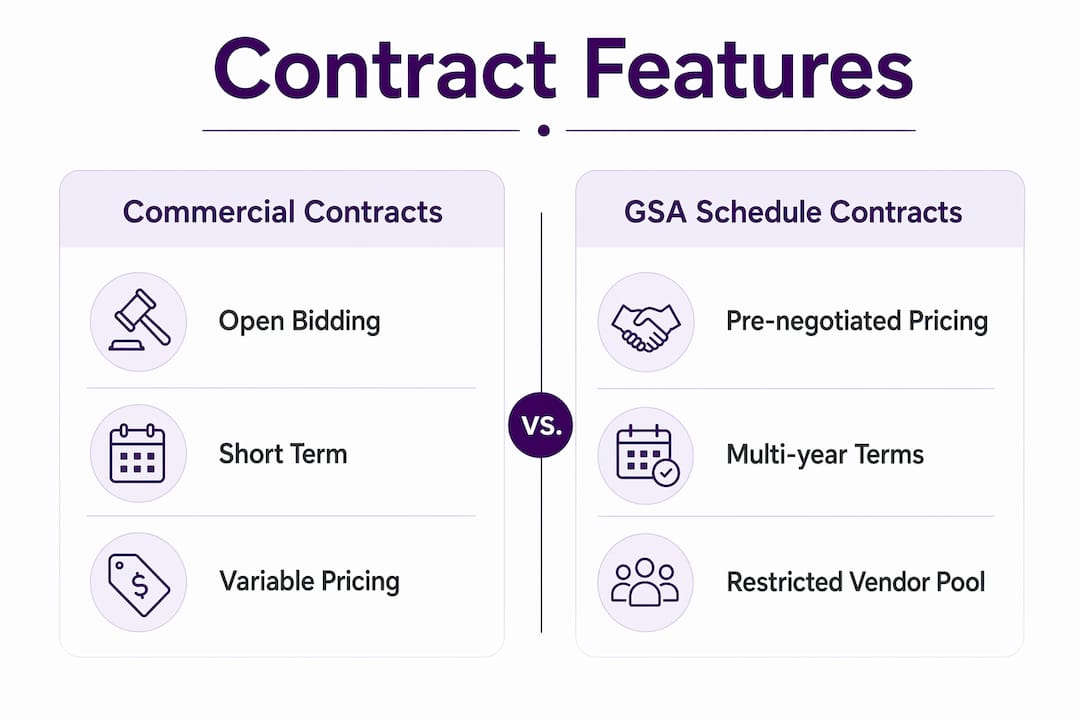
Multi-year contract terms add another layer of income predictability. GSA Schedule contracts run for a base period with multiple option years, giving holders a long runway of potential revenue. A contractor who secures a task order in year one of a five-year contract does not need to re-compete for that work annually. That predictability is exactly what a business needs when commercial pipelines dry up.
| Feature | Commercial contracts | GSA Schedule contracts |
|---|---|---|
| Pricing process | Open bidding, price wars | Pre-negotiated, fixed fair pricing |
| Contract length | Typically 1 year | Base period plus multiple option years |
| Competition level | Open market, unlimited bidders | Restricted to vetted MAS vendors |
| Procurement speed | Weeks to months | Days to weeks |
| Vendor vetting | Buyer-dependent | GSA-verified past performance and pricing |
The restricted vendor pool deserves particular attention. The MAS program includes over 17,000 contractors offering 25 million line items, which sounds large until you compare it to the full commercial market. GSA vetting acts as an implied endorsement. Agencies trust that vendors on schedule have passed financial stability checks, pricing reviews, and past performance evaluations. That trust translates directly into buyer confidence during periods when agencies are under pressure to spend carefully.
Pro Tip: GSA’s vetting process is also your marketing tool. When pitching to federal buyers, your Schedule status signals that the government has already reviewed and approved your pricing and performance record. Use that explicitly in your capability statements.
How GSA contracts performed during past recessions
Historical evidence confirms what the structural logic predicts. During the 2008 financial crisis, businesses with government contracts sustained revenue streams while their commercial counterparts watched client spending collapse. Companies that had diversified into federal sales before the recession hit were able to maintain headcount, honor supplier commitments, and in some cases grow, while purely commercial competitors contracted sharply.
The pattern repeats because federal procurement operates independently of private-sector demand cycles. When consumer spending drops, retail, hospitality, and discretionary services suffer immediately. Federal agencies buying IT support, professional services, or scientific equipment do not reduce those purchases because consumer confidence fell. Their mandates and their budgets remain intact.
| Economic period | Private sector impact | GSA contractor impact |
|---|---|---|
| 2008 financial crisis | Sharp revenue declines across most industries | Government contractors maintained stable order flow |
| 2020 COVID recession | Commercial clients froze discretionary spending | Federal agencies accelerated procurement in health, IT, and logistics |
| 2025 market volatility | Commercial uncertainty in tech and real estate | GSA reforms concentrated spend on high-performing vendors |
The 2025 reforms are worth examining closely. GSA saved $24 million annually by eliminating low-value contracts under its OneGov strategy. That efficiency push did not reduce total federal spend. It redirected it toward contractors who maintain compliance, competitive pricing, and strong past performance records. Contractors who treat their GSA Schedule as an active sales channel rather than a passive listing are the direct beneficiaries of that shift.
How GSA contracts benefit business owners during economic uncertainty
The practical benefits of holding a GSA Schedule contract during a downturn go beyond simply having a government client. The contract changes how your entire business operates under pressure.
Access to the federal marketplace gives you a client base that does not disappear when the economy softens. Federal procurement provides stable purchasing independent of commercial demand drops or supply chain disruptions. That stability lets you plan hiring, manage cash flow, and invest in operations with a confidence that purely commercial businesses cannot match during uncertain periods.
GSA approval also shortens your sales cycle with federal buyers. Agencies can issue purchase orders directly against your Schedule without running a full competitive procurement. For small and mid-sized businesses, this means less time chasing proposals and more time delivering work. The advantages of GSA Schedule contracts compound over time as your past performance record grows and agencies return for repeat orders.
Specific benefits that matter most during economic downturns:
- Reduced dependence on any single commercial client or industry vertical
- Predictable revenue from multi-year task orders that survive budget cycles
- Lower cost of sales compared to open-market federal bidding
- Enhanced credibility that carries over into commercial pitches as well
- Access to government contract opportunities across 24 federal agencies and thousands of state and local entities using Cooperative Purchasing
Diversification is the most underrated benefit. A business that generates 40% of its revenue from federal contracts and 60% from commercial clients is structurally more resilient than one that is 100% commercial. When commercial revenue drops 30% in a recession, the federal portion holds. The net impact on the business is far less severe than it would be otherwise. This is the core logic behind why small businesses thrive in bad economies when they hold a GSA contract.
Key takeaways
GSA contracts are recession-proof because government spending mandates, pre-negotiated pricing, multi-year terms, and a restricted vendor pool create revenue stability that commercial contracts cannot replicate.
| Point | Details |
|---|---|
| Government mandates sustain demand | Federal agencies must continue purchasing essential services regardless of economic conditions. |
| Pre-negotiated pricing speeds sales | Agencies skip open bidding and order directly, compressing the sales cycle during downturns. |
| Multi-year terms provide income predictability | Task orders spanning multiple years protect revenue when commercial pipelines slow. |
| GSA vetting signals vendor credibility | Schedule approval acts as an implied endorsement, reducing buyer hesitation during tight budgets. |
| Diversification reduces recession exposure | Contractors with federal revenue streams absorb commercial downturns without catastrophic loss. |
The real edge most contractors miss
I have worked with enough contractors to know that most of them treat their GSA Schedule like a trophy rather than a tool. They get approved, list their offerings, and wait. That approach works fine in a strong economy. It fails completely when a recession hits and every agency buyer is under pressure to justify every dollar.
The contractors who actually benefit from the recession-resistant nature of GSA contracts are the ones who treat the Schedule as an active sales channel. They update their pricelist regularly, respond to sources sought notices, and build relationships with contracting officers before they need them. When the economy tightens and agencies consolidate their vendor lists, those contractors get the calls. The ones who listed and forgot do not.
The 2025 contract eliminations are a signal worth taking seriously. GSA removed 1,600 vendors who were not performing or not compliant. That is not a threat to good contractors. It is an opportunity. The reasons GSA Schedules appeal to federal buyers are the same reasons active contractors win work during downturns: trust, speed, and verified pricing. Build a predictable client growth strategy around those three factors and your GSA contract becomes exactly what it is designed to be: a floor under your revenue when everything else is uncertain.
— Josh
Start building your recession-resistant revenue stream
Securing a GSA Schedule contract is one of the most concrete steps a business owner can take to reduce dependence on volatile commercial markets. Gsascheduleservices.com specializes in helping small and mid-sized businesses get on schedule faster, with less paperwork and fewer compliance headaches. From readiness assessments to negotiation support and ongoing contract management, the team at Gsascheduleservices handles the process so you can focus on winning federal work. If you are ready to explore what a GSA contract could mean for your business’s financial stability, start with the GSA Schedule discovery process and find out exactly where you stand.
FAQ
Why are GSA contracts considered recession-proof?
GSA contracts are backed by federal appropriations and legal procurement mandates, meaning agencies must continue buying essential goods and services even during economic downturns. This keeps demand for Schedule holders stable when commercial clients reduce spending.
How do GSA contracts provide stability during a recession?
Pre-negotiated pricing and multi-year contract terms allow agencies to issue purchase orders quickly without re-bidding, giving GSA vendors predictable revenue that does not depend on commercial market conditions.
What happened to GSA contractors during the 2008 recession?
Businesses holding government contracts sustained revenue during the 2008 financial crisis while commercial clients cut spending sharply. Federal procurement cycles continued independently of private-sector demand drops.
How does GSA’s 2025 contract reform affect current vendors?
GSA eliminated 1,600 low-performing contracts and saved $24 million annually, concentrating federal spend on compliant, high-performing vendors. Active Schedule holders with strong past performance records benefit directly from this consolidation.
Can small businesses realistically benefit from GSA contracts in a downturn?
Small businesses with GSA Schedules can maintain revenue by accessing federal buyers who operate on appropriated budgets unaffected by consumer confidence. The key is treating the Schedule as an active sales channel rather than a passive listing.
Recommended
- Access $150mm daily bids with our simple GSA Services
- Access $150mm daily bids with our simple GSA Services
- Access $150mm daily bids with our simple GSA Services
- Access $150mm daily bids with our simple GSA Services