
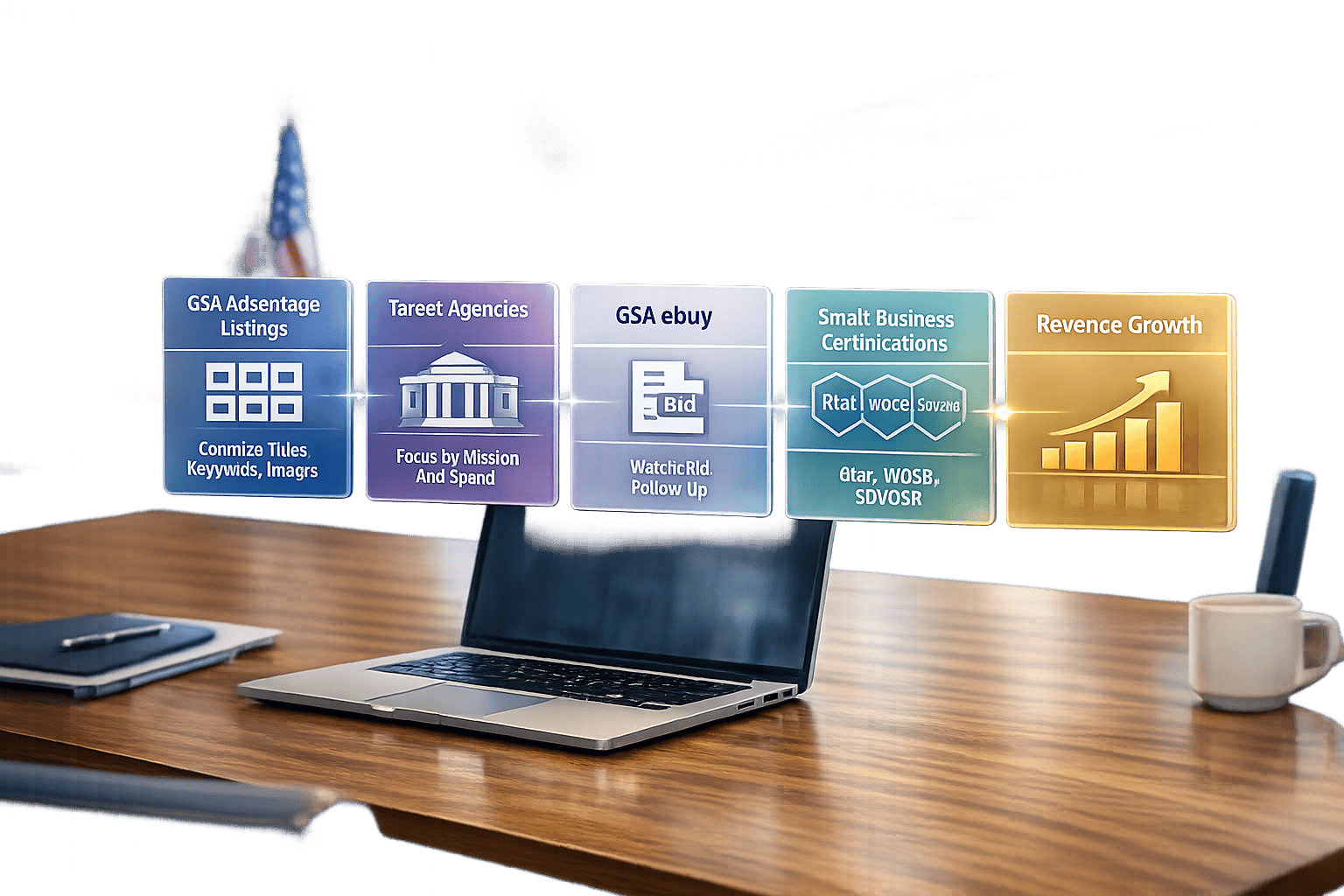
Want to turn your GSA Schedule into a revenue generator? Securing a GSA contract is just the start – success comes from effective marketing. Here’s what you need to know:
- What is a GSA Schedule? A long-term contract allowing businesses to sell to federal agencies at pre-negotiated rates.
- Why marketing matters: Holding a GSA Schedule doesn’t guarantee sales. Federal buyers prioritize value and competition is fierce.
- Key strategies to succeed: Update GSA Advantage listings, target the right agencies, leverage tools like eBuy, and use small business certifications to stand out.
- Actionable insights: Align marketing with the federal buying cycle, optimize listings with compliance terms, and analyze award data to identify opportunities.
Federal contracting is complex, but with the right approach, your GSA Schedule can drive significant sales. This guide simplifies the process to help you connect with federal buyers and grow your business.
Building a GSA Marketing Plan
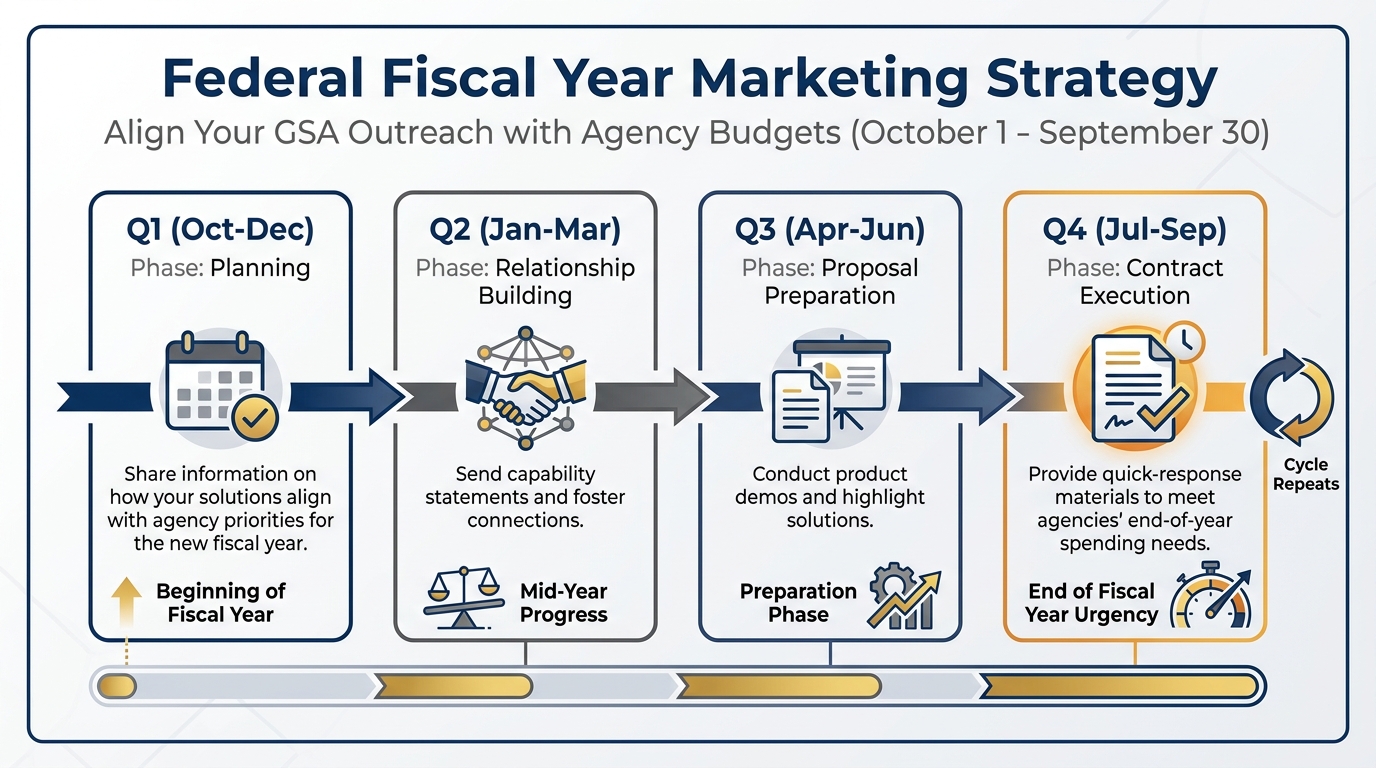
Federal Fiscal Year Marketing Strategy by Quarter
A well-crafted plan can transform your GSA Schedule into a sales-driving tool. As GSA.gov puts it:
“We strongly recommend you think about what a successful marketing strategy is, and create and develop a federal marketing and sales plan outlining the activities you’ll conduct to meet your goals.” – GSA.gov
Selling to federal buyers isn’t the same as selling commercially. The process involves longer sales cycles, strict compliance rules, and unique buyer needs. To avoid missteps, ensure your sales, marketing, and accounting teams understand GSA terms and regulations. Start with clear goals and align your resources to fit the federal buying cycle.
Setting Clear Goals and Objectives
Define specific, measurable goals. For example, aim to secure three contracts or establish connections with a set number of Contracting Officers within a specific timeframe.
Structure your objectives around the federal fiscal year (October 1–September 30). This approach helps you align outreach efforts with agency budgets and the predictable pace of federal procurement:
| Quarter | Focus | Marketing Approach |
|---|---|---|
| Q1 (Oct–Dec) | Planning | Share information on how your solutions align with agency priorities for the new fiscal year |
| Q2 (Jan–Mar) | Relationship Building | Send capability statements and foster connections |
| Q3 (Apr–Jun) | Proposal Preparation | Conduct product demos and highlight solutions |
| Q4 (Jul–Sep) | Contract Execution | Provide quick-response materials to meet agencies’ end-of-year spending needs |
By setting clear objectives, you can also focus your resources more effectively. Instead of trying to target every agency, prioritize those most likely to need your offerings.
Identifying Target Agencies and Buyers
Once you’ve outlined your internal goals, zero in on the agencies and buyers that align with your market. This step relies heavily on thorough market research. Tools like USASpending.gov and the Federal Procurement Data System (FPDS) can help you identify which agencies have historically purchased products or services similar to yours. These platforms reveal contract values, spending patterns, and other insights to guide your strategy.
GSA.gov advises contractors to “identify and target the agencies and departments where you have the most opportunity based on your market research”. Don’t overlook smaller agencies – they often have consistent spending patterns and less competition compared to larger departments.
Additionally, each federal agency has a Small Business Office – often referred to as OSDBU or OSBP – designed to help small businesses navigate procurement processes. These offices can connect you with Contracting Officers, inform you of upcoming opportunities, and guide you through agency-specific requirements. Attending Industry Days and GSA-hosted events is another great way to meet procurement officers and program managers in person.
If you offer IT, security, or law enforcement products, consider GSA’s Cooperative Purchasing program. This program allows state and local governments to buy from your GSA Schedule, expanding your customer base without requiring additional contracts.
Using Small Business Certifications
Small business certifications can be a game-changer in federal contracting. These credentials make you eligible for set-aside contracts – opportunities reserved exclusively for certified businesses. Certifications like 8(a) Business Development, HUBZone, Service-Disabled Veteran-Owned Small Business (SDVOSB), and Women-Owned Small Business (WOSB) are highly sought after by federal buyers.
Beyond set-aside contracts, these certifications also enhance your credibility. Many Contracting Officers prefer working with certified small businesses, even in open competitions, as it helps agencies meet their diversity and inclusion goals.
Make your certifications a focal point in your marketing materials, GSA Advantage listings, and capability statements. When reaching out to Small Business Offices, highlight your certifications upfront to establish rapport and open doors for meaningful discussions. Pairing a GSA Schedule with relevant certifications positions you as a go-to vendor in the federal marketplace.
Improving Your GSA Advantage Listings
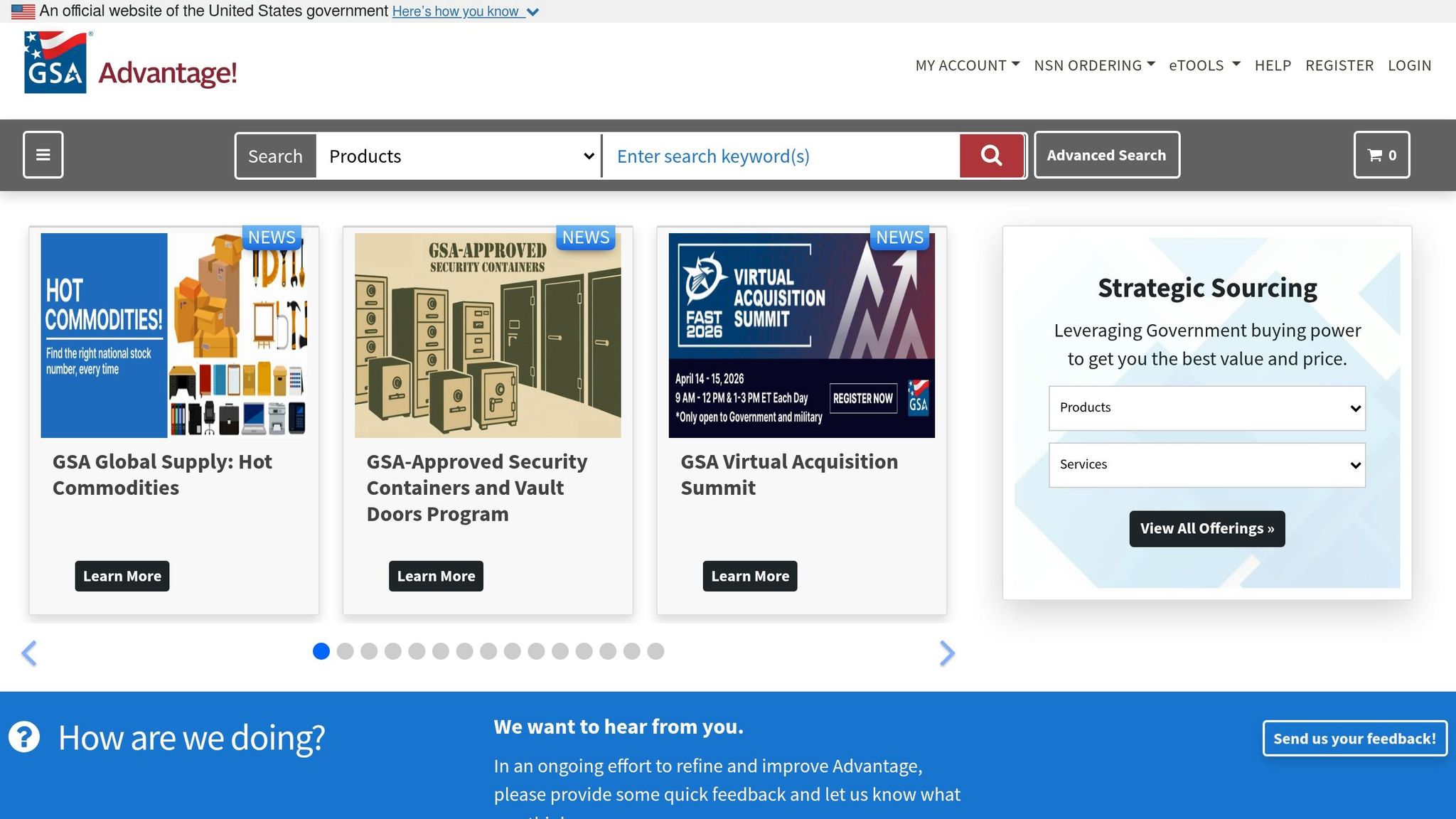
Your GSA Advantage listing serves as the first impression federal buyers have of your business. A well-optimized listing can turn your GSA Schedule into a powerful sales tool. Since federal buyers often rely on GSA Advantage to research vendors, outdated or vague listings can mean missed opportunities. Refining your listings is essential for attracting and retaining federal buyer interest.
Writing Effective Product and Service Descriptions
Federal buyers search differently than commercial customers – they rely on technical terms, part numbers, and compliance-related keywords. To ensure your products or services appear in their searches, tailor your descriptions to meet these criteria. For instance, instead of saying “durable office chair”, try “ergonomic task chair, GSA-approved, TAA-compliant.” Including specific identifiers like MIL-SPEC numbers, FIPS standards, or agency acronyms can significantly improve your visibility.
| Description Element | What to Include | Purpose |
|---|---|---|
| Keywords | Part numbers, MIL-SPEC, FIPS, agency acronyms | Boosts search rankings and makes products easier to find |
| Technical Specs | Dimensions, power requirements, material types | Ensures products meet agency needs |
| Compliance | TAA, Green Purchasing, small business certifications | Meets federal procurement rules |
| Support Info | Warranty terms, lead times, return policies | Builds buyer trust and reduces perceived risks |
It’s crucial to lead with compliance details like Trade Agreements Act (TAA) status, Green Purchasing qualifications, or small business certifications. Federal buyers often use these filters to narrow down their options before diving into individual product details.
Adding Visuals and Reviews
Visuals and reviews can make or break buyer confidence. High-quality images – like multiple product angles, clear software screenshots, or detailed diagrams – help buyers understand your offerings and make informed decisions. These visuals also assist procurement officers in justifying their choices to supervisors and stakeholders.
Customer reviews and case studies provide another layer of trust. If your business has successfully completed federal contracts, showcase those achievements. Include specifics like contract numbers (when appropriate), delivery timelines, and performance metrics. This kind of social proof reassures buyers that your company can meet government expectations.
Keeping Listings Updated
Keeping your listings up to date is non-negotiable. Federal buyers expect accurate pricing, current product availability, and functional links in your electronic catalog. Outdated information not only damages credibility but could also lead to compliance issues with GSA.
Make it a habit to:
- Update pricing and product details regularly
- Remove discontinued items and add new offerings promptly
- Verify that all hyperlinks work correctly
- Keep your contact information accurate and accessible
Additionally, ensure your titles and descriptions remain rich with relevant keywords to align with evolving buyer search behaviors.
Effective GSA Marketing Strategies
Once your GSA Advantage listings are polished and your outreach plan is underway, the next step is to amplify your federal marketing efforts. Federal buyers aren’t going to stumble upon your offerings by chance. You need to actively promote your Schedule using targeted strategies to connect with the right agencies at the right time.
Using eBuy and Direct Outreach
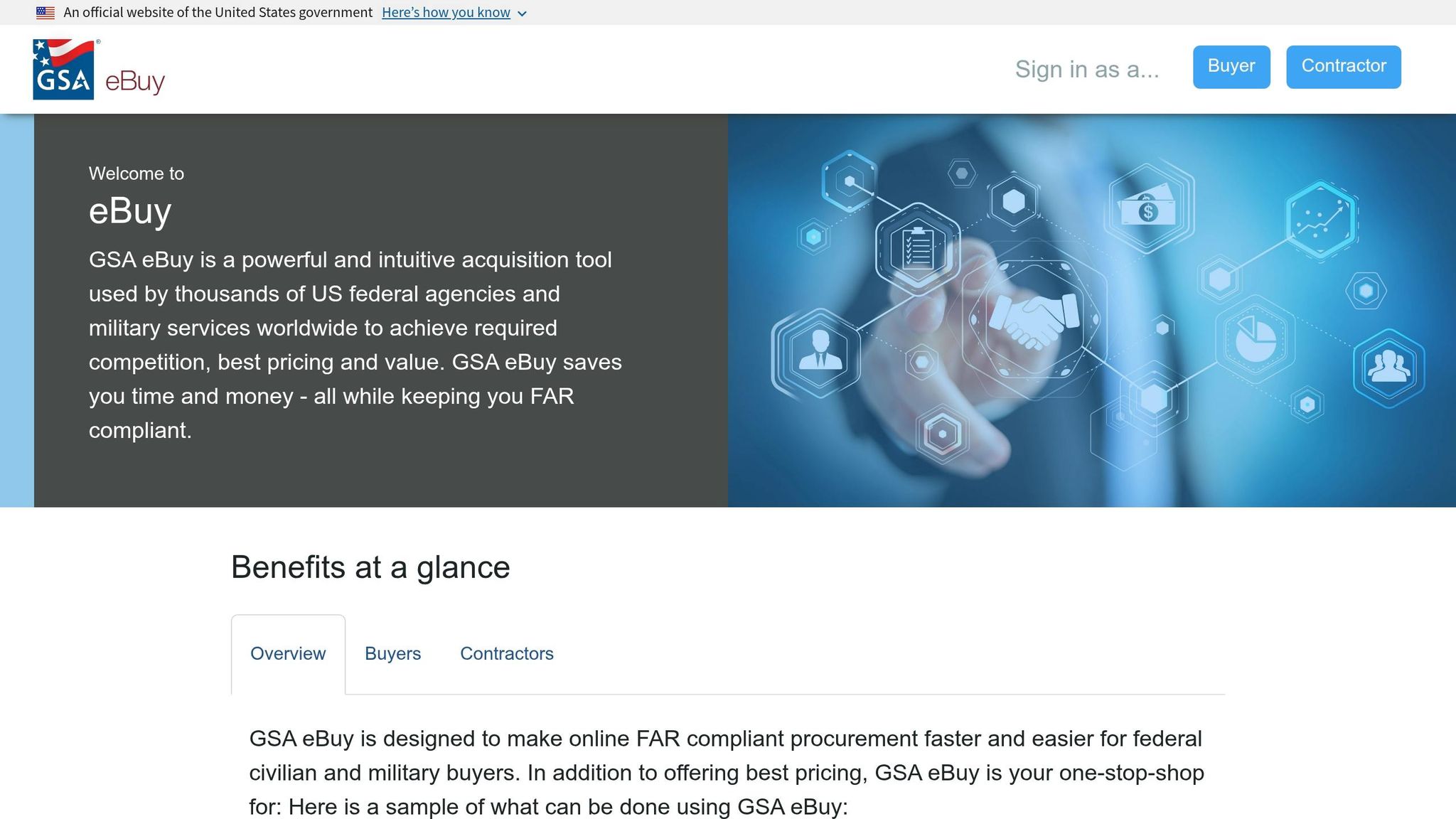
eBuy is GSA’s online Request for Quote (RFQ) system, where federal buyers post immediate needs under GSA Schedules. Think of it as a marketplace for urgent agency requirements. To make the most of it, register your GSA Schedule on GSA eLibrary, and set up email alerts for RFQs that match your offerings. Use filters based on your Special Item Numbers (SINs), NAICS codes, and set-aside status to zero in on relevant opportunities.
Timing is everything on eBuy. Many RFQs have tight deadlines – some as short as 5 to 10 days – so daily monitoring is key. Tailor your quotes to highlight competitive pricing, proven results, and compliance. Small businesses that respond to 10 or more RFQs weekly often see success rates improve by 20-30%.
Direct outreach to contracting officers (COs) can also yield significant results. Platforms like SAM.gov and USAspending.gov can help you identify COs managing contracts in your area. Craft personalized emails that feature a one-page capability statement, emphasizing your small business status, unique strengths, and past achievements. Address specific agency challenges or recent awards to make your outreach relevant. Follow up 2-3 times over two weeks, and explore opportunities to meet COs through agency industry days or LinkedIn. Companies that focus on 5-10 high-potential agencies each quarter often report response rates as high as 15%.
For example, a small IT firm combined these tactics by bidding on 50 Department of Defense (DoD) RFQs annually through eBuy while reaching out to 20 COs with tailored product demos. This dual approach earned them $2.5 million in awards by packaging hardware and software solutions. Similarly, a service provider targeting the VA used eBuy alerts and webinars to convert 12% of contacts into $1 million in contracts. These examples show how combining outreach with proactive bidding can increase wins by 30%.
Analyzing Award Data for Insights
Award data is a goldmine for understanding spending patterns and identifying opportunities. Free tools like USAspending.gov and GSA’s Federal Procurement Data System (FPDS) allow you to filter by NAICS codes, agencies, and set-aside categories, offering insights such as:
- Top contractors in your field
- Average award sizes and contract values
- Repeat buyers with consistent procurement habits
- Win rates based on business size (e.g., small businesses secure 40% of awards under $100,000)
Use this data to fine-tune your marketing efforts. For instance, if the DoD ramps up spending on logistics, you can pivot your outreach and eBuy efforts towards their buyers. One example showed a company increasing sales by 25% after targeting DoD logistics awards based on procurement trends.
Recent data from 2023-2025 highlights a 15% rise in IT and cybersecurity awards under Multiple Award Schedules (MAS), with small business set-asides accounting for 23% of federal spending. Companies tracking these trends through FPDS dashboards shifted focus to high-growth areas like cloud services, boosting win rates by 18%.
To maximize your efforts, segment data by agencies awarding over $500,000 annually within your NAICS code. Apply the 80/20 rule: devote 70% of your efforts to the top 5 agencies that represent the bulk of opportunities. Businesses adopting this approach have increased awards by 35%, often uncovering underserved niches like sustainable products, which align with federal green purchasing initiatives.
Building a Best Value Proposition
Once you’ve refined your outreach and analyzed award data, it’s time to craft a compelling value proposition. Federal buyers are looking for best value, which combines competitive pricing, risk reduction, and quality assurance. To stand out, focus on:
- Competitive pricing, typically 10-15% below market rates through volume discounts
- Proven reliability, such as a 99% on-time delivery rate
- Quality certifications, like ISO 9001
Your value proposition should shine through in every interaction – whether it’s your GSA Advantage listing, eBuy responses, or capability statements. Use specific metrics to back up your claims, like: “Reduced agency costs by 20% for 50+ clients” or “Delivered 100% TAA-compliant products with zero defects over three years.” GSA auditors often prioritize quantifiable results in best value evaluations.
Small business certifications can also give you a competitive edge in set-aside competitions. Highlight these in your messaging, such as: “HUBZone-certified for 100% local sourcing, minimizing logistics risks.” According to SBA reports, certified businesses win awards 25% faster.
Pair competitive pricing with clear delivery timelines, warranties, and your small business status to present a well-rounded offer. Remember, federal buyers need to justify their decisions to supervisors – make their job easier by providing concrete evidence of your value.
How GSA Focus Simplifies Marketing Campaigns
Securing a GSA Schedule is just the beginning. Turning it into a revenue-generating tool requires effective management and focused marketing efforts. That’s where GSA Focus steps in, managing your GSA contract lifecycle while offering tailored marketing solutions to help you tap into federal sales opportunities.
Full GSA Schedule Management
GSA Focus takes the burden off your shoulders by handling 95% of GSA Schedule tasks, cutting your involvement from over 100 hours to just 3–4 hours. This streamlined process can speed up your market entry by 4–5 times. Their secure online portal simplifies document uploads – you only need to provide around 12 required items. From there, their team prepares your offer, communicates with GSA auditors to resolve clarifications, and manages final negotiations.
But their support doesn’t stop at acquisition. GSA Focus ensures your contract stays compliant and up-to-date by managing modifications, price adjustments, and SAM.gov renewals. This ongoing oversight keeps your listings active and optimized on GSA Advantage, freeing you to focus on your core business. With a 98% success rate in securing GSA Schedule contracts, their system is designed to avoid common pitfalls like incomplete forms or rejected submissions.
Once your schedule is in place, GSA Focus shifts gears to help you maximize federal sales through targeted marketing strategies.
Marketing Support for Federal Contracts
After streamlining your schedule management, GSA Focus amplifies your federal sales efforts with its GSA Accelerator program. This program fast-tracks success through a “Filtering, Watchlist, Pipeline” model. Their Pipeline Sprint enables you to start bidding within two weeks, offering a curated daily watchlist of opportunities from sources like GSA, SAM.gov, DIBBS, and state-level platforms.
The program also includes three months of active proposal writing with two sessions per month, helping you build a robust library of templates. Additionally, targeted email outreach and a Federal Brand Audit ensure your GSA Advantage listings are compelling and optimized with strategic keywords, certifications like 8(a) or HUBZone, and engaging descriptions. To keep you on track, GSA Focus provides twice-monthly coaching calls and access to a private LinkedIn group for ongoing support.
Proven Success and Support
GSA Focus’s comprehensive approach delivers measurable results. To date, they’ve secured over 550 GSA Contract awards, driving more than $500 million in federal sales for their clients. On average, clients see an additional $927,000 in revenue after obtaining a GSA Schedule, with an ROI ranging from 52–87x.
“GSA Focus accelerates your access to a GSA Schedule 5x faster, with only 4 hours of your time in most cases.”
- Josh Ladick, Founder, GSA Focus
“MacGyver Solutions is one of GSA Focus’ success stories – having them do the heavy lifting on the initial contract was a huge help.”
- Mike Jackson, Founder, MacGyver Solutions, Inc
GSA Focus stands behind its services with strong guarantees, offering a full refund if a GSA Award isn’t secured and a 5x ROI guarantee on the Accelerator program over 18 months (as long as effort requirements are met). With over 17 years of experience and direct connections at the GSA, they’re equipped to help small businesses navigate regulatory complexities and excel in the federal marketplace.
Conclusion
Securing a GSA Schedule opens the door to federal opportunities, but the real challenge lies in converting that access into actual sales. Simply holding a contract isn’t enough – without well-optimized listings and proactive outreach, your competitors could easily outpace you. To succeed, you need to treat your presence on GSA Advantage as you would any commercial marketplace, using data-driven strategies to connect with the right agencies.
The key difference between a dormant schedule and a thriving revenue source is execution. Focus on refining your digital presence with search-friendly titles, detailed technical specifications, and relevant certifications. Combine this with tools like USASpending.gov and active participation in eBuy bidding to turn visibility into secured contracts. As GSA.gov emphasizes, precise execution is essential for success.
For small businesses that find navigating these complexities overwhelming, working with experienced professionals can make all the difference. Companies like GSA Focus handle acquisition, compliance, and marketing, allowing you to concentrate on federal sales. With a 98% client satisfaction rate, they’ve developed a system that transforms GSA Schedules into engines for growth.
This guide has outlined how targeted marketing strategies can turn your GSA Schedule into a powerful tool for expansion – now it’s time to put it into action.
FAQs
How do I choose which agencies to target first?
When diving into federal spending data, the first step is identifying agencies whose procurement needs align with what you offer. Tools like GSA eLibrary, GSA Advantage, and SSQ+ are invaluable for researching purchasing trends and understanding demand. By analyzing this data, you can pinpoint agencies with consistent or growing procurement budgets that match your products or services.
The key is to focus on agencies with substantial spending potential that align closely with your offerings. This approach not only boosts your chances of success but also saves time and resources – an essential strategy outlined in the guide for targeting agencies with GSA contracts.
What should I update first in my GSA Advantage listing to get more leads?
Want to catch the attention of federal buyers? Start by fine-tuning your product listings. Here’s how:
- Write clear, benefits-focused descriptions: Highlight what sets your products apart while weaving in relevant industry keywords. This helps your listings stand out in searches.
- Use high-quality images: Crisp, professional visuals make your offerings more appealing and trustworthy.
- Set accurate and competitive pricing: Ensure your prices reflect market trends and are attractive to buyers.
When your listings are polished and optimized, they’re easier to find and more enticing to potential customers. This can directly boost your chances of generating leads and growing your federal business.
How many eBuy RFQs should I respond to each week to see results?
To improve your chances of securing federal contracts, aim to respond to 3 to 5 eBuy RFQs every week. Staying active not only helps you maintain consistency but also boosts your visibility among potential buyers, giving you more opportunities to make an impression and build momentum.
Related Blog Posts
- 5 Tips for GSA Advantage Sales Success
- How to Promote GSA Contracts to Agencies
- Ultimate Guide To GSA Contracting Results
- GSA Advantage Website 101: A Small Business Guide