
Your GSA price list sets the maximum rates you can charge federal agencies. Getting it right is critical for compliance, profitability, and competitiveness in a market where GSA Schedule spending exceeds $45 billion annually. Missteps, like ignoring the Price Reductions Clause or outdated pricing, can lead to audits or forced price cuts. Here’s a quick overview of the best practices to maintain compliance and protect your margins:
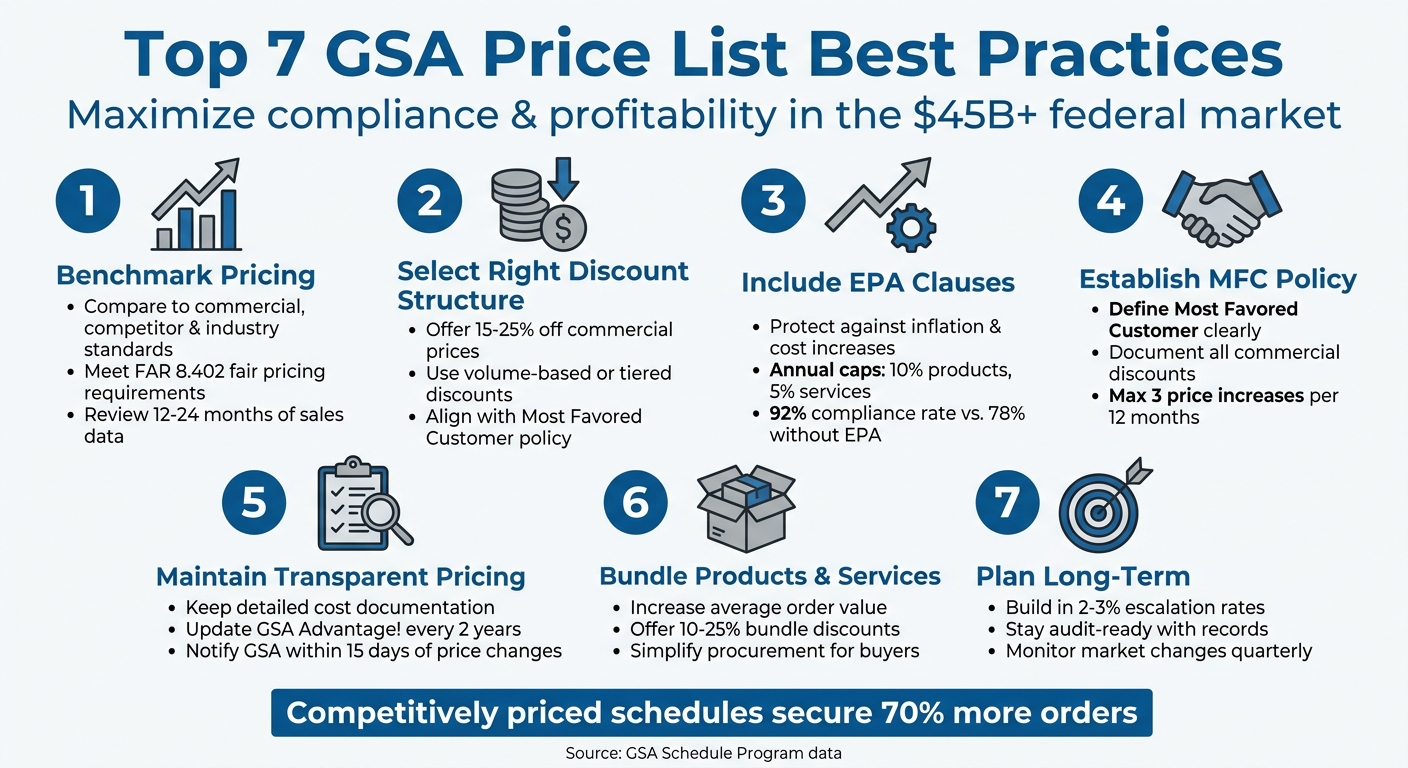
- Benchmark Pricing: Compare rates to commercial, competitor, and industry standards to meet federal fair pricing rules.
- Discount Structures: Offer volume-based or tiered discounts while keeping profitability intact.
- Economic Price Adjustment (EPA): Use clauses to adjust for inflation or rising costs.
- Most Favored Customer Policy: Ensure GSA pricing matches or beats your best commercial rates.
- Transparent Pricing: Keep detailed records to justify rates and avoid compliance issues.
- Bundling Products/Services: Combine offerings to increase value and simplify procurement.
- Long-Term Planning: Stay audit-ready with documented pricing strategies and room for adjustments.
7 GSA Price List Best Practices for Federal Contractors
How to Price Your Government Contracts
1. Compare Your Pricing to Commercial, Competitor, and Industry Standards
To ensure your pricing is competitive and compliant, start by benchmarking it against commercial records, competitor data, and trusted industry standards. Use reliable data sources like your own sales records (preferably from the last 12–24 months), competitor pricing on the GSA eLibrary (eLibrary.gsa.gov), and industry benchmarks from platforms like Bloomberg or IBISWorld. This step is essential for meeting FAR 8.402 requirements, which mandate proof of fair and reasonable pricing.
Accuracy and Transparency in Pricing Data
Documenting your pricing details thoroughly is critical. Use a spreadsheet to track price ranges, sales volumes, and discounts. For instance, if you sell IT hardware at $500 per unit with a 20% discount for bulk buyers, make sure this information is clearly outlined in your GSA Price List Justification. A comparison matrix can simplify this process – include columns for Category, Commercial Price, Competitor Average, Proposed GSA Price, and Justification. Regularly updating this data is vital to avoid compliance issues caused by outdated information. This approach not only strengthens your justification but also ensures you meet GSA’s stringent requirements.
Compliance with GSA Regulations and Guidelines
Staying compliant with regulations like FAR 15.402, GSA Order 5260.2B, and the Price Reductions Clause (PRC) is non-negotiable. Common mistakes include using data older than two years, ignoring basis of award sales, or failing to certify commerciality. These missteps can result in mandatory price reductions or even debarment. For example, contractors who omitted 30–40% commercial discounts during audits faced significant pricing adjustments.
Profitability and Competitiveness in the Federal Market
Balancing profitability with competitiveness is key. Most successful GSA schedules offer discounts of 15–25% off commercial prices. Data shows that competitively priced schedules can secure up to 70% more orders compared to overpriced ones. To gauge your position, analyze at least 10–12 similar contracts on GSA Advantage! and aim for an 85% Price Competitiveness Index relative to GSA market averages. This ensures your pricing aligns with market expectations and attracts more federal buyers.
Flexibility to Adapt to Economic or Market Changes
Market conditions can shift quickly, so build flexibility into your pricing strategy. Conduct quarterly reviews to keep your benchmarks current. For example, during the 2022 inflation surge, companies that aligned their pricing with updated industry data secured a 5% EPA increase without violating the PRC, as industry benchmarks showed cost increases of up to 8%. Tools like the Bureau of Labor Statistics Producer Price Indexes can help you track relevant market changes. Regular updates – ideally every three months – can prevent forced price reductions of 12–15% caused by ignoring market trends.
2. Select the Right Discount Structure
When it comes to pricing for federal buyers, choosing the right discount structure is a balancing act. It’s about protecting your profit margins while staying compliant with federal regulations. The Most Favored Customer (MFC) policy is at the heart of this process – GSA requires that you offer federal buyers a deal that’s as good as, or better than, what your best-paying commercial client receives.
Staying Aligned with GSA Regulations
To stay on the right side of GSA rules, you’ll need a well-documented pricing strategy that ties your GSA rates directly to your commercial pricing. A key part of this is understanding your Basis of Award (BOA) – the customer category used as a benchmark during contract negotiations. If you offer better pricing to your BOA customer, the Price Reductions Clause (PRC) requires you to adjust your GSA rates accordingly.
For contracts using Transactional Data Reporting (TDR), instead of monitoring the PRC, you’ll need to submit monthly or quarterly reports detailing actual prices paid by the government. Another critical step is ensuring that your Schedule Input Program (SIP) uploads match your most recent contract modifications. Misaligned data between SIP files and contract changes can lead to compliance headaches. Regular audits and maintaining a clear changelog can help avoid discrepancies between your GSA Advantage price list and invoiced prices.
Balancing Profitability and Competitiveness
Your discount structure shouldn’t just meet compliance requirements – it should also enhance your competitiveness in the federal market. Volume-based, prompt payment, and customer-tiered discounts are great tools to achieve this. Instead of slashing prices to outdo competitors, consider bundling services or offering tiered discounts based on factors like purchase volume or payment terms. For example, offering a better rate for larger commitments or quicker payments can make your pricing more attractive.
Use tools like GSA Advantage! and GSA eLibrary to research how competitors price their Special Item Numbers (SINs). Keep in mind that GSA pricing serves as a ceiling rate – you can’t charge more than this pre-negotiated price, but you’re free to offer additional discounts to specific agencies as needed. When setting your initial rates, think ahead to include room for Economic Price Adjustments (EPA), as GSA often limits annual price increases.
Building Flexibility into Your Pricing
Flexibility is key in navigating market or economic changes. The Economic Price Adjustment (EPA) clause allows for price increases, typically once a year, to account for rising costs. To stay ahead, review your discount structure quarterly and plan for increases in option years. If you need to request a price adjustment, you’ll need to submit a formal justification letter to your Contracting Officer, backed by evidence of higher costs.
Tiered discounts can also provide flexibility, letting you cater to different federal buyers while maintaining a solid base rate. By planning ahead and building adaptability into your pricing strategy, you can protect your margins while staying competitive in a dynamic market.
3. Include Economic Price Adjustment Clauses
Flexibility to Adapt to Economic or Market Changes
Economic Price Adjustment (EPA) clauses are a crucial tool for maintaining flexibility in your GSA contract. These clauses act as a safeguard against rising costs that can erode your profit margins over time. Whether it’s inflation, increased material costs, or updates to commercial pricing, EPA clauses allow you to adjust prices without violating GSA regulations. Between 2020 and 2023, inflation significantly impacted industries, with steel prices alone rising by 25–40%. This led over 500 GSA contractors to leverage EPA clauses to stay afloat. Without this protection, contractors risk locking in rates that fail to account for market changes, leaving little room for profitability.
For implementation, you can choose Clause 552.216-70, which ties pricing to your published commercial list, or Clause I-FSS-969, which allows for fixed or index-based annual escalation. Many government contractors prefer the fixed escalation option, though securing increases above 2.5% has become increasingly challenging since 2021.
Compliance with GSA Regulations and Guidelines
To ensure compliance, EPA clauses are non-negotiable for future price adjustments on your GSA Schedule. A 2022 GSA audit revealed that contracts with EPA clauses had a 92% compliance rate during volatile market conditions, compared to just 78% for contracts without them. Proper documentation is key. For Clause 552.216-70, you’ll need a standalone, dated commercial price list. If you’re using a market-based adjustment, reference Bureau of Labor Statistics (BLS) indices to justify changes. Your EPA clause must clearly outline adjustment formulas, annual caps (typically 10% for products and 5% for services), and the economic indicators being used. This level of detail not only keeps you compliant but also ensures your profit margins are protected.
Profitability and Competitiveness in the Federal Market
Incorporating EPA clauses isn’t just about compliance – it’s a strategic move to safeguard profitability. For instance, during the 8% CPI increase between 2022 and 2023, contracts with EPA clauses managed price increases of 5–7%, maintaining margins that were 15–20% higher than those locked into fixed-price agreements. Additionally, data from FY2023 shows that contracts with EPA clauses experienced 25% fewer pricing disputes and an 18% higher renewal rate. By building in EPA protection, you can bid more competitively on initial pricing, knowing you have the flexibility to adjust later. This approach has been shown to boost win rates by 12% according to GSA Schedule statistics. To keep pricing fair and competitive, limit EPA adjustments to uncontrollable factors like materials and fuel costs.
4. Establish Your Most Favored Customer Policy
Accuracy and Transparency in Pricing Data
Your Most Favored Customer (MFC) is the commercial buyer who benefits from your best discount or lowest price. Meanwhile, the Basis of Award (BOA) serves as the benchmark customer or category for determining GSA pricing. To stay compliant, maintaining precise and well-organized documentation is crucial. This includes tracking cost structures, commercial sales data, and the rationale behind discounts. Ensure that all commercial invoices reflect the terms disclosed to your MFC.
Before submitting pricing data to the GSA, confirm that your commercial prices are up-to-date. If your commercial rates are lower than your proposed GSA rates, the GSA will not approve any increases. To avoid discrepancies, maintain a detailed changelog of every contract modification and price adjustment. This ensures that your internal records align perfectly with the GSA-approved price list. Such thorough documentation not only keeps you compliant but also supports strategic pricing decisions that align with your broader goals.
Compliance with GSA Regulations and Guidelines
Accurate record-keeping does more than keep your business organized – it’s a critical part of meeting GSA compliance standards. Building on earlier discussions about discount structures, your MFC policy must adhere to strict guidelines.
If you offer a better discount to your BOA or MFC than what’s disclosed, the Price Reductions Clause (PRC) mandates retroactive reductions in your GSA pricing. To simplify compliance, consider opting into Transactional Data Reporting (TDR). This approach shifts the focus from monitoring rigid MFC/PRC requirements to reporting transparent transactional data instead.
Pricing adjustments are limited under GSA contracts. Contractors can typically make no more than three price increases in a 12-month period, with annual caps often set at 10% for products, 5% for professional services, and 4% for human capital services. A well-documented MFC policy safeguards your business from financial inconsistencies and compliance risks, ensuring alignment with the pricing strategies discussed earlier.
Profitability and Competitiveness in the Federal Market
Navigating GSA’s MFC requirements doesn’t mean sacrificing profitability – it’s about smart pricing strategies. Tiered pricing structures, like volume-based or prompt payment discounts, can offer flexibility while preserving a strong BOA relationship. Here’s an example of how pricing might vary by customer type:
| Client Type | Rate/hr | Notes |
|---|---|---|
| Commercial | $150 | Ad hoc, short-term work |
| MFC | $135 | 1-year commitment, 30-day terms |
| GSA | $125 | 3-year term, fast pay, stable volume |
This table illustrates how GSA pricing, while lower than commercial rates, remains profitable due to guaranteed volume and faster payment terms. Federal buyers will appreciate clear, straightforward pricing that’s easy to justify internally. Avoid complicated package names and provide transparent explanations for your rates.
To stay competitive, monitor market indexes like the Employment Cost Index (ECI) or Consumer Price Index (CPI) from the Bureau of Labor Statistics (BLS). These resources help you demonstrate that your pricing is fair and reasonable. With over $45 billion spent annually through GSA Schedules, competitive pricing that balances profitability and compliance can position your business for sustained success in the federal market.
5. Maintain Fair and Reasonable Pricing with Full Transparency
Accuracy and Transparency in Pricing Data
Federal buyers hold GSA pricing to rigorous scrutiny under FAR Part 15 standards. This means your pricing needs to hold up under comparisons with commercial market rates, competitor pricing, and other government benchmarks.
To ensure your pricing is defensible, keep thorough documentation that reflects actual costs. This includes up-to-date commercial catalogs and supplier updates. By tracking labor, materials, and overhead in real time, you can streamline audits and avoid surprises.
When requesting a GSA price adjustment, make sure your commercial prices have increased first. If your commercial rates remain unchanged, the GSA will reject your request. Aligning federal and commercial pricing not only ensures compliance but also builds trust. Proper documentation is key to navigating GSA pricing rules effectively.
Compliance with GSA Regulations and Guidelines
GSA contracts come with strict rules that govern how you price, report, and adjust your rates. For example, the Price Reductions Clause (FAR 552.238-81) requires you to maintain a consistent price-discount relationship with your Basis of Award customer. If your commercial prices drop or your Basis of Award customer gets a better discount, you must notify the GSA within 15 calendar days. Alternatively, the Transactional Data Reporting (TDR) model allows for more flexibility, requiring monthly sales reports with detailed transaction data.
Your negotiated pricing must be listed on GSA Advantage! within 30 days and updated every two years. This transparency lets federal buyers easily compare rates. To stay competitive, regularly review pricing from other contractors on GSA Advantage! and GSA eLibrary.
GSA price increases are capped annually. When requesting an increase, back it up with objective data from sources like the Bureau of Labor Statistics. Indexes such as the Consumer Price Index (CPI) or the Employment Cost Index (ECI) can help demonstrate that your request is based on real market changes.
Flexibility to Adapt to Economic or Market Changes
While compliance is essential, staying flexible is just as important. Market conditions are always shifting, and your GSA pricing strategy should be able to adjust accordingly. Economic Price Adjustment (EPA) clauses – like 552.216-70 for products or I-FSS-969 for services – offer a way to justify price increases due to inflation or rising costs. These clauses can help you address issues like wage hikes or material cost spikes without breaking contract terms.
Typically, price increase requests can be submitted no sooner than 12 months after the contract award or the last approved increase. They must also be submitted no later than 60 days before the contract expires.
With over $45 billion in annual spending through GSA Schedules, fair and transparent pricing isn’t just a regulatory requirement – it’s a cornerstone of long-term success. By documenting cost drivers, keeping a close eye on market trends, and using verifiable economic data to adjust rates, you can strike the right balance between compliance and profitability. This approach ensures your business remains competitive and sustainable in the federal market.
6. Bundle Products and Services for Maximum Value
Profitability and Competitiveness in the Federal Market
Bundling products and services can be a game-changer for businesses looking to increase their average order value and stand out in the competitive federal marketplace. With over $45 billion spent annually through GSA Schedules, federal buyers are increasingly drawn to complete solutions that simplify procurement. For example, offering a bundle that includes a laptop, a protective case, and a support contract can make it easier for agencies to justify the purchase and save time by avoiding the hassle of sourcing each item individually.
This strategy doesn’t just streamline the buying process; it also helps you manage inventory more effectively. By pairing slower-moving items with popular ones – a tactic known as leader bundling – you can give lesser-known products more visibility while boosting your revenue per transaction. Michael Seaman, CEO of Swipesum, sums it up well:
A smart bundle pricing strategy can help you attract more customers, raise your average order value, and boost your bottom line.
Accuracy and Transparency in Pricing Data
While bundling offers clear advantages, it’s essential to ensure your pricing is both accurate and transparent. Buyers need to see that your bundled pricing is competitive and easy to understand. Each item in the bundle must align with its designated Special Item Number (SIN), and SKUs should match the exact descriptions approved in your contract. When uploading bundles through the Schedule Input Program (SIP), double-check every detail – formats, decimals, and units – to avoid rejections.
A well-balanced discount between 10% and 25% on bundled products compared to individual purchases is typically effective. This range provides value to government buyers while protecting your profit margins. Keep in mind that GSA Schedule pricing represents the maximum you can charge, so your bundle pricing must stay within these limits. To maintain compliance and audit readiness, document your pricing methodology thoroughly. Include commercial sales data and cost breakdowns to back up your bundle pricing decisions.
Compliance with GSA Regulations and Guidelines
Bundled offerings must meet the same regulations as individual products. If your pricing is subject to the Price Reductions Clause (PRC), ensure that your bundle discounts align with the pricing disclosed to the GSA. Alternatively, if you’re using Transactional Data Reporting (TDR), managing bundled pricing can be easier since the focus shifts from strict pricing audits to data transparency.
To make your bundles more appealing, use clear, benefit-focused titles in your GSA Advantage! listings. As GSAFocus advises:
Bundle services where it makes sense… [it] makes you easy to justify internally for buyers.
Avoid vague or confusing package names – clarity helps you win contracts. Regularly review your bundle pricing, ideally on a quarterly basis, to ensure it aligns with invoices and complies with all GSA requirements.
7. Plan for Long-Term Profitability and Compliance
Profitability and Competitiveness in the Federal Market
Your GSA Schedule pricing acts as a ceiling rate, capping charges to the pre-approved amounts. To maintain control, define your Basis of Award (BOA) customer. This helps manage the Price Reductions Clause (PRC) if you offer higher discounts to commercial clients. Alternatively, you can opt into Transactional Data Reporting (TDR), which shifts compliance from detailed audits to transparent data submissions.
Federal agencies spend over $45 billion annually on GSA Schedules, making it a highly competitive market. To stay ahead, use tools like GSA Advantage! and GSA eLibrary to research vendors. Analyze how competitors structure their pricing, labor categories, and terms. This research not only helps you understand buyer expectations but also highlights ways to stand out. Building a strategic pricing foundation ensures you’re prepared to adapt as market dynamics shift.
Flexibility to Adapt to Economic or Market Changes
A strong pricing strategy needs room to adjust to changing economic conditions. Fixed rates can hurt your margins when inflation, labor costs, or supply chain issues arise. To address this, include Economic Price Adjustment (EPA) clauses in your contract. These clauses allow you to update prices based on commercial catalog changes or economic indicators like the Consumer Price Index (CPI). For products, EPA adjustments typically follow clause 552.216-70, while services use clause I-FSS-969.
GSA limits price increases to three times within a 12-month period, with caps of up to 10% for products, 5% for professional services, and 4% for human capital services. After your contract is awarded, you’ll need to wait 12 months before requesting your first increase. Additionally, any requests must be submitted at least 60 days before the contract expires. Negotiating a built-in escalation rate of 2–3% during the initial award can provide financial stability while reducing administrative work.
Compliance with GSA Regulations and Guidelines
A flexible pricing plan is only effective if paired with strict compliance. Audit readiness is key to protecting your contract. Document your pricing methodology thoroughly, including commercial invoices, discount disclosures, and cost structures. When submitting EPA requests, use evidence like Bureau of Labor Statistics (BLS) data or documented labor cost increases. Keep records of any commercial price changes, such as updated catalogs or supplier letters, to ensure your GSA rates align with your commercial pricing.
Set your initial rates with planned EPA adjustments in mind. Prepare for audits by tracking all non-comparable sales that could trigger retroactive PRC adjustments. GSA Contracting Officers conduct independent research and won’t approve rates just because they align with competitors. Your pricing must be supported by solid documentation proving it’s fair and reasonable. By focusing on a well-documented, forward-looking strategy, you can protect your pricing integrity throughout the contract’s duration.
Conclusion
Making smart pricing decisions is crucial for protecting your profit margins and staying compliant with federal regulations. By regularly comparing your rates to commercial and competitor benchmarks, you can remain competitive in a market where federal agencies spend over $45 billion annually through GSA Schedules. Choosing the right discount structure and clearly defining your Basis of Award (BOA) can help you avoid compliance issues that might lead to mandatory price reductions.
These strategies not only safeguard your pricing but also give you the flexibility to adapt to market changes. For instance, including Economic Price Adjustment (EPA) clauses in your contracts can shield you from inflation, rising labor costs, and supply chain disruptions. GSA typically allows annual price increases of about 10% for products, 5% for professional services, and 4% for human capital services. Additionally, bundling products and services can enhance value for buyers and help your offerings stand out.
To ensure you’re always audit-ready, document every price, discount, and commercial sale meticulously. This preparation will help you handle Contractor Assistance Visits and audits without risking your contract. Finally, training your sales team on commercial discounts and maintaining clear, accessible records are key steps to avoiding compliance problems.
FAQs
How do I pick my Basis of Award customer?
When choosing your Basis of Award (BOA) customer, prioritize the commercial client where your company is most competitive. This client should represent your top-tier pricing, reliability, and discounting policies, showcasing the best of your commercial practices. By aligning your GSA pricing with this particular customer, you ensure that your rates are fair and reasonable during GSA’s evaluation process.
Moreover, solid past performance plays a crucial role in justifying your selection. Tools like CPARS (Contractor Performance Assessment Reporting System) and PPQs (Past Performance Questionnaires) can help demonstrate your track record, reinforcing compliance with GSA requirements. Together, these elements create a strong foundation for your BOA customer choice.
Should I choose PRC or TDR for my Schedule?
When deciding between PRC (Price Reduction Clause) and TDR (Transactional Data Reporting), it all comes down to your business priorities and how you manage compliance.
PRC obligates you to lower your GSA rates if you reduce your commercial prices. On the other hand, TDR requires you to submit detailed sales data regularly but minimizes the chance of triggering price reductions.
If retaining control over your pricing while managing reporting requirements sounds manageable, TDR could be a better fit. However, if maintaining price stability is your top priority, PRC might align better with your strategy.
What proof do I need for an EPA price increase?
To support an EPA price increase, you’ll need to provide key documentation that demonstrates the need for the adjustment. This includes materials like market analyses, commercial sales practices (CSP) data, sales history, and updated price lists. These documents help illustrate market changes and back up your request.
Make sure to submit everything through the GSA eMod system to ensure your request aligns with the terms and clauses of your contract.
Related Blog Posts
- GSA Price List Update Success Stories
- How to Set GSA Prices for Federal Contracts
- 5 GSA Discounting Rules for Compliance
- Price Reasonableness in GSA Contracts: Basics