Your email subject line is your first – and sometimes only – chance to capture a GSA buyer’s attention. Why? Nearly 47% of recipients open emails based solely on the subject line, and with government buyers constantly navigating packed inboxes, yours needs to stand out. Here’s the formula: keep it short (under 50 characters), personalize it to the agency, and focus on the buyer’s value – like compliance, cost savings, or risk reduction.
Key Takeaways:
- Why it matters: Federal buyers often need 5+ follow-ups to close deals, and subject lines can make or break your outreach.
- What works: Brevity, personalization (agency-specific details), and highlighting benefits like compliance or pricing.
- Proven templates: From "Supporting [Agency]’s Mission with [Your Service]" to "Quick Response on RFQ [Number]", these examples resonate with buyers’ priorities.
Crafting subject lines tailored to GSA buyers isn’t just about grabbing attention – it’s about building trust and opening doors to federal opportunities. Let’s explore how to get it right.
How Government Contractors Should Email Federal Buyers (templates included)
What Makes a Good Email Subject Line for GSA Buyers
When it comes to GSA buyers, your email subject line needs to cut through the noise of crowded inboxes. Think of it as your 5-second elevator pitch: short, sharp, and directly tied to your broader federal outreach strategy. GSA buyers are inundated with vendor emails and procurement notices daily, so your subject line has to grab attention immediately. The secret? Focus on three key elements: brevity, personalization, and value.
Keep It Short and Direct
GSA buyers are often on the go, checking emails on their mobile devices during packed schedules. That means your subject line needs to be under 50 characters to ensure it displays fully on smaller screens. Anything longer risks being cut off, leaving your message unclear – or worse, ignored. Treat your subject line like a headline: every word must count. Keep it laser-focused and relevant to the recipient’s priorities.
Personalize for the Recipient
Generic messages are a fast track to the trash folder. To stand out, include agency-specific details in your subject line – like the agency’s name, a project reference, or even the buyer’s role. This shows you’ve done your homework and understand their mission. Instead of asking vague questions about their challenges, address known agency pain points directly. As Julien Cannon, Manager for Winvale‘s Business Consulting Group, puts it:
"Knowing the hot button issues makes your pitch more salient".
By personalizing your message, you demonstrate that your email isn’t just another mass outreach. It’s a direct, thoughtful communication tailored to their needs.
Focus on Value and Compliance
GSA buyers prioritize "best value" over simply choosing the lowest price. Your subject line should reflect this by emphasizing cost savings, risk reduction, and compliance credentials. For example, referencing your GSA Schedule number or certifications like HUBZone or SDVOSB immediately signals your procurement readiness. Including details like Special Item Numbers (SINs) or compliance with TAA or Section 889 requirements reassures buyers that you meet mandatory criteria.
Instead of focusing on what you’re selling, highlight what the buyer gains – whether it’s faster deployment, extended maintenance, or volume discounts. Make their decision easy by leading with the benefits.
| Element | Subject Line Strategy | Buyer Benefit |
|---|---|---|
| Compliance | Mention TAA or HUBZone status | Meets mandatory requirements |
| Value | Highlight volume discounts | Supports "Best Value" decisions |
| Risk Reduction | Reference GSA Schedule # | Builds immediate trust |
| Relevance | Use specific SINs | Confirms vendor eligibility |
7 Email Subject Line Templates for GSA Buyers
7 Proven Email Subject Line Templates for GSA Buyers
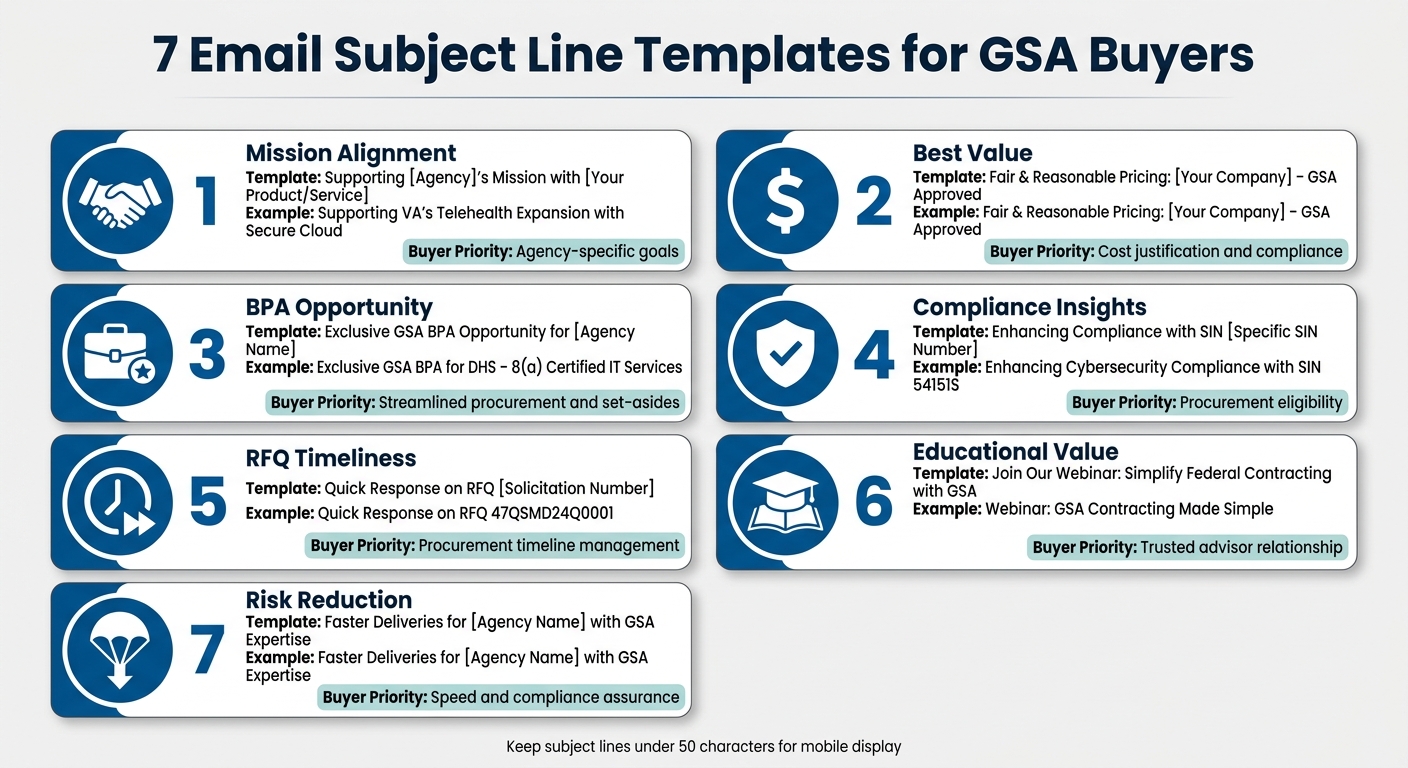
Crafting the perfect email subject line can make or break your outreach efforts, especially when targeting GSA buyers. Below are seven subject line templates designed to resonate with their priorities, ensuring your emails grab attention and deliver results.
Template 1: Highlighting Mission Alignment
"Supporting [Agency]’s Mission with [Your Product/Service]"
This approach demonstrates that you understand the agency’s goals. For example, a subject like "Supporting VA’s Telehealth Expansion with Secure Cloud Solutions" immediately signals relevance. Including a specific initiative or objective adds a personal touch that resonates with buyers.
Template 2: Emphasizing Best Value
"Fair & Reasonable Pricing: [Your Company] – GSA Approved"
GSA buyers are required to ensure pricing is "fair and reasonable", so using this language directly speaks to their needs. If your contract has Best-in-Class (BIC) status, mentioning it can further establish your credibility. As Niraj Kapur, Managing Partner at Everybody Works in Sales, points out:
"A unique, attention-grabbing subject line hints at something interesting waiting in the body of the message – more so if it offers a solution tailored to your prospect’s business needs".
Template 3: Prompting BPA or Contract Opportunities
"Exclusive GSA BPA Opportunity for [Agency Name]"
Blanket Purchase Agreements (BPAs) simplify procurement, and buyers value vendors who understand this efficiency. For instance, "Exclusive GSA BPA for DHS – 8(a) Certified IT Services" highlights both the opportunity and your qualifications, such as socioeconomic status.
Template 4: Offering Compliance Insights
"Enhancing Compliance with SIN [Specific SIN Number]"
Including your Special Item Number (SIN) in the subject line immediately communicates procurement eligibility. An example like "Enhancing Cybersecurity Compliance with SIN 54151S" not only saves the buyer time but also positions you as procurement-ready.
Template 5: Highlighting RFQ Timeliness
"Quick Response on RFQ [Solicitation Number]"
Timeliness is crucial for Contracting Officers managing proposal submissions. Referencing the exact solicitation number from GSA eBuy, such as "Immediate Availability for RFQ 47QSMD24Q0001", shows professionalism and a readiness to meet mission-critical needs.
Template 6: Providing Educational Value
"Join Our Webinar: Simplify Federal Contracting with GSA"
Educational outreach is a great way to build trust before formal solicitations. A concise subject like "Webinar: GSA Contracting Made Simple" positions you as a knowledgeable advisor – something 87% of business buyers value.
Template 7: Stressing Risk Reduction
"Faster Deliveries for [Agency Name] with GSA Expertise"
Buyers prioritize minimizing risks and delays. Highlighting your GSA Schedule number or compliance credentials, like TAA or HUBZone status, reinforces your reliability. Remember, GSA Schedule pricing acts as a ceiling rate, ensuring the government won’t pay more than the pre-negotiated amount, which further reduces financial risk.
| Template Type | Example Subject Line | Buyer Priority Addressed |
|---|---|---|
| Mission Alignment | "Supporting VA’s Telehealth Expansion with Secure Cloud" | Agency-specific goals |
| Best Value | "Fair & Reasonable Pricing: [Your Company] – GSA Approved" | Cost justification and compliance |
| BPA Opportunity | "Exclusive GSA BPA for DHS – 8(a) Certified IT Services" | Streamlined procurement and set-asides |
| Compliance Insights | "Enhancing Cybersecurity Compliance with SIN 54151S" | Procurement eligibility |
| RFQ Timeliness | "Quick Response on RFQ 47QSMD24Q0001" | Procurement timeline management |
| Educational Value | "Webinar: GSA Contracting Made Simple" | Trusted advisor relationship |
| Risk Reduction | "Faster Deliveries for [Agency Name] with GSA Expertise" | Speed and compliance assurance |
How to Customize Subject Lines for Specific GSA Buyers
Generic subject lines just don’t cut it with GSA buyers. If you want your message to stand out, you need to tailor it to the specific agency you’re targeting. Personalization is a must – it shows that you’ve done your research and understand their unique needs.
Reference Agency-Specific Needs
The first step is digging into the agency’s mission, priorities, and challenges. Check out their recent eBuy postings, strategic plans, and annual reports to get a sense of what matters most to them. Tools like USASpending.gov and Schedule Sales Query Plus (SSQ+) can help you identify which agencies are actively purchasing what you offer and when they tend to buy. Stick to publicly available information and keep it professional. A good format to follow is: [Agency Name] + [Specific Challenge/Goal] + [Your Value Proposition]. This approach not only personalizes your subject line but also ensures it’s relevant to the buyer’s needs.
Include GSA-Specific Details
Adding GSA-specific identifiers to your subject lines is a smart way to show you’re ready to do business. Include details like Special Item Numbers (SINs), GSA contract numbers, or references to eBuy solicitations. For instance, a subject line like "GSA Schedule 84-10-XXXX Response: IT Solutions for DHS" or "eBuy RFQ #47QRAD23R0001: Compliance-Ready SIN 541-1 Solutions" makes it clear you understand the process and have the necessary credentials. If you hold certifications like HUBZone or SDVOSB that align with the agency’s goals, mention them too. Use GSA eLibrary or eBuy to find active solicitations and reference them directly. This approach not only builds credibility but also saves buyers time by confirming your eligibility to meet their procurement needs.
Test and Optimize for Different Roles
Different buyers within an agency care about different things. Contracting officers focus on compliance, best value, and risk reduction, while end users are more interested in how your solution will improve their operations. Tailor your subject lines to match these priorities. For example, a contracting officer might be drawn to "GSA Schedule Compliance-Ready Solution for Army Facilities", while an end user might prefer "Streamline DoD Facility Upgrades with Proven GSA Schedule". Track metrics like open rates, click-through rates, and response times to see what works best for each audience. Use a spreadsheet or CRM to log your findings, including agency profiles, subject line versions, and engagement data. Review this information quarterly to spot trends and refine your strategy. The more aligned your subject lines are with each buyer’s priorities, the better your chances of making an impact.
How to Track and Improve Subject Line Performance
Understanding how your subject lines perform is key to figuring out what resonates with your audience. While open rates are a good starting point, they don’t give you the full picture. With changes like Apple Mail Privacy Protection inflating open rates by about 3.5% year-over-year, it’s crucial to dig deeper. Metrics such as reply and response rates can provide a clearer view of actual engagement.
Monitor Engagement Metrics
Start by keeping an eye on your open rates, which generally range from 21% to 25% across most industries. Personalizing subject lines with details like agency names or contract specifics can push open rates as high as 46%. Beyond open rates, focus on click-to-open rates (CTOR) to ensure the email content delivers on the subject line’s promise. Watch your unsubscribe rate too – if 30.4% of unsubscribes are due to subject lines not matching the email content, that’s a problem. Keep bounce rates under 2% and work to reduce spam complaints, as 69% of recipients mark emails as spam based solely on the subject line. These metrics provide the foundation for testing and improving your strategy.
Conduct A/B Testing
A/B testing helps take the guesswork out of crafting subject lines that work. Start by testing two subject lines (A and B) on small, random segments of your list, then send the winning version to the rest of your audience. For larger lists (5,000–20,000 contacts), test each version on 15–20% of your audience, wait 4–8 hours for results, and send the best-performing subject line to the remaining 60–70%. Test one variable at a time, such as length, personalization, or tone, to identify what makes a difference. For instance, you might compare “Mission Support” with “Cost Savings” to see what resonates with a specific agency. Document your results to track trends and refine your approach over time.
Iterate Based on Feedback
Once you’ve tested, use feedback to sharpen your strategy. Metrics alone aren’t enough – buyer feedback is just as important. For GSA contracts, request a debrief after wins or losses to understand what worked or missed the mark. Use this insight to adjust your email templates and build a collection of effective subject lines. Over time, you may notice that some agencies respond better to compliance-focused messaging, while others prefer language that aligns with their mission. Regularly reviewing your performance data can help you spot these trends. As thatmarketingbuddy.com puts it:
"Stop writing clever subject lines and start writing clear ones".
Conclusion
Crafting effective email subject lines for GSA buyers hinges on being clear, relevant, and focused on value. The strategies outlined here offer a solid starting point: begin with the seven templates, then tailor them to align with the agency’s needs, include GSA-specific details like Schedule numbers or SINs, and reflect the roles of your contacts.
Well-thought-out subject lines can increase B2B engagement by 20-30%, making it easier to build trust and credibility over time. In the competitive world of federal contracting, these small details can make a big difference. They demonstrate to buyers that you understand their goals and can provide solutions to their unique challenges.
For those seeking expert support in federal contracting, GSA Focus offers a full-service solution to simplify the process. With over 17 years of experience and a 98% satisfaction rate, they assist small businesses in acquiring and managing GSA Schedule Contracts. Their services cover everything from document preparation and compliance to negotiation and targeted email outreach, ensuring you connect with the right buyers.
Continuously test, measure, and improve your subject lines to create a strong federal opportunities pipeline. Let GSA Focus help you streamline your efforts and open doors to federal contracting success.
FAQs
Should I include my GSA Schedule number in the subject line?
Including your GSA Schedule number in the subject line can work wonders for your email’s effectiveness. It immediately signals credibility and demonstrates compliance with GSA standards. This small detail helps position your email as more relevant and trustworthy to GSA buyers, which can significantly boost engagement rates.
How can I personalize a subject line without sounding salesy?
To make a subject line feel personal without coming across as overly promotional, aim for relevance and specificity. Use details like the recipient’s name, their role, or a recent action they’ve taken to demonstrate that the email is thoughtfully tailored for them. Steer clear of generic sales language or pushy phrases. Instead, craft subject lines that align with their interests or address potential challenges, keeping the tone professional yet engaging to pique their curiosity and establish trust.
What metrics matter most if open rates are unreliable?
If open rates aren’t giving you the full story, shift your attention to response rates, engagement, and the quality of interactions. Look at metrics like replies, click-through rates, and milestone updates. These offer a much better sense of how well your message is connecting with GSA buyers.
Related Blog Posts
- How GSA Contractors Use Blogs for Marketing
- How to Communicate with GSA Buyers
- How to Write Emails for Federal Buyers
- Email Campaign ROI for GSA Vendors