
GSA Schedule Contracts offer businesses access to a $50.6 billion federal marketplace with up to 20 years of revenue potential. These contracts simplify government procurement by pre-negotiating prices, reducing administrative burdens, and fostering consistent income through repeat purchases. From 2021 to 2025, GSA MAS sales grew 25%, with small businesses securing 36% of awards in 2025. Key sectors like IT and Professional Services dominate, while new categories and flexible pricing adjustments ensure contractors remain competitive. Success depends on proactive marketing, compliance, and building strong relationships with federal buyers. GSA Schedules streamline market access, but active management is crucial to unlock their full potential.
GSA Schedule Contracts: Market Size, Growth, and Revenue Potential Statistics
GSA Contracts Step by Step in 2025
What GSA Schedule Contracts Are and Why They Matter
Securing a GSA Schedule Contract can be a game-changer for businesses looking to tap into the federal marketplace. These contracts not only offer long-term revenue potential but also provide a streamlined path to working with government buyers. Here’s an overview of what they are and why they hold such importance.
GSA Schedule Contracts Defined
A GSA Schedule Contract, formally called a Multiple Award Schedule (MAS), is essentially a pre-negotiated agreement between a business and the U.S. General Services Administration. Think of it as earning an official "approved vendor" badge that simplifies the purchasing process for federal agencies. With pricing, terms, and conditions already set, government buyers can directly procure goods and services without the usual red tape. This status not only boosts your credibility as a federal supplier but also opens the door to a wide range of opportunities in the federal market. In short, having a GSA Schedule Contract is like holding a key to a marketplace filled with potential.
Market Size and Opportunity
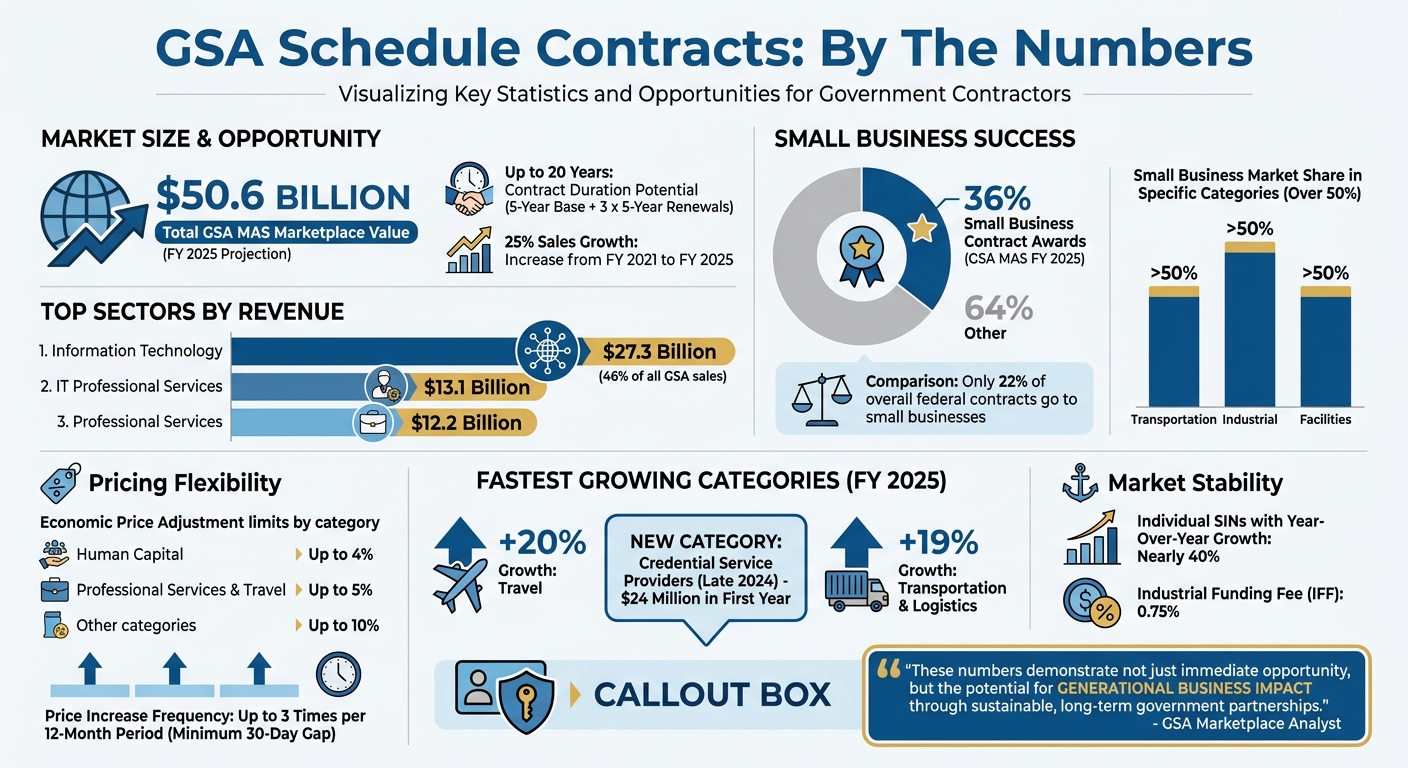
The federal market presents vast opportunities, and GSA Schedule Contracts play a pivotal role in helping businesses access them. For example, small businesses have seen significant success, capturing over 50% of sales in categories like Transportation, Industrial, and Facilities. Additionally, 36% of GSA MAS Contract awards went to small businesses in FY 2025, compared to just 22% of overall federal contracts – a clear indication of the program’s accessibility for smaller enterprises.
When it comes to specific sectors, Information Technology leads the pack, accounting for $27.3 billion (46% of all GSA sales). Professional Services followed closely at $12.2 billion, with IT Professional Services alone contributing $13.1 billion. The program saw notable growth in FY 2025, with Travel increasing by 20% and Transportation & Logistics growing by 19%. Even newer categories, like Credential Service Providers introduced in late 2024, made an impact, generating nearly $24 million in their first full year.
These numbers highlight the immense potential for businesses willing to navigate the federal marketplace with a GSA Schedule Contract in hand.
How 20-Year Contract Terms Create Consistent Revenue
GSA Schedule Contracts are built around a long-term design, offering businesses up to 20 years of access to the federal marketplace. This is achieved through an initial five-year base period, followed by three optional five-year renewals. Such an arrangement provides companies with the opportunity to plan for steady growth and establish predictable revenue streams.
Stable Income Through Multi-Year Contracts
Thanks to the extended structure of these contracts, businesses can rely on consistent income over time. By reducing the frequency of competitive bidding, contractors can focus on building strong, long-term relationships with federal agencies while delivering dependable solutions. As Exodie C. Roe III, Associate Administrator of OSDBU at GSA, shared:
"One small business was so successful that now, 30 years later, the owners’ children are involved in the business. It’s created a generational impact on a community".
Economic Price Adjustment (EPA) clauses ensure contractors can adapt to market conditions while maintaining profitability. These clauses allow for price adjustments within specific limits: up to 4% for Human Capital, 5% for Professional Services and Travel, and 10% for other categories. Contractors can request up to three price increases within a 12-month period, provided there is at least a 30-day gap between requests. This flexibility helps contractors sustain their margins throughout the contract’s duration.
Repeat Purchases from Government Agencies
Beyond price stability, repeat purchases from federal agencies further cement a dependable revenue stream. Agencies often rely on the GSA MAS to fulfill recurring needs using Blanket Purchase Agreements, which act like pre-approved accounts for ongoing services or supplies. These agreements, facilitated through platforms such as GSA Advantage!, prioritize vendors with proven track records, ensuring consistent business for contractors.
The numbers back up this reliability. GSA MAS sales have grown by about 25% since fiscal year 2021, projected to hit $50.6 billion by FY 2025. Even during periods of budget uncertainty, the GSA MAS remains a stable source of revenue, with nearly 40% of individual Special Item Numbers (SINs) reporting year-over-year sales growth. This combination of repeat business and market resilience reinforces the long-term revenue potential for contractors.
How to Increase Profitability with GSA Schedule Contracts
Maximizing the 20-year revenue potential of GSA Schedule contracts requires a strategic mix of buyer diversification, disciplined pricing, and unwavering compliance. By combining agency outreach with careful pricing strategies, businesses can position themselves for sustained revenue growth.
Working with Multiple Government Agencies
The GSA Multiple Award Schedule connects businesses with federal, state, and local agencies, offering a streamlined path to expand their buyer base. Focusing on agencies with recurring needs can provide a steady revenue stream. Tools such as GSA eLibrary, SAM.gov, and FedBiz365 are invaluable for identifying agencies that frequently purchase specific products or services. To build credibility, businesses might start with smaller contracts under the $250,000 simplified acquisition threshold before pursuing larger opportunities.
Profitability can also grow by combining the GSA Schedule with other contract vehicles. Agency-specific Indefinite Delivery, Indefinite Quantity (IDIQ) contracts and Blanket Purchase Agreements (BPAs) complement the GSA Schedule by establishing terms for future orders without fixed quantities. This approach can elevate a company from being a transactional vendor to a strategic partner. As the FEDCON Team highlights:
"When program and contracting officials see you only as ‘our GSA vendor,’ your role can become transactional and price-driven. When you show up on multiple vehicles… you become part of the agency’s long-term planning".
Small businesses have additional opportunities by targeting set-aside contracts for 8(a), HUBZone, or Service-Disabled Veteran-Owned Small Businesses (SDVOSBs), which often face reduced competition. However, consistent marketing to government buyers is critical to turning GSA Schedule access into meaningful sales. By combining diverse agency relationships with strict pricing oversight, businesses can protect and grow their profit margins.
Pricing and Compliance Requirements
Engaging with multiple agencies opens the door to more revenue, but pricing discipline and compliance are just as critical to maintaining profitability. Pre-negotiated pricing often results in tighter margins, but businesses can offset this through higher sales volumes and lower administrative costs thanks to streamlined procurement processes. Regular compliance checks, such as quarterly contract modifications and Economic Price Adjustment (EPA) reviews, help avoid forced price reductions of 12–15%. Verifying the Industrial Funding Fee (IFF) – currently 0.75% – annually ensures accurate reporting and avoids penalties.
To stay competitive, businesses should conduct biannual Price Realism Checks (PRC) to assess market pricing and validate their cost structures. Additionally, Cost Accounting Standards (CAS) recertification every three years ensures alignment with federal requirements. These practices not only safeguard profits but also help businesses remain compliant throughout the contract’s lifespan, providing a stable income foundation over the 20-year term.
How GSA Contracts Simplify Market Access
Selling to government agencies can be an uphill battle for small businesses due to the sheer volume of administrative hurdles. However, GSA Schedule contracts make this process much easier by standardizing procurement, allowing companies to shift their focus toward growth and building strong customer relationships instead of drowning in paperwork.
Simplified Procurement Process
One of the standout benefits of GSA contracts is pre-negotiated pricing. Once pricing is deemed "fair and reasonable" at the contract level, businesses no longer need to renegotiate for each individual order or task . Standardized terms also mean that companies can skip repeated legal reviews for every agency they work with. Additionally, the pre-vetting process ensures that eligibility, financial stability, and past performance are already verified, eliminating the need to repeat these steps for every new solicitation .
The Multiple Award Schedule (MAS) program further simplifies things by using streamlined procurement methods. Government buyers can order quickly through the GSA Advantage! platform with minimal documentation, giving businesses access to federal contracting opportunities worth over $39 billion annually. Long-term agreements – sometimes lasting up to 20 years – reduce the need for frequent recompetes, offering businesses a more stable and predictable procurement environment.
| Administrative Task | Traditional Procurement | GSA Schedule Procurement |
|---|---|---|
| Pricing | Negotiated for every contract/order | Pre-negotiated at the master contract level |
| Terms & Conditions | Reviewed/negotiated per agency | Standardized and pre-vetted |
| Vetting/Eligibility | Required for every solicitation | Completed once at the master contract level |
| Ordering Process | Complex, multi-step bidding | Streamlined, often via online systems |
This structure not only speeds up the procurement process but also reduces the administrative strain on businesses.
Reduced Administrative Work and Costs
Beyond simplifying the process, GSA Schedules cut down on the time and resources businesses spend on contract management. Once awarded a Schedule, companies can redirect their efforts toward marketing and building relationships with federal buyers.
The costs associated with maintaining a GSA Schedule are manageable, with contractors paying a 0.75% Industrial Funding Fee (IFF), which is often offset by the administrative savings. For newer businesses, the Startup Springboard program helps lower barriers to entry by waiving the two-year business history requirement for eligibility.
For companies overwhelmed by the initial application process, working with experts can make a big difference. Specialists like GSA Focus offer full-service support, handling everything from document preparation to compliance checks and negotiation assistance. This allows businesses to enjoy the benefits of streamlined procurement without pulling internal resources away from their primary goals.
Planning for Long-Term Success with GSA Contracts
Securing a GSA Schedule is a significant achievement, but it’s just the beginning. The real challenge – and opportunity – comes from actively managing and promoting your contract over its potential 20-year lifespan. Treating the Schedule as a passive credential leaves its revenue potential untapped. Consistent effort and strategic planning are essential to make the most of this opportunity.
Marketing Your GSA Schedule to Government Buyers
Simply having a GSA Schedule doesn’t guarantee sales. For federal buyers to engage with your offerings, you need to make them visible. Start by listing your products or services on GSA Advantage!, a platform that helps government buyers discover your offerings.
Beyond that, tap into tools like GSA eLibrary and SAM.gov to identify agencies that align with your products or services. Focus your outreach on agencies with purchasing patterns that match your offerings. Many contractors also collaborate with Procurement Technical Assistance Centers (PTAC). These centers help businesses navigate the complexities of federal marketing and connect with potential buyers.
Consistent marketing is key. Building recognition with government agencies lays the groundwork for repeat engagements. For new contractors, initiatives designed to help businesses break into the federal market can be a great way to gain traction.
Building Relationships with Federal Buyers
Visibility is important, but building and maintaining strong relationships with government buyers is what drives long-term success. A GSA contract’s true value lies in repeat business, which depends on trust and proven performance. To achieve this, you need to understand and work closely with two key roles in federal procurement:
- Contracting Officer (CO): The individual responsible for modifying contracts and ensuring compliance.
- Contracting Officer’s Representative (COR): The person who oversees delivery and quality standards.
Professional communication with both roles is essential for maintaining a positive working relationship. By consistently delivering on your promises – on time and to the required standards – you can build a reputation for reliability. This trust often leads to repeat orders and even recommendations within the federal procurement network.
Reliability matters. Agencies prefer vendors who meet deadlines, maintain quality, and handle administrative tasks efficiently. For businesses that find compliance requirements – like Transactional Data Reporting (TDR), SAM.gov registration, or Trade Agreements Act (TAA) adherence – overwhelming, working with a partner like GSA Focus can simplify the process. They manage compliance so your team can stay focused on core business operations.
Conclusion
GSA Schedule Contracts provide small businesses with a reliable way to access federal revenue streams over a potential 20-year period. These contracts simplify connections with government buyers, minimize administrative hurdles, and open doors for repeat business with agencies that prioritize dependable vendors. However, simply securing a GSA Schedule isn’t enough – success hinges on proactive marketing, strict adherence to compliance rules, and cultivating strong relationships with government agencies.
The potential for consistent revenue is clear, but it requires sustained effort. For instance, in 2016, 32% of GSA contract holders reported zero sales, highlighting the importance of active participation. Businesses that thrive treat their GSA Schedule as a long-term commitment, leveraging tools like GSA Advantage! to promote their offerings, ensuring compliance through platforms like the SSQ+ Dashboard, and building trust with Contracting Officers.
To qualify, small businesses must demonstrate financial stability, a solid history of past performance, and a willingness to meet compliance obligations, which include paying the standard 0.75% IFF. The application process, which typically takes three to six months, demands thorough documentation, transparent pricing, and attention to detail. Once awarded, contract holders must manage ongoing requirements, such as annual price adjustments, which are generally capped at 10% per item.
For businesses without prior federal contracting experience, navigating the complexities of securing and maintaining a GSA Schedule can be daunting. The administrative workload – managing documentation, compliance reporting, and more – can quickly become overwhelming. That’s where professional support can make a difference. GSA Focus offers a comprehensive service that handles everything from document preparation to compliance management and negotiation support. By outsourcing these challenges, businesses can concentrate on their strengths while seizing opportunities in the federal marketplace.
FAQs
How do I pick the right GSA SINs for my business?
To select the right GSA SINs (Special Item Numbers), start by identifying categories that match your business’s core strengths and align with market needs. Areas like IT modernization, cybersecurity, and professional services are currently in high demand and could be worth your attention.
Dig into SINs that align with your expertise – evaluate their market demand, competition levels, and how they fit into your long-term business strategy. Taking the time to thoroughly research and vet these SINs not only ensures compliance but also boosts your chances of winning contracts.
What does it take to get sales after award on a GSA Schedule?
After earning a GSA Schedule award, turning it into sales requires active effort and a strategic approach. Start by ensuring your SAM registration is always up to date – this is crucial for staying visible to federal buyers. Take advantage of platforms like GSA Advantage and eBuy to showcase your products or services effectively.
Don’t stop there. Build strong relationships with federal buyers by demonstrating your reliability and expertise. Highlight the benefits of your pre-negotiated pricing to make purchasing decisions easier for them. Finally, stay on top of your obligations, like submitting quarterly sales reports, to maintain compliance and credibility. With consistent effort, you can turn your GSA award into a steady stream of sales.
What ongoing compliance tasks should I plan for each year?
Each year, take time to review key elements of your GSA contract, including pricing, reporting, and certifications. Make sure to renew your SAM.gov registration annually to avoid interruptions. Stay on top of compliance by monitoring sales thresholds, fulfilling reporting obligations, and keeping all necessary documents up to date. These regular check-ins will help ensure your GSA contract remains active and in good standing.
Related Blog Posts
- How to Promote GSA Contracts to Agencies
- Ultimate Guide To GSA Contracting Results
- GSA Schedule: What Happens After Approval
- How GSA Contracts Deliver Long-Term Revenue