
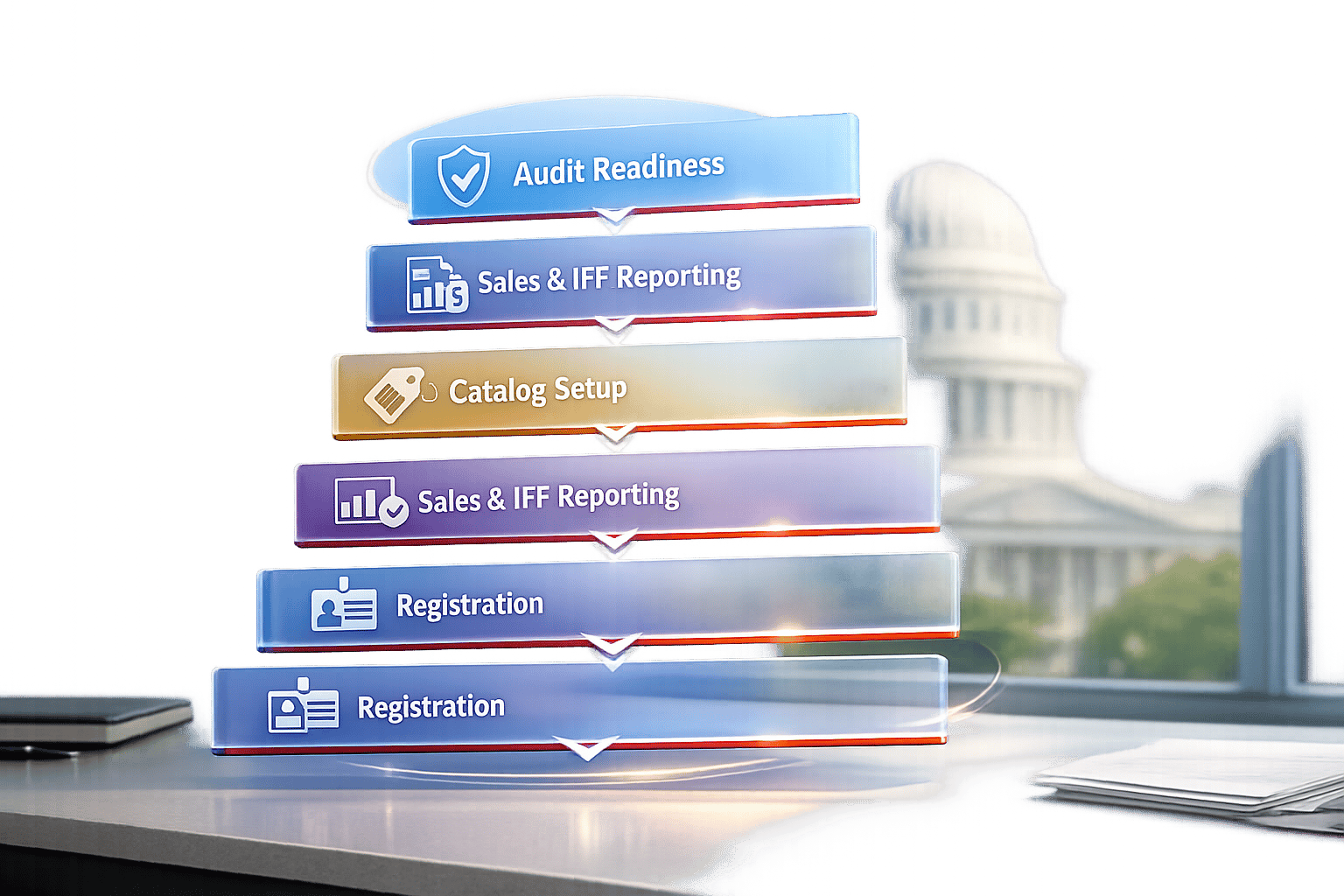
Staying compliant with your GSA Schedule contract is essential for maintaining eligibility, avoiding penalties, and continuing to receive government orders. This guide breaks down everything you need to know, from registration to ongoing requirements and audits. Here’s a quick overview:
- Registration: Start with SAM.gov, secure your Unique Entity ID (UEI) and CAGE Code, and ensure your business details match IRS and USPS records.
- Key Contract Clauses: Understand obligations like the Price Reductions Clause, Trade Agreements Act (TAA), and reporting sales with the 0.75% Industrial Funding Fee (IFF).
- Pricing and Catalog Setup: Use the FAS Catalog Platform (FCP) to upload accurate product and service details for GSA Advantage.
- Reporting Deadlines: Submit sales and IFF reports quarterly or monthly (if under TDR) and meet annual certifications like VETS-4212 by September 30.
- Audit Preparation: Keep records of invoices, IFF payments, and compliance documentation to avoid issues during reviews.
Whether managing compliance in-house or seeking external support, staying organized and proactive ensures your GSA contract remains active and profitable.
Advanced Compliance Issues and Changes in the GSA Multiple Award Schedule Program
GSA Compliance Checklist
Establishing compliance with your GSA Schedule starts with registration, documentation, and understanding the key contract clauses that govern your obligations. A solid foundation is essential before tackling ongoing requirements. This checklist highlights the critical steps every vendor needs to follow.
Registration and Required Documents
The first step is registering on SAM.gov, the central hub for federal contracting. As of February 2026, SAM.gov consolidates several legacy systems, making an active profile essential for managing contracts. During registration, you’ll receive a Unique Entity ID (UEI) – a 12-character alphanumeric code for identifying your entity. U.S.-based vendors also get a CAGE Code, automatically assigned and validated by the Defense Logistics Agency.
Accuracy is key. Your legal business name and address must match IRS and USPS records exactly, including designations like “LLC” or “Inc.” If you’ve recently moved, update your address with the IRS first to ensure alignment across databases.
Prepare these essential documents:
- IRS EIN assignment letter (Form CP 575) or your latest federal tax return
- Articles of Incorporation with proof of State of Incorporation
- Electronic Funds Transfer (EFT) details (e.g., routing and account numbers from a voided check or bank statement)
You’ll also need operational data, such as average annual receipts over the last three years, your 12-month average employee count, and your primary NAICS code. If the automated system encounters issues, submit clear PDF scans of state-stamped incorporation documents and address proofs.
To avoid disruptions, start your SAM.gov renewal 60 to 90 days before the annual expiration date. This process isn’t one-and-done – it requires yearly renewal to maintain an active contract.
Once registration is complete, the next step is understanding the contract clauses that define your responsibilities.
GSA Schedule Contract Clauses
Your contract clauses are the framework for maintaining compliance. Here are the key ones to know:
- Price Reductions Clause (552.238-81): Report any price reductions to your contracting officer within 15 days of the effective date.
- Trade Agreements Act (TAA): Products sold through your GSA Schedule must be manufactured or “substantially transformed” in the U.S. or a TAA-approved country. This applies to every item in your catalog.
- Clause 552.238-80: Track sales by Special Item Number (SIN) and remit the 0.75% Industrial Funding Fee (IFF) within 30 days after the end of each reporting period.
- Scope of Contract (552.238-113): Accept all orders from executive branch agencies within your contract’s minimum and maximum order limits – partial acceptance isn’t an option.
Other clauses include:
- Clause 552.238-82: Requires formal modification requests for any contract changes, with catalog updates on GSA Advantage completed within 30 days.
- Cancellation Clause (552.238-79): Sets minimum sales thresholds – $100,000 in the first five years and $125,000 every five years thereafter. Falling short may result in contract cancellation.
- Employment Eligibility Verification (52.222-54): Requires E-Verify enrollment.
- Service Contract Reporting (52.204-15): Mandates annual reporting by October 31.
Some vendors may also operate under Transactional Data Reporting (TDR) via Clause 552.238-80 Alternate I, which requires detailed line-item data instead of traditional Commercial Sales Practices reporting.
With these clauses in mind, the next step is setting up your pricing and catalog.
Pricing and Catalog Setup
Properly setting up your pricing and catalog is non-negotiable under GSAR clause 552.238-88. Begin by registering with the GSA Vendor Support Center (VSC) and submitting electronic catalog files via the FCP within 30 days of contract award, modification, or option exercise. If notified of FCP eligibility, transition from SIP or EDI systems immediately, as FCP is now the preferred standard.
Key steps include:
- Ensure all Authorized Negotiators have a FAS ID to manage the FCP catalog.
- Submit a Seller Profile in FCP to establish contractor details, such as minimum order requirements and points of contact.
- Use the “Baseline” action in FCP to create your authoritative catalog and price list, initiated in eMod as a “Catalog Baseline Mod.”
GSA identifies products using your contract number, manufacturer part number, and manufacturer name. Separate submissions into:
- Product Files for items available for direct purchase on GSA Advantage
- Services Plus Files for items not available for direct purchase
Upload product details and images per GSA guidelines to ensure accuracy on GSA Advantage. After each upload, verify that products and services display correctly. If errors occur, initiate a modification or FCP action immediately. Additionally, upload a Terms & Conditions (T&C) file to eLibrary and GSA Advantage, excluding pricing if it’s already included in your Product or Services Plus files.
Finally, provide order status updates for GSA Advantage orders via the Purchase Order (PO) Portal, EDI, or cXML. Accurate product representation not only ensures compliance but also keeps your contract active.
Compliance Requirements and Reporting
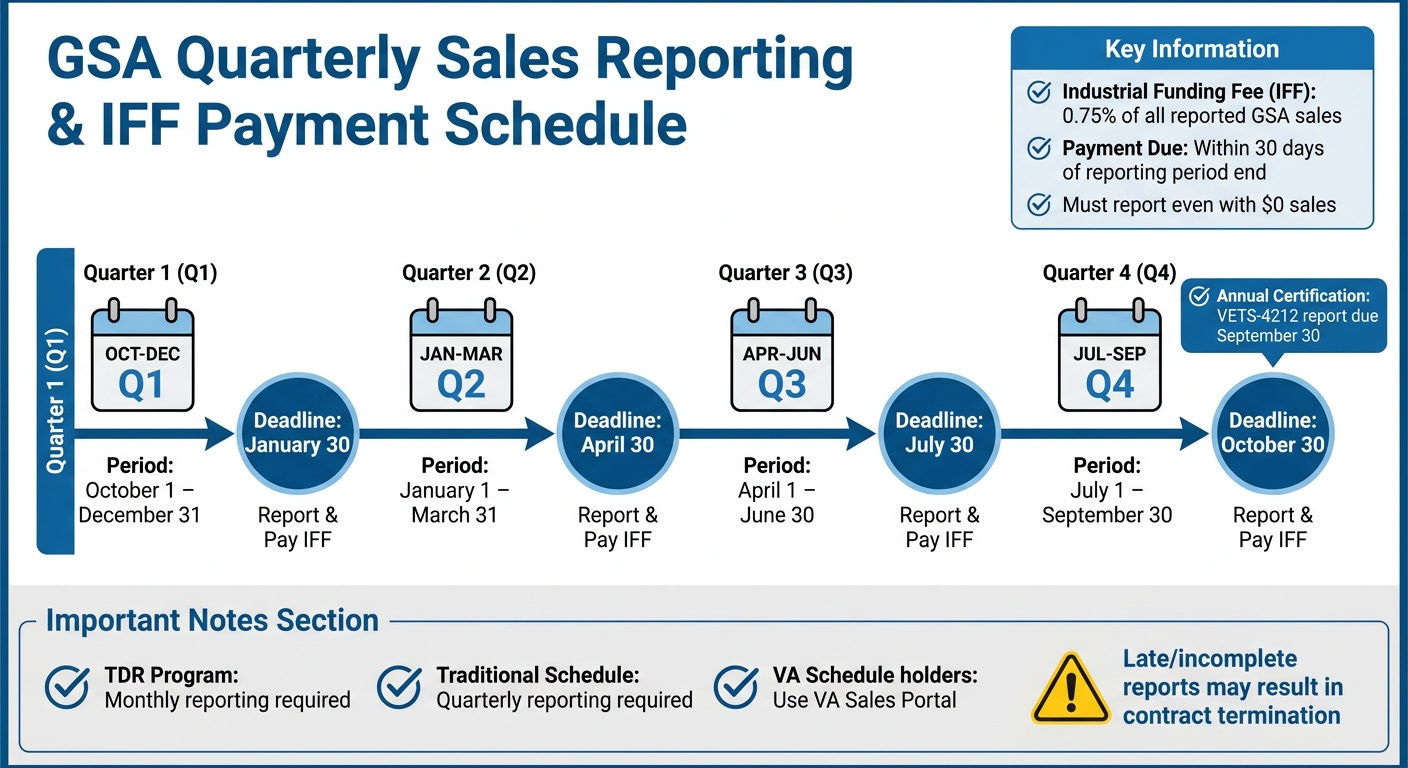
GSA Vendor Compliance Quarterly Reporting Deadlines and Requirements
Once your GSA Schedule is active, staying compliant involves keeping a close eye on sales, meeting reporting deadlines, and paying required fees. Missing these obligations can lead to contract cancellations or audits. Understanding what needs to be reported – and when – can help you maintain your contract without issues.
Sales Reporting and Industrial Funding Fee (IFF)
All GSA sales must be reported through the Federal Acquisition Service (FAS) Sales Reporting Portal (SRP). Reporting frequency depends on your program: contractors in the Transactional Data Reporting (TDR) program report monthly, while those in the traditional Schedule program report quarterly. If you’re a VA Schedule holder, you’ll use the VA Sales Portal instead.
A sale qualifies as reportable if:
- The product or service is listed on your GSA contract.
- Your GSA contract number appears on the purchase order.
- The customer used GSA Advantage or eBuy.
- The price is at or below your MAS price.
If you’re unsure whether an order qualifies as a MAS sale, confirm with the ordering agency.
Some items, like open market products (non-contract items), travel, or other direct costs, are not reportable. These must be clearly labeled as “open market”, following FAR 8.402(f) procedures. Subcontractor work is also generally excluded, except for rare cases under FAR 51.1.
The Industrial Funding Fee (IFF) – 0.75% of all reported GSA sales – must be paid within 30 days of the reporting period’s end. Even if you have no sales for the quarter, you’re still required to submit a report showing $0 to stay compliant. To simplify this process, tag your GSA sales in your accounting system.
| Quarter | Period Covered | Reporting & IFF Deadline |
|---|---|---|
| Q1 | October 1 – December 31 | January 30 |
| Q2 | January 1 – March 31 | April 30 |
| Q3 | April 1 – June 30 | July 30 |
| Q4 | July 1 – September 30 | October 30 |
Submitting late or incomplete reports can have serious consequences, such as contract termination, poor contractor assessment ratings, or even triggering a formal audit. To avoid these risks, submit your reports early to account for potential technical issues.
Annual Reporting and Certification Deadlines
In addition to quarterly sales reporting, GSA vendors must meet annual certification requirements. For example, the VETS-4212 report, which tracks veteran employment data, is due every year on September 30.
If you work with authorized dealers, ensure your tracking system can accurately report sales for all participating dealers. Before setting up these relationships, coordinate with your Procurement Contracting Officer (PCO). It’s also critical to keep contract sales distinct from non-contract sales (both government and non-government) to ensure accurate reporting.
Audit Preparation
GSA audits are a part of maintaining compliance. These audits check your adherence to pricing rules, sales reporting, and contract terms. To prepare, keep detailed records, including:
- Sales invoices and purchase orders.
- Proof of IFF payments.
- Documentation of discount calculations.
- Evidence of Trade Agreements Act (TAA) compliance for each product.
Organized records can make audits more manageable and demonstrate your commitment to compliance.
Post-Award Compliance and Contract Maintenance
Once you secure a GSA Schedule, keeping everything up to date is just as important as winning the award. Staying compliant means handling administrative updates and syncing your information across systems promptly. The go-to platform for federal registration details is SAM.gov. Any changes – whether it’s your company name, ownership structure, contact details, or banking information – must be updated here first. Just keep in mind that updates on SAM.gov take about 24 hours to process. This delay is crucial because you’ll need to confirm those changes before moving forward with other updates.
Contract Modifications
When it’s time to make changes to your contract – like adding or removing products, tweaking service details, or adjusting prices – you’ll need to submit formal modifications through eOffer/eMod. To do this, you must have a digital certificate and be listed as an Authorized Negotiator. Only individuals with this status can submit these requests, so double-check the list of negotiators on file.
For price increases, make sure they align with your contract’s EPA clause, such as 216-70 or I-FSS-969, which are tied to market indicators. If you’re reducing prices or introducing new discounts, you’re required to notify your GSA Contracting Officer at least 15 calendar days before making the change, as per the Price Reduction Clause (FAR 552.238-81).
Additionally, GSA periodically issues mass modifications to update solicitation clauses. You must sign these updates within 90 days of receipt to stay compliant with current terms and conditions. Keep an eye on the Mass Modification System so you don’t miss any important updates. After any modification, ensure all relevant federal systems reflect the changes.
Annual Updates to SAM.gov and GSA Advantage
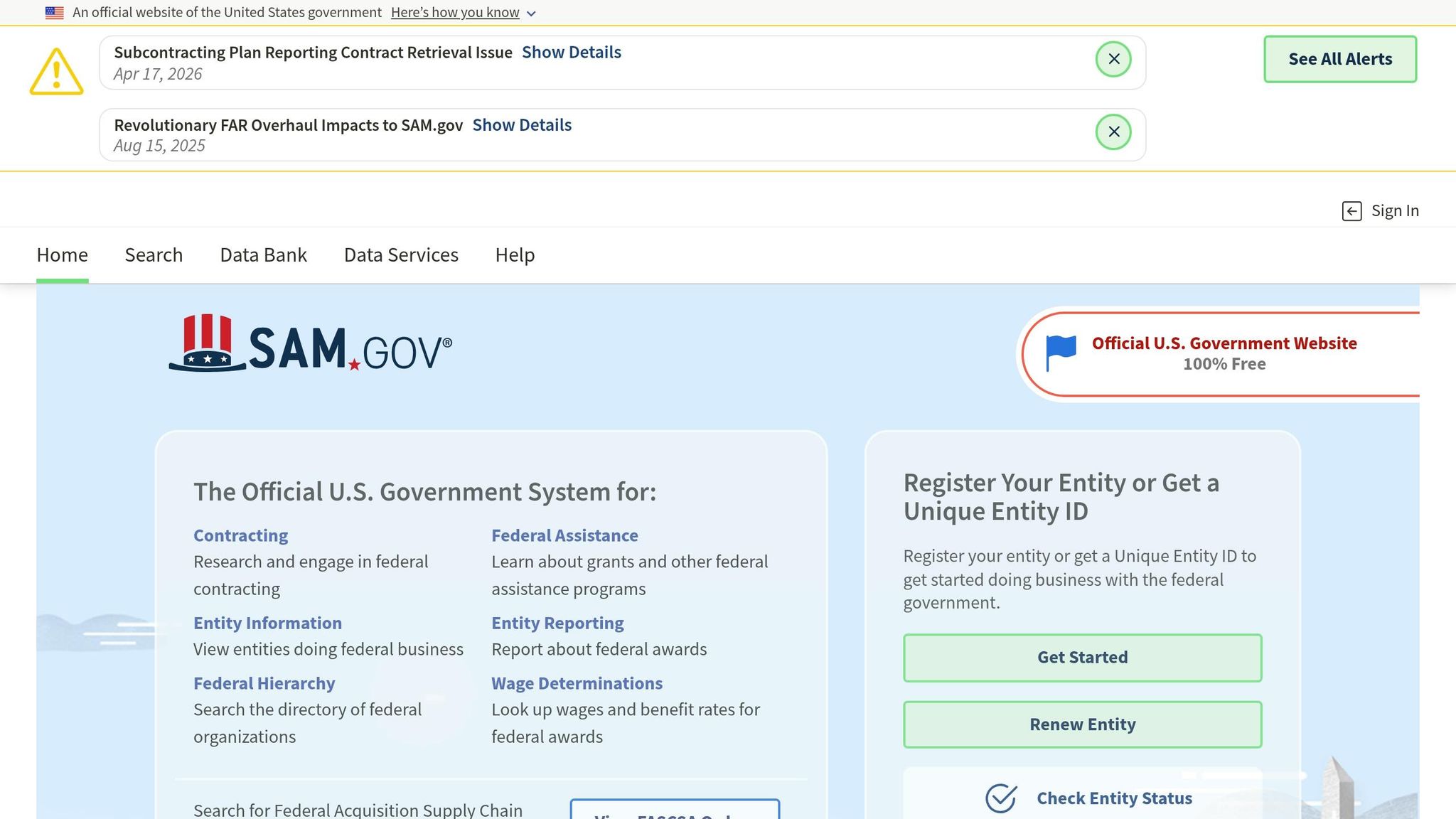
Your SAM.gov registration needs to be renewed annually, but don’t wait for the renewal date if your business details change in the meantime. For example, if you update banking information, the system will trigger an eMod request, which must be verified by an authorized negotiator. Notify federal buyers immediately about any routing changes to avoid disruptions in payments.
For your GSA Advantage! catalog, updates are required at least once every 2 years, but it’s best to refresh it whenever you change products or prices. This ensures federal buyers always see the most accurate information. Make sure these updates are also reflected on GSA eLibrary, GSA eBuy, and the GSA PO Portal. If you’re selling commercial-off-the-shelf (COTS) products, you’re likely using the FAS Catalog Platform (FCP), which is also transitioning to include service catalogs.
Accurate and updated records across these platforms help maintain compliance and build trust with federal buyers.
Internal Compliance Monitoring
Beyond system updates, internal monitoring is your safety net for staying on track. Set up processes to track all contract obligations and recurring deadlines. For example, categorize your GSA sales within your accounting system to simplify quarterly reporting and Industrial Funding Fee (IFF) calculations. Keep detailed records of invoices, purchase orders, IFF payments, and Trade Agreements Act (TAA) documentation to prepare for audits and assessments.
Take a close look at your “report cards” from past GSA Audits or Contractor Assistance Visits. These evaluations often highlight recurring issues you can address before your next contract renewal. If your company has an individual subcontracting plan, don’t forget to submit Individual Subcontracting Reports (ISR) by April 30 and October 30 each year.
To keep everything running smoothly, create a compliance checklist that includes all these tasks. Staying organized can prevent contract cancellations and ensure your operations continue without hiccups.
Working with GSA Focus for Compliance Support
Tackling GSA compliance on your own can feel like a monumental task – just the initial setup can demand over 100 hours of work. For small businesses, this administrative burden can quickly become unmanageable. That’s where GSA Focus steps in. They offer a full-service, done-for-you solution that takes the stress out of compliance, handling everything from document preparation to ongoing monitoring.
How GSA Focus Simplifies Compliance
GSA Focus takes care of 95% of the paperwork required for GSA contracts, leaving you with just 3 to 4 hours of effort to gather 12 key documents. Their GSA Onboard service provides a secure portal that serves as a checklist for uploading required files. From there, they prepare and submit your GSA Offer and handle any clarifications during the review process. With 17+ years of experience and over 550 GSA contract awards under their belt, GSA Focus has refined the process to be five times faster than doing it solo.
Once your contract is approved, their GSA Maintenance on Autopilot service keeps you compliant. They manage critical tasks like tracking sales reporting deadlines, submitting the Industrial Funding Fee (IFF), completing annual certifications, and handling contract modifications through eOffer/eMod. They also oversee SAM.gov renewals and GSA Advantage catalog updates, ensuring you stay on track and avoid penalties. This efficient system not only saves time but also reduces costs. As John Wayne II from GrowMyBusinessQuick.com put it, “Without GSA Focus, we couldn’t have navigated the complex process to secure GSA Contract Awards for several of our clients.”
Why Choose GSA Focus?
The benefits of working with GSA Focus are clear. Their thorough pre-submission reviews and audit-tested templates help clients cut revisions by up to 90% compared to managing the process alone. With a 98% success rate, the likelihood of rejection or delays due to incomplete documentation is significantly reduced. Clients also see a meaningful financial impact, with an average of $927,000 added to their bottom line and total federal sales exceeding $500 million.
Mike Jackson, Founder of MacGyver Solutions, Inc., shared: “MacGyver Solutions is one of GSA Focus’ success stories – having them do the heavy lifting on the initial contract was a huge help.”
To further ease concerns, GSA Focus offers a refund guarantee if your GSA Award isn’t secured (based on pre-agreed goals). Ready to streamline your compliance journey? Start with a free consultation at gsascheduleservices.com, where you’ll receive a tailored compliance plan and a fixed-fee proposal.
Conclusion
Staying compliant isn’t a one-and-done task – it’s an ongoing responsibility that demands consistent attention and careful monitoring. Missing deadlines or incurring penalties can put your compliance status – and future opportunities – at risk.
This guide has walked you through the critical steps, from preparing documents to ensuring you’re audit-ready. Each part of the process plays a role in maintaining your GSA Schedule. Keeping detailed records and conducting regular internal pre-audits are some of the most effective ways to avoid compliance issues.
Now, it’s time to decide how you’ll approach compliance. If you have the internal bandwidth, you can use the checklists and timelines provided in this guide to manage the process yourself. Stay on top of deadlines, keep your records organized, and stay informed about updates to the Federal Acquisition Regulation (FAR). If that feels like too much to handle, consider turning to GSA Focus. Their compliance solutions simplify the process and take much of the administrative workload off your plate.
Whether you choose to handle compliance internally or rely on GSA Focus’s expertise, the key is to act now. Only vendors who maintain compliance can tap into the billions of dollars in federal spending available each year. Ready to take the next step? Visit gsascheduleservices.com to schedule a free consultation and get a compliance plan tailored to your business.
FAQs
How do I know if an order counts as a GSA sale?
When a purchase involves products or services listed under your GSA Schedule contract, it qualifies as a GSA sale. These transactions need to be reported separately from non-GSA sales. Typically, this reporting happens quarterly through the FAS Sales Reporting Portal. Accurate and timely reporting is critical to staying compliant and keeping your GSA contract in good standing.
What records should I keep to be audit-ready?
To maintain audit readiness as a GSA contractor, it’s crucial to keep your records in order. This includes contracts, invoices, delivery documents, certifications, sales reports, and correspondence. Generally, most records need to be kept for at least three years after the final payment. However, some exceptions exist – like GSA SmartPay records, which must be retained for six years.
Make sure your sales reports, contract modifications, and pricing documentation are accurate and up to date. Store all records securely and create backups to ensure they’re easily accessible when an audit comes around. Staying organized now can save you a lot of stress later.
When do I need to submit a contract modification?
When changes affect your GSA Schedule contract – whether it’s pricing, scope, terms, or administrative details – you’ll need to submit a contract modification. This covers updates like new products or services, price adjustments, revised terms or conditions, changes to contact details, or updates to key personnel.
It’s also important to note that Mass Modifications issued by GSA are mandatory. These must be accepted within 90 days to stay compliant and prevent any interruptions to your contract.
Related Blog Posts
- How to Track GSA Contract Compliance
- Ultimate Guide to GSA Compliance Standards
- Common GSA Compliance Mistakes And Fixes
- Ultimate Guide To GSA Contracting Results