

GSA marketing and traditional marketing serve different purposes and operate in vastly different environments. While traditional marketing focuses on creativity, emotional engagement, and broad consumer outreach, GSA marketing is all about compliance, precision, and navigating federal procurement systems. Here’s a quick breakdown of the key differences:
- Audience Focus: GSA marketing targets federal procurement officers who prioritize compliance, past performance, and problem-solving. Traditional marketing appeals to general consumers and focuses on creating demand.
- Platforms: GSA marketing relies on tools like GSA eLibrary, GSA Advantage!, and eBuy. Traditional marketing uses social media, search engines, and TV ads.
- Flexibility: GSA marketing operates under strict pricing and reporting rules, while traditional marketing allows for more dynamic pricing and creative campaigns.
- Compliance Requirements: GSA contractors must meet sales thresholds, follow specific reporting rules, and maintain regulatory compliance. These constraints don’t apply to traditional marketing.
Quick Comparison
| Criteria | GSA Marketing | Traditional Marketing |
|---|---|---|
| Target Audience | Federal procurement officers | General consumers |
| Platforms Used | GSA eLibrary, GSA Advantage!, eBuy | Social media, TV, search engines |
| Pricing | Fixed, pre-approved pricing | Flexible, negotiable |
| Compliance | Strict federal regulations and reporting rules | Minimal compliance requirements |
| Goal | Meet federal needs and maintain contract status | Create demand and drive consumer purchases |
Takeaway: GSA marketing is a specialized approach requiring compliance expertise and precision, while traditional marketing thrives on creativity and flexibility. Success in GSA marketing depends on understanding federal requirements, building visibility in procurement systems, and maintaining strict adherence to reporting and performance standards.
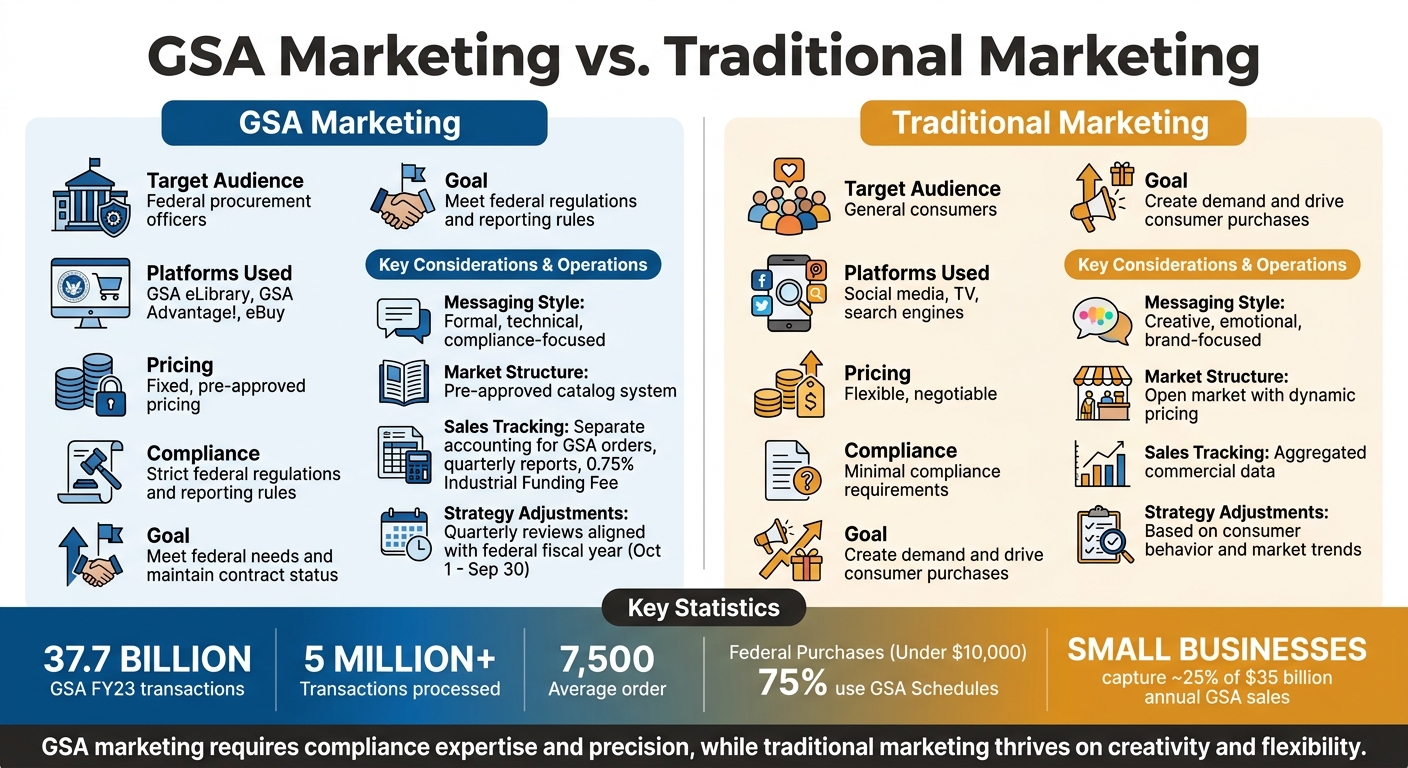
GSA Marketing vs Traditional Marketing: Key Differences Comparison
Multiple Award Schedule (MAS) Contract Marketing and Finding Opportunities
Target Audience and Messaging Differences
Marketing to federal buyers is a whole different ballgame compared to selling in commercial markets. Federal procurement officers are laser-focused on solving specific challenges while working within strict budgets and regulatory frameworks. As Kyle Hayes from US Federal Contractor Registration points out:
"In commercial markets, marketing is designed to help create interest. In federal contracting, the need usually exists before a vendor enters the picture".
This distinction changes everything about how you approach communication. Your messaging in the federal space has to align with these unique dynamics.
What Federal Procurement Officers Prioritize
Federal buyers care about one thing above all: whether your solution fits their needs and complies with their requirements. Unlike commercial buyers who might be drawn to a sleek brand or emotional appeal, federal officers are all about practicality. They evaluate vendors based on how well they meet agency-specific demands and their track record of delivering results. Past performance is a critical factor – it’s how they gauge your ability to deliver without creating risks. As Hayes explains:
"What gets attention isn’t just a strong message. It’s a business that looks like a clear fit for the work".
Timing is another key difference. Federal buyers often start researching potential vendors long before an official solicitation is released. They rely on tools like Small Business Search (SBS) and forecast databases to identify contractors early. So, if you’re waiting for an RFP to make yourself visible, you’re already late. Your visibility and credibility need to be established well in advance, with a focus on showing clear, compliant performance.
How to Message Federal Buyers
To connect with federal buyers, your messaging has to shift gears – this isn’t about persuasive storytelling; it’s about proving your capabilities. Federal communications need to be formal, technical, and packed with specifics. For instance, instead of making a broad claim like "Our software saves you time", you should highlight how your solution meets stringent security and regulatory standards.
Educational content is your ally here. Think technical guides, compliance updates, and white papers – these tools build trust far more effectively than flashy promotions. Federal buyers value substance over style.
The format of your materials is just as important as the message itself. Federal buyers expect detailed contract references, up-to-date compliance documentation, and adherence to federal guidelines like GPO Style. Your capability statements, GSA price lists, and RFQ responses need to be laser-focused on solving specific agency problems. Forget about the creative, visually driven presentations that work in the commercial world – they simply don’t resonate here. Instead, focus on clear implementation plans and technical demonstrations that show you’re ready to deliver.
Compliance and Performance Requirements
Marketing under a GSA Schedule comes with a unique set of rules and expectations. Unlike traditional marketing, where messaging and sales tracking can be more flexible, GSA marketing operates within strict federal guidelines. These rules shape how products are promoted, how sales are tracked, and how performance is measured.
Required GSA Sales Thresholds
Simply holding a GSA Schedule doesn’t guarantee sales success. As GSA.gov puts it:
"Becoming a GSA contract holder does not guarantee you’ll get any business. You still need to compete against other businesses for contracts or orders".
To meet the required sales thresholds, contractors must adopt active and competitive strategies, especially as the fiscal year-end approaches (October 1 through September 30). Unlike commercial products that may linger on the market with little activity, GSA-listed products require consistent marketing efforts. Additionally, contractors must ensure that all sales are meticulously tracked and reported, aligning with federal standards.
Documentation and Reporting Rules
GSA contracts bring a heightened level of accountability when it comes to documentation. While traditional sales data might be aggregated, GSA orders require separate accounting. GSA.gov highlights this need:
"Your accounting department may need to set up a tracking system to separate our orders from all other orders. They’ll need to know about the reporting requirements and prompt payment discounts".
Contractors must adhere to several reporting requirements, including:
- Maintaining separate accounting systems for GSA orders.
- Submitting quarterly sales reports and paying a 0.75% Industrial Funding Fee.
- Providing monthly line-item Transactional Data Reporting (TDR) for certain contracts.
Additionally, under GSAR 552.203-71, advertisements cannot suggest government endorsement, and all products must comply with the Trade Agreements Act (TAA), which requires manufacturing or substantial transformation in the U.S. or a designated country.
To avoid compliance missteps, it’s essential for sales, marketing, and accounting teams to receive thorough training on these requirements. Mismanagement or unintentional violations could put the entire contract at risk.
Market Dynamics and Strategy Differences
In the world of GSA marketing, compliance and reporting requirements set the stage, but the real distinction lies in how the market operates. The strategies that work for GSA marketing are a world apart from traditional marketing approaches. It’s not just about what you sell – it’s about how you sell it.
Pre-Approved Catalog vs. Open Market
GSA contractors rely on a pre-approved catalog system, specifically the GSA eLibrary (GSAeB). Here, every product or service is listed with fixed pricing, detailed descriptions, and compliance certifications, all established during the contract approval process. This system simplifies procurement for federal buyers, offering a searchable database that eliminates the need for lengthy negotiations. In FY23 alone, this system processed over 5 million transactions, totaling $37.7 billion, with the average order clocking in at about $7,500.
On the other hand, traditional marketing thrives on flexibility. Prices can be adjusted, proposals customized, and every deal negotiated individually. While this approach allows businesses to secure higher margins on some transactions, it also demands significantly more effort per sale. Notably, about 75% of federal purchases under $10,000 are made through GSA Schedules, precisely because they bypass the delays of traditional open-market sales that require extensive RFP processes.
For GSA contractors, the catalog structure shifts the focus toward maximizing visibility within the eLibrary search system and maintaining consistent sales volume. Imagine an IT hardware company listing a laptop in the GSA catalog. The listing would include a specific SIN (Special Item Number), detailed technical specs as required by FAR 52.212-3, and a fixed unit price – say, $1,200 per laptop. Compare that to the company’s commercial website, where they could offer promotional deals like “Buy 10, get 20% off.” That kind of pricing flexibility is off the table in GSA marketing.
But the differences don’t stop at catalog structure. Timing and strategy adjustments are another major factor that sets GSA marketing apart.
Regular Strategy Adjustments in GSA Marketing
The federal budget cycle significantly impacts GSA marketing strategies. The government’s fiscal year runs from October 1 through September 30, and procurement priorities shift with new appropriations, omnibus bills, and policy changes. For example, a small IT firm increased its GSA sales by 35% in FY23 by pivoting its catalog to focus on cloud services. This move came after the FY22 Infrastructure Bill boosted federal IT budgets from $10 billion to $12 billion. By updating their SINs and pricing quarterly, they stayed ahead of the curve.
To succeed in this environment, GSA marketers need to adjust their strategies regularly. Quarterly reviews are essential to align with federal fiscal quarters, while major updates should coincide with the new budget cycle each October. Monthly optimizations of GSA eLibrary listings can also help capture emerging demand. For instance, after Executive Order 14028 on cybersecurity, adding terms like "cybersecure" to product descriptions became a smart move.
This level of precision contrasts sharply with traditional marketing, where adjustments are more often tied to consumer behavior than government spending cycles. To stay competitive, GSA contractors should keep an eye on federal budgets through GAO reports, analyze their GSA Schedule sales data monthly to identify underperforming products, and monitor USAspending.gov for procurement forecasts that reveal where agencies are directing their funds.
Team Coordination for GSA Marketing
When it comes to GSA marketing, internal team coordination isn’t just helpful – it’s essential. Unlike traditional marketing efforts, GSA marketing requires every department to work in sync. A single error in messaging, pricing, or reporting could jeopardize your entire contract.
Cross-Department Alignment
The GSA.gov website emphasizes the importance of collaboration:
"Educate your sales, marketing, and accounting departments. They need to know everything about the contract, including who can order from it, pricing details, and ordering terms and conditions."
This isn’t just a suggestion – it’s a necessity. Without this level of understanding, your team risks violating contractual requirements.
Every department has a role to play. For instance, your marketing team must create content that complies with GSAR 552.203-71, which prohibits implying government endorsement of products. Meanwhile, the sales team needs to monitor GSA eBuy daily for RFQs and understand the nuances of agency-specific ordering processes. On the financial side, the accounting department must manage separate systems for GSA orders, calculate the 0.75% Industrial Funding Fee, and handle prompt payment discounts.
The compliance and contract management team ensures your business stays in good standing by managing SAM.gov registrations, signing mass modifications within 90 days, and verifying Trade Agreements Act (TAA) compliance. Your technical/product teams handle detailed specifications for catalog listings and proposals, while customer support provides agency-specific ordering guides and monitors delivery performance.
Here’s a breakdown of how each team contributes:
| Internal Team | Function | Key Responsibilities |
|---|---|---|
| Marketing | Content & Visibility | Catalog optimization, capability statements, SEO for GSA Advantage! |
| Sales/BD | Relationship & Lead Gen | eBuy monitoring, agency outreach, responding to RFIs/RFQs |
| Compliance | Regulatory Oversight | SAM.gov updates, mass modifications, TAA compliance, sales reporting (72A) |
| Support | Retention | Federal account handling, ordering guides, performance tracking |
| Technical | Validation | Providing specs for listings, technical input for proposals, case study data |
When these teams work together seamlessly, they create a solid foundation for meeting GSA requirements and achieving long-term success.
Efficient Internal Workflows
To meet GSA’s rigorous compliance and performance standards, your internal workflows need to be as efficient as possible. Start by assigning a dedicated point of contact to monitor GSA eBuy opportunities daily. Missing an RFQ deadline means missing out on potential revenue. Schedule regular cross-departmental reviews of RFPs to ensure that specifications, pricing, and compliance align perfectly.
Monthly pricing reviews are another must. These sessions allow your team to analyze competitor rates and make adjustments via eMod to stay competitive. Additionally, align your marketing and sales outreach efforts with the federal fiscal year (October 1 through September 30). Ramp up activity in Q3 and Q4 to take advantage of year-end spending surges.
A centralized digital resource library can also make a big difference. By housing agency-specific ordering guides and compliance documentation in one place, you ensure that all team members have quick access to critical information, minimizing delays.
Poorly managed workflows can hinder your GSA Schedule performance. Success often comes down to how well your teams communicate and coordinate – a smooth operation keeps your business compliant and competitive.
Conclusion
GSA marketing isn’t just another form of advertising – it’s a highly specialized field. Federal procurement officers care less about flashy branding and more about compliance and delivering value. To succeed, businesses must meet strict requirements, like achieving at least $2,500 in sales within the first 120 days after being awarded a GSA Schedule contract. With over $35 billion in annual sales flowing through GSA contracts – and small businesses capturing roughly 25% of that – there’s clear potential for those who approach it strategically.
Success in this space hinges on a few critical factors: optimizing your catalog to align with federal fiscal cycles, ensuring smooth workflows across departments to meet GSA standards, and maintaining consistent performance reporting to stay compliant.
For small businesses, trying to navigate these complexities without expert help can be overwhelming. That’s where services like GSA Focus come in. By handling the bulk of administrative tasks – like document preparation, compliance checks, and negotiations – they free you up to concentrate on running your business. This kind of partnership can significantly reduce your time-to-market, cutting the typical 18-month timeline for federal sales down to just 6 months.
If you’re ready to tap into federal opportunities, start by assessing how well your marketing aligns with GSA requirements. Build strong team coordination, refine your processes, and don’t hesitate to bring in specialists who know the ropes. The federal marketplace rewards those who understand its rules and are prepared to deliver.
FAQs
How do I market a GSA Schedule without breaking compliance rules?
Marketing a GSA Schedule while staying within federal guidelines requires a strategic yet compliant approach. Start by leveraging GSA platforms like GSA Advantage and eBuy to showcase your offerings. These tools are specifically designed to connect vendors with government buyers, making them essential for visibility.
Additionally, ensure that all marketing materials align with federal standards. This means avoiding exaggerated claims and adhering to the specific guidelines set for government communications. Participating in industry events and trade shows can also be a great way to connect with agency representatives and showcase your solutions directly to potential buyers.
To maintain relevance and compliance, regularly update your GSA listings with accurate product descriptions, pricing, and terms. Staying informed about the latest compliance rules is equally important, as regulations can change over time.
By combining these tactics, you can effectively promote your GSA Schedule while respecting federal requirements.
What should I optimize in GSA eLibrary and GSA Advantage! to get found?
To stand out on GSA eLibrary and GSA Advantage!, focus on optimizing your product listings. Start with clear, keyword-rich titles that are easy to understand and relevant to what buyers are searching for. Pair these with concise descriptions that emphasize key benefits, compliance details, and any standout features. Don’t forget to include detailed technical specifications to address buyers’ needs thoroughly.
Visuals matter too – use high-quality images that showcase your products effectively. Keep your pricing accurate and competitive, and regularly review performance metrics to identify areas for improvement. Lastly, actively manage customer reviews and ensure all product information is current and search-friendly. These steps can help you attract more attention from federal buyers.
What internal systems do I need to track GSA sales and reporting?
To keep tabs on GSA sales and meet reporting requirements, you’ll need the FAS Sales Reporting Portal (SRP). This platform is where you submit your sales data to stay compliant. For a deeper dive into federal sales trends and performance, the Schedule Sales Query (SSQ) system is your go-to resource. Together, these tools make managing GSA sales much more streamlined.
Related Blog Posts
- How GSA Contracts Impact Federal Construction Compliance
- 5 GSA Marketing Mistakes to Avoid
- How GSA Advantage Simplifies Federal Buying
- 3 Marketing Tactics for GSA Partnerships