
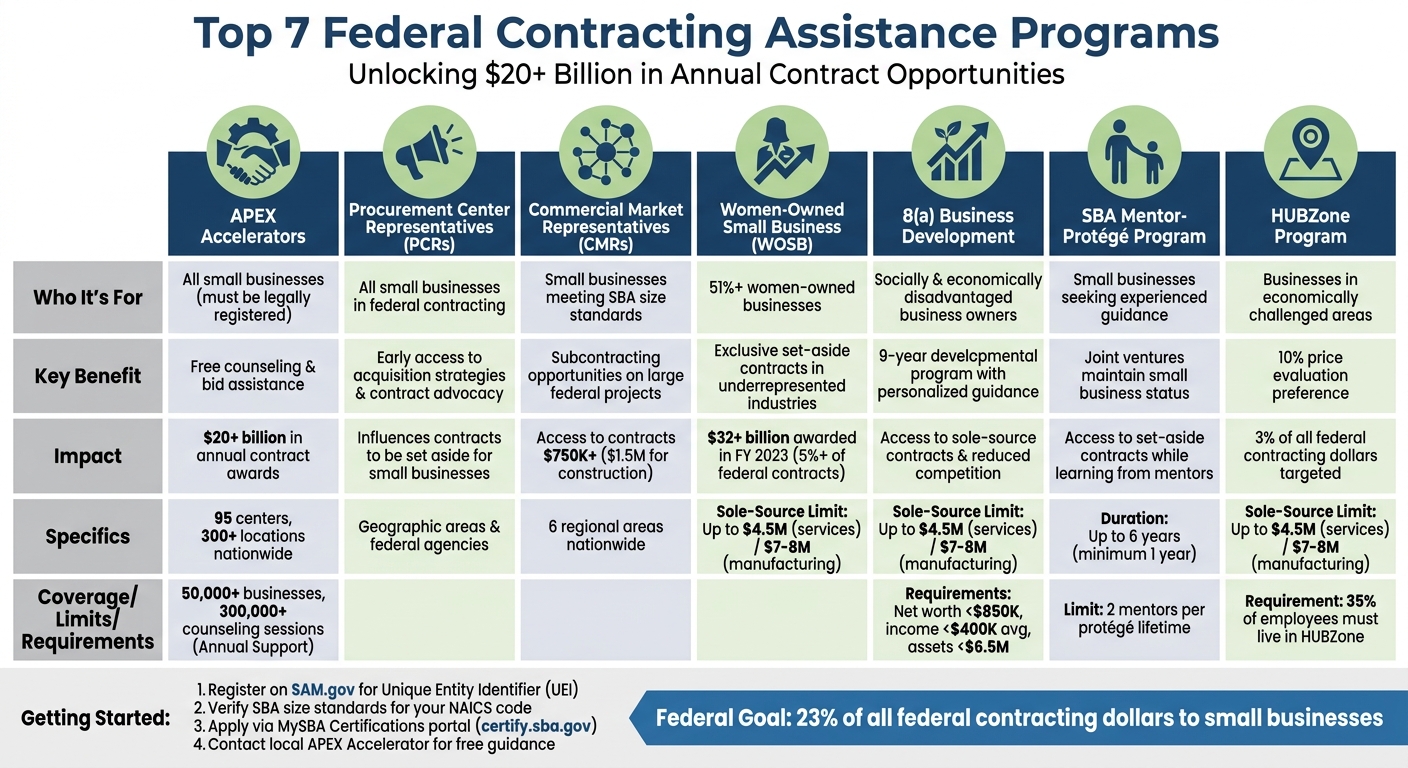
The federal government sets aside billions in contracts annually for small businesses, aiming for at least 23% of all federal contracting dollars to go to them. To help small businesses navigate this vast opportunity, seven key programs provide specialized support, certifications, and guidance. These include:
- APEX Accelerators: Free resources to help businesses register, bid, and secure contracts.
- Procurement Center Representatives (PCRs): Advocates ensuring contracts are reserved for small businesses.
- Commercial Market Representatives (CMRs): Focus on subcontracting opportunities for small businesses.
- Women-Owned Small Business (WOSB) Program: Exclusive contracts for women entrepreneurs.
- 8(a) Business Development Program: Support for socially and economically disadvantaged businesses.
- SBA Mentor-Protégé Program: Partnerships with experienced businesses to grow and compete.
- HUBZone Program: Contracts for businesses in economically challenged areas.
Each program has unique benefits, eligibility criteria, and application processes, offering small businesses a structured path to federal contracting success. Start by registering on SAM.gov and exploring certifications to unlock opportunities.
7 Federal Contracting Assistance Programs for Small Businesses Comparison
How To Use SAM.Gov to Win Contracts as Small Business Government Contractor
1. APEX Accelerators (formerly Procurement Technical Assistance Centers)
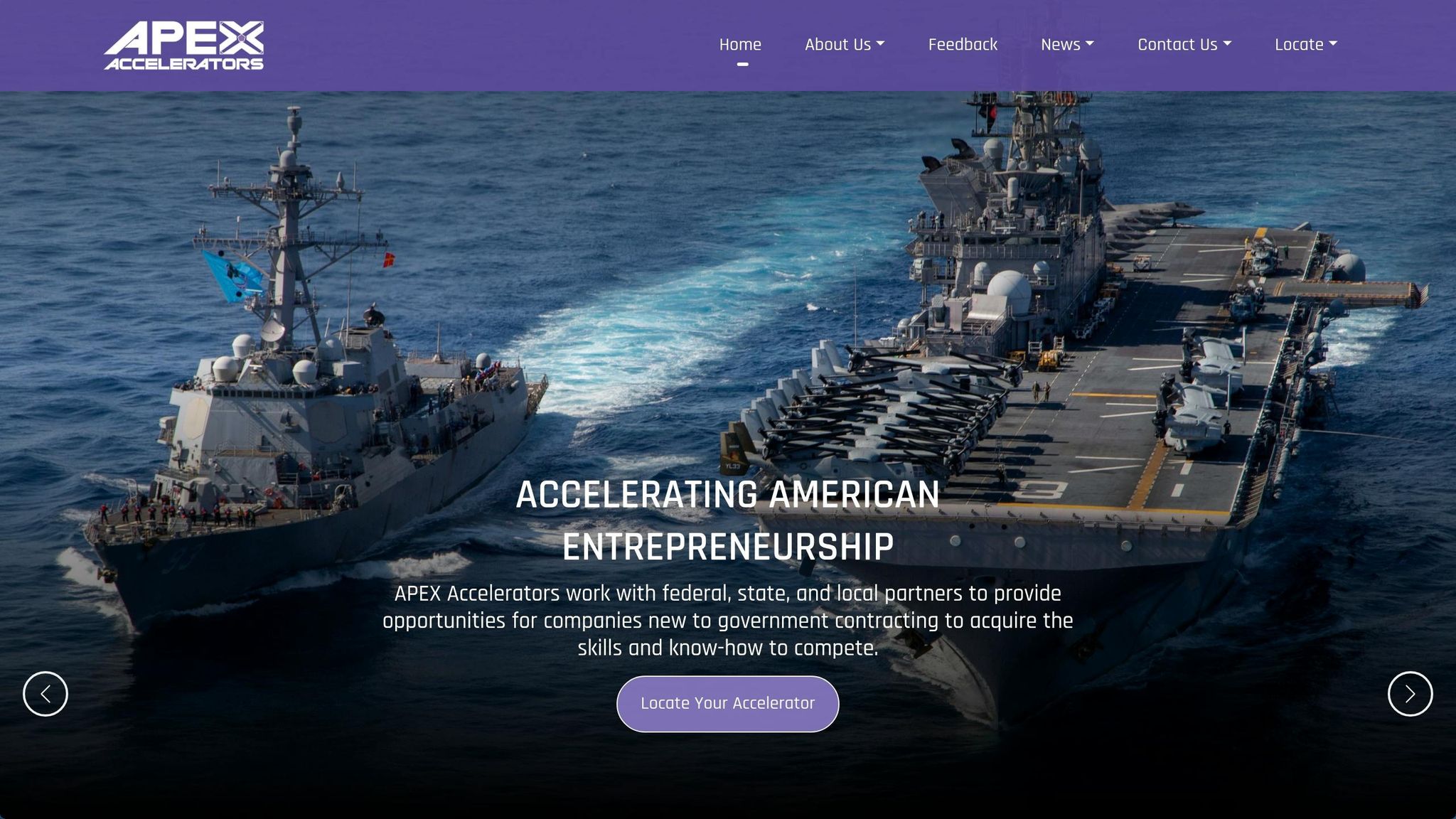
APEX Accelerators operate across 95 centers and over 300 locations nationwide, supporting more than 50,000 businesses annually with over 300,000 counseling sessions each year. Backed by the Department of Defense, these centers were rebranded from Procurement Technical Assistance Centers (PTACs) to APEX Accelerators in 2023. Despite the new name, their mission remains the same: helping small businesses compete for government contracts at the federal, state, and local levels. Let’s break down who qualifies for these services and how they can benefit your business.
Eligibility Requirements
Good news – APEX services are available to all small businesses, regardless of revenue, past contract experience, or certifications. The only requirement is that your business must be legally registered. For LLCs and S-Corps, this means registration with the Secretary of State, while sole proprietors need to register with their city or county. Even if your business is less than a year old, you can still access assistance. However, newer businesses might be referred to partners like SCORE for help with foundational tasks such as creating business plans or setting up accounting systems.
Key Benefits for Small Businesses
APEX Accelerators offer a wealth of free support to small businesses, including:
- SAM.gov registration: Guidance through the registration process.
- Certifications: Help identifying programs like 8(a) or Women-Owned Small Business (WOSB).
- Bid compliance reviews: Assistance in ensuring your bids meet all requirements.
- Capability statements: Support in crafting professional capability statements.
- Contract opportunities: Matching your business with relevant opportunities.
- Training: Workshops on reading solicitations and understanding contract types.
These services make a real impact, contributing to over $20 billion in contract awards each year. To put this into perspective, private consultants typically charge between $2,000 and $5,000 for similar bid-review services – APEX provides this at no cost.
How to Access or Apply for the Program
Getting started with APEX is straightforward. Head to apexaccelerators.us and enter your ZIP code to locate the nearest center. Once you’ve found one, reach out to schedule an intake session. These sessions, lasting 30–60 minutes, allow counselors to understand your business goals and develop a tailored plan. Be sure to bring the following:
- Your EIN (Employer Identification Number)
- Your UEI (Unique Entity Identifier), if you have one
- A list of your products or services
- Any current certifications
It’s important to note that while APEX counselors act as expert guides, they won’t write proposals for you – they focus on equipping you with the tools and knowledge to succeed.
2. Procurement Center Representatives (PCRs)
Procurement Center Representatives (PCRs) are representatives from the Small Business Administration (SBA) who work with federal agencies and military sites to advocate for small businesses. Their main role is to encourage these agencies to reserve certain contracts exclusively for small businesses. By reviewing acquisition strategies during the planning stages, PCRs can influence decisions to create more opportunities for small businesses.
Eligibility Requirements
The services offered by PCRs are open to all small businesses interested in federal contracting. Whether you’re just starting out or already have experience, you can access their guidance and support. This inclusivity ensures that even newcomers can benefit from expert advice on navigating the federal procurement process.
Key Benefits for Small Businesses
One of the standout advantages of PCRs is their early access to federal acquisition strategies. This allows them to advocate effectively for contracts to be set aside for small businesses. As the SBA explains:
"PCRs view many federal acquisition and procurement strategies before they’re announced, which enables them to influence opportunities that should be set aside for small businesses".
Beyond their advocacy role, PCRs offer direct support to small businesses by helping them navigate the complexities of federal contracting. They match small business capabilities with agency needs, provide advice during the pre-solicitation phase, and assist in resolving payment disputes when agencies delay or withhold payments.
How to Access or Apply for the Program
Connecting with your designated PCR early in the procurement process can make a big difference. PCRs are assigned based on geographic areas and specific federal agencies or military sites. For example, Area 1 covers the Northeast and Puerto Rico, while Area 2 focuses on the Mid-Atlantic region.
To find your PCR, you can consult the SBA PCR directory, which includes contact details such as names, phone numbers, and email addresses. Reaching out during the pre-solicitation phase is particularly helpful if you believe your business can meet an agency’s needs. Alternatively, you can contact your local SBA District Office for assistance in identifying the right PCR for your business.
3. Commercial Market Representatives (CMRs)
Commercial Market Representatives (CMRs) play a crucial role in opening doors for small businesses through subcontracting opportunities on large federal projects. Unlike focusing on prime contracts, CMRs zero in on helping small businesses secure subcontractor roles. This is especially important for contracts that are too large for small businesses to handle alone. By focusing on this niche, CMRs ensure that small businesses get tailored support and access to opportunities that align with their capacity and qualifications.
Eligibility Requirements
To benefit from CMR assistance, your business must meet the SBA’s small business size standards. Additionally, many subcontracting opportunities are geared toward specific groups, such as Women-Owned Small Businesses (WOSB), Small Disadvantaged Businesses (8(a)), and HUBZone-certified firms. Federal law mandates that prime contractors with contracts exceeding $750,000 – or $1.5 million for construction – develop and maintain a small business subcontracting plan.
Key Benefits for Small Businesses
CMRs not only monitor large federal contractors to ensure they meet their subcontracting commitments but also provide valuable resources to small businesses. Through the Subcontracting Program Assistance (SPA), they help small businesses market their services to prime contractors and identify suitable opportunities. CMRs also offer direct counseling and training tailored to subcontracting, making it easier for small businesses to navigate the process and succeed in their roles.
How to Access or Apply for the Program
There’s no formal application process to work with a CMR. Instead, you can directly contact the CMR assigned to your region. The SBA divides the country into six areas, each with specific contacts. For instance, if you’re in the Northeast or Mid-Atlantic regions, you can reach out to Mr. Christopher Sao at 617-565-5570 or via email at christopher.sao@sba.gov. For businesses in the South, Ms. Arnette Mayhew is the point of contact at 404-331-0266 or arnette.mayhew@sba.gov. Before reaching out, ensure your business is properly registered and identify the prime contractors you aim to work with.
4. Women-Owned Small Business (WOSB) Federal Contract Program
The Women-Owned Small Business (WOSB) Federal Contract Program is designed to open doors for women entrepreneurs in industries where they’ve historically been underrepresented. Each year, the federal government aims to allocate at least 5% of its contracting dollars to women-owned small businesses. In fiscal year 2023, this commitment translated into over $32 billion awarded to WOSBs, surpassing the 5% target for the fourth year in a row.
Eligibility Requirements
To qualify for the WOSB program, your business must meet the following criteria:
- Ownership and Control: At least 51% of the business must be owned and controlled by women who are U.S. citizens. Women must oversee daily operations and make long-term decisions.
- Small Business Standards: Your business must align with SBA’s small business size standards.
- EDWOSB Requirements: For the Economically Disadvantaged Women-Owned Small Business (EDWOSB) category, additional financial limits apply:
- Personal net worth below $850,000
- Three-year average adjusted gross income of $400,000 or less
- Total assets not exceeding $6.5 million
Additionally, WOSB and EDWOSB set-asides are limited to specific NAICS codes where women are underrepresented. Since 2020, businesses must be certified through the SBA or an approved third-party certifier, as self-certification no longer qualifies for federal set-asides.
Key Benefits for Small Businesses
Participating in the WOSB program provides access to set-aside contracts, which restrict competition exclusively to certified WOSB or EDWOSB businesses in eligible industries. Moreover, contracting officers can issue sole-source contracts directly to certified firms without requiring competitive bids. These sole-source thresholds are capped at $4.5 million for services and between $7 million and $8 million for manufacturing contracts.
For businesses that meet the economic disadvantage criteria, EDWOSB certification offers even broader industry opportunities compared to standard WOSB certification. This program also integrates well with other federal initiatives designed to simplify the contracting process for small businesses.
How to Access or Apply for the Program
To get started, follow these steps:
- Register on SAM.gov: Create an account and obtain a Unique Entity Identifier (UEI).
- Submit Your Application: Use the MySBA Certifications portal at certify.sba.gov to apply.
- Provide Documentation: Upload essential documents, including proof of U.S. citizenship (passport or birth certificate), business formation documents, and three years of tax returns.
The SBA offers direct certification at no cost, while third-party certifiers typically charge between $1,000 and $3,000. Once your application is complete, the SBA generally processes it within 90 calendar days.
This streamlined process ensures that women entrepreneurs can access federal contracting opportunities more efficiently.
5. 8(a) Business Development Program
The 8(a) Business Development Program is a nine-year initiative designed to support small businesses owned by socially and economically disadvantaged individuals. It provides four years of developmental assistance followed by five years of transitional support, helping businesses establish themselves and compete effectively even after leaving the program.
Eligibility Requirements
To qualify for the program, at least 51% of the business must be owned and controlled by U.S. citizens who are considered socially and economically disadvantaged. The SBA automatically presumes social disadvantage for groups such as Black Americans, Hispanic Americans, Native Americans, Asian Pacific Americans, and Subcontinent Asian Americans. Applicants from other backgrounds can still qualify by submitting a detailed narrative and evidence of specific incidents of bias.
Economic disadvantage criteria include:
- A personal net worth under $850,000 (excluding the value of the business and primary residence)
- A three-year average adjusted gross income of $400,000 or less
- Total assets not exceeding $6.5 million
Additionally, the business must meet the SBA’s size standards for its primary NAICS code and generally have at least two years of operational history. Owners must also demonstrate good character and note that participation in the program is a one-time opportunity.
Key Benefits for Small Businesses
The 8(a) program offers access to sole-source federal contracts, with limits of up to $4.5 million for services and between $7 million and $8 million for manufacturing contracts. Federal agencies can also set aside competitive contracts exclusively for 8(a) certified businesses, reducing competition.
Participants benefit from personalized guidance provided by SBA Business Opportunity Specialists throughout the nine years. Additionally, they gain access to free training through the SBA’s Empower to Grow program, equipping them with the tools they need to succeed in federal contracting.
How to Access or Apply for the Program
To start, register on SAM.gov to obtain a Unique Entity Identifier (UEI) and complete the preliminary eligibility questionnaire at certify.sba.gov. Applications are submitted electronically through the MySBA Certifications portal, and there is no application fee.
You’ll need to provide:
- Three years of personal and business tax returns
- Personal financial statements using SBA Form 413
- Business formation documents
- A social disadvantage narrative (if applicable)
Once your application is complete, the SBA typically provides a decision within 90 days. For assistance, you can turn to local SBA District Offices or APEX Accelerators, which offer free guidance on eligibility and application preparation. This additional support ensures small businesses can navigate the federal contracting landscape more effectively.
6. SBA Mentor-Protégé Program
The SBA Mentor-Protégé Program is designed to connect small businesses with experienced mentors to help them grow and compete more effectively for federal contracts. Since its launch in 2020, following a merger of previous programs, this initiative has allowed mentor-protégé joint ventures to bid on government contracts while maintaining the protégé’s small business status.
Eligibility Requirements
To participate, protégés must be for-profit small businesses or agricultural cooperatives with relevant industry experience. A protégé must secure a mentor before applying and cannot have any affiliation with the proposed mentor at the time of application.
Mentors, which can be businesses of any size, must also meet specific criteria. They need to be organized for profit or as an agricultural cooperative, demonstrate good character, and not be debarred or suspended from federal contracting. Additionally, they must show the capability to provide meaningful guidance and share their expertise to support the protégé’s growth.
Each protégé is limited to two mentors over its lifetime, and if engaging two simultaneously, their roles must not overlap. The Mentor-Protégé Agreement (MPA) can last up to six years, but the relationship must continue for at least one year after approval.
Key Benefits for Small Businesses
One major advantage of this program is that it allows mentors and protégés to form joint ventures, which can bid on small business set-aside contracts. These contracts include opportunities for 8(a), HUBZone, Women-Owned Small Businesses (WOSB), and Service-Disabled Veteran-Owned Small Businesses (SDVOSB), as long as the protégé meets the small business requirements.
Beyond contracting opportunities, mentors offer critical business development support. This can include help with internal management systems like accounting, marketing, and strategic planning. Mentors may also provide financial support, such as equity investments or loans, and assist with navigating the complexities of federal procurement.
How to Access or Apply for the Program
If you’re ready to take advantage of the program, here’s how to get started:
- Register both your business and your mentor’s business on SAM.gov to obtain a Unique Entity Identifier (UEI).
- Complete the SBA’s mandatory online tutorial and save the certificates for your application.
Next, collaborate with your mentor to draft a formal Mentor-Protégé Agreement (MPA) using the SBA’s template. The agreement should clearly outline the type of business development assistance the mentor will provide. Submit your application through the SBA Certify website (certify.sba.gov) using your protégé’s UEI.
The review process typically takes about 105 days, including a 15-day initial screening and a 90-day detailed review. Once approved, you’ll need to submit annual evaluations to the SBA to demonstrate the progress and effectiveness of the relationship.
For personalized help with finding a mentor or preparing your application, reach out to your local SBA office or APEX Accelerators, both of which offer free guidance.
7. HUBZone Program
The HUBZone Program – short for Historically Underutilized Business Zones – focuses on helping small businesses in economically challenged areas win federal contracts. Unlike programs designed around ownership characteristics, this one is all about geography. If your business is located in a HUBZone and employs residents from these areas, you could qualify for federal contracting perks.
Eligibility Requirements
To get HUBZone-certified, your business needs to meet a few key criteria:
- Be SBA-certified as a small business.
- Be at least 51% owned and controlled by U.S. citizens, Community Development Corporations, agricultural cooperatives, Alaska Native Corporations, Native Hawaiian Organizations, or Indian tribes.
- Have a principal office located in a designated HUBZone (no P.O. boxes or registered agent addresses allowed).
- Ensure that at least 35% of your employees live in a HUBZone.
Meeting and maintaining these requirements is essential to retain your certification.
Key Benefits for Small Businesses
HUBZone certification comes with some major perks. For starters, certified businesses get a 10% price evaluation preference, meaning your bid can be up to 10% higher than competitors and still be considered competitive. Federal agencies can also directly award sole-source contracts to HUBZone-certified firms – up to $4.5 million for services and between $7 million and $8 million for manufacturing contracts.
Additionally, there’s a federal goal to allocate at least 3% of all contracting dollars to HUBZone-certified companies. If you combine HUBZone certification with others like 8(a), WOSB, or SDVOSB, your eligibility and opportunities multiply. Prime contractors often look for HUBZone-certified businesses to meet their subcontracting goals, giving you even more chances to secure work.
How to Access or Apply for the Program
Getting started with the HUBZone Program requires a few steps:
- Use the SBA HUBZone Map at maps.certify.sba.gov to confirm your principal office location and verify that 35% of your employees live in a HUBZone.
- Register your business on SAM.gov to get a Unique Entity Identifier (UEI).
- Create an account on the MySBA Certifications portal at certify.sba.gov.
When applying, you’ll need to upload documents like your office lease or deed, payroll records, and proof of employee residency. The SBA usually reviews applications within 60 to 90 days. Once certified, you’ll need to recertify annually and undergo a full review every three years.
It’s crucial to keep your records up to date. If fewer than 35% of your employees live in a HUBZone, you risk losing your certification. And if your area loses its HUBZone designation, you’ll generally have a three-year "Redesignated Area" grace period to make adjustments.
HUBZone certification can be a game-changer for businesses in underserved areas. Next, we’ll explore how to make the most of these programs to grow your federal contracting opportunities.
How to Use These Programs Effectively
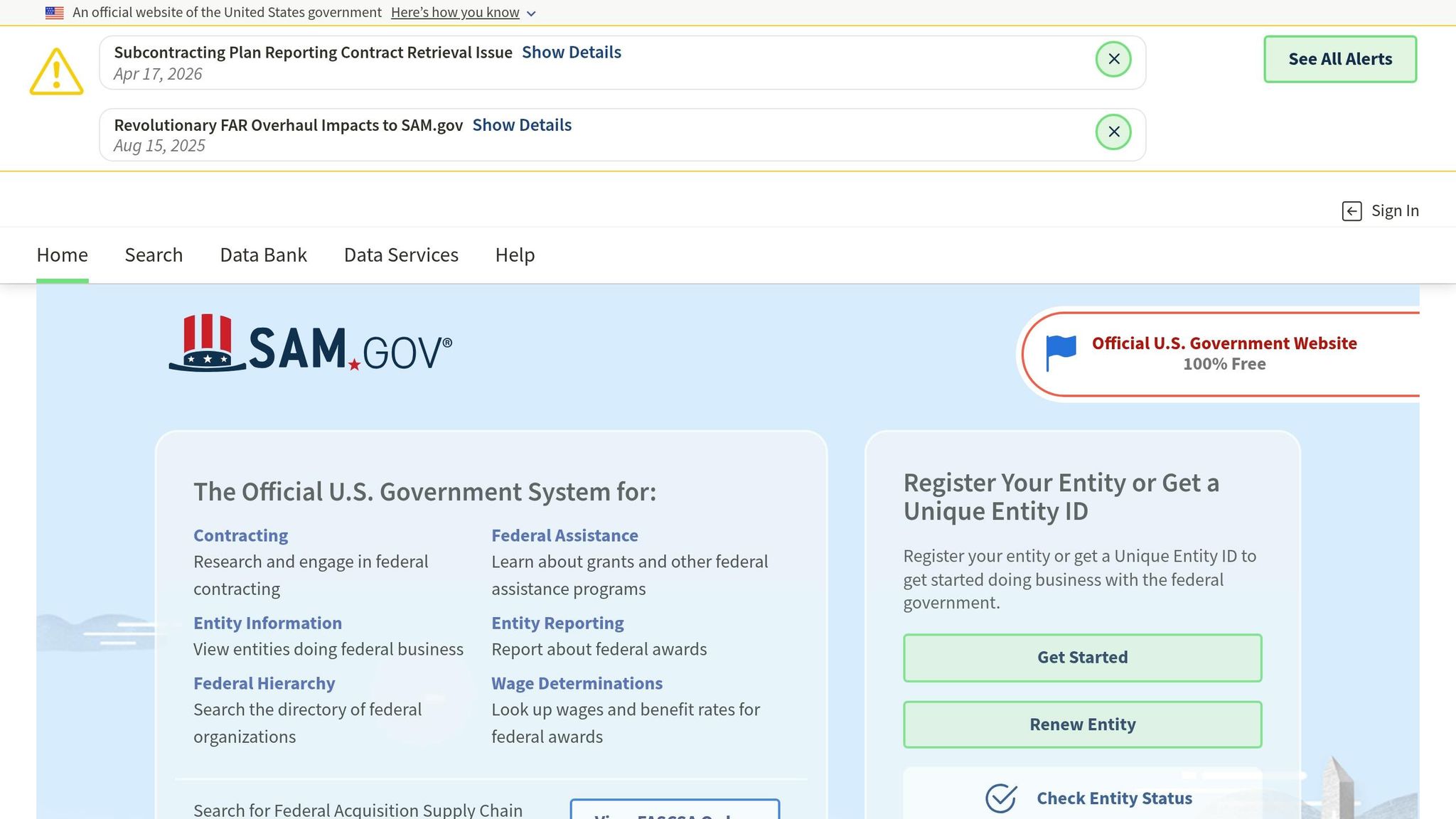
To get the most out of contracting assistance programs, start by registering on SAM.gov. This step confirms your small business status and provides you with a Unique Entity Identifier (UEI) – a critical piece for moving forward.
Once you have your UEI, check that your business meets the required size standards. This involves verifying your eligibility under the SBA size standards tied to your North American Industry Classification System (NAICS) code. Eligibility depends on either your five-year average revenue or your 24-month average employee count. Keep in mind that if your business has affiliates with shared ownership or management, their revenues and employee numbers may be combined with yours under affiliation rules.
Timing is key – apply as early as possible since SBA processing can take weeks or even months. For programs like 8(a), HUBZone, and WOSB, use the MySBA Certifications portal at certify.sba.gov. For SDVOSB applications, head to the Veteran Small Business Certification portal. Make sure to have all your documentation ready ahead of time. For example, GSA Schedules often require two years in business and two years of financial statements, though newer businesses may qualify under the Startup Springboard program, which waives some of these requirements. Proper preparation can make the entire process much smoother.
Take advantage of local APEX Accelerators for expert advice and market research. These centers provide one-on-one counseling, which can save you time and reduce stress. After registering on SAM.gov, set up saved searches and email alerts using your NAICS codes and set-aside filters. This will ensure you’re automatically notified about opportunities that match your business. If you’re not ready to pursue prime contracts due to a lack of past performance, consider subcontracting with large prime contractors. These contractors are required to have small business subcontracting plans for contracts over $900,000 (or $2 million for construction).
Conclusion
The seven contracting assistance programs discussed earlier offer small businesses a structured way to secure federal contracts. Programs like APEX Accelerators provide personalized guidance, while Procurement Center Representatives and Commercial Market Representatives advocate for small businesses within federal agencies. Certification programs such as WOSB, 8(a), HUBZone, and the SBA Mentor-Protégé Program open doors to exclusive set-aside contracts. As the U.S. Small Business Administration explains, "The U.S. government is the largest customer in the world. It buys all types of products and services – in both large and small quantities – and it’s required by law to consider buying from small businesses".
To begin, confirm your eligibility using SBA size standards and register on SAM.gov to obtain your Unique Entity Identifier (UEI). Reach out to your local APEX Accelerator for free assistance with certifications and market research. If you’re not ready for prime contracts, consider subcontracting opportunities through Commercial Market Representatives, as federal prime contractors must include small business subcontracting plans for contracts exceeding $750,000 (or $1.5 million for construction).
For businesses looking for a more hands-off approach, additional support is available. Federal contracting can be intricate, but these programs are designed to provide the advocacy and resources you need to succeed. Companies like GSA Focus (https://gsascheduleservices.com) simplify the process by managing documentation, compliance, and negotiation for GSA Schedule Contracts.
Start now and position your business to access billions in federal contracting opportunities.
FAQs
Which certification should I pursue first – WOSB, 8(a), or HUBZone?
The right certification to pursue first largely depends on your business’s qualifications and objectives. The 8(a) Program stands out for its benefits, such as sole-source contracts and mentorship opportunities, making it a strong choice if your business meets the requirements. Meanwhile, certifications like HUBZone and WOSB offer set-aside opportunities that cater to specific business criteria. To decide, prioritize based on your eligibility and long-term goals – start with the 8(a) Program if you qualify, or focus on HUBZone or WOSB if they align better with your business strategy.
Do I need past performance to win federal contracts, or should I start as a subcontractor?
Having a track record of past performance can greatly boost your chances of securing federal contracts. It shows that you’re dependable and capable of delivering on commitments. But if you’re just stepping into the world of federal contracting, starting as a subcontractor is a savvy move. It’s an opportunity to gain hands-on experience, build a solid performance history, and form connections with prime contractors. These steps can position you more competitively when pursuing direct contracts in the future.
What should I prepare before registering on SAM.gov and applying for SBA certifications?
Before diving into registration on SAM.gov or applying for SBA certifications, it’s crucial to have all the necessary paperwork in order. You’ll need documents that confirm your small business’s eligibility and compliance. This includes verifying details like socio-economic status, ownership structure, operational processes, and proof of control – especially for certifications like 8(a), WOSB (Women-Owned Small Business), or HUBZone.
Make sure your business meets the specific requirements for the certification you’re pursuing. For instance, HUBZone applicants must prove their location within a qualified area, while veteran-owned businesses need documentation of veteran status. Having these materials organized and ready will streamline the submission process and help avoid delays.
Related Blog Posts
- Top 7 GSA Schedule Benefits for Small Businesses
- How to Access GSA Small Business Support Programs
- What Is HUBZone Certification?
- How Federal Spending Boosts Small Business Contracts