
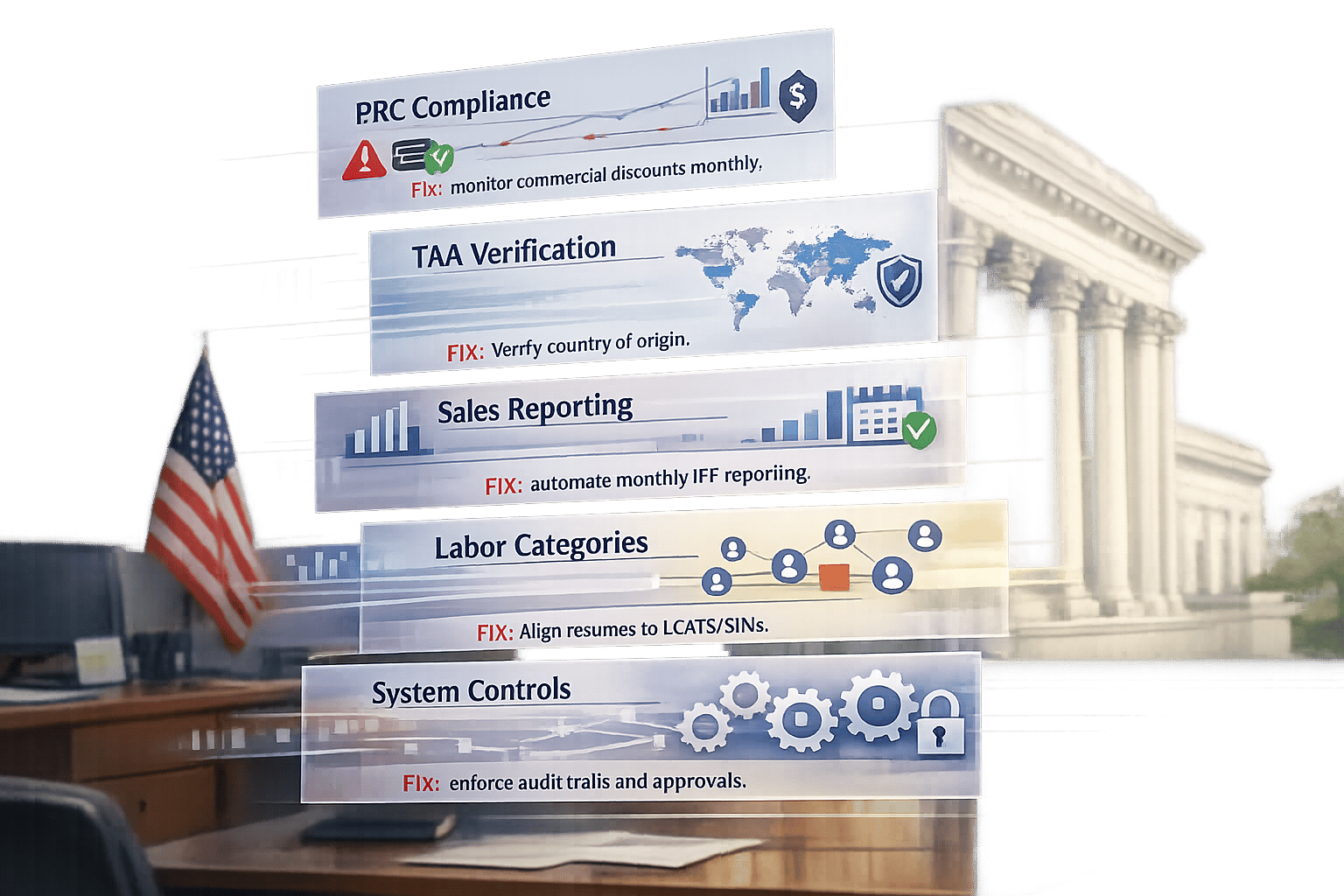
Avoid costly mistakes with your GSA Schedule contract. Non-compliance during audits can lead to penalties, contract termination, or repayment of overcharges. Here’s what you need to know:
- Price Reduction Clause (PRC) Violations: Mismanaging pricing relationships with your Basis of Award (BOA) customer can trigger compliance issues. Regularly monitor discounts and educate your sales team to avoid errors.
- Trade Agreements Act (TAA) Non-Compliance: Ensure all products are manufactured or substantially transformed in TAA-compliant countries. Verify supplier certifications and update records promptly.
- Sales Reporting Errors: Mistakes in GSA sales reporting, such as underreporting or misclassification, can lead to penalties. Use automated systems and conduct regular reconciliations.
- Labor Category Issues: Assign personnel who meet the qualifications outlined in your contract. Keep documentation up-to-date and consistent.
- Weak Compliance Systems: Without proper internal controls, errors persist. Establish clear policies, provide role-specific training, and conduct regular internal audits.
Key takeaway: Proactive measures like robust internal systems, regular audits, and proper training can prevent these common pitfalls. If you’re unsure, consider consulting a GSA compliance expert to safeguard your contract and revenue.
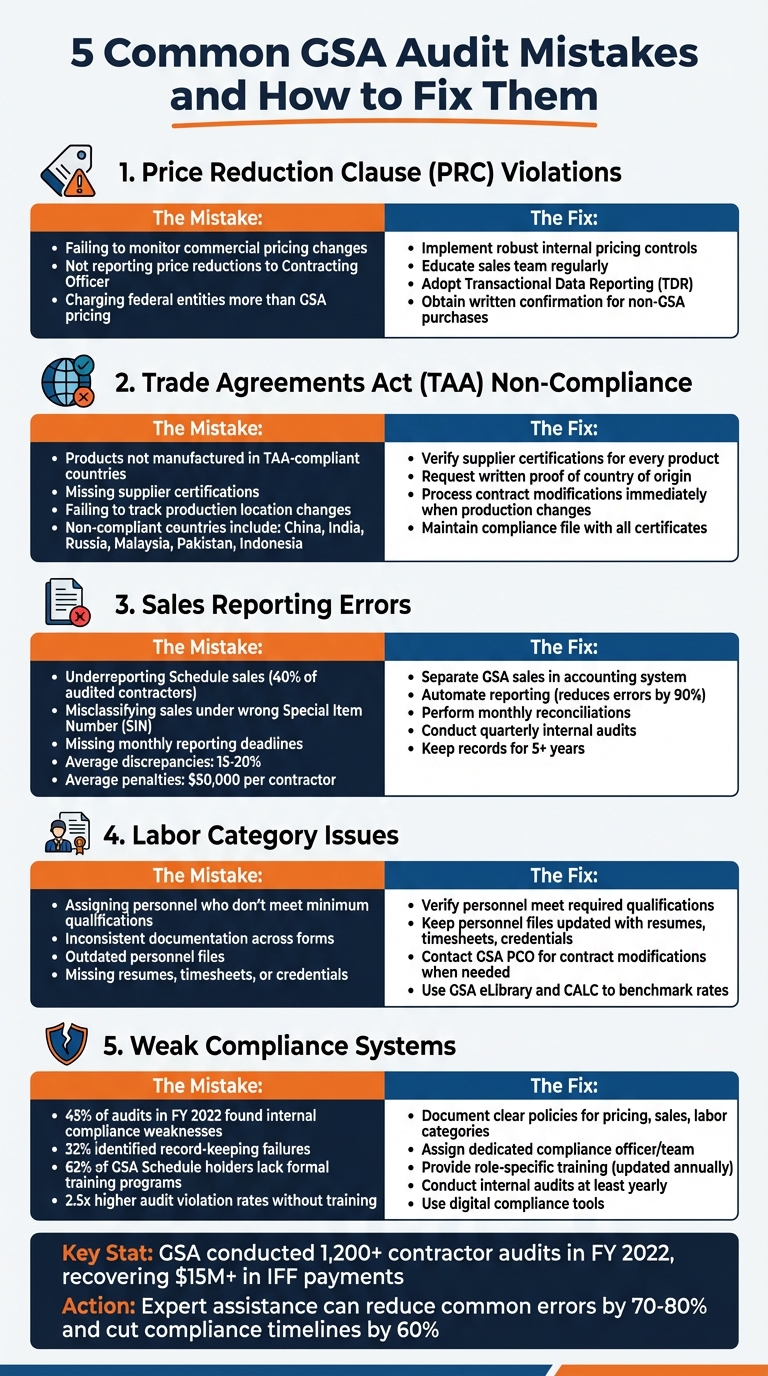
5 Common GSA Audit Mistakes and How to Fix Them
Price Reduction Clause Violations
The Price Reduction Clause (PRC) in GSA contracts is often misunderstood. Its purpose is straightforward: the government must receive pricing that’s at least as favorable as what you offer to your best commercial customer. This customer, known as the Basis of Award (BOA), defines the pricing relationship. If you later provide the BOA customer with a better deal than what was disclosed in your contract, you’re required to notify your Contracting Officer and adjust your GSA pricing accordingly through a contract modification. A clear understanding of the PRC is essential to avoid pricing missteps and uphold the integrity of your contract.
How the PRC Works and Why It Matters
The PRC operates on a simple concept: the price relationship between your BOA customer and the government must remain consistent. When setting your GSA pricing, you identify a specific BOA customer and establish the discount structure. If you disrupt this structure by offering the BOA customer a better discount than what’s disclosed in your contract, corrective action must be taken to restore compliance. Maintaining this price integrity is critical for staying within the bounds of GSA regulations and avoiding potential violations.
Typical PRC Violations
Most violations of the PRC happen unintentionally. Common errors include:
- Failing to monitor changes in commercial pricing or discounts.
- Overlooking mandatory discounts like Quantity/Volume or Prompt Payment discounts.
- Not reporting price reductions to your Contracting Officer.
- Charging federal entities more than your GSA pricing without securing written confirmation that an alternative contracting mechanism was used.
These mistakes often stem from a lack of oversight or understanding, but they can lead to serious compliance issues. Preventing such errors ensures your operations remain aligned with GSA requirements.
"It is imperative that GSA Multiple Award Schedule holders enact internal controls and ensure that sales personnel are educated and aware of the impact that giving commercial customers discounts greater than disclosed in the company’s Commercial Sales Practices can have on GSA Schedule pricing." – Patrick Morgans, Manager for Winvale’s BCG team
How to Fix PRC Violations
Addressing PRC violations starts with implementing robust internal pricing controls. These controls should track every commercial discount to ensure compliance. Educating your sales team is equally important – regular training sessions can help them understand how their pricing decisions impact GSA contracts.
One effective solution is adopting Transactional Data Reporting (TDR), which eliminates the need for ongoing PRC monitoring by removing the requirement to disclose Commercial Sales Practices. Additionally, when federal customers purchase outside your GSA Schedule, always obtain written confirmation that GSA pricing doesn’t apply. These measures not only correct violations but also act as a safeguard against future compliance challenges.
Trade Agreements Act (TAA) Non-Compliance
The Trade Agreements Act (TAA) of 1979 enforces strict rules about the origin of products sold through GSA contracts. Staying compliant with TAA regulations is crucial – it protects both your contract and your reputation. It’s also a top priority during GSA audits.
TAA Requirements Explained
Under the TAA, products sold via GSA Schedule contracts must be manufactured or "substantially transformed" in the United States or a designated country. This rule applies to physical goods, software, and services. For services, the country of origin is based on where your company is headquartered, not where the work is performed.
The list of TAA-designated countries is specific. It includes WTO GPA members like Japan, South Korea, the United Kingdom, and Germany, along with Free Trade Agreement partners such as Mexico, Chile, and Singapore. Least Developed Countries like Afghanistan and Haiti, as well as Caribbean Basin nations like Jamaica and the Bahamas, are also included. However, major manufacturing hubs like China, India, Russia, Malaysia, Pakistan, and Indonesia are excluded.
"The government does go after companies who they feel have made false claims about TAA products to government buyers." – GSAFocus
These requirements are strict, and even small missteps can lead to compliance issues.
Why TAA Non-Compliance Happens
Despite clear guidelines, supply chain changes can create compliance risks. Many violations occur when businesses fail to notice that shifts in production have made their previously compliant products non-compliant. For example, manufacturers may move production to a non-TAA country without notifying their partners, making it difficult to track the origin of multi-source products.
Auditors now demand detailed manufacturing records and certificates of origin. Without these, even accidental violations can result in contract suspension or termination.
"TAA compliance mistakes can cost contractors valuable awards, often without warning." – USFCR
How to Fix TAA Compliance Issues
To avoid compliance pitfalls, verify supplier certifications for every product on your GSA Schedule. Always request written proof of the country of origin and manufacturing location. If a manufacturer shifts production – even to another TAA-compliant country – process a contract modification immediately to update your records.
Set up a regular review process to ensure that the country-of-origin data on GSA Advantage is accurate. If a manufacturer notifies you of production changes, update your contract documentation right away. Keep a compliance file with all certificates, supplier declarations, and related communications. This file can be invaluable during audits and demonstrates your proactive approach to compliance.
"It is a good practice to periodically review the country of origin of products offered on your GSA contract, as manufacturers sometimes change their manufacturing points." – GSA Vendor Support Center
Sales Reporting Errors
If you’re a GSA Schedule holder, you’re required to report all sales monthly through the GSA eLibrary, also called G-Invoicing or eMod. This process is crucial for tracking your Industrial Funding Fee (IFF) payments and ensuring compliance with the Price Reduction Clause. Mistakes in sales reporting can lead to major issues, such as audits, penalties, back payments of IFF with interest, or even suspension of your contract. In short, getting your sales reporting right is essential to keep your contract in good standing.
Why Accurate Sales Reporting Matters
Accurate sales reporting plays a dual role. First, it ensures proper payment of the IFF, a 0.75% fee applied to all Schedule sales that helps fund GSA operations. While this fee is automatically deducted from government payments, you’re responsible for self-reporting and paying it for commercial sales. Second, these reports help enforce the Price Reduction Clause. During audits, GSA reviews your reported sales against tax returns, bank statements, and customer records covering the past five years.
For instance, in FY 2022, GSA carried out over 1,200 contractor audits. Around 25% of these audits uncovered sales reporting issues, recovering more than $15 million in IFF payments. A 2023 report revealed that 40% of audited contractors underreported sales, with discrepancies averaging 15–20%. These errors led to average penalties of $50,000 per contractor – a costly mistake to avoid.
Common Sales Reporting Mistakes
Underreporting is the most frequent error, often caused by failing to account for all Schedule-related sales or excluding commercial sales that impact Price Reduction Clause compliance. Misclassification is another common issue, such as reporting non-GSA sales as Schedule sales or vice versa, which can throw off IFF calculations and compliance tracking.
Other typical errors include:
- Incorrectly categorizing sales under the wrong Special Item Number (SIN)
- Missing deadlines or submitting incomplete monthly reports
- Failing to report sales under blanket purchase agreements (BPAs)
For example, one contractor underreported $2.5 million in Schedule sales, resulting in $18,750 in unpaid IFF and requiring a corrective action plan. In another case, $1.2 million worth of non-TAA compliant products were misclassified under Schedule sales, leading to TAA violations and price adjustments under the Price Reduction Clause.
How to Improve Sales Reporting Accuracy
To avoid these pitfalls, start by setting up your accounting system to clearly separate GSA sales from other transactions. Use unique transaction codes or modifiers to keep everything organized. Automating your reporting process can also make a big difference. By integrating your ERP system with GSA’s G-Invoicing platform, you can automatically populate SINs, calculate the 0.75% IFF, and flag incomplete reports. Automation has been proven to reduce manual errors by as much as 90%.
In addition, perform regular reconciliations by comparing reported sales with actual invoices on a monthly basis. Conduct quarterly internal audits to catch any discrepancies early. For example, one company discovered a 15% error rate during a pre-audit review, allowing them to fix the issues before an official audit began.
Training your team is equally important. Make sure they know how to distinguish between reportable and non-reportable sales and properly map SINs. Lastly, keep all relevant records – such as invoices, contracts, and supporting documentation – for at least five years. These documents are vital for substantiating your sales reports during audits.
Labor Category Compliance Issues
Labor category compliance is just as critical as sales reporting when it comes to maintaining contract integrity and passing audits. Under GSA contracts, professional services personnel must meet specific qualification criteria, including minimum education and experience levels. These aren’t just guidelines – they’re binding contractual obligations. Assigning employees who don’t meet these requirements violates the terms of your Multiple Award Schedule (MAS) contract, which can lead to penalties or even contract modifications.
Labor Category Requirements in GSA Contracts
Each contractor’s MAS contract outlines unique labor categories and qualifications, determined during the pre-award phase or when new categories are added through contract modifications. For instance, if your contract states that a "Senior IT Consultant" must hold a bachelor’s degree and have seven years of experience, those are the minimum qualifications you must meet – no exceptions.
Typically, these labor categories apply to employees exempt from the Service Contract Act (SCA), such as professionals in executive or supervisory roles defined under 29 C.F.R. Part 541. These positions often require advanced education or independent decision-making responsibilities. During compliance reviews, Industrial Operations Analysts (IOAs) carefully examine personnel records to ensure employees assigned to task orders meet the stated qualifications.
Common Labor Category Mistakes
Despite clear guidelines, contractors frequently stumble over a few recurring issues. The most common mistake is assigning personnel who don’t meet the minimum qualifications. Contractors sometimes assume that the ordering Contracting Officer (CO) can waive these requirements, but this is a misconception. As the GSA Vendor Support Center emphasizes:
"This requirement cannot be waived by the ordering CO"
Another frequent issue is inconsistent documentation. For example, discrepancies between your Commercial Sales Practices form, price list, and corporate records can raise red flags during audits. If your listed qualifications don’t align across these documents, GSA reviewers will likely flag the inconsistency. Many companies also neglect to keep their personnel files up to date. Missing documents like resumes, timesheets, or proof of educational credentials can make compliance assessments a challenge.
How to Fix Labor Category Compliance Problems
To avoid compliance issues, always verify that assigned personnel meet the required qualifications for their labor category. Keep personnel files well-organized and updated with resumes, timesheets, and educational credentials, as IOAs will review these during assessments.
If your labor category qualifications need to change, or if you need to add new categories, reach out to your GSA Procurement Contracting Officer (PCO) to initiate a contract modification.
"If you find that you need to adjust your labor category qualification requirements or add additional labor categories, it may be possible. Contact your GSA PCO for additional information"
Finally, leverage tools like GSA eLibrary and CALC to compare your labor category rates with competitors. This helps ensure your rates stay competitive while remaining compliant with market standards.
Weak Internal Compliance Systems
Weak internal compliance systems can undermine even the best understanding of GSA practices. While contractors may be familiar with GSA requirements, ineffective internal processes often lead to recurring compliance failures. In FY 2022, GSA conducted over 1,200 audits, and 45% highlighted internal compliance weaknesses, with 32% specifically identifying record-keeping failures. Without standardized procedures and consistent monitoring, these issues often remain hidden until audits uncover repeated mistakes.
Inconsistent responses from employees to similar compliance scenarios can further complicate matters, resulting in uneven application of GSA requirements. Often, organizations fail to learn from prior audit findings, allowing the same errors to occur repeatedly.
Signs Your Compliance System Needs Improvement
There are several indicators that your compliance system might need attention. For example, inconsistent record-keeping – where documentation practices differ across departments or time periods – can make it challenging to demonstrate compliance during audits. If your team struggles to locate essential documents or cannot clearly explain decisions around pricing, sales reporting, or labor category classifications, it’s a clear sign your system lacks proper structure.
A 2021 survey by the Professional Services Council revealed that 62% of GSA Schedule holders did not have formal compliance training programs. These companies were found to have 2.5 times higher rates of audit violations. Other warning signs include not having a dedicated compliance officer or team, skipping regular internal audits, and failing to track regulatory updates or adjust practices accordingly.
How to Build a Better Compliance System
To improve your compliance infrastructure, start by documenting clear policies for key areas such as pricing, sales reporting, and labor categories. Assign a dedicated compliance officer or team to oversee adherence to these policies and ensure the organization stays updated on regulatory changes.
Role-specific training is another essential step. Create tailored training programs for pricing teams, sales staff, HR, and finance professionals. These programs should focus on the GSA requirements most relevant to each role, be updated annually or whenever regulations change, and include documentation to confirm employee understanding of compliance responsibilities.
Centralized record-keeping systems are critical. These systems should provide detailed audit trails that clearly outline the "who, what, when, and why" behind key compliance decisions. Conducting internal audits at least once a year – or more frequently for organizations managing complex GSA contracts – can act as an early warning system, allowing you to address issues before external audits identify them. The use of digital compliance tools, such as GSA eLibrary and automated reporting software, has increased by 40% since 2020 and has proven effective in reducing manual errors in sales reporting.
Getting Expert Help with GSA Compliance
Creating robust internal compliance systems is crucial, but having expert help can significantly speed up the process and ensure long-term success. Many businesses fall into the "DIY Trap" when tackling GSA compliance on their own. They spend months navigating the maze of paperwork and regulations, only to face rejections or discover preventable audit violations.
Why Expert Assistance Makes a Difference
Experts bring a level of specialized knowledge that can catch costly mistakes before they escalate. For example, professional reviews can reduce common errors like PRC violations or TAA non-compliance by as much as 70–80%. This not only helps businesses avoid penalties – which average $50,000 per violation, according to GSA enforcement data – but also ensures smoother compliance overall.
Surprisingly, the cost of managing compliance without help often outweighs the investment in expert services. Professionals offer measurable benefits across the board: mock audits and compliance reviews catch discrepancies early, especially in sales reporting, where 40% of audits typically find issues. Real-world cases show that expert assistance can cut audit findings in half within six months. In one instance, a proposed $100,000 fine was reduced to $20,000 after expert negotiation using FAR 52.212-4.
These strategies are part of the comprehensive support offered by companies like GSA Focus, making compliance more manageable and less stressful.
How GSA Focus Supports Your Compliance Needs
GSA Focus stands out by providing an all-inclusive, done-for-you solution that addresses compliance at every stage. Their services include preparing essential documents like PRC trackers and TAA certifications, conducting quarterly compliance reviews, and offering real-time monitoring dashboards for pricing and sales tracking. This approach has helped over 500 small businesses secure GSA Schedules, cutting compliance timelines by 60%.
They also tackle specific challenges head-on. For example, when a small IT firm faced TAA non-compliance due to sourcing products from non-designated countries, GSA Focus stepped in. They performed a detailed supply chain audit, found compliant alternatives from approved countries like the US and Canada, updated the necessary offeror representation, and negotiated a contract modification. The outcome? The business kept its schedule and secured $2 million in federal orders – without any penalties.
With a 98% satisfaction rate across more than 600 clients and an average ROI of 87×, GSA Focus delivers tangible results. Their services include gap assessments against GSA MAS guidelines and customized training on tools like eOffer and eMod, helping clients achieve a 90% improvement in internal readiness. In one standout case, a manufacturer avoided an audit entirely thanks to proactive fixes identified during a pre-audit review.
How to Prevent Future Audit Problems
What You’ve Learned
Tackling GSA audit challenges starts with understanding the common pitfalls. The key issues include tracking discounts to avoid PRC violations, verifying product origins to meet TAA requirements, accurately classifying and reporting sales, ensuring labor category compliance, and maintaining strong internal systems. Weak processes often allow these problems to fester until an audit brings them to light.
Addressing these requires consistent effort and the right tools. Automated pricing systems can flag PRC risks before they escalate. Conducting supply chain audits and maintaining clear country-of-origin documentation ensures TAA compliance. Regular transaction reviews and automated reporting tools help minimize reporting errors. Properly assigning labor categories with documented qualifications prevents staffing missteps. Additionally, quarterly internal audits help catch and resolve issues early. With these challenges in mind, here are actionable steps to maintain compliance.
Steps to Maintain Compliance
Start with a compliance calendar to keep track of deadlines for sales reports, price reviews, and transaction audits. Use resources like CALC and GSA eLibrary regularly to benchmark rates and confirm that your services remain within the approved scope of your contract. Staying on top of these tasks helps prevent recurring audit issues.
"Reviewers are trained to spot inconsistencies – and when they do, they’ll ask for clarifications or reject your offer outright." – GSAFocus
Annual staff training on GSA requirements is crucial, especially in areas where your business has faced challenges. Assign specific compliance responsibilities to team members and monitor their performance using accuracy-related metrics. If your internal team lacks the necessary expertise, consider hiring GSA compliance specialists. The cost of investing in proper systems and expert advice is far less than the financial and reputational damage caused by serious audit violations. By following these steps consistently, you can protect your contract and revenue.
FAQs
How do I know if a discount triggers the PRC?
When a discount results in a price drop that must be reported under GSA discounting rules, it activates the Price Reduction Clause (PRC). This applies when the discount matches or exceeds those offered to your largest commercial customer. To stay compliant, it’s crucial to carefully document every price change.
What proof do I need for TAA country of origin?
To meet TAA requirements, you need to provide documentation that confirms the products are either manufactured or substantially transformed in the United States or in a designated TAA-compliant country. This verification is essential for ensuring compliance.
What should I do before a GSA audit starts?
Before a GSA audit, it’s crucial to get everything in order to stay compliant and steer clear of penalties. Start by gathering essential documents – think sales records, pricing details, contracts, and financial reports. Conducting internal reviews can help you spot and address any red flags before the auditors do. Also, make sure your team is well-trained in compliance requirements and proper record-keeping practices. Maintaining accurate and current records not only simplifies the audit process but also makes the entire experience far less stressful.
Related Blog Posts
- Top 5 Compliance Issues in GSA Contracts
- Common GSA Compliance Mistakes And Fixes
- Common GSA Audit Issues and How to Avoid Them
- GSA Audit Compliance Strategies: What Works Best