
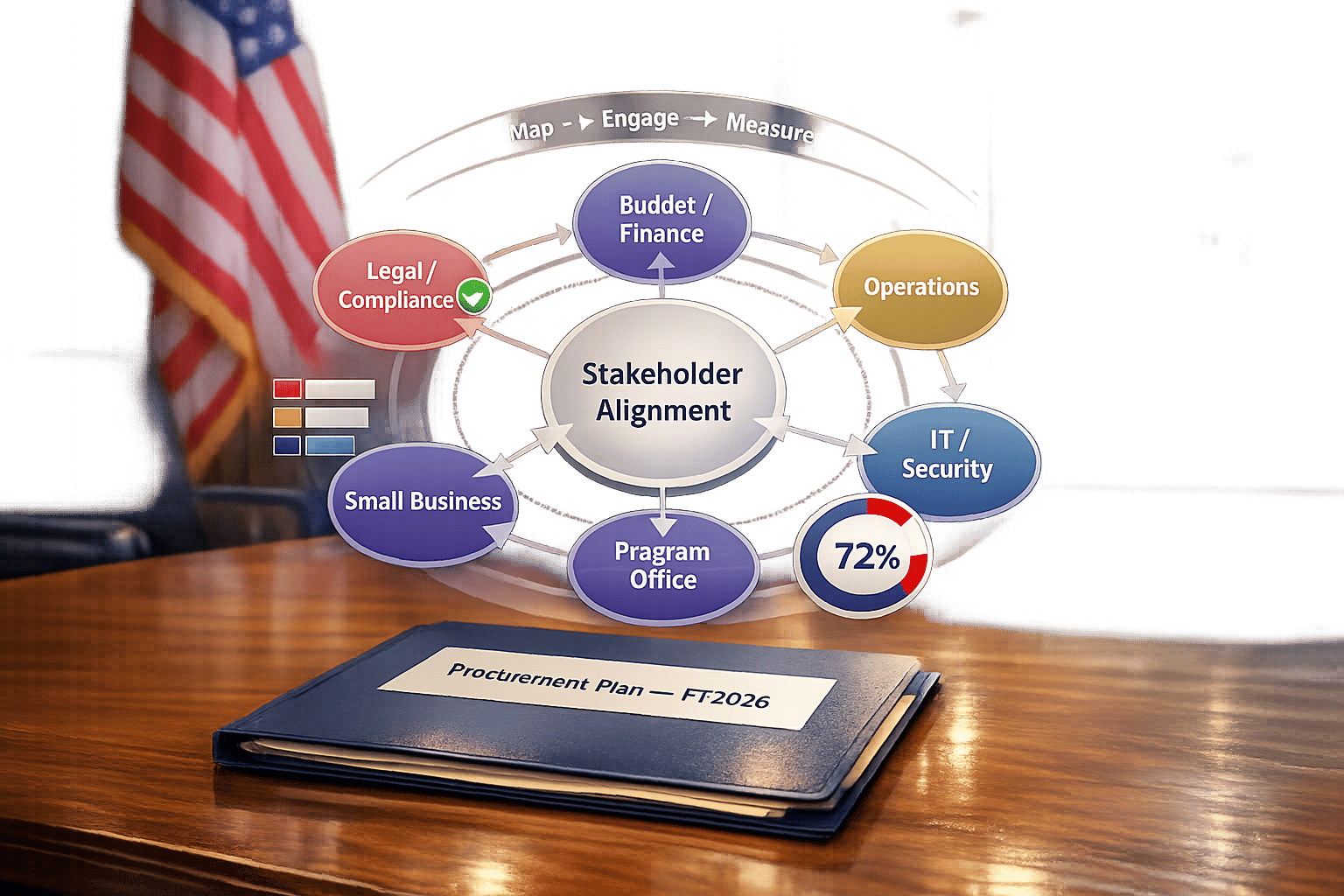
Procurement planning is the backbone of securing the right goods and services efficiently. But here’s the catch: without engaging internal stakeholders early, even the best plans can fall flat. Why? Because collaboration ensures budgets, compliance, and operational needs align before contracts are signed, avoiding costly mistakes.
Key takeaways:
- What it is: Procurement planning defines what’s needed, when, and how it’s sourced.
- Why it matters: Engaging stakeholders like Finance, IT, and Legal early reduces risks and improves outcomes.
- How to succeed: Use tools like Power-Interest Grids and RACI matrices to clarify roles and responsibilities.
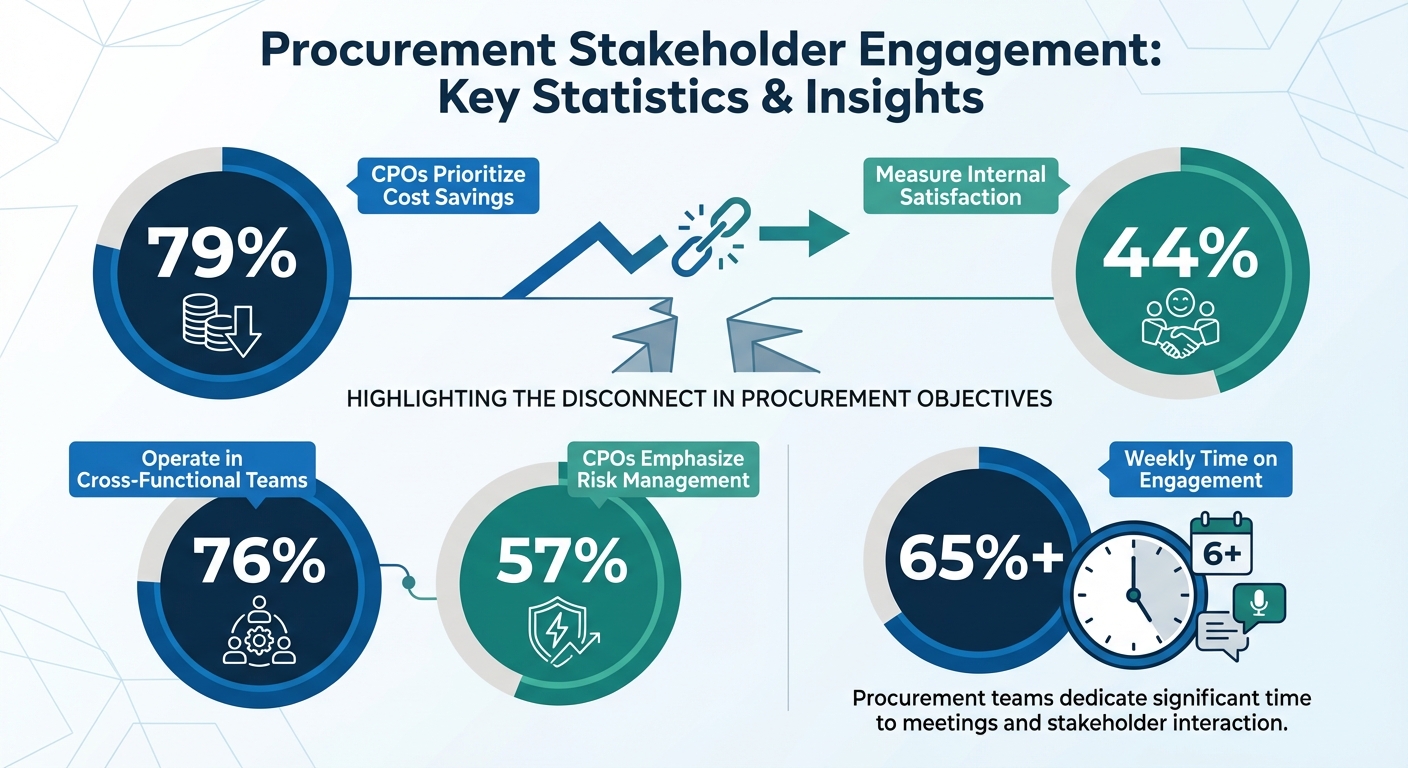
- Stats to know: 79% of procurement leaders prioritize cost savings, but only 44% measure internal customer satisfaction.
Procurement Stakeholder Engagement Statistics and Key Metrics
Collaborative Procurement: Effectively Engaging Stakeholders
Identifying Key Internal Stakeholders
Understanding who holds influence over resources, funding, or outcomes is crucial when navigating procurement. These individuals and groups shape the success of your strategy, so knowing how to engage with them is key.
Key Stakeholder Groups in Procurement
First, let’s talk about budget owners. They control funding and define what’s needed for procurement. Without their support, your plan simply won’t get off the ground.
Then there’s the finance team, responsible for ensuring the budget is in place and tracking financial performance. Legal teams play a critical role too, reviewing contracts and ensuring compliance with company policies to minimize risk.
For more technical purchases – like software or specialized equipment – Operations and IT step in. They ensure the solutions not only meet technical requirements but also integrate seamlessly with existing systems. Finally, senior management oversees the big picture. Their focus is on how procurement decisions impact profitability and align with broader organizational goals.
Here’s an interesting stat: 79% of Chief Procurement Officers prioritize cost savings, yet only 44% of procurement organizations measure internal customer satisfaction. That gap is significant. As Sachin Sharma, CEO of ProcureDesk, explains:
Cost reduction is not the only goal for your internal customers. A department’s first and foremost goal is to deliver on its key metrics and not cost savings!
This highlights the need to balance financial goals with the priorities of internal teams. Once you’ve identified these groups, the next step is to map their influence and interests.
Mapping Stakeholder Influence and Interests
A Power-Interest Grid is a great tool for categorizing stakeholders based on their level of influence and interest. Here’s how it works:
- High-power, high-interest stakeholders (like budget owners and senior management) demand your closest attention. Engage them early and often.
- High-power, low-interest groups need to be kept satisfied but don’t require constant updates.
- Low-power, high-interest stakeholders should be regularly informed to maintain their support.
- Low-power, low-interest groups only need occasional monitoring.
To further clarify roles, use a RACI matrix. This framework defines who is:
- Responsible: The person or team doing the work.
- Accountable: The decision-maker who signs off.
- Consulted: Those who provide input through two-way communication.
- Informed: Stakeholders who receive updates without direct involvement.
This approach eliminates confusion and ensures everyone knows their part in the procurement process. It’s worth noting that 76% of procurement teams now operate within cross-functional teams, emphasizing the importance of collaboration over working in silos. Mapping stakeholders and their roles helps align efforts and ensures no key influence is overlooked.
Creating a Stakeholder Engagement Plan
Once you’ve mapped out your stakeholders, the next step is crafting an engagement plan that actively involves them throughout the procurement process. This ensures that every stakeholder feels heard and that their needs are addressed.
Setting Clear Objectives and Outcomes
Start by defining specific objectives tailored to each stakeholder group. These objectives should align your procurement goals with their unique priorities. For instance:
- Budget owners need to see that procurement aligns with financial constraints.
- Legal teams prioritize contracts that meet corporate standards and minimize risks.
- Finance teams focus on how savings impact financial statements.
- Senior management wants visibility into how procurement decisions drive profitability.
- End users care about solutions that solve operational challenges, not just the cheapest option.
Sachin Sharma, CEO of ProcureDesk, emphasizes the importance of procurement teams earning their place in strategic discussions:
Procurement always complains that they don’t have a seat on the table and things would be much better if they did. I don’t disagree, but Procurement needs to earn that seat.
To "earn that seat", procurement must show its value in ways stakeholders understand. Rather than focusing on enforcing policies, position yourself as a partner who enables success. Ask questions that uncover business challenges and share insights like market trends or spend analysis to highlight opportunities. When your objectives align with stakeholder needs, engagement becomes easier and more productive.
These objectives will guide how you communicate and engage with each group.
Choosing Engagement Methods and Communication Channels
Once your objectives are clear, select the most effective communication methods for each stakeholder. Tailor your approach based on their level of influence and interest:
- High-influence, high-interest stakeholders (e.g., budget owners, senior management) benefit from frequent updates like weekly meetings or detailed briefings.
- Low-interest, low-influence groups can often be kept informed with monthly updates or self-service access to key resources.
Think about whether stakeholders prefer active or passive communication. Active stakeholders want regular interaction and opportunities to contribute, while passive stakeholders are more comfortable accessing information on their own. Aligning your approach with these preferences reduces unnecessary friction.
To make communication even more effective, consider the VARK model:
- Use dashboards for visual learners.
- Provide briefings for those who process information best through listening.
- Share concise documents for stakeholders who prefer reading and writing.
- Host workshops for hands-on, kinesthetic learners.
Workshops, in particular, are a great way to gather input from cross-functional teams. They create an open space for discussions and help surface potential concerns early. Regular feedback – through surveys, interviews, or informal chats – keeps your engagement plan adaptable and ensures you’re meeting stakeholder needs effectively.
Adapting Communication for Different Stakeholders
Addressing Stakeholder-Specific Concerns
Different stakeholders have unique priorities, and understanding these is key to effective communication. For instance, finance teams focus on metrics like EBITDA, budget adherence, and cost savings. IT teams need reassurance about technical compatibility and security, while legal departments emphasize strict regulatory and contract compliance. Operations, on the other hand, value vendor reliability and timely delivery over marginal cost savings, as noted by Sachin Sharma.
To connect with stakeholders effectively, it’s essential to frame outcomes in terms that resonate with their specific challenges. A great example of this approach comes from Michelle Vita, Senior Director of Procurement at Datadog. In December 2024, she used internal surveys to uncover friction points within her organization. Acting on this feedback, her team introduced an automated legal review process through a Jira board, significantly reducing manual intervention and ensuring contracts moved smoothly through the pipeline. This case study highlights how tailored communication and actionable solutions can directly address stakeholder concerns.
By combining targeted messaging with practical solutions, procurement teams can position themselves as strategic partners while driving meaningful improvements.
Tools for Team Collaboration
Effective collaboration goes beyond just communication – it also requires the right tools. These tools not only address stakeholder-specific needs but also promote transparency and efficiency across teams.
- Purchase order systems: Provide finance teams with real-time visibility into spending, backed by reliable data.
- Communication platforms like Slack: Allow teams to stay updated without the need for endless meetings.
- Workflow tools like Jira: Automate legal and contract review processes, ensuring everyone is informed about status changes.
- Dashboards and repositories: Dashboards offer quick access to key metrics, while centralized repositories store critical contract details like renewal and expiration dates, ensuring all teams can access essential information when needed.
Interestingly, only 44% of procurement organizations currently measure internal customer satisfaction. Introducing quarterly surveys or informal feedback sessions can help establish benchmarks and create feedback loops. These methods not only track performance but also show stakeholders that their input leads to real, impactful changes.
Measuring Stakeholder Engagement Results
Key Metrics for Measuring Engagement
To truly gauge engagement, it’s essential to look at both numbers and the less tangible signs of procurement’s influence within the organization. Start with procurement-specific metrics like spend under management, which reveals how much of the organization’s purchasing is being routed through your team. When more departments rely on procurement instead of bypassing it, it’s a clear indicator of stronger engagement.
Another critical measure is savings delivered. Collaboration with stakeholders often translates into cost reductions. In fact, 76% of Chief Procurement Officers point to cost savings as a top objective, while 57% also emphasize risk management. This highlights the importance of aligning procurement strategies with what each department values most.
Additionally, keep an eye on engagement activity metrics, such as meeting participation rates, response times, and the quality of stakeholder input. These indicators can reveal how consistently stakeholders are involved throughout a project. A sudden decline in these metrics might signal underlying issues that need immediate attention. Notably, over 65% of procurement teams spend more than six hours weekly on meetings and stakeholder engagement, so it’s crucial to ensure this time investment leads to actionable results.
Using Data to Improve Engagement
Once you’ve gathered your metrics, the next step is to analyze the data for insights. Break it down by stakeholder groups – finance, legal, operations, and others – to identify where relationships might need extra attention. For example, if certain departments show stagnant engagement levels, such as "Neutral" or "Resistant" ratings, it’s a sign that your strategies may need tweaking.
Comparing metrics like spend under management and savings delivered across departments can further illuminate gaps. If these numbers are low in specific areas, it often means procurement hasn’t yet built trust or established itself as a key advisor. Regular surveys and informal feedback sessions can help uncover what’s missing or where pain points are shifting. When feedback scores dip, consider increasing the frequency of updates or creating more opportunities for stakeholders to share their input.
The foundation of improvement lies in establishing a baseline for your engagement metrics. With this starting point, you can continuously refine your approach, letting the data guide your next steps.
Conclusion
Engaging internal stakeholders elevates procurement from a basic transactional role to a key strategic partner within the organization. By aligning stakeholders with broader business objectives, procurement can create processes that add value across the board, helping the company achieve its goals more effectively. This alignment also plays a crucial role in identifying and minimizing financial and reputational risks that might otherwise disrupt critical initiatives.
To make this shift, procurement teams need to move beyond simply focusing on cost savings. While 79% of Chief Procurement Officers still rank cost reduction as their top priority, true engagement means understanding what each department values most – whether it’s ensuring supply chain stability, improving operational efficiency, or mitigating risk. Procurement earns its place as a strategic partner by consistently demonstrating value in ways that align with these priorities.
This transformation relies on fostering collaboration with leadership and departments early on. Senior leadership involvement ensures buy-in and grants procurement teams access to valuable insights into departmental needs and sourcing strategies. Combining this with tools like surveys and feedback loops creates a dynamic system that identifies trends, uncovers new opportunities, and continuously evaluates the effectiveness of current processes. As highlighted in the Datadog example, listening to stakeholders and acting on their feedback can streamline operations and remove unnecessary friction.
Strategic stakeholder engagement also drives competitive advantages. For example, centralizing contract and spending data increases visibility, helping stakeholders identify overlapping projects and cut redundant costs. Multi-functional project teams further enhance this process by ensuring that requirements are developed collaboratively, from start to finish, so that acquisitions meet the actual needs of users. Regular surveys and centralized data are critical tools to keep this alignment on track.
Looking ahead, procurement teams should focus on consistent communication, regular surveys, early collaboration with department heads, and centralizing data for real-time insights. By prioritizing these practices, procurement shifts from being seen as a policy enforcer to becoming a driver of innovation and measurable value. This transformation positions procurement as an indispensable partner in achieving organizational success through effective stakeholder engagement.
FAQs
When should stakeholders be involved in procurement planning?
Stakeholders play a crucial role in procurement planning, and their involvement should start right from the beginning. Engaging them early builds strong relationships, aligns objectives, and ensures their priorities are addressed. This upfront collaboration improves communication and fosters a sense of teamwork, making decision-making more straightforward and reducing potential obstacles along the way. Plus, gathering input from stakeholders early on provides useful perspectives and helps gain their support, laying the groundwork for a smoother and more effective procurement process.
How do I decide which stakeholders need the most attention?
To figure out which stakeholders require the most focus, start by identifying those who either hold the most influence over or are most impacted by the procurement process. Develop a stakeholder register and map out each stakeholder based on their involvement, influence, and interest. Pay close attention to those with high levels of influence and interest, as their backing – or resistance – can play a major role in the outcome. Conducting a thorough stakeholder analysis allows you to customize engagement strategies and allocate resources wisely, paving the way for a smoother procurement process.
What metrics show stakeholder engagement is effective?
Key metrics to watch for are enhanced communication, smarter decision-making, and smoother workflows. Signs of success include stronger collaboration, greater stakeholder support, and active involvement from participants. These outcomes show that your engagement efforts are effectively aligning objectives and encouraging teamwork.
Related Blog Posts
- Ultimate Guide to Engaging Procurement Officials
- Types of Federal Procurement Methods Explained
- Pre-RFP Engagement Tips for Small Businesses
- 5 Key Roles in Federal Acquisition Teams