
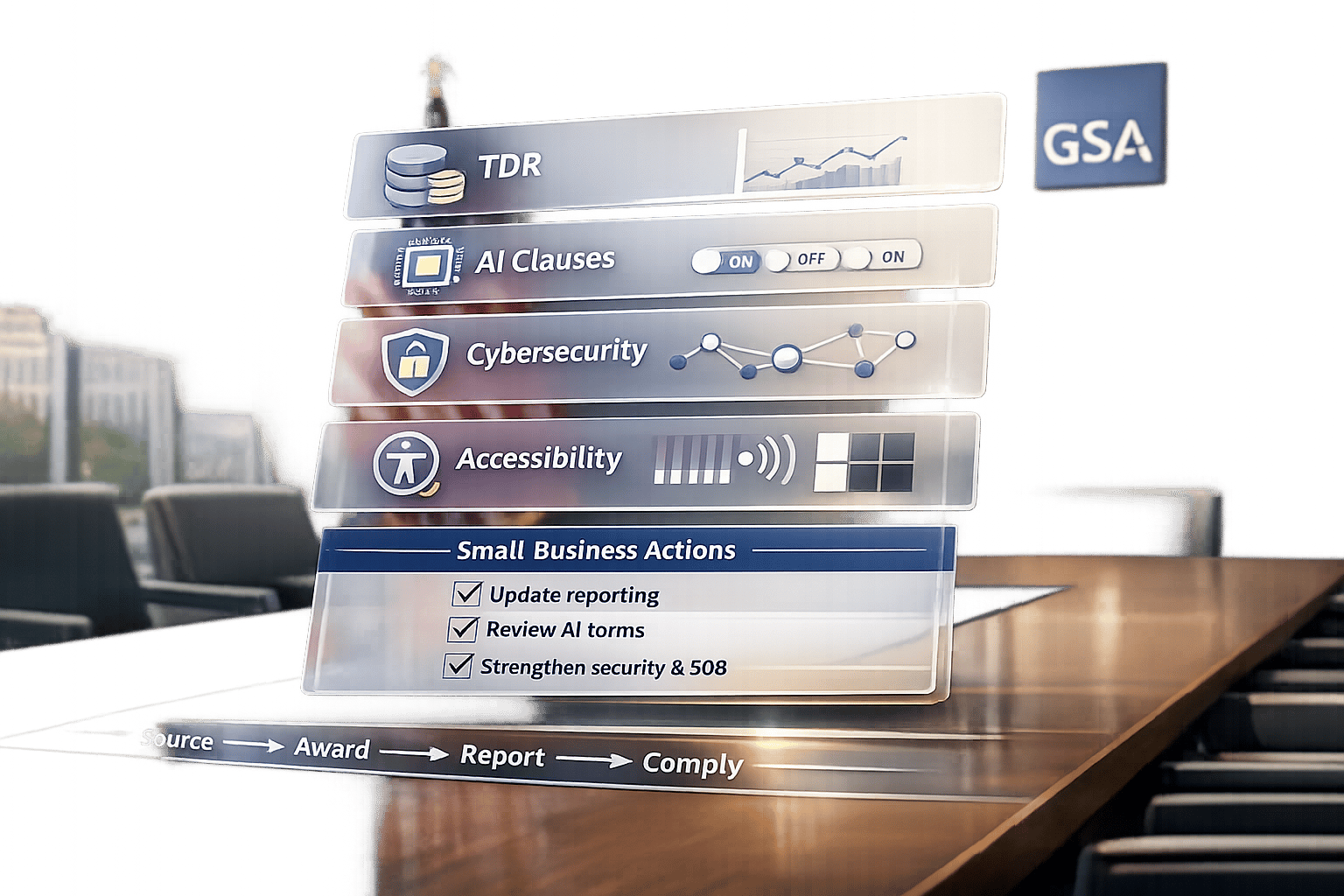
The federal government allocates $490 billion annually to goods and services, with the GSA managing much of this through its Multiple Award Schedule (MAS) program. Small businesses captured 45.56% of the MAS’s $51.12 billion in awards, thanks to streamlined digital procurement tools and policies like Executive Order 14240.
Recent changes, such as the OneGov Strategy and expanded Transactional Data Reporting (TDR), are simplifying compliance and cutting costs. Key contract vehicles like Polaris and Alliant 3 are opening doors for small businesses, while cybersecurity and accessibility standards are becoming stricter.
GSA Focus supports small businesses by handling application processes, compliance, and ongoing management, helping them save time and secure federal opportunities faster. With upcoming deadlines and policy shifts, businesses must act now to stay competitive in this evolving landscape.
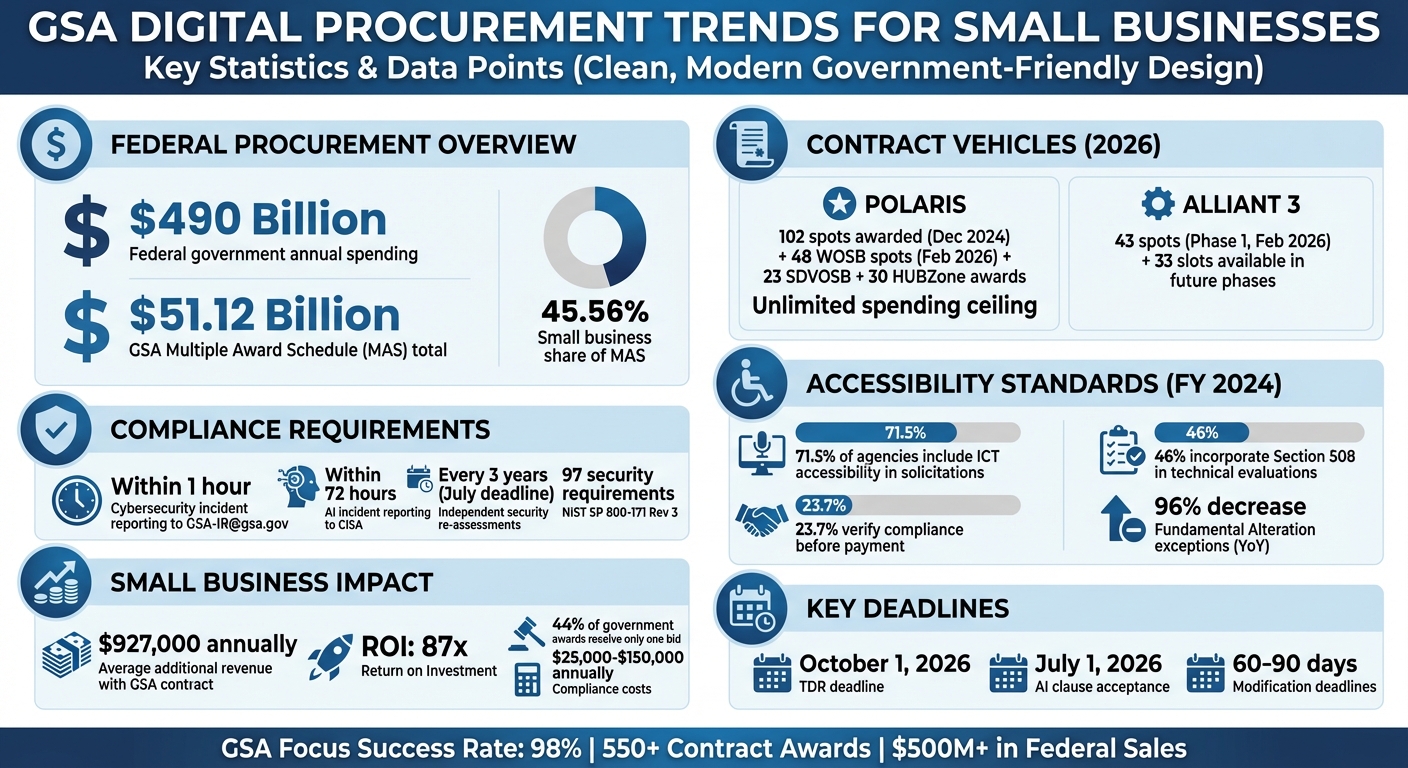
GSA Digital Procurement: Key Statistics and Compliance Requirements for Small Businesses
GAO audits of DOGE underway; GSA unveils modernized IT tool procurement strategy
Digital Procurement Trends in the GSA Framework
The General Services Administration (GSA) is making strides in simplifying federal IT contracting, especially for small businesses. Recent updates are not only modernizing digital procurement but also creating new opportunities for small business participation.
Expansion of Small Business Contracting Vehicles
Two key contract vehicles are set to reshape the landscape for small businesses by 2026. Polaris, a contract vehicle designed with small businesses in mind, has created exclusive pools for different categories. For instance, in December 2024, Polaris awarded 102 spots, with plans to add 48 more for Women-Owned Small Businesses (WOSB) by February 2026. Service-Disabled Veteran-Owned and HUBZone businesses will also see 23 and 30 awards, respectively. What sets Polaris apart is its unlimited spending ceiling, allowing agencies to allocate funds without restrictions, giving small businesses the room to grow and scale.
On the other hand, Alliant 3, which completed its first phase in February 2026, focuses primarily on large contractors, awarding 43 spots. However, these prime contractors are required to maintain small business subcontracting plans, opening doors for partnerships. Notably, there are still 33 slots available in future phases, providing small businesses with two pathways: subcontracting with major players like Booz Allen, Leidos, and CACI or competing for the remaining prime positions. Both vehicles are supported by regulatory updates that make it easier for small businesses to participate.
Policy Changes Supporting Small Business Participation
Recent shifts in policy are easing the administrative load for small businesses, making federal contracting more accessible. For example, the "Refresh 31" update, introduced in March 2026, expanded mandatory Transactional Data Reporting (TDR) to 112 additional Special Item Numbers that were previously exempt. In exchange, the GSA eliminated the Price Reductions Clause (PRC) for businesses participating in TDR. This change means small businesses no longer have to track and report changes in commercial pricing, significantly reducing compliance challenges and lowering the risk of False Claims Act lawsuits.
Additionally, the GSA is standardizing AI contract terms across federal agencies by incorporating provisions from OMB M-25-22. As Laura Stanton, Assistant Commissioner for the GSA Office of Information Technology Category, explained:
"Agencies can now achieve their socioeconomic goals and meet stringent federal compliance and security requirements for IT, while working with some of the best and most creative small IT companies".
These updates are a game-changer, removing barriers that have traditionally made it difficult for small businesses to compete in federal markets.
Simplified Procurement Pathways
Streamlined contracting processes are further simplifying market entry for small businesses. Instead of relying on individual competitions, federal agencies are turning to streamlined task orders on existing contract vehicles. By following FAR 8.404 and 8.405 guidelines, contracts can now be awarded in a matter of weeks rather than months. This shift reduces the time and resources small businesses need to invest in competing for federal work.
The GSA is also introducing phased awards, which allow for faster contract activation while continuing to evaluate additional proposals. Another noteworthy development is the introduction of regular on-ramps for vehicles like Polaris. These on-ramps enable new small businesses to join contract vehicles periodically, ensuring that the pool of contractors evolves alongside changing technology needs.
Technology and Compliance Requirements in Digital Procurement
Securing federal contracts through GSA now demands more than just meeting basic security protocols. Small businesses must swiftly adjust to a stringent set of technology and compliance requirements, including advanced cybersecurity measures, accessibility standards, and emerging AI regulations, to stay competitive in this space.
Cybersecurity and Zero Trust Architectures
GSA has set the bar high for cybersecurity by mandating NIST SP 800-171 Revision 3 for all systems handling Controlled Unclassified Information (CUI). This updated framework now includes 97 specific security requirements, a slight reduction from the previous 110, but with a broader security focus. However, the Department of Defense still allows contractors to use the older Revision 2 for CMMC compliance, creating a dual-standard environment that can be tricky to navigate for small businesses.
GSA’s system approval process follows a five-phase lifecycle – starting with preparation and extending to continuous monitoring. Within this framework, GSA enforces a "Zero Tolerance" policy for nine critical controls, such as phishing-resistant MFA and boundary protection. Failure to meet any of these controls results in immediate denial of authorization.
The reporting requirements are equally rigorous. Contractors must notify GSA-IR@gsa.gov within one hour of detecting a cybersecurity incident involving CUI. As Skadden Arps Slate Meagher & Flom explains:
"The Guide explicitly states that contractors must ‘not delay reporting in order to collect additional details’".
This rapid reporting underscores the federal government’s shift toward continuous monitoring rather than relying on one-time authorizations.
Another challenge for small businesses is the limited availability of GSA-approved assessors. Securing one early is crucial, as independent re-assessments are mandatory every three years, with the deadline set for the last workday of July.
AI-related contracts add another layer of complexity. New clauses require the use of American AI systems, strict data localization, and reporting of incidents to CISA within 72 hours.
Beyond cybersecurity, digital accessibility standards have become a key focus for federal ICT procurements.
Digital Accessibility and Section 508 Compliance
Accessibility is no longer just a formality in federal procurement – it’s now a core evaluation criterion. By FY 2024, 71.5% of government entities were including ICT accessibility requirements in solicitations, and 46% of agencies had incorporated Section 508 compliance into their technical evaluations.
Contractors are required to submit Accessibility Conformance Reports (ACRs), often based on the Voluntary Product Accessibility Template (VPAT®), to prove their products meet accessibility standards. During market research, half of all agencies now routinely request these reports. However, only 23.7% of entities consistently verify accessibility compliance before final acceptance and payment.
When full compliance isn’t possible, contractors must document exceptions – such as Fundamental Alteration, Undue Burden, or "Best Meets" – and obtain approvals from designated officials like the Section 508 Program Manager or CIO. Oversight has tightened significantly, with a 96% year-over-year decrease in the issuance of Fundamental Alteration exceptions as of FY 2024.
For small businesses, staying ahead in this area means proactively aligning with accessibility guidelines. Tools like the Accessibility Requirements Tool (ART) can help businesses understand the specific language agencies use to define accessibility needs. Additionally, consulting Section 508 Subject Matter Experts during proposal development can ensure compliance with these increasingly strict standards, giving small businesses a competitive edge in federal markets.
How GSA Focus Helps Small Businesses Navigate Digital Procurement
For small businesses, navigating the maze of digital procurement can feel like an uphill battle. Between stringent cybersecurity measures and Section 508 accessibility standards, the complexities can quickly become overwhelming. That’s where GSA Focus steps in, taking over the heavy lifting of the GSA Schedule application and contract management process. By doing so, they let businesses concentrate on what they do best – running their operations – without being bogged down by administrative headaches.
Full-Service Support for GSA Schedule Success
GSA Focus tackles these challenges with a comprehensive approach, starting with their GSA Readiness Score™. This tool assesses a business’s preparedness before any significant investments are made, saving time and resources from the outset. From there, they handle over 100 hours of intricate paperwork, including FAR interpretation and compliance documentation, ensuring nothing falls through the cracks.
To simplify the process, GSA Focus provides a secure online portal that organizes document uploads and compliance requirements in one place. Carolyn Kinsell of Solers RG praises the system:
“Understands GSA. Provides easy-to-use portal and tools”.
But their support doesn’t stop at paperwork. GSA Focus also acts as an authorized negotiator during the GSA review process, boasting a 98% success rate for contract approvals. Compare that to the DIY route, which typically eats up over 100 hours of a client’s time. With GSA Focus, clients only invest 3–4 hours of their own time and see results 4–6x faster.
Even after a contract is awarded, GSA Focus keeps things running smoothly with their "Maintenance on Autopilot" service, ensuring businesses remain compliant with ever-changing federal regulations. This end-to-end support sets the stage for long-term success.
Access to Federal Market Opportunities
Getting a GSA Schedule is just the beginning. Winning contracts requires strategic positioning, and GSA Focus excels here, too. They offer a daily curated watchlist of federal bid opportunities worth approximately $150 million, leveraging a proprietary pipeline that tracks sources like GSA eBuy, SAM.gov, and DIBBS. This accelerates market entry and keeps opportunities flowing.
Their "GSA Accelerator" service takes things further, offering bi-monthly proposal writing, targeted outreach to federal buyers, and a federal brand audit. These efforts have led to over 550 contract awards and more than $500 million in federal sales for their clients. Businesses typically see an additional $927,000 in annual revenue after securing a GSA contract, with an impressive return on investment of 87x.
Mike Jackson, the Founder of MacGyver Solutions, Inc., shares his experience:
“MacGyver Solutions is one of GSA Focus’ success stories – having them do the heavy lifting on the initial contract was a huge help”.
Considering that nearly 44% of government awards receive only one bid, small businesses that partner with experienced teams like GSA Focus gain a clear edge in the federal marketplace. By providing the tools, expertise, and ongoing support, GSA Focus empowers small businesses to thrive in this competitive arena.
Conclusion
The federal procurement landscape is shifting quickly, and small businesses must stay ahead of new compliance deadlines. These updates mark a major shift in how the GSA oversees its $38 billion in annual Multiple Award Schedule sales. With the October 1, 2026, TDR deadline and the July 1, 2026, AI clause acceptance on the horizon, the time to act is now.
But it’s not all hurdles – there are opportunities, too. For instance, under the FAR Overhaul initiative, GSA’s Technology Transformation Services awarded a SaaS contract in just 21 days in March 2026, saving 43% in costs. This demonstrates how regulatory changes can streamline processes and reduce spending.
That said, navigating these changes isn’t simple. Adapting ERP systems for TDR compliance, documenting AI components, and meeting strict modification deadlines of 60 to 90 days requires significant investment. Compliance costs are estimated to range between $25,000 and $150,000 annually. In such a demanding environment, expert guidance becomes a necessity.
Strategic partnerships are key to managing these challenges. With a 98% success rate, GSA Focus offers comprehensive support, handling everything from initial assessments to ongoing compliance. This frees small businesses to focus on growth instead of getting bogged down by administrative complexities.
As the federal market continues to consolidate under GSA vehicles and regulations become more intricate, small businesses that embrace expert support will be better equipped to tackle TDR implementation, AI compliance, and FAR Overhaul opportunities. The question is – how quickly can your business adapt?
FAQs
Do I need Polaris or a GSA MAS Schedule to sell to federal agencies?
No, you don’t need Polaris or a GSA Multiple Award Schedule (MAS) to sell to federal agencies. These contracts, including the Polaris GWAC, can make procurement easier and provide access to lucrative opportunities, but they aren’t a strict requirement. Many small businesses thrive using alternative approaches. That said, having a GSA Schedule can simplify the process and open doors, especially as federal procurement increasingly aligns with GSA policies.
What do I need to change in my systems to meet GSA TDR requirements?
To align with GSA TDR requirements, make sure your systems are set up to manage monthly transaction-level data submissions through the FAS Sales Reporting Portal. Your processes should be capable of collecting and reporting 16 specific data points within 30 days after the end of each month.
With the removal of the Price Reduction Clause (PRC), your attention should now shift from tracking commercial pricing practices to focusing on accurate and detailed sales data reporting.
Which compliance items should I prioritize first: cybersecurity, Section 508, or AI clauses?
When it comes to procurement, the General Services Administration (GSA) places a strong emphasis on cybersecurity compliance. This means vendors must prioritize protecting both data and the supply chain. Whether it’s safeguarding sensitive government information or ensuring the integrity of products and services, meeting these standards is non-negotiable. Staying updated on the latest cybersecurity protocols and demonstrating compliance can make or break a business’s ability to work with the GSA.
Section 508 Accessibility Requirements
Another critical area is Section 508 accessibility requirements, which ensure that all electronic and information technology (EIT) is accessible to individuals with disabilities. Vendors must design and deliver products and services that meet these accessibility standards. From software interfaces to web-based applications, compliance with Section 508 not only aligns with federal law but also reflects a commitment to inclusivity.
AI Clauses: A Work in Progress
The GSA is also developing AI clauses to address the growing role of artificial intelligence in procurement. While these regulations are still evolving, it’s clear that businesses will need to stay proactive in understanding and adhering to these guidelines as they take shape. By keeping an eye on regulatory updates, vendors can position themselves to meet future requirements without delay.
By focusing on these key areas – cybersecurity, accessibility, and AI – businesses can ensure they remain aligned with the GSA’s latest procurement priorities. Compliance isn’t just about meeting standards; it’s about building trust and staying ahead in a competitive market.
Related Blog Posts
- Ultimate Guide to GSA Compliance Standards
- Regulatory Requirements for Federal Contracts
- Key Terms in GSA Contracts Explained
- Types of Federal Procurement Methods Explained