
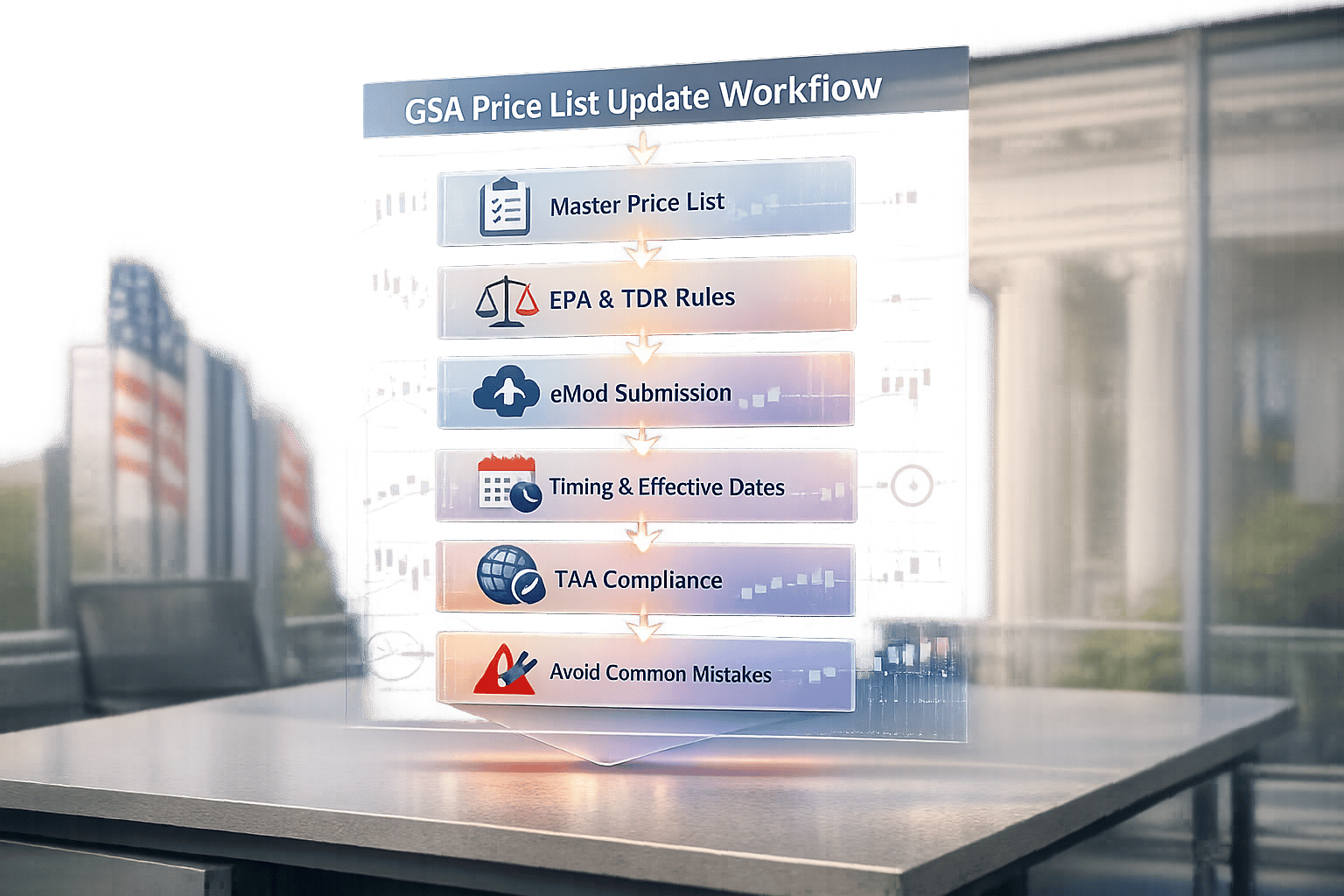
Your GSA price list is more than a catalog – it’s a contract with the federal government. Keeping it accurate and compliant protects your revenue, builds trust with buyers, and avoids penalties.
Here’s what you need to know:
- Why Updates Matter: Outdated listings can reduce visibility, damage trust, and lead to order cancellations or catalog suspension. Regular updates help you stay competitive and compliant.
- Key Challenges: Price Reductions Clause (PRC) violations, technical errors, and regulatory changes like the Federal Acquisition Service Catalog Platform (FCP) and expanded Transactional Data Reporting (TDR) can complicate updates.
- How to Stay Compliant: Maintain an up-to-date master price list, follow Economic Price Adjustment (EPA) rules, and ensure Trade Agreements Act (TAA) compliance for all products.
- Practical Steps: Prepare documentation (e.g., manufacturer price lists, supplier letters), submit modifications through eMod, and update GSA Advantage! within 30 days.
- Avoid Mistakes: Double-check pricing, timing, and documentation to prevent delays or violations.
Need help? Services like GSA Focus can simplify the process, managing updates, compliance, and submissions for you. Staying on top of your price list ensures you remain competitive in the federal market.
Compliance & Pricing Report in FCP – MAS Vendor Training
GSA Price List Requirements Explained
Navigating the complexities of GSA price list requirements is essential, especially when dealing with outdated catalogs and federal regulations.
Your GSA price list must align with strict federal rules aimed at protecting government funds. A key component of these rules is the Basis of Award (BOA) – a designated customer or category that serves as the benchmark for ensuring the government’s discount is fair. Essentially, the BOA acts as your pricing baseline. If you offer a better discount to your BOA customer than to the government, you could face a contract violation.
The Price Reductions Clause (PRC) enforces this pricing relationship. If your BOA customer receives a better deal – whether through promotions, volume discounts, or seasonal offers – you are required to adjust your GSA price accordingly. Ignoring these adjustments can lead to serious consequences, including audits by the GSA Office of Inspector General (OIG), retroactive price corrections, government refunds, or even contract termination.
Some contractors opt for Transactional Data Reporting (TDR) instead of PRC monitoring. With TDR, monthly sales reports replace the need to track discounts manually. Recent updates, like MAS Solicitation Refresh 31, have expanded TDR requirements to cover more Special Item Numbers (SINs). It’s crucial to determine whether your contract uses the PRC model or the TDR framework, as this distinction shapes how you manage compliance.
Compliance Rules for GSA Price Lists
Staying compliant begins with maintaining a Master Price List. This document should match your contract exactly, listing SINs, SKUs, prices, and country of origin. By keeping this updated, you can avoid discrepancies during catalog revisions. Regularly review your commercial sales practices to ensure that discounts or promotions don’t unintentionally breach PRC rules. Always make sure the government’s pricing remains the most favorable.
The Federal Acquisition Service Catalog Platform (FCP) offers built-in validation tools to identify missing data or pricing inconsistencies before submission. These tools are invaluable for catching errors early, as delays in catalog updates can result in outdated listings that are less appealing to federal buyers.
Once you’ve mastered these basics, it’s time to turn your attention to Economic Price Adjustment clauses.
Economic Price Adjustment (EPA) Clauses
MAS Refresh 29 introduced GSAR 552.238-120, which replaced older EPA clauses and now governs all price adjustments. Incorporating this updated clause is a must before submitting any price increase requests. Skipping this step could lead to delays or outright rejection of your submission.
The new clause allows for three adjustment methods: Fixed Escalation (a pre-negotiated annual percentage, like 3%), Market Index (pricing tied to external metrics such as the Bureau of Labor Statistics Employment Cost Index), and Established Pricing (adjustments based on your documented Commercial Price List). Under the older 552.216-70 clause, price increases were capped – typically at 5% annually for services and 10% for products. The updated 552.238-120 clause offers more flexibility, eliminating mandatory waiting periods between requests.
Proper documentation is critical for EPA requests to ensure catalog accuracy and avoid compliance issues. Submit requests at least 60 days before the desired effective date, as processing can take 45–60 days or longer. Before submitting, review the GSA 4P report (or C&P report in FCP) to understand the market data your Contracting Officer will use for price comparisons. If your manufacturer releases a new price list, request it 30 days in advance to meet submission deadlines.
For temporary or small price reductions, use Temporary Price Reductions (TPRs). These go into effect immediately upon submission, while permanent price decreases require formal approval and are much harder to reverse. As Ray Smith, Founder of Smith Government Consulting, explains:
"Once a permanent decrease is approved, reversing it requires a new EPA to be submitted".
How to Update Your GSA Price List
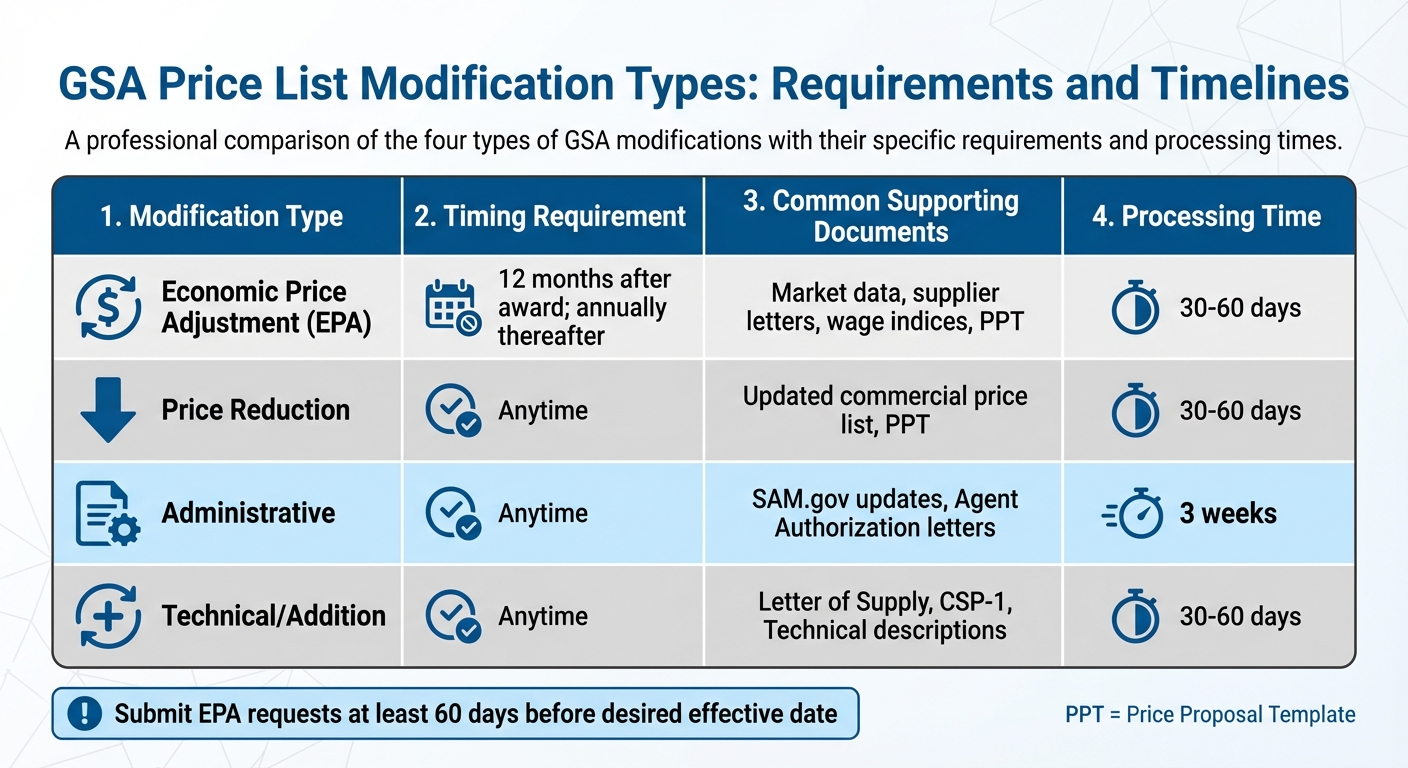
GSA Price List Modification Types: Requirements and Timelines
Now that we’ve covered the EPA clauses and compliance guidelines, let’s dive into the practical steps for updating your price list.
Preparing for a Price Increase
Before submitting a price increase, confirm that your commercial pricing has indeed changed. Gather all necessary documentation, such as manufacturer price lists with effective dates, supplier letters, or industry wage indices. These documents will serve as proof to support your request.
Timing is key here. Submit your request at least 60 days in advance of when you want the new prices to take effect. The review process typically takes between 30 and 60 days. Under the older clause, annual price increases are limited to 5% for services and 10% for products, though in recent years, achieving an escalation above 2.5% annually has become increasingly challenging.
Double-check your Price Proposal Template (PPT) calculations – errors in this area are a common reason for rejection. Once all your documents are ready and verified, you’re set to submit your modifications through the eMod system.
Submitting Modifications Through eMod
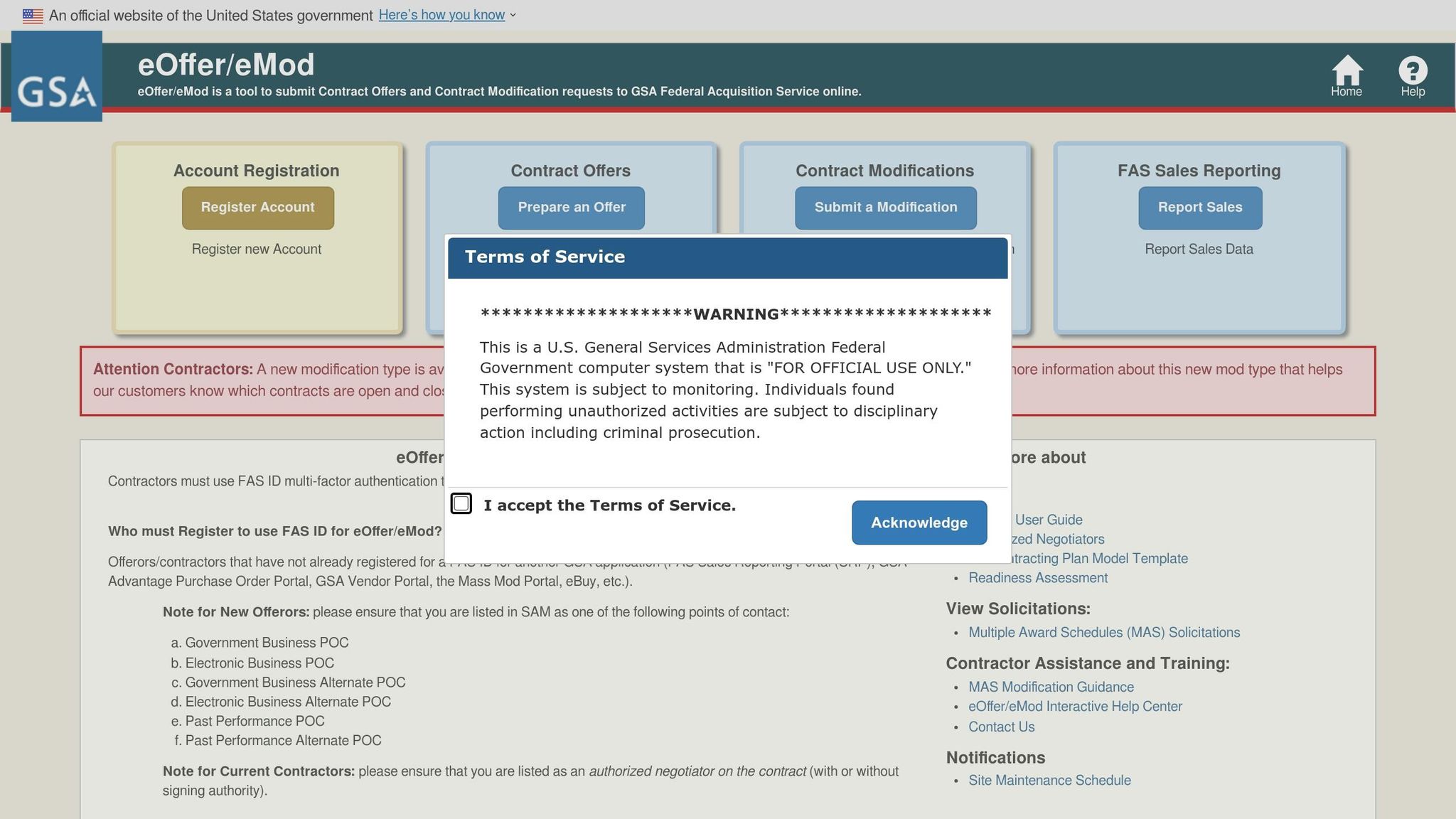
After confirming your updated pricing and gathering the required documents, the next step is to use the eMod system to submit your modifications. Start by selecting the appropriate modification type. For example:
- Economic Price Adjustments (EPA): These are used for price increases and require supporting documents like market data, supplier letters, or wage indices.
- Price Reductions: These can be submitted at any time and require your updated commercial price list and PPT.
Here’s a quick breakdown of modification types and their documentation needs:
| Modification Type | Timing Requirement | Common Supporting Documents |
|---|---|---|
| Economic Price Adjustment (EPA) | 12 months after award; annually thereafter | Market data, supplier letters, wage indices, PPT |
| Price Reduction | Anytime | Updated commercial price list, PPT |
| Administrative | Anytime | SAM.gov updates, Agent Authorization letters |
| Technical/Addition | Anytime | Letter of Supply, CSP-1, Technical descriptions |
Administrative modifications are quicker to process, often completed within 3 weeks. On the other hand, EPA requests can take 30 to 60 days. Be careful to avoid common errors, such as choosing the wrong modification type, missing required signatures, or including items outside your awarded SIN scope. These mistakes can delay your approval by several weeks.
Once submitted, your Contracting Officer will review your documentation, ensure compliance with your EPA clause, and either approve the modification or request additional clarifications.
Common Mistakes to Avoid in GSA Price List Updates
Even seasoned contractors can stumble when updating their GSA price lists, leading to delays in approvals or compliance headaches. By understanding these common pitfalls, you can streamline your submissions and minimize back-and-forth with your Contracting Officer.
Errors to Watch Out For
One of the biggest missteps is allowing discrepancies between your Commercial Sales Practices (CSP), current pricing strategies, and contract pricing. This often happens when contractors offer competitive discounts to commercial customers without considering how it impacts their Basis of Award (BOA) relationship. Keep in mind, not every commercial discount requires a government price adjustment – only those that alter the BOA relationship trigger obligations under the Price Reductions Clause.
Another frequent issue is inadequate documentation. For example, submitting Economic Price Adjustment (EPA) requests without a complete and well-organized support package can slow down reviews and lead to additional questions from the Contracting Officer. To avoid this, ensure your documentation aligns with your approved EPA method and includes robust market data, such as indices from the Bureau of Labor Statistics or producer price indices. Avoid relying on vague reasons like general cost increases or urgency.
Timing mistakes are also common. Submitting a price increase request too soon – less than 12 months after your last increase – or within 60 days of your contract’s expiration will result in automatic rejection. Another timing-related error is failing to confirm actual increases in commercial prices before submitting a GSA modification. This oversight violates the BOA rule and often leads to rejections.
Lastly, Trade Agreements Act (TAA) compliance is a critical area that contractors sometimes overlook. Every time you add new products or modify existing ones, you need to verify TAA compliance for each item. Selling non-compliant products through a GSA schedule is a serious violation and can have significant consequences.
To avoid these pitfalls, it’s crucial to establish clear and consistent documentation practices.
How to Maintain Accurate Documentation
Accurate documentation is the foundation of compliance. Here are some steps to help you stay organized and avoid pricing errors:
- Create a master price list that mirrors your signed contract exactly. Include details like Special Item Numbers (SINs), SKUs, awarded prices, and TAA country of origin. This serves as your single source of truth for all pricing decisions and helps prevent discrepancies.
- Implement a change control process with a dedicated owner. Use a change log to track approvals and updates, creating a clear audit trail. This is especially helpful during Contractor Assistance Visits (CAV) or GSA Inspector General audits, where Price Reductions Clause violations are a top concern.
- Conduct quarterly internal audits to compare recent invoices with your master price list and your live GSA Advantage! catalog. This proactive step helps catch pricing misalignments before they escalate into compliance problems. Always double-check that units of measure and discount structures match your contract terms exactly.
- Regularly monitor your commercial pricing practices, particularly discounts offered to BOA customers. Document any analysis of changes to ensure they don’t impact your benchmark relationship. This habit can save you from making pricing adjustments that inadvertently violate your contract.
| Error Type | Key Risks | Prevention Solutions |
|---|---|---|
| Pricing Drift | PRC violations, mandatory refunds, modification rejections | Maintain a master price list; conduct quarterly audits; monitor BOA customer discounts |
| Incomplete Documentation | Extended review timelines, follow-up questions, denials | Align support with approved EPA method; include BLS/PPI data; verify commercial price changes |
| Poor Timing | Automatic rejection, delayed increases | Submit only after 12+ months from the last increase; allow 60+ days before expiration |
| TAA Non-Compliance | Product removal, contract violations | Verify country of origin for all new/modified products; keep supplier documentation |
| Outdated Catalogs | Canceled orders, compliance flags | Update GSA Advantage! within 30 days of modifications; perform monthly catalog reviews |
Using GSA Focus for Price List Updates

Navigating GSA price list updates can feel like walking through a maze, especially for small businesses juggling federal compliance alongside daily operations. It’s no surprise that many contractors seek expert help to stay on track. That’s where GSA Focus steps in, offering a full-service solution to handle the entire modification process. With them managing eMod submissions and regulatory requirements, you’re free to focus on growing your business.
What GSA Focus Brings to the Table
GSA Focus specializes in managing all types of price list modifications, whether it’s simple adjustments or more intricate updates. Their service tiers are designed to match the complexity of your needs:
- Tier 1: Straightforward updates ($1,000)
- Tier 2: Renewals and basic additions ($1,500)
- Tier 3: Price increases, novations, or combined actions ($2,000)
- Tier 4: Complex modifications involving three or more actions ($3,000)
- Annual retainer: $1,500 covers administrative tasks, mass modifications, sales reporting, and strategic advisory support
One of their standout offerings is their compliance assurance process, particularly for handling price increases. GSA Focus conducts thorough pricing analysis and benchmarking to ensure your proposed rates are competitive and reasonable. They also streamline the documentation preparation for your specific Economic Price Adjustment (EPA) clause – whether it’s GSAR 552.238-120 or I-FSS-969 – helping you navigate both the newer Transactional Data Reporting (TDR) model and traditional pricing compliance methods.
By addressing common challenges like documentation gaps, timing issues, and compliance risks, GSA Focus eliminates many of the headaches that contractors often face.
The results speak volumes. With over 550 GSA Contract awards secured and more than $500 million in federal sales generated by their clients, GSA Focus has a proven track record. As John Wayne II from GrowMyBusinessQuick.com said:
"Without GSA Focus, we couldn’t have navigated the complex process to secure GSA Contract Awards for several of our clients".
Simplifying the Process with GSA Focus
GSA Focus takes the stress out of the modification process by managing every step, from initial review to post-approval updates. Their approach starts with a checklist-driven data collection process, where they gather updated price lists, 5–10 invoices, and relevant project documents to ensure a complete submission.
Once your documentation is ready, they handle the eMod upload, monitor the review process, and address any follow-up questions from your Contracting Officer. After approval, they take care of updating your GSA Advantage! catalog – a crucial step to keep your products visible and prevent order cancellations.
Their expertise with the upcoming 2026 MAS pricing changes is particularly valuable. They provide guidance on dual compliance models (TDR and traditional), clarify EPA documentation requirements, and help identify triggers for the Price Reduction Clause. Additionally, they conduct periodic competitive analysis on GSA Advantage! to benchmark your pricing and prepare for audits.
The time savings alone make their services a game-changer. Instead of spending weeks navigating EPA clauses, verifying pricing, and managing eMod uploads, you can delegate everything to GSA Focus. As Raja Srinivasan from Geoidentity shared:
"Guided us through every step… Highly responsive".
For small businesses with limited resources, this kind of support opens the door to federal revenue opportunities – without the usual compliance headaches.
Conclusion
Keeping your GSA price list current is key to protecting revenue and staying competitive in the federal market. Here’s a quick roadmap to follow: update your listings to reflect commercial changes, gather complete EPA documentation, submit modifications through eMod, and update your GSA Advantage! catalog within 30 days.
This process helps you stay compliant while meeting market demands. With the 2026 pricing updates – such as expanded TDR requirements and EPA clarifications under Refresh #29 – contractors must fine-tune their internal systems. Submitting updates on time with all necessary documentation is more important than ever, especially since GSA’s TDR expansion is expected to save $50 million annually across agencies.
To navigate these challenges, avoid common missteps like incomplete EPA support, mismatched BOA pricing, or weak competitive analysis. Regular quarterly reviews and an up-to-date master price list are crucial. Conduct compliance checks to ensure your signed contract – including SINs, SKUs, and TAA compliance – is accurate, catching issues before they lead to audits or business disruptions.
For small businesses balancing federal compliance with daily operations, GSA Focus offers a lifeline. They assist with document preparation, pricing analysis, eMod submissions, and catalog updates, helping you implement these best practices efficiently. This reduces your workload and minimizes compliance risks, allowing you to concentrate on growing your federal sales.
FAQs
Do I follow PRC or TDR on my contract?
Starting September 30, 2025, all GSA contractors must adhere to the Transactional Data Reporting (TDR) system, which takes the place of the Price Reduction Clause (PRC). If you’re a contractor, it’s crucial to update your processes to meet TDR requirements and stay compliant.
What documents do I need for an EPA price increase?
To request an EPA price increase, you’ll need to gather several key documents. These include a price proposal, a market analysis, commercial sales practice data (if it applies to your situation), and a sales history. It’s crucial to ensure these documents are both accurate and fully compliant with GSA regulations. This attention to detail will help strengthen your case and improve the chances of your request being approved.
How do I avoid TAA issues when adding products?
To steer clear of problems with the Trade Agreements Act (TAA) when updating your GSA price list, make sure your products meet TAA requirements. This means they must be either manufactured or substantially transformed in the United States or a TAA-approved country.
Take the time to thoroughly verify where your products come from, ensure they meet the criteria for substantial transformation, and keep detailed supply chain documentation. Having this information on hand will not only ensure compliance but also prepare you for audits, helping to avoid any TAA-related complications.
Related Blog Posts
- GSA Price List Update Success Stories
- How to Remove Products from GSA Schedule
- Common GSA Compliance Mistakes And Fixes
- How to Update GSA Schedule Prices