
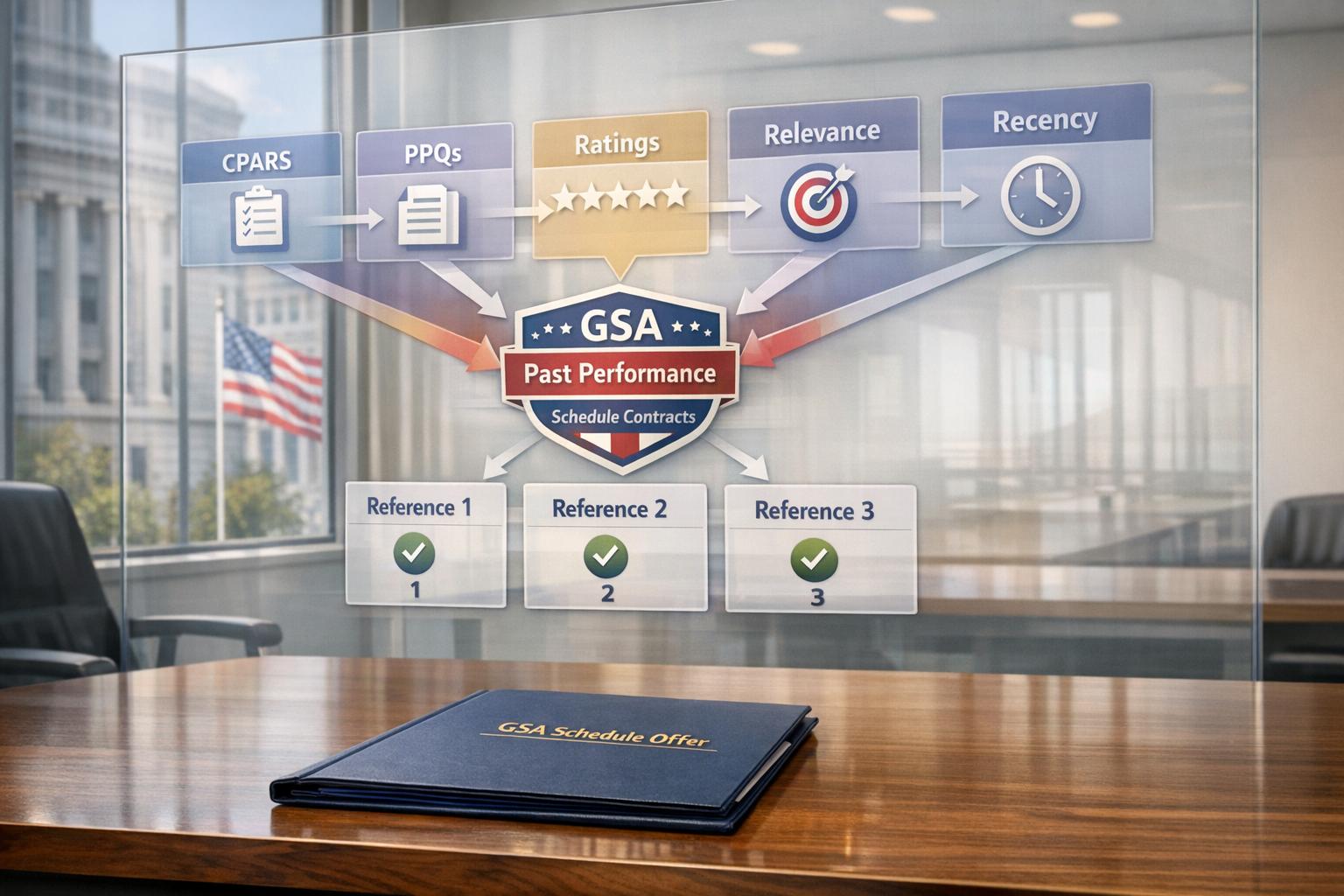
When bidding on a GSA Schedule contract, your past performance is a critical factor in determining whether you win. The General Services Administration (GSA) uses detailed evaluations to assess your ability to deliver quality work on time and within budget. Here’s what you need to know:
- What is Past Performance? It’s proof of how well you’ve completed similar projects, focusing on quality, timeliness, cost control, and customer satisfaction.
- Why Does GSA Care? Past performance helps GSA gauge your reliability and ability to meet contract requirements. They rely on systems like CPARS (Contractor Performance Assessment Reporting System) to evaluate contractors.
- How is It Rated? GSA uses a five-point scale: Exceptional, Very Good, Satisfactory, Marginal, and Unsatisfactory. Ratings of Satisfactory or higher are generally acceptable.
- What Counts as Relevant Work? Only projects completed in the last 3 years (or 6 years for construction) and aligned with the contract’s scope are considered. You’ll need at least three references or documented projects.
- Ways to Showcase Past Performance: Use CPARS reports, Past Performance Questionnaires (PPQs), or detailed narratives to demonstrate your qualifications.
To succeed, make sure your documentation is accurate, aligns with the contract’s requirements, and highlights your ability to manage similar projects effectively. Missing or incomplete information can hurt your chances, so double-check everything before submission.
What Is Past Performance and Why Does GSA Use It?
Past Performance Definition
Past performance is essentially proof of how well a contractor has delivered on previous projects. According to FAR Part 2, it refers to the performance of an offeror or contractor on active or completed contracts. But it’s not just about what kind of work was done – it’s about how it was done. Key factors like meeting deadlines, staying within budget, and ensuring client satisfaction take center stage.
Barbara Kinosky, Managing Partner at Centre Law Group, explains it clearly: "The government believes a contractor’s previous performance on a contract is an indicator of future performance".
This track record plays a crucial role in how GSA evaluates contractors because it helps determine their reliability and consistency.
Why GSA Requires Past Performance
For GSA, past performance serves as a vital tool for assessing contractor dependability. Under FAR 9.100–9.110, it’s used as a non-price factor to ensure the government receives the best value.
Here’s how it works: a Past Performance Evaluation Team (PET) reviews a contractor’s documented history and compiles a report for the Source Selection Official (SSO), who makes the final decision on awarding the contract. This process helps weed out contractors who may have impressive proposals but a history of missed deadlines, overspending, or subpar work.
GSA also leans on CPARS (Contractor Performance Assessment Reporting System) evaluations to measure performance history. For federal contracts exceeding $150,000, CPARS keeps a record of active evaluations, focusing on the past three years – or six years for construction and architect-engineer contracts. If a contractor lacks a performance history, they receive a neutral rating instead . This ensures every contractor is judged fairly, based on their track record or the absence of one.
Reporting Past Performance in CPARS
How GSA Evaluates Past Performance
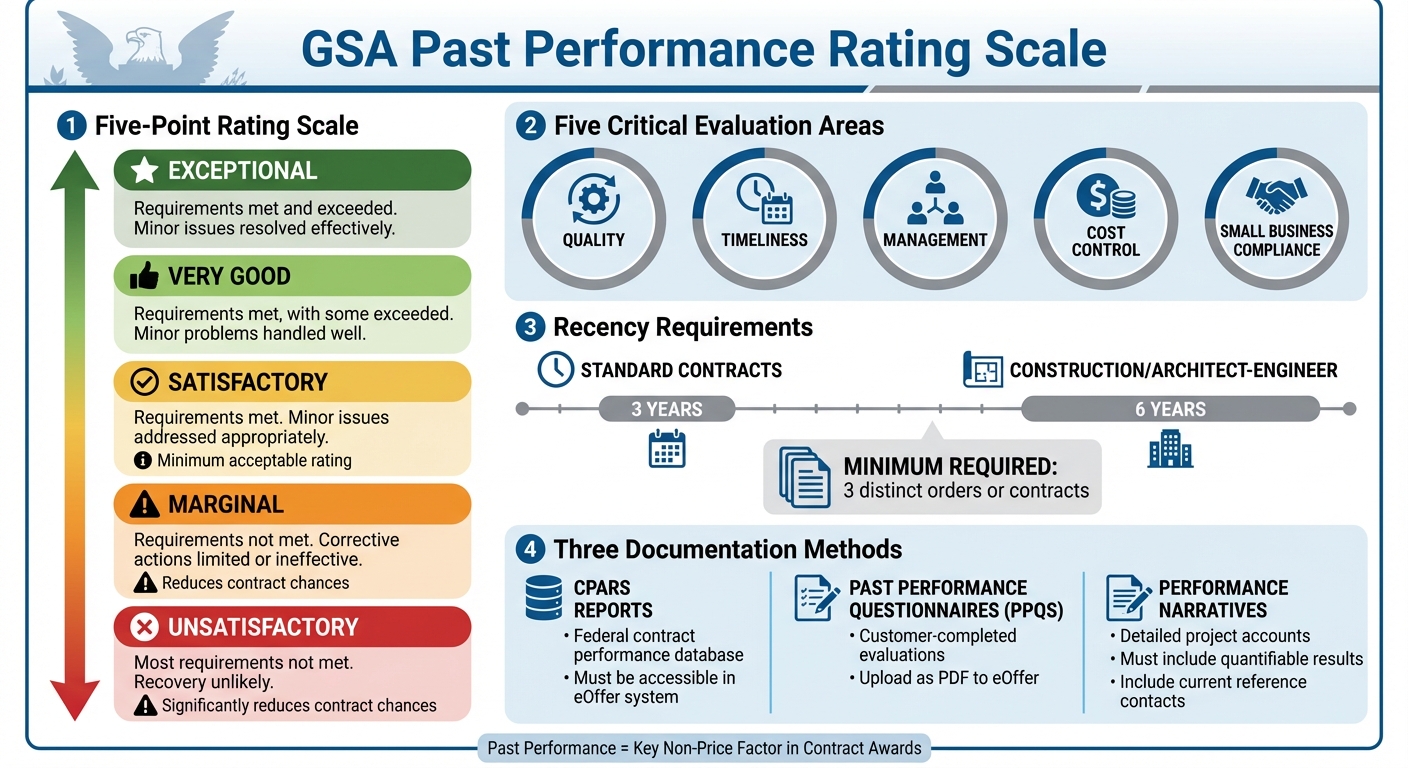
GSA Past Performance Rating Scale and Evaluation Criteria
The GSA Rating Scale
The General Services Administration (GSA) uses a five-point rating scale to assess contractor performance. This scale helps measure how well contractors meet contract requirements and resolve any issues that arise.
| Rating | Definition |
|---|---|
| Exceptional | Requirements met and exceeded; minor issues resolved effectively. |
| Very Good | Requirements met, with some exceeded; minor problems handled well. |
| Satisfactory | Requirements met; minor issues addressed appropriately. |
| Marginal | Requirements not met; corrective actions were limited or ineffective. |
| Unsatisfactory | Most requirements not met; recovery is unlikely. |
The Past Performance Evaluation Team (PET) uses these ratings to determine a contractor’s "confidence level" in delivering the required work. Ratings of Satisfactory or higher are generally acceptable, but Marginal or Unsatisfactory ratings can significantly reduce your chances of winning a contract. Beyond the numerical ratings, GSA also evaluates how closely your past work aligns with the current contract’s requirements.
How GSA Assesses Work Relevance
GSA doesn’t evaluate all past work – only projects that are "similar in scope" to the contract you’re bidding on. This means your previous projects must align with the products or services listed in the solicitation, particularly the Special Item Number (SIN) you’re offering.
The evaluation focuses on five critical areas:
- Quality of the product or service
- Timeliness of delivery
- Management effectiveness
- Cost control, especially in cost-reimbursement contracts
- Compliance with small business subcontracting requirements
This ensures that your work history directly demonstrates your ability to meet the demands of the new contract.
"Relevant customer references are defined as customers for whom the offeror has performed work similar in scope to products/services included in this solicitation." – GSA Solicitation
Your references must also meet recency requirements – typically, these are contracts or orders completed within three years of submitting your offer. Additionally, you need to demonstrate performance across at least three distinct orders or contracts. If your Contractor Performance Assessment Reporting System (CPARS) reports don’t cover three relevant projects, you’ll need to provide Past Performance Questionnaires from customer references. This approach ensures that your track record is both recent and relevant to the contract being awarded.
Past Performance Weight in Contract Awards
Past performance plays a critical role in the contract award process. It’s one of the key non-price factors GSA considers. According to FAR 9.1, past performance is used to determine whether a contractor is "responsible" and capable of performing the required work.
"Past performance information allows an agency to determine whether the contractor: Is responsible… [and] Offers the best value to the agency in performing the contract requirements." – Reuters/Practical Law
The PET compiles a detailed report that is submitted to the Source Selection Official (SSO), who makes the final decision. This means even a competitive price won’t guarantee a win if your past performance is weak. On the flip side, a strong performance history can set you apart from competitors, even if your pricing isn’t the lowest.
3 Ways to Demonstrate Past Performance to GSA
When submitting your GSA offer, you’ll need to provide three past performance references that prove your ability to manage the contract effectively. These references are essential, as they directly validate your qualifications against the evaluation criteria. To meet this requirement, GSA allows three different methods for documenting your past performance. You can mix and match these approaches to best suit your experience. Here’s a closer look at the three ways you can showcase your track record.
Using CPARS Reports
The Contractor Performance Assessment Reporting System (CPARS) is the federal government’s go-to database for tracking contractor performance. If you’ve worked on federal contracts before, your performance ratings are likely stored in CPARS. These reports must be accessible within the GSA eOffer system when you submit your proposal. To make the most of CPARS, ensure that the documented projects align closely with the scope of the GSA solicitation you’re pursuing. This means highlighting performance in areas like quality, timeliness, and cost control.
If any of your CPARS reports include negative feedback, you’ll need to address those issues directly in your proposal. And if you don’t have three qualifying CPARS reports, you’ll need to rely on the other methods outlined below to complete your submission.
Submitting Past Performance Questionnaires
If CPARS reports aren’t available or you need additional references, Past Performance Questionnaires (PPQs) are a solid alternative. These questionnaires are completed by your customers, who evaluate your performance on projects similar to the GSA contract you’re pursuing. Key areas assessed include quality, timeliness, cost management, and customer service.
Once completed, you’ll upload the PPQs as PDFs to the eOffer system. GSA provides a standardized template for these forms, but customers can use their own format as long as they address all required evaluation areas. If a customer prefers to send the PPQ directly to the GSA Procurement Contracting Officer (PCO), you’ll need to upload a letter in the eOffer system explaining this arrangement. Keep in mind, failing to upload either the completed PPQs or the explanatory letter could result in your proposal being rejected.
"A customer reference may use a format of their own choosing, but must address all of the evaluation areas outlined in the Past Performance Questionnaire." – GSA Website
Writing Past Performance Narratives
Past performance narratives allow you to go beyond standardized reports by providing a detailed account of your project experience. These narratives are your chance to highlight how you approach project execution, solve problems, and manage tasks effectively. They should tie directly to the Special Item Numbers (SINs) you’re targeting, offering a clear connection between your experience and the GSA contract requirements.
To craft a compelling narrative, structure it with clear sections: introduce the project, outline your methodology, discuss challenges, and detail quantifiable results. For instance, instead of vaguely stating that you completed a project on time, specify that you delivered an $850,000 IT modernization project two weeks early while cutting operational costs by 18%. Including these specifics not only strengthens your case but also demonstrates your ability to manage projects of similar scope and complexity.
Make sure to include current contact information for your project references, as GSA may contact them to verify your claims. Also, limit your examples to projects completed within the last three years to meet GSA’s recency requirements.
How to Prepare Past Performance Documentation
Preparing accurate and thorough past performance documentation is essential for showcasing your track record and meeting GSA’s evaluation criteria. This process involves carefully selecting relevant projects, ensuring they align with the target SIN requirements, and verifying every detail for accuracy.
Choosing the Right Projects
When selecting projects, focus on those that directly align with the targeted SIN, rather than simply highlighting high-value contracts. GSA evaluators prioritize projects that match the scope, complexity, and scale described in the SIN requirements.
Start by reviewing the SIN descriptions to identify projects that demonstrate the specific capabilities GSA seeks. This includes aligning with service categories, contract types (e.g., fixed-price or cost-reimbursement), dollar values, and geographic locations, where applicable.
"A commercial contract demonstrating the exact capabilities an agency needs can be more valuable than a federal contract in an unrelated field".
Your submission should include at least three distinct contracts or orders to show a breadth of experience. Avoid reusing the same client or project across multiple Past Project Descriptions, as this could suggest limited organizational capacity. For newer businesses without an extensive history, projects completed by predecessor companies or key personnel can be included.
Once you’ve identified suitable projects, confirm they meet GSA’s recency standards to ensure they qualify.
Meeting Recency Requirements
To demonstrate current capabilities, GSA requires project experience to fall within specific timeframes. CPARS reports and Past Performance Questionnaires must cover projects completed within the last three years. For project narratives, the work must have been completed within the last two years. If you’re submitting an ongoing project, ensure at least the base year or the first year of a multi-year task order has been completed.
After confirming recency, double-check that all supporting details are accurate and free of errors.
Verifying Your Documentation
Before uploading, take the time to verify all documents for accuracy, completeness, and traceability. For CPARS reports and Past Performance Questionnaires, ensure they follow the official format and meet the required timeframes. If a CPARS report contains negative feedback, include a documented explanation addressing the issue.
"A negative past performance rating, which could be due to the evaluator’s mistake or omission, might affect your ability to get future awards".
If you believe a rating is unjustified, use the 60-day comment period to submit a rebuttal or work with the evaluator to request a revision.
For Past Performance Questionnaires, confirm that all sections are completed, signed by the client, and address evaluation areas such as quality, timeliness, cost control, management, and small business subcontracting compliance. If a client prefers to send their PPQ directly to the GSA Contracting Officer, upload a letter in eOffer explaining this arrangement.
Each project narrative should include a signed and fully executed Statement of Work. Double-check that quantifiable results are accurate and that reference contact information is up to date. GSA evaluators will verify your claims, so any inconsistencies between your narrative and references could disqualify your proposal.
Conclusion
Grasping how GSA evaluates past performance is a crucial step for small businesses aiming to secure federal contracts. The process relies on presenting a solid track record through official documents like CPARS reports, Past Performance Questionnaires, and project narratives. These materials need to clearly demonstrate your ability to deliver quality work on time and within budget.
"Past performance information is one indicator of an offeror’s ability to perform the contract successfully." – GSA Solicitation
This highlights the importance of a well-thought-out documentation strategy. To strengthen your application, submit at least three references from separate contracts or orders. GSA evaluators focus on how relevant and aligned your work is with the contract’s scope, rather than just its size.
Failing to provide complete documentation can jeopardize your chances. If you lack sufficient CPARS reports, Past Performance Questionnaires can effectively showcase your private sector experience in a format that GSA evaluators can easily assess.
If navigating this complex process feels daunting, seeking professional help can simplify things significantly. GSA Focus offers tailored support to guide small businesses through the GSA Schedule acquisition process. From preparing documents to ensuring compliance and handling negotiations, their expertise can cut your direct involvement to just three hours while managing the 100+ hours typically needed for a full application. With a 98% success rate and a refund guarantee, they provide a reliable way to transform a challenging process into a straightforward path to federal contracts.
FAQs
What if I have no CPARS history?
If you don’t have a CPARS history, there are still ways to highlight your past performance. Share details about recent and relevant projects you’ve completed, include customer references, and provide detailed project descriptions. These approaches are perfectly acceptable during GSA contract evaluations and can help demonstrate your expertise and qualifications.
How do I prove my work is “relevant” to a SIN?
To show your work aligns with a SIN (Special Item Number), it’s important to highlight how your past performance meets the SIN’s specific requirements. This can be done by providing supporting documentation like:
- CPARS reports: These evaluations from the Contractor Performance Assessment Reporting System offer detailed insights into your performance on previous contracts.
- Past Performance Questionnaires (PPQs): Completed by clients or contracting officers, these provide direct feedback on your work quality and reliability.
- Project experience reports: These should outline relevant projects you’ve successfully delivered, emphasizing capabilities that match the SIN’s scope.
These materials help paint a clear picture of your expertise and track record, making it easier to demonstrate your ability to meet the SIN’s needs effectively.
How can I offset a negative past performance rating?
To handle a negative past performance rating, maintain a professional and factual tone in your response. Use the 14-day window to thoroughly review the evaluation for any potential errors. If you find discrepancies or believe the rating lacks context, you can request a higher-level review. In your reply, focus on correcting inaccuracies and providing relevant context, ensuring your points are clear and supported by evidence. This approach demonstrates accountability while addressing concerns constructively.
Related Blog Posts
- How to Use Past Performance in GSA Proposals
- Ultimate Guide to Marketing with Past Performance
- Ultimate Guide to GSA Past Performance Requirements
- What is GSA Past Performance Evaluation?