
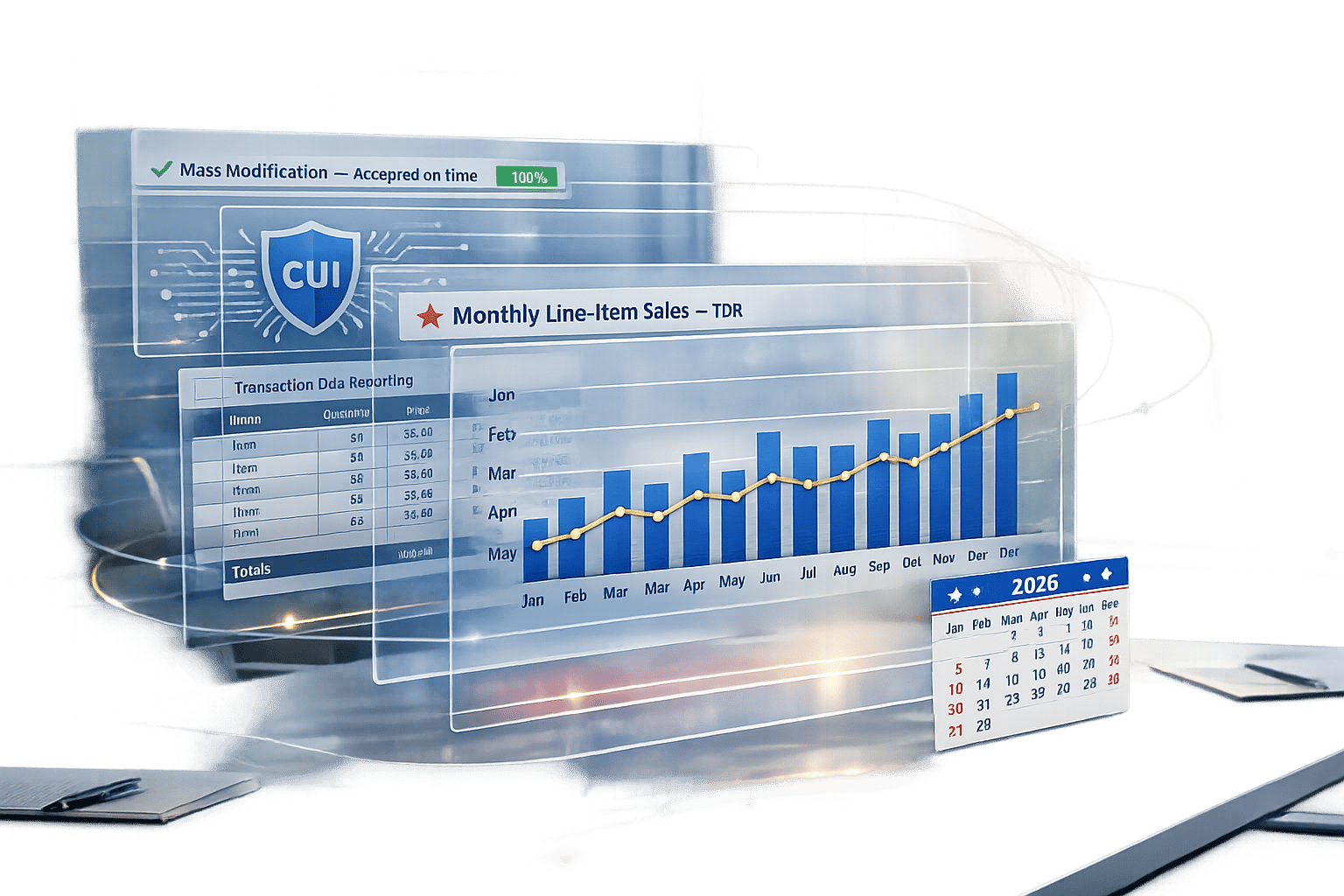
Big changes are here for GSA Schedule contractors in 2026. With the GSA MAS Solicitation Refresh 31, Transactional Data Reporting (TDR) is now mandatory for all contractors. Here’s what you need to know:
- Monthly Reporting: Sales data must be submitted monthly (within 30 days). Product contractors report 16 data points, while service contractors report 11.
- No More PRC & CSP Disclosures: The Price Reductions Clause (PRC) and Commercial Sales Practices (CSP-1) tracking are eliminated, reducing administrative burdens.
- Compliance Deadlines: Contractors must accept the TDR Mass Modification (A909) within 90 days to avoid contract suspension.
- Cybersecurity Updates: New rules for Controlled Unclassified Information (CUI) include third-party assessments and a one-hour incident reporting deadline.
These updates aim to improve transparency and reduce costs, with GSA projecting $50 million in annual savings. For small businesses, while the changes simplify some processes, they also demand better internal systems to handle detailed reporting. Contractors should act quickly to stay compliant and competitive.
GSA’s Mandatory Transactional Data Reporting Expansion
Changes to GSA Reporting Requirements in 2026
The introduction of GSA MAS Solicitation Refresh 31 in February 2026 marks a major shift in reporting requirements for contractors under the General Services Administration (GSA). Below, we’ll break down the most critical updates around transactional data, reporting schedules, and fee obligations.
Expanded Transactional Data Reporting (TDR) Coverage
Starting in 2026, Transactional Data Reporting (TDR) becomes mandatory for all MAS contractors, covering every Special Item Number (SIN). This change brings 112 previously exempt service SINs into the TDR framework, ensuring that all contractors – whether offering products or services – adhere to a unified, data-centric reporting system.
One major benefit of this update is the elimination of the Price Reductions Clause (PRC) and CSP-1 disclosure requirements. This change simplifies administrative tasks for contractors.
Contractors with pending non-TDR offers must either withdraw and resubmit under the new guidelines or face rejection, as legacy proposals will no longer be accepted.
In addition to broader TDR coverage, contractors must also adhere to updated reporting timelines.
New Monthly Reporting Rules for Specific SINs
One of the most notable adjustments is the shift from quarterly to monthly reporting for all sales. Contractors must submit their data through the FAS Sales Reporting Portal (SRP) within 30 calendar days after the end of each month.
The specifics of reporting vary depending on the type of contractor:
- Product contractors must report up to 18 data elements per line item, including details like manufacturer name, part number, Universal Product Code (UPC), quantity, unit price, and the shipping zip code.
- Services contractors are required to report around 11 data elements and upload the Performance Work Statement (PWS) or Statement of Work (SOW) for each transaction.
To comply, contractors must accept both the Refresh 31 Mass Modification and the TDR Mass Modification (A909) within 90 days of issuance. Failing to do so could result in contract suspension. Once accepted, the TDR requirements go into effect at the start of the next sales reporting quarter. For example, if modifications are accepted in February 2026, TDR reporting begins April 1, 2026.
Updated Industrial Funding Fee (IFF) Reporting
Changes to the Industrial Funding Fee (IFF) reporting process align with the new transactional data requirements. Although sales data must now be reported monthly, the IFF – still set at 0.75% of reported sales – remains due quarterly, within 30 days after quarter-end. Contractors, however, have the option to make monthly IFF payments if it better suits their accounting practices.
The GSA also estimates that eliminating PRC and CSP tracking will save contractors an average of 22 labor hours per contract annually. With the availability of real-time transactional data, GSA contracting officers will have better tools to identify pricing inconsistencies and negotiate more effectively. Federal Acquisition Service Commissioner Josh Gruenbaum emphasized this point:
“Fully implementing TDR will equip our contracting officers with comprehensive data on purchased items and their prices so they can negotiate effectively and serve as uncompromising fiduciaries of taxpayer dollars”.
These updates set the stage for improved compliance and deeper market insights, which will be explored further in the next section.
GSA Compliance Focus Areas and Market Data
The compliance landscape for 2026 is shaping up to be a pivotal moment for GSA oversight. Alongside technical reporting updates, the agency’s expanded access to data is reshaping how accountability and procurement strategies are handled across the federal marketplace.
Increased Emphasis on Transparency and Accountability
The rollout of GSA’s mandatory Transactional Data Reporting (TDR) program goes beyond simply gathering more information. Its goal is to equip contracting officers with a deeper understanding of market pricing and purchasing trends. Contractors are now required to submit 16 data elements monthly, up from 12 during the 2025 pilot phase. This detailed reporting enables GSA to identify pricing inconsistencies and negotiate better deals.
The benefits of these changes are already evident. During the phased TDR implementation in FY 2025, GSA achieved notable cost avoidance, with projections suggesting savings could reach $50 million now that TDR is mandatory for all MAS contracts. As GSA Administrator Edward Forst explained:
“This program mirrors what the private sector is already doing and will lead to smarter purchasing”.
This expanded data collection is not just about cost – it also lays the groundwork for better market insights and more robust accountability measures.
Beyond pricing, cybersecurity compliance is tightening as well. Contractors handling Controlled Unclassified Information (CUI) must now comply with NIST SP 800-171 Revision 3. This includes moving from self-attestation to mandatory third-party assessments. Additionally, contractors are required to report CUI incidents to GSA within one hour. Eric Crusius, a Partner at Hunton Andrews Kurth, offered a word of caution:
“The goals are really laudable, but from a practical standpoint, if they move too fast on it, I think [GSA] will lose a lot of contractors”.
These measures reflect GSA’s broader shift toward secure, data-driven contracting, which is essential for businesses of all sizes.
Key Findings from FY 2025 Market Data
The enhanced compliance measures introduced by GSA align with noticeable shifts in federal purchasing patterns, as revealed in FY 2025 data.
Federal marketplace activity in FY 2025 showed some unexpected trends. For instance, GSA Advantage sales in Q1 2025 dropped to $101 million – a 21% decrease compared to 2024 and a 26% decline from the four-year average spanning 2020 to 2023. However, this dip wasn’t consistent across all agencies. The Department of Veterans Affairs (VA) saw a 29% increase in spending, while the Department of the Navy experienced a 36% decrease, and the Department of Health and Human Services reported a 48% drop.
Product category data also highlighted these shifts. VA SIN A-70 (Physiotherapy Apparatus) sales skyrocketed by 683%, reaching $1.22 million in Q1 2025, while Photographic Supplies sales plummeted by 45%. These extremes suggest a growing focus on modernization priorities like healthcare technology, cloud infrastructure, and cybersecurity, while agencies reduced spending on less critical items.
Administrative changes also played a role in altering market dynamics. For example, a federal audit initiative in April 2025 limited or deactivated 468,243 government purchase cards, setting their spending limit to just $1. Despite the overall decline in spending, MAS contract approvals remained steady, with 170 approvals in March 2025 compared to 168 in March 2024. This consistency indicates that GSA is successfully maintaining its contractor pipeline, even as procurement priorities shift toward compliance and high-importance projects.
How Reporting Changes Affect Small Businesses
The move to mandatory Transactional Data Reporting (TDR) under Refresh 31 brings a mixed bag for small businesses with GSA Schedule contracts. On one hand, the elimination of Commercial Sales Practices tracking lightens some administrative tasks. But on the other, the new monthly reporting requirements and detailed data submissions demand greater coordination between sales, accounting, and compliance teams. This shift introduces both challenges and opportunities, setting the stage for small businesses to adapt and thrive in federal contracting.
Compliance Challenges for Small Businesses
One of the biggest hurdles for small businesses is integrating their systems to meet the new reporting standards. Each transaction now requires detailed data, including standardized product descriptions and part numbers across accounting, invoicing, and catalog systems. Any inconsistencies could lead to reporting errors, which might trigger audits.
The shift to monthly reporting also marks a major adjustment. While the Industrial Funding Fee (IFF) of 0.75% is still remitted quarterly, small businesses now need to establish a “monthly close” process for sales data. This practice, common among larger companies, may be unfamiliar to smaller contractors.
Data quality is another persistent issue. As of June 2025, the GSA Office of the Inspector General reported that 73% of TDR sales data was unusable due to poor implementation.
This means even small-volume contractors must comply if their Special Item Numbers (SINs) fall under TDR requirements.
The stakes are high when it comes to data accuracy. While TDR reduces the burden of the Price Reductions Clause, it introduces new risks under the False Claims Act if reporting errors occur. Small businesses must quickly verify their contract terms – if their agreements reflect the TDR version, they must stop tracking the Price Reductions Clause and begin monthly transactional reporting.
Growth Opportunities in Federal Contracting
Despite these challenges, the changes also open doors for growth. The removal of Commercial Sales Practices disclosures and the traditional Price Reductions Clause has simplified GSA Schedule participation. Christopher Griesedieck, Jr. and Dismas Locaria of Venable LLP described these requirements as:
“among the most burdensome requirements of the MAS program”.
This streamlining makes federal contracting more accessible to businesses that previously avoided it due to its complexity.
Federal Acquisition Service Commissioner Josh Gruenbaum highlighted the strategic benefits of TDR:
“Fully implementing TDR will equip our contracting officers with comprehensive data on purchased items and their prices so they can negotiate effectively and serve as uncompromising fiduciaries of taxpayer dollars”.
For small businesses, this means negotiations are now grounded in actual market transactions rather than theoretical commercial discount benchmarks. It’s a more transparent process, giving contractors a clearer understanding of expectations.
Additionally, the availability of contractor-reported TDR data through the Vendor Support Center provides small businesses with a competitive edge. This “Demand Data” reveals top-selling products and services, helping businesses identify trends and refine their pricing strategies based on what federal agencies are actively purchasing.
The federal contracting landscape is also shifting in favor of small businesses. The FY 2026 National Defense Authorization Act (NDAA) replaced the “lowest overall cost alternative” standard with a “best value” approach. This change prioritizes quality, past performance, and specialized expertise – areas where small businesses often excel. Furthermore, federal goals to award 23% of prime contracts to small businesses, with specific targets for women-owned and HUBZone-certified firms, create additional opportunities.
GSA has also lifted the 33% cap on Order Level Materials (OLMs), giving contractors more flexibility to include incidental products and services at the order level. Combined with the OneGov Initiative, which consolidates federal procurement, these changes create a steady flow of opportunities for small businesses that secure prime positions on MAS or participate in Joint Ventures and Mentor-Protégé agreements.
For small businesses navigating these changes, expert guidance can make all the difference. Services like GSA Focus (https://gsascheduleservices.com) help contractors handle compliance, document preparation, and negotiations, allowing them to focus on delivering results rather than struggling with administrative hurdles.
Transactional vs. Aggregate Reporting: A Comparison
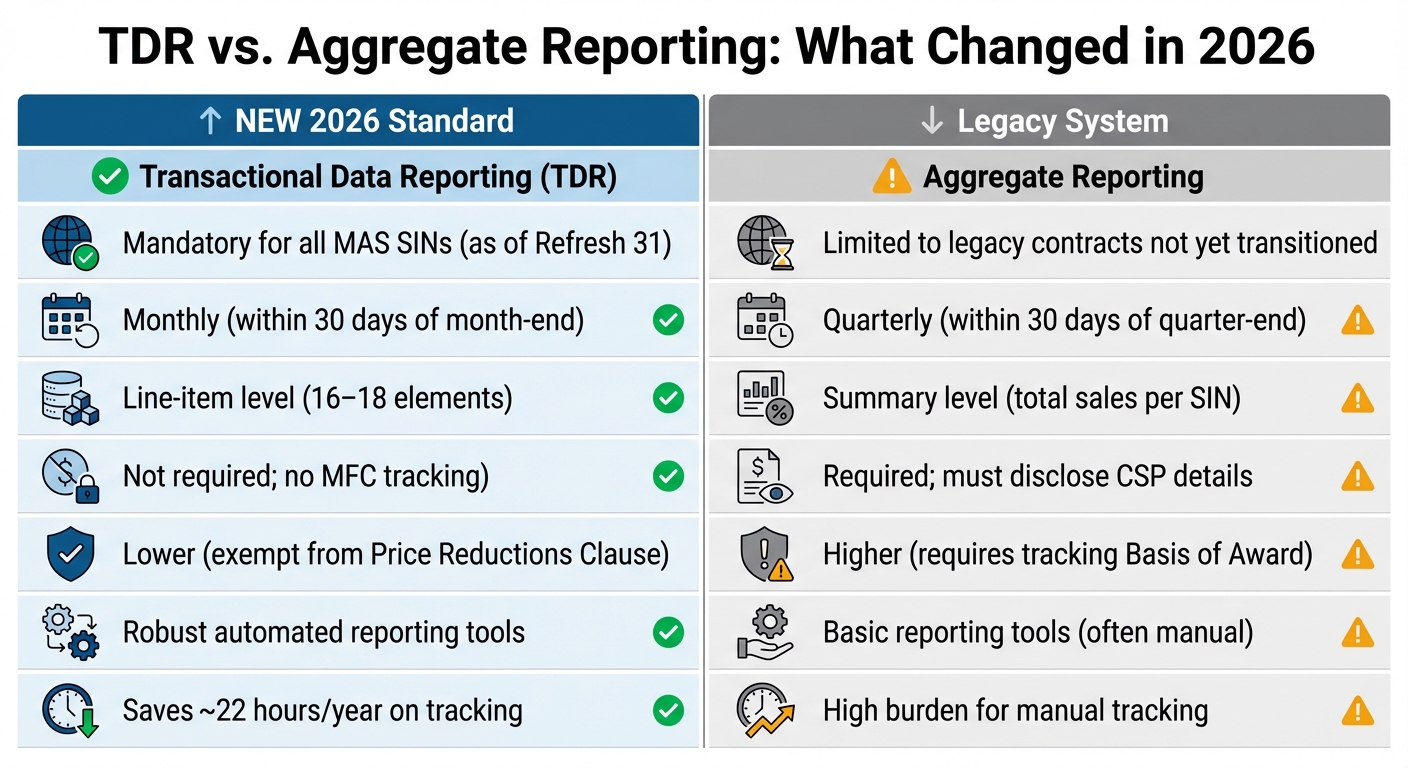
TDR vs Aggregate Reporting: GSA Sales Requirements Comparison 2026
In early 2026, the introduction of Refresh 31 made Transactional Data Reporting (TDR) mandatory for all Multiple Award Schedule (MAS) contractors. This marked the end of aggregate reporting, bringing significant changes to how contractors report sales data.
The key difference between the two systems lies in the level of detail required. TDR demands itemized transaction details, capturing 16–18 specific data points like manufacturer part numbers, unit measures, and prices. In contrast, aggregate reporting only required summary-level sales totals for each Special Item Number (SIN). To meet TDR requirements, contractors must now use accounting systems capable of automatically capturing detailed data, eliminating the manual process of preparing quarterly summaries.
Another major shift is the exemption from legacy pricing disclosures under TDR. Contractors no longer have to comply with the Price Reductions Clause, track Most Favored Customer (MFC) or Basis of Award pricing, or provide Commercial Sales Practices (CSP) disclosures. These requirements were a cornerstone of aggregate reporting and often led to audits and financial recoupments.
This change aligns with the General Services Administration’s (GSA) goal of streamlining procurement processes and increasing transparency as part of its 2026 initiatives.
Reporting Methods Comparison Table
| Feature | Transactional Data Reporting (TDR) | Aggregate Reporting |
|---|---|---|
| Applicability | Mandatory for all MAS SINs (as of Refresh 31) | Limited to legacy contracts not yet transitioned |
| Frequency | Monthly (within 30 days of month-end) | Quarterly (within 30 days of quarter-end) |
| Data Granularity | Line-item level (16–18 elements) | Summary level (total sales per SIN) |
| Pricing Disclosure | Not required; no MFC tracking | Required; must disclose CSP details |
| Compliance Risk | Lower (exempt from Price Reductions Clause) | Higher (requires tracking Basis of Award) |
| System Needs | Robust automated reporting tools | Basic reporting tools (often manual) |
| Labor Impact | Saves ~22 hours/year on tracking | High burden for manual tracking |
Despite its benefits, TDR’s monthly reporting and detailed data submissions require contractors to invest in automated systems upfront. For contractors still using aggregate reporting, it’s crucial to accept the “Participate in TDR” Mass Modification within the 90-day window to ensure compliance.
This updated reporting framework highlights GSA’s shift toward more detailed, real-time data collection, which supports its broader market and compliance goals.
Conclusion
The 2026 Refresh 31 introduces Transactional Data Reporting (TDR), a major overhaul in GSA sales reporting. This change requires all MAS contractors to submit detailed line-item data monthly, replacing the older Commercial Sales Practices disclosures and the Price Reductions Clause, both of which demanded significant administrative effort.
These changes mean contractors need to act fast to adapt their systems and processes. Small businesses, in particular, should prioritize compliance immediately. Contractors must accept the Refresh 31 and TDR Mass Modifications within 90 days and ensure their systems can capture all 16 required data elements. Reporting under TDR begins on the first day of the quarter after accepting the modification. Even when contractors have no sales in a given month, they are still required to submit a report.
The financial benefits are notable: GSA estimates $50 million in annual cost savings for the government with full TDR implementation, while contractors could save over $3,000 annually on compliance costs. Josh Gruenbaum, Federal Acquisition Service Commissioner, emphasized the importance of this shift:
“Fully implementing TDR will equip our contracting officers with comprehensive data on purchased items and their prices so they can negotiate effectively and serve as uncompromising fiduciaries of taxpayer dollars”.
For contractors navigating this transition, expert assistance can make all the difference. GSA Focus (https://gsascheduleservices.com) offers tailored support for small businesses managing GSA Schedule Contracts, including help with document preparation, compliance, and ongoing guidance – services that are invaluable during regulatory changes like TDR.
This move toward transaction-focused reporting highlights GSA’s dedication to data-driven procurement and greater market transparency. Contractors who adapt quickly and maintain accurate monthly reporting will position themselves for success in the evolving federal marketplace.
FAQs
What systems do I need to capture all required TDR data fields?
To ensure all necessary TDR data fields are captured, utilize the FAS Sales Reporting Portal (FAS SRP) – the designated platform for submitting transactional data. This system accommodates the reporting of 16 mandatory data points. Stay prepared to adjust your processes, as the GSA plans to introduce additional TDR fields and quality measures during solicitation updates expected in May 2024. Make sure your systems align with FAS SRP requirements for smooth data submissions.
How do I fix errors after submitting a monthly TDR report?
To fix errors in a submitted TDR report, start by carefully reviewing it for any inaccuracies or missing information. If you spot issues, refer to GSA’s TDR reporting guidelines and make the necessary updates through the designated portal. It’s also a good idea to ensure your data collection methods are accurate and, if possible, automated to minimize errors in the future. Consistently reviewing your submissions can help you stay compliant and avoid unnecessary delays in the reporting process.
What happens if I miss the 90-day A909 mass mod deadline?
Missing the 90-day A909 mass modification deadline could lead to the removal of your GSA Schedule contract from GSA eLibrary, GSA Advantage, and eBuy. If that happens, your ability to pursue federal contracting opportunities through GSA will end as of March 2026. To keep your contract active and maintain access to these opportunities, make sure to meet the compliance requirements on time.
Related Blog Posts
- Ultimate Guide to GSA Compliance Standards
- How to Get a GSA Contract in 6 Steps
- GSA Reporting Deadlines: Ultimate Guide
- GSA Modification Documentation: Trends in 2026