
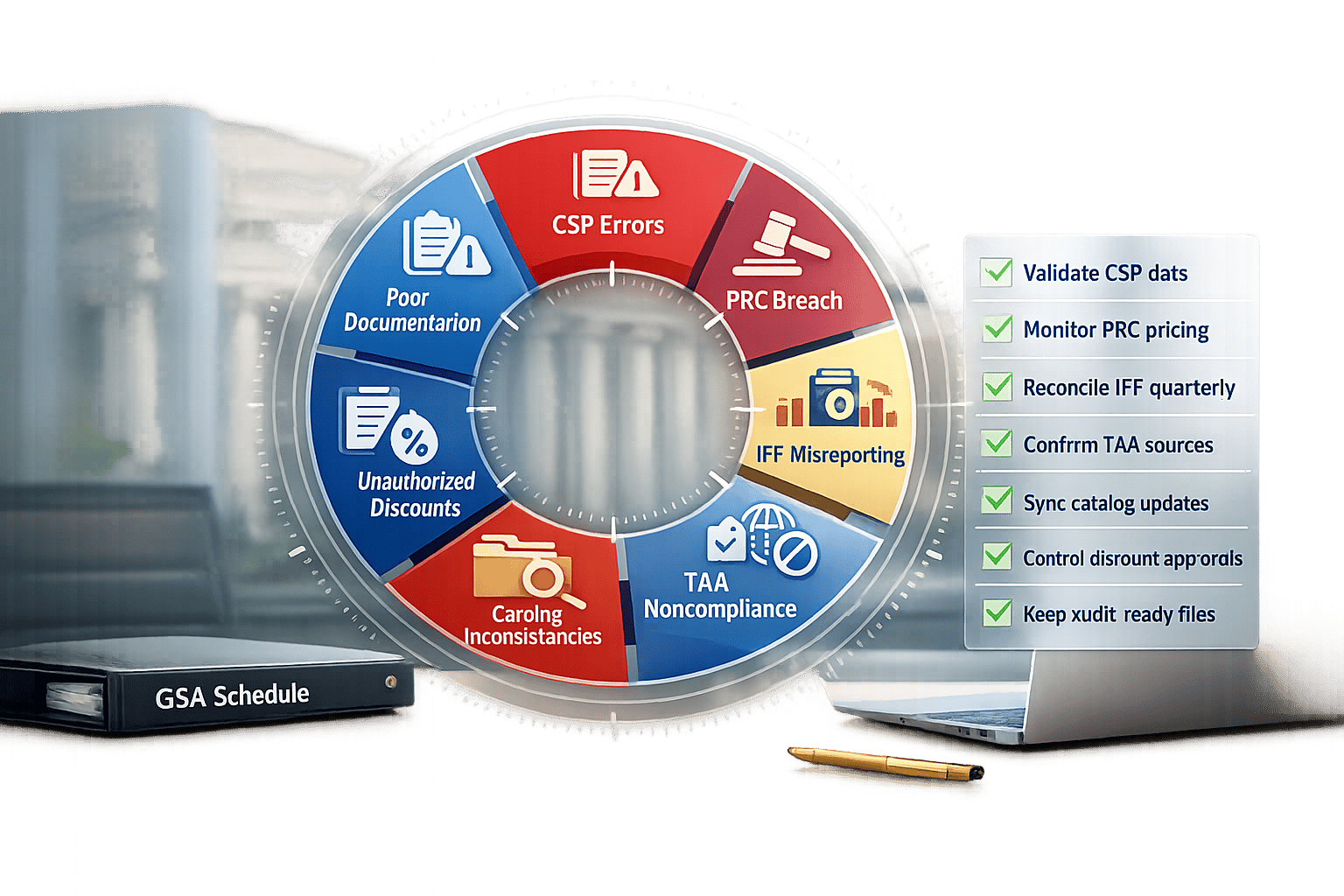
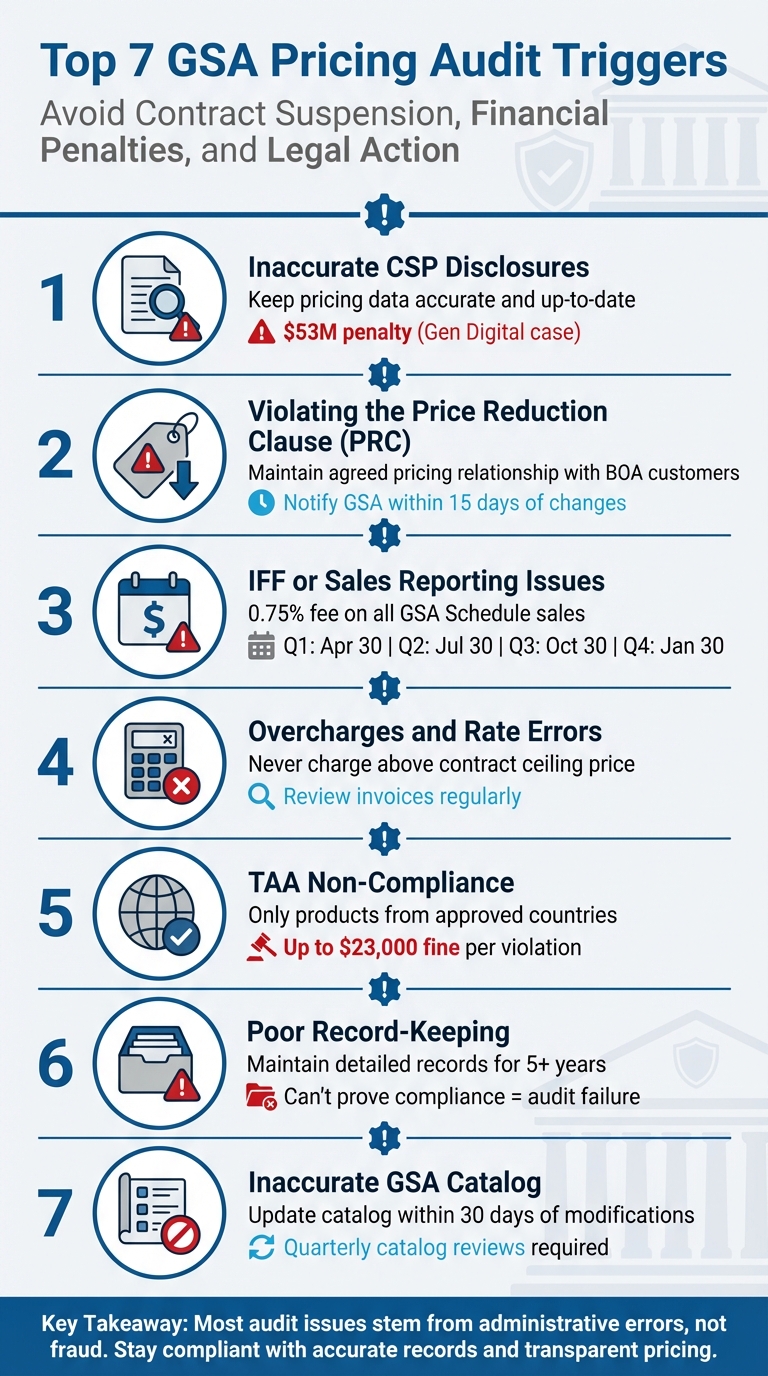
Failing a GSA pricing audit can lead to contract suspension, financial penalties, or even legal action. To avoid these pitfalls, you need to understand the most common audit triggers and how to prevent them. Here’s a quick overview:
- Inaccurate CSP Disclosures: Errors or omissions in Commercial Sales Practices (CSP) disclosures can lead to severe penalties. Always keep your pricing data accurate and up-to-date.
- Violating the Price Reduction Clause (PRC): Failing to maintain the agreed pricing relationship with your Basis of Award (BOA) customers can trigger audits. Notify GSA of any changes within 15 days.
- IFF or Sales Reporting Issues: Missing or incorrect Industrial Funding Fee (IFF) submissions and sales reports can result in contract termination. Always reconcile sales records and submit reports on time.
- Overcharges and Rate Errors: Charging above your contract’s ceiling price or misapplying discounts can lead to audits. Regularly review invoices and pricing structures.
- TAA Non-Compliance: Listing products from non-approved countries violates the Trade Agreements Act (TAA). Verify and document the Country of Origin for all products.
- Poor Record-Keeping: Lack of proper documentation makes it difficult to prove compliance. Maintain detailed records of pricing, discounts, and sales for at least five years.
- Inaccurate GSA Catalog: Discrepancies between your GSA Advantage! catalog and your contract rates can raise red flags. Keep your catalog accurate and aligned with contract terms.
Key Takeaway: Most audit issues stem from administrative errors, not deliberate fraud. By maintaining accurate records, keeping pricing transparent, and adhering to GSA rules, you can reduce risks and protect your contract.
Need help navigating GSA compliance? Reach out to experts who can guide you through the process and help you stay audit-ready.
7 Common GSA Pricing Audit Triggers and Prevention Tips
1. Inaccurate or Incomplete Commercial Sales Practices (CSP) Disclosures
Your Commercial Sales Practices (CSP) disclosure is a snapshot of your pricing and discount policies over the past 12 months. The GSA relies on this information to identify your Most Favored Customer (MFC) and negotiate a government discount that matches – or beats – your best commercial offer. When CSP disclosures are incomplete, inaccurate, or misleading, it often leads to GSA pricing audits and serious financial consequences.
The stakes couldn’t be higher. For example, in January 2024, the U.S. District Court held Gen Digital Inc. liable for nearly $53 million under the False Claims Act. The company had failed to disclose details about reward discounts and rebate programs in its CSP disclosures, resulting in 3,352 affected transactions and penalties totaling $36,872,000, plus treble damages. Similarly, in 2014, Hewlett-Packard settled claims for $108 million due to similar disclosure issues.
Some common mistakes include failing to list specific customer types or discount levels, providing inaccurate standard price details, or not updating disclosures when pricing practices change. Even temporary offers, like volume discounts or promotional rebates, must be disclosed. It’s better to include too much information than to risk being seen as withholding critical details.
Your CSP also establishes the Basis of Award (BOA) customer, which acts as the pricing benchmark for your entire GSA contract. If you offer a discount better than what’s disclosed to your BOA customer, you must notify your GSA Contracting Officer within 15 calendar days. Failure to do so can trigger the Price Reductions Clause and lead to an audit.
To stay compliant, maintain a centralized repository of pricing records – such as invoices, contracts, and discount structures – and ensure your CSP is updated whenever contracts are modified or renewed. Regularly engage with your sales team to confirm that actual practices align with the disclosed CSP. Treat your CSP as a living document that evolves with your business practices.
2. Non-Compliance with the Price Reduction Clause (PRC)
The Price Reduction Clause (PRC), outlined in GSAR 552.238-81, is all about ensuring that the agreed discount relationship between the federal government and your Basis of Award (BOA) customer stays intact. Here’s how it works: if you initially offer your BOA customer a 5% discount and the government a 10% discount, that 5-point difference must remain constant. If you later increase the discount for your BOA customer to 9% but fail to adjust the government’s discount to 14%, you’ve disrupted the balance. This triggers the PRC, requiring you to notify your GSA Contracting Officer within 15 calendar days of the price reduction. Understanding these details is essential to avoid unintended breaches and the audits that often follow.
Failing to comply can lead to serious consequences, such as overcharge repayments, contract suspensions, or even violations of the False Claims Act if non-disclosure is intentional.
"The PRC isn’t just legal jargon; it’s a financial landmine that can detonate profits, trigger audits, and even terminate contracts." – iQuasar LLC
Another challenge is the misclassification of discounts. Many contractors struggle to differentiate between standard discounts (routine reductions that trigger PRC) and non-standard discounts (one-time exceptions that might not trigger PRC if properly documented). To complicate matters, sub-to-prime work is considered a commercial transaction under the PRC, a fact that often goes unnoticed. For contractors not using Transactional Data Reporting (TDR), End-of-Term Contractor Assessments occur every five years. During these assessments, GSA reviews BOA transactions to confirm compliance. Interestingly, TDR participants face 30% fewer compliance issues because they are exempt from PRC requirements.
To stay on the right side of compliance:
- Clearly define your BOA customer in writing.
- Train your sales team to spot discounts that could disrupt the pricing relationship.
- Use automated CRM tools to track BOA pricing in real time.
- Conduct quarterly internal audits comparing commercial sales data with GSA invoices.
- If eligible, opt into TDR to simplify PRC tracking.
3. Failing to Submit the Industrial Funding Fee (IFF) or Misreporting Sales
When it comes to avoiding audit triggers, staying on top of fee submissions and sales reporting is crucial.
The Industrial Funding Fee (IFF) is a 0.75% fee on all GSA Schedule sales. This fee supports the Federal Supply Schedules program and, while technically paid by the government buyer as part of the purchase price, it’s the contractor’s responsibility to report and remit it to GSA every quarter. Missing a payment or misreporting sales figures can quickly draw scrutiny from an Industrial Operations Analyst (IOA) and potentially lead to an investigation by the GSA Office of Inspector General (OIG).
Even if you’ve had no sales during a quarter, you’re still required to submit a "zero sales" report. Skipping this step is considered a violation of your contract and could result in its termination. Deadlines for sales reports and IFF payments fall 30 days after the end of each quarter: April 30 (Q1), July 30 (Q2), October 30 (Q3), and January 30 (Q4).
"Missing reports or underreporting sales raise red flags."
- Bipin, GSA Contract Services
For context, if your GSA sales total $100,000, you owe $750 in IFF. Mistakes often happen when contractors include non-reportable items – like open market products, shipping fees, or taxes – in their reported sales totals. IOAs closely examine invoices and purchase orders, and any mismatches can lead to a deeper audit.
To stay compliant, reconcile your GSA sales records every 30 days instead of waiting until the end of the quarter. This proactive approach helps catch errors early. Consider setting up automated reminders for deadlines and using a system that separates GSA Schedule sales from other transactions. Also, remember that GSA requires contractors to maintain all supporting documentation for five years.
4. Overcharges and Overstated Rates on Task Orders
Overcharges and overstated rates are another major factor that can trigger audits, especially when they breach your contract’s ceiling price. Such violations not only break compliance rules but can also lead to contract suspensions and even referrals to the Department of Justice (DOJ) under the False Claims Act.
One common cause of overcharges is a Price Reductions Clause (PRC) violation. For example, if a change in a Basis of Award (BOA) discount isn’t reflected in your GSA pricing within 15 days, you’re at risk of overcharging. This failure to adjust disrupts the agreed-upon pricing relationship and draws additional attention from auditors. Professional service providers, who are not eligible for Transactional Data Reporting (TDR), often face heightened scrutiny and are more frequently targeted for Office of Inspector General (OIG) audits. These contractors are subject to routine assessments to ensure compliance with pricing rules.
To minimize risks, it’s essential to take proactive measures. Keep an up-to-date master price list aligned with your contract, conduct quarterly internal audits of invoices, and set up automated alerts to track changes in BOA discounts. These steps, combined with earlier compliance controls, can help you avoid potential audit triggers.
5. Trade Agreements Act (TAA) Non-Compliance
Having non-compliant products on your GSA Schedule is like walking a tightrope – you risk triggering an audit and losing your contract entirely. The Trade Agreements Act of 1979 requires that the U.S. government only buys products made or significantly transformed in the United States or in countries with approved trade agreements. Since GSA Schedule contracts always exceed the TAA’s threshold of $183,000, every product you list must meet these requirements.
GSA and the Office of Inspector General (OIG) closely monitor the Country of Origin (COO) information provided in the GSA Advantage! catalog. Mislabeling or listing products from non-compliant countries – such as China, India, Russia, Malaysia, or Vietnam – immediately raises alarms. TAA violations are one of the leading reasons contracts are canceled during GSA audits. And the penalties are steep: violations can lead to prosecution under the False Claims Act, resulting in triple damages and fines as high as $23,000 per violation.
One common pitfall is relying on verbal assurances from suppliers instead of obtaining written certifications. If you’re a reseller, you need official documentation verifying each product’s origin – don’t just take your supplier’s word for it. Back in May 2016, the GSA issued notices to thousands of contractors, urging stricter compliance with TAA regulations due to mounting Congressional pressure.
To safeguard your contract, create and maintain a dedicated compliance file for each product, including manufacturer certificates and bills of lading. If you’re claiming “substantial transformation” – where a product’s essential character is changed through manufacturing or processing in a TAA-approved country – document every step of that transformation. Typically, this means showing that at least 50% of the production occurred in an approved country.
Staying compliant doesn’t stop at record-keeping. Your catalog must always be accurate and up-to-date. Even if you use automated tools to sync your listings with GSA Advantage!, the responsibility for ensuring TAA compliance ultimately falls on you. Conduct bi-annual reviews of your catalog to remove discontinued or non-compliant items. Additionally, update your listings promptly if there are any changes in sourcing or manufacturing locations. Taking these steps will help you steer clear of potential compliance issues and protect your contract.
6. Poor Record-Keeping and Documentation
Your records are your first line of defense. Without proper documentation, contractors struggle to prove compliance with key requirements like pricing disclosures and the Price Reduction Clause (PRC). This lack of proof often leads to questioned costs – or worse, allegations under the False Claims Act. If you can’t provide a clear audit trail, you’re essentially asking auditors to trust you blindly, which is never a winning strategy. Accurate and thorough records are the backbone of GSA pricing compliance.
The challenge is real: GSA has labeled MAS pricing procedures and related record-keeping as one of its "most burdensome information collections under the Paperwork Reduction Act of 1995". But no matter how time-consuming, these records are non-negotiable. Contractors are expected to maintain detailed documentation of pricing policies, sales records, and labor data.
Here’s a cautionary tale: During a preaward audit, one contractor faced ceiling price reductions because they lacked detailed labor cost records and documentation of non-GSA sales discounts. With limited data, auditors relied on the contractor’s non-GSA pricing to recommend lower GSA rates, identifying $12,500 in potential overcharges from unverified task order billings.
Poor documentation is a frequent audit trigger. The GSA OIG consistently highlights this issue in its "Top Five Failures" series, showing how missing records have led to overcharge findings and rate reductions. Even one undocumented commercial discount can snowball into PRC violations or defective pricing claims, significantly increasing compliance risks. And with GSA’s mandatory Transactional Data Reporting (TDR) set to roll out across all Special Item Numbers by FY26, the importance of maintaining accurate sales and pricing records will only grow.
To avoid these pitfalls, consider these strategies:
- Use digital tools to track CSP and PRC data.
- Conduct quarterly audits of sales records and IFF reports.
- Keep all commercial invoices with discount details for at least six years.
- Map labor categories to task orders and back them up with timecards.
- Maintain a centralized compliance folder with timestamped records and automated reconciliations for PRC and IFF.
- Perform annual pricing reviews and address discrepancies immediately through modifications.
7. Inaccurate GSA Advantage! Catalog or Price List
Your GSA Advantage! catalog serves as the public representation of your pricing, making its accuracy absolutely critical. Any discrepancies between your listed prices and your negotiated contract rates can lead to audit risks. The GSA Office of Inspector General (OIG) frequently cross-references catalog prices with reported sales data and your Basis of Award (BOA) pricing. When mismatches are found, they can suggest overcharges or violations of the Price Reduction Clause, prompting deeper scrutiny of your sales practices.
The expectations for accuracy leave no room for error. Every price in your catalog must align with your GSA Schedule rates, including any discounts, promotions, or modifications tied to your BOA. If you offer rebates, volume discounts, or limited-time deals, these must also be reflected in your GSA pricing. Additionally, GSA mandates catalog updates within 30 days of any contract modification. If your catalog isn’t current, it stops being a sales tool and becomes a liability instead.
Contractors with high sales volumes or those flagged for Transactional Data Reporting (TDR) discrepancies face even greater risks. GSA’s automated systems continuously scan for non-compliance, and items that don’t meet requirements can be removed immediately. For instance, an OIG report on IT resellers uncovered numerous cases where GSA-listed prices exceeded commercial rates, highlighting systemic catalog issues. These automated checks make it clear: catalog accuracy isn’t optional.
The consequences of inaccuracies can be severe. You may face retroactive price adjustments, financial penalties for overcharges, contract sanctions, or even termination. These issues can also come to light during mergers or acquisitions, potentially lowering your company’s value, or during End-of-Term Assessments, which require thorough internal compliance reviews.
To avoid these risks, make catalog reviews a quarterly priority. Compare your GSA prices with your actual commercial sales data, and use tools like GSA’s eOffer and eLibrary to confirm accuracy before submitting updates. Maintaining a master price list that mirrors your signed contract – including SINs, SKUs, awarded prices, and country of origin – is essential. Think of your catalog as a living document that demands regular attention and updates.
How GSA Focus Can Help
GSA Focus takes the hassle out of GSA Schedule compliance by managing everything from document preparation to contract administration and audit prevention. They ensure that each step – whether it’s paperwork or negotiations – is handled efficiently, so small businesses can focus on securing federal contracts.
One of their key strengths is minimizing audit risks. GSA Focus addresses common triggers like errors in Commercial Sales Practices (CSP) disclosures or Price Reductions Clause (PRC) violations. They carefully review all required Multiple Award Schedule (MAS) documents to ensure accurate CSP reporting and maintain clear communication with GSA Contracting Officers. If the Office of Inspector General (OIG) initiates an audit, GSA Focus steps in to work directly with auditors, using their expertise to navigate the complexities of federal regulations. They also stress that most audit issues arise from neglect or misunderstanding – not deliberate fraud – making professional oversight crucial.
When it comes to pricing, GSA Focus helps establish a sustainable discount structure during the proposal phase, ensuring compliance with PRC requirements. They verify that your Final Contract Price stays below the awarded ceiling rates and ensure any commercial price changes are reported to your Contracting Officer within the mandatory 15-day timeframe. Additionally, their training equips your sales team to differentiate between standard and non-standard discounts, reducing the chance of accidental PRC violations. This hands-on approach helps your business stay compliant while focusing on winning government contracts.
Conclusion
GSA pricing compliance isn’t just about avoiding audits – it’s a safeguard for your contract and your business’s reputation. The seven triggers we’ve discussed, from errors in Commercial Sales Practices disclosures to outdated GSA Advantage! catalogs, are entirely avoidable with the right systems in place. Most compliance issues arise from simple oversights rather than intentional violations, making proactive management absolutely essential.
The consequences of non-compliance, however, can be severe. They range from contract suspensions and mandatory government refunds to potential referrals to the Department of Justice under the False Claims Act. To mitigate these risks, it’s crucial to conduct regular audits, keep your catalogs up to date, and maintain documentation for at least five years. Beyond penalties, non-compliance can jeopardize your ability to secure future federal contracting opportunities – an impact no business can afford to ignore.
FAQs
What documents should I keep to pass a GSA pricing audit?
To successfully navigate a GSA pricing audit, it’s crucial to keep your records organized and up-to-date. Key documents to have on hand include your GSA Price List, commercial sales practices disclosures, financial statements, and detailed records of any price reductions or discounts offered. Additionally, maintain accurate product descriptions, units of measure, and any contract amendments. Regularly reviewing and updating these materials ensures you’re always prepared and in compliance with GSA requirements.
How do I know if a discount triggers the Price Reduction Clause (PRC)?
If you offer a discount to your Basis of Award (BOA) customer that exceeds the pricing or terms in your GSA contract, the Price Reduction Clause (PRC) may be triggered. To steer clear of this, it’s crucial to maintain consistent pricing relationships between your BOA customer and the GSA. Make it a habit to regularly review your pricing strategies and ensure your commercial sales disclosures are clear and accurate. This proactive approach can help you avoid accidental PRC violations.
How can I confirm a product is TAA-compliant before listing it?
To meet TAA compliance requirements, your product must be either entirely made or significantly transformed in the U.S. or a country designated under the TAA. It’s crucial to keep thorough records of your supply chain and manufacturing processes to demonstrate compliance. Falling short of these requirements can jeopardize your ability to sell to the federal government, making it vital to confirm the origin of your product.
Related Blog Posts
- Top 5 Compliance Issues in GSA Contracts
- Common GSA Compliance Mistakes And Fixes
- Common GSA Audit Issues and How to Avoid Them
- How GSA Pricing Works: A Guide for Vendors