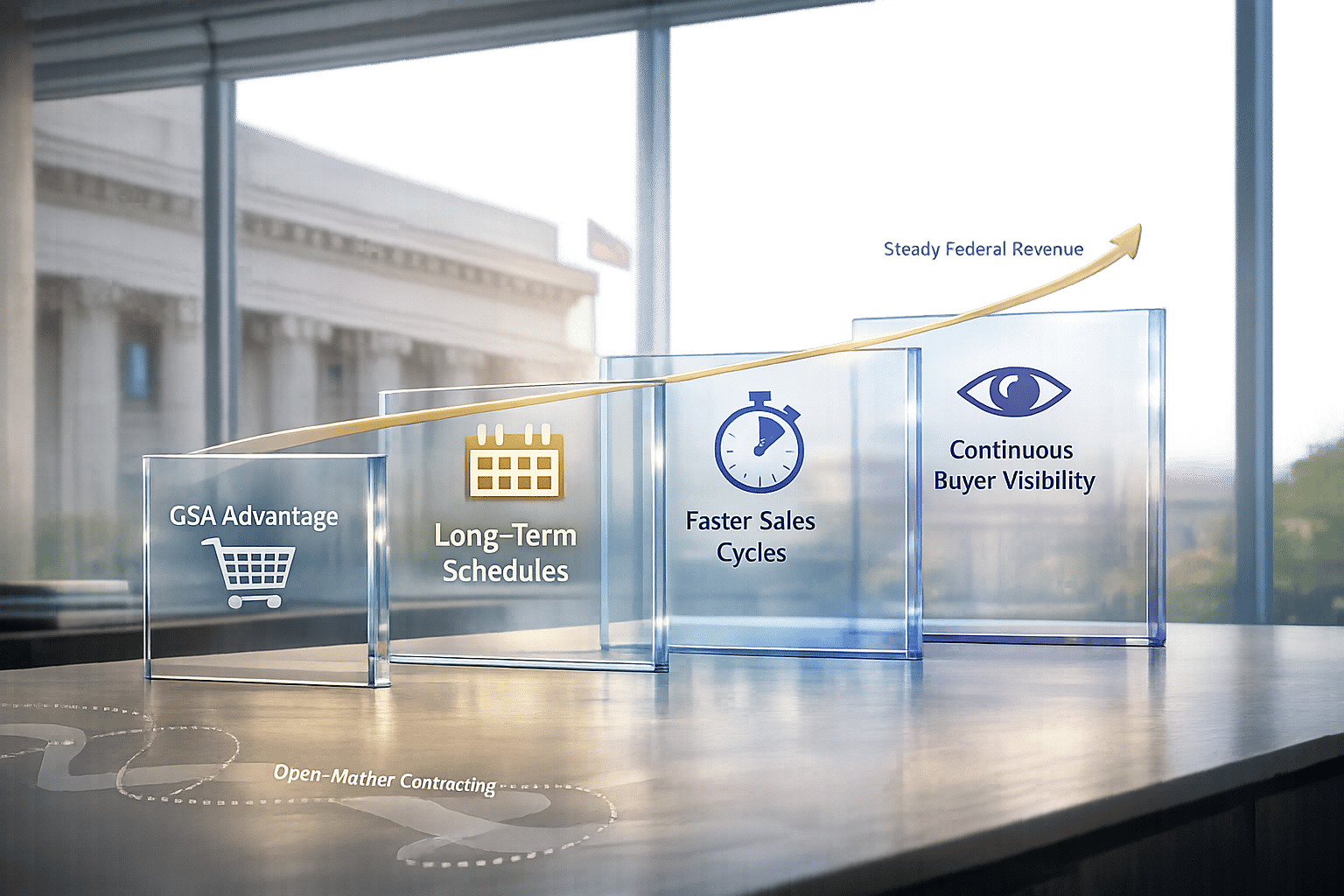
GSA Advantage simplifies federal procurement by connecting pre-approved vendors with government buyers. With access to over 11 million products and a streamlined process, it reduces procurement timelines from months to days. Vendors benefit from long-term contracts (up to 20 years), predictable revenue, and continuous exposure to 450,000+ government buyers. Unlike open-market contracting, which is short-term and highly competitive, GSA Advantage offers stability, faster sales cycles, and repeat business opportunities. While the application process can take 6–12 months, platforms like GSA Focus can help vendors navigate the complexities and unlock federal contracting success.
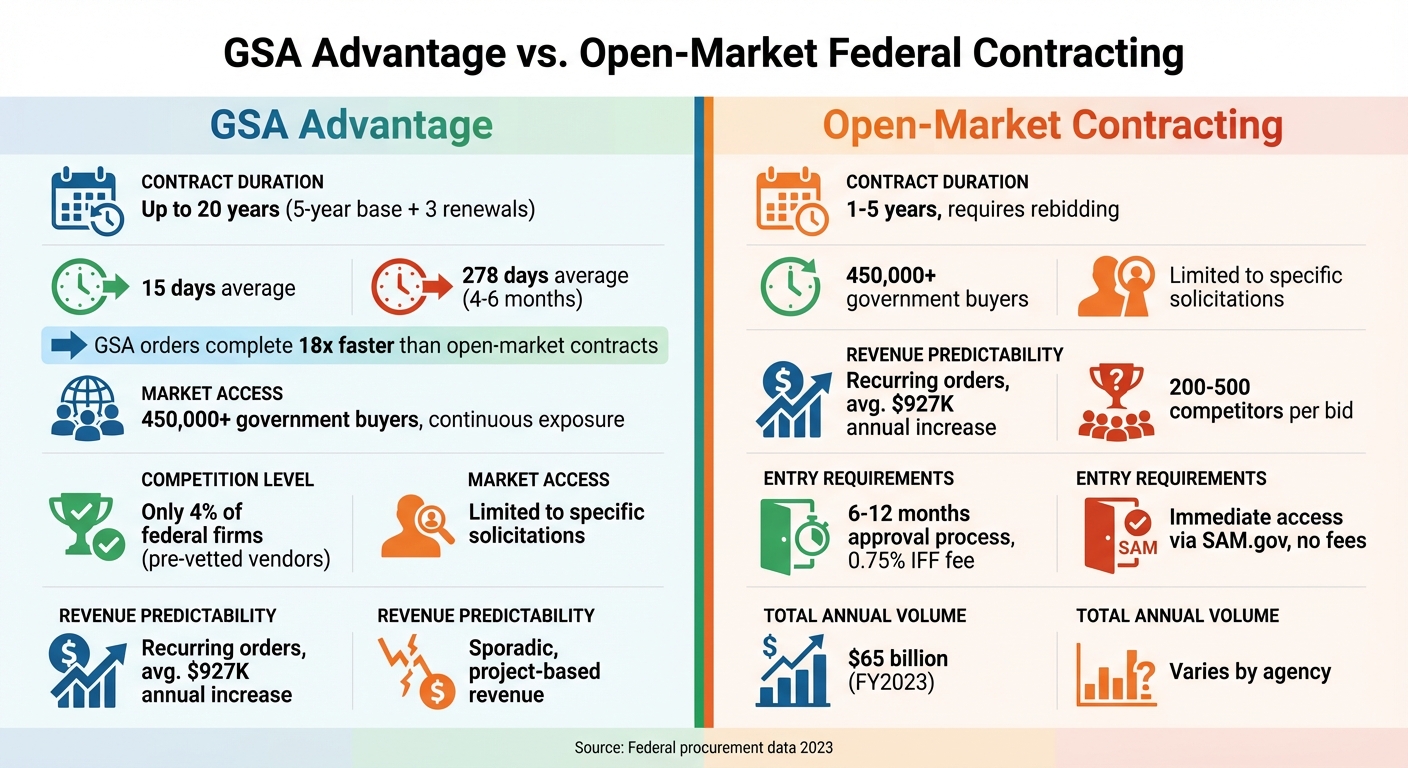
GSA Advantage vs Open-Market Federal Contracting Comparison
1. GSA Advantage
Contract Duration
GSA Schedule contracts offer a five-year term with the possibility of three additional five-year renewals, giving vendors up to 20 years of uninterrupted access to federal buyers. This long-term structure eliminates the frequent re-competition required for traditional federal contracts with shorter terms. Once pricing is established as fair and reasonable, vendors can maintain their contracts without needing to compete again. This stability not only simplifies the process but also boosts visibility and shortens sales cycles.
Visibility to Buyers
The extended contract terms also mean consistent exposure to federal buyers. Vendors listed on GSA Advantage benefit from searchable catalogs on both GSA Advantage and the GSA eLibrary. With only 4% of federal firms included, competition is significantly reduced, and vendors gain instant credibility as pre-vetted suppliers. Buyers using general keywords can easily find optimized listings featuring key details, ensuring vendors appear in relevant results without requiring constant marketing efforts.
Sales Process Efficiency
GSA Advantage also speeds up the procurement process dramatically. Instead of the typical 278-day sales cycle, the platform cuts it down to just 15 days. Buyers can quickly compare products, prices, and delivery options, making purchasing decisions faster and more straightforward. This Federal Acquisition Regulation (FAR) 8.4-compliant process allows vendors to close deals more efficiently, helping them plan and execute sales with greater predictability.
Buyer Relationship Potential
The benefits of GSA Advantage extend beyond the initial sale. Federal agencies often return to trusted GSA vendors for repeat purchases. Buyers can search for specific vendor names on GSA Advantage, creating "follow me" opportunities where an initial sale can lead to ongoing orders without re-competition. With continuous catalog visibility and features like direct website links in vendor ads, the platform supports long-term relationships, turning one-time transactions into ongoing revenue streams. This approach solidifies GSA Advantage as a reliable path to sustained federal contracting opportunities.
The Benefits If Getting On a GSA Schedule
2. Open-Market Federal Contracting
Unlike the structured, long-term approach of GSA Advantage, open-market federal contracting takes a more fragmented and project-based route.
Contract Duration
Open-market contracts are short-term and tied to specific projects, meaning businesses must continuously compete for new opportunities. These contracts lack the stability of long-term agreements, requiring vendors to engage in repeated bidding cycles. On average, the procurement process for each contract takes about 4 to 6 months. This unpredictability makes it harder for businesses to forecast revenues and plan for growth.
Visibility to Buyers
In the open market, vendor visibility is limited to the lifespan of a particular solicitation or request for proposals. Vendors must actively market themselves and pitch for every opportunity. Federal buyers, on the other hand, are tasked with conducting their own research on vendor pricing, past performance, and financial reliability. With a larger and more diverse pool of competitors, the open market creates a fiercely competitive environment for every contract.
Sales Process Efficiency
The open-market bidding process is anything but quick. It involves a lot of paperwork, bureaucracy, and multiple rounds of negotiations, including individualized pricing discussions. This lengthy process often slows down decision-making, adding to the uncertainty of when – or if – a deal will close.
Buyer Relationship Potential
Most open-market contracts are one-off projects or cater to highly specific needs, which limits opportunities for repeat business. Vendors must re-establish their qualifications with each new solicitation, as there’s no pre-vetted status to rely on. While building strong relationships with government buyers can give vendors an edge, the transactional nature of these contracts makes it difficult to form lasting partnerships. This stands in sharp contrast to the consistency and efficiency businesses can achieve through GSA Advantage’s long-term contracts.
Contract Duration: Long-Term Stability vs. Short-Term Awards
When it comes to federal contracting, GSA Advantage contracts stand out for their long-term stability. These contracts start with a 5-year base period and can be renewed for up to 20 years in total. This setup ensures vendors maintain consistent access to federal buyers without the hassle of frequent re-application or competition. In contrast, open-market federal awards typically last 1–5 years and require vendors to rebid once the term ends, adding uncertainty and disrupting long-term planning.
This stability isn’t just about convenience – it has real financial advantages. A predictable revenue stream allows vendors to confidently invest in specialized staff and develop capabilities tailored to federal needs. Open-market contracts, with their shorter terms and frequent rebidding, rarely offer such opportunities. For vendors aiming to succeed in the federal market, this kind of consistency is key to achieving operational efficiency and maintaining steady growth.
Here’s a quick comparison of the two contracting methods:
| Contract Type | Base Period | Maximum Duration | Renewal Process | Stability Benefits |
|---|---|---|---|---|
| GSA Schedule (GSA Advantage) | 5 years | Up to 20 years | Performance-based renewals; no re-competition | Predictable revenue, pre-negotiated pricing, continuous market access |
| Open-Market Federal Awards | 1–3 years (typical) | Up to 5 years | Competitive rebid required | High uncertainty, frequent negotiations, limited planning horizon |
Additionally, the long-term nature of GSA contracts simplifies pricing and compliance. With pre-negotiated pricing locked in for up to 20 years, vendors avoid the constant back-and-forth of pricing negotiations found in open-market contracts. Adjustments are made through Economic Price Adjustment clauses, ensuring fair pricing while reducing administrative burdens. This streamlined approach reinforces the procurement benefits that make GSA contracts so attractive.
Visibility to Buyers: Continuous Exposure vs. One-Time Efforts
GSA Advantage ensures your products are visible to federal buyers around the clock, building on the extended visibility granted by long-term contracts. With listings accessible for up to 20 years, this platform provides consistent market exposure without requiring ongoing marketing efforts.
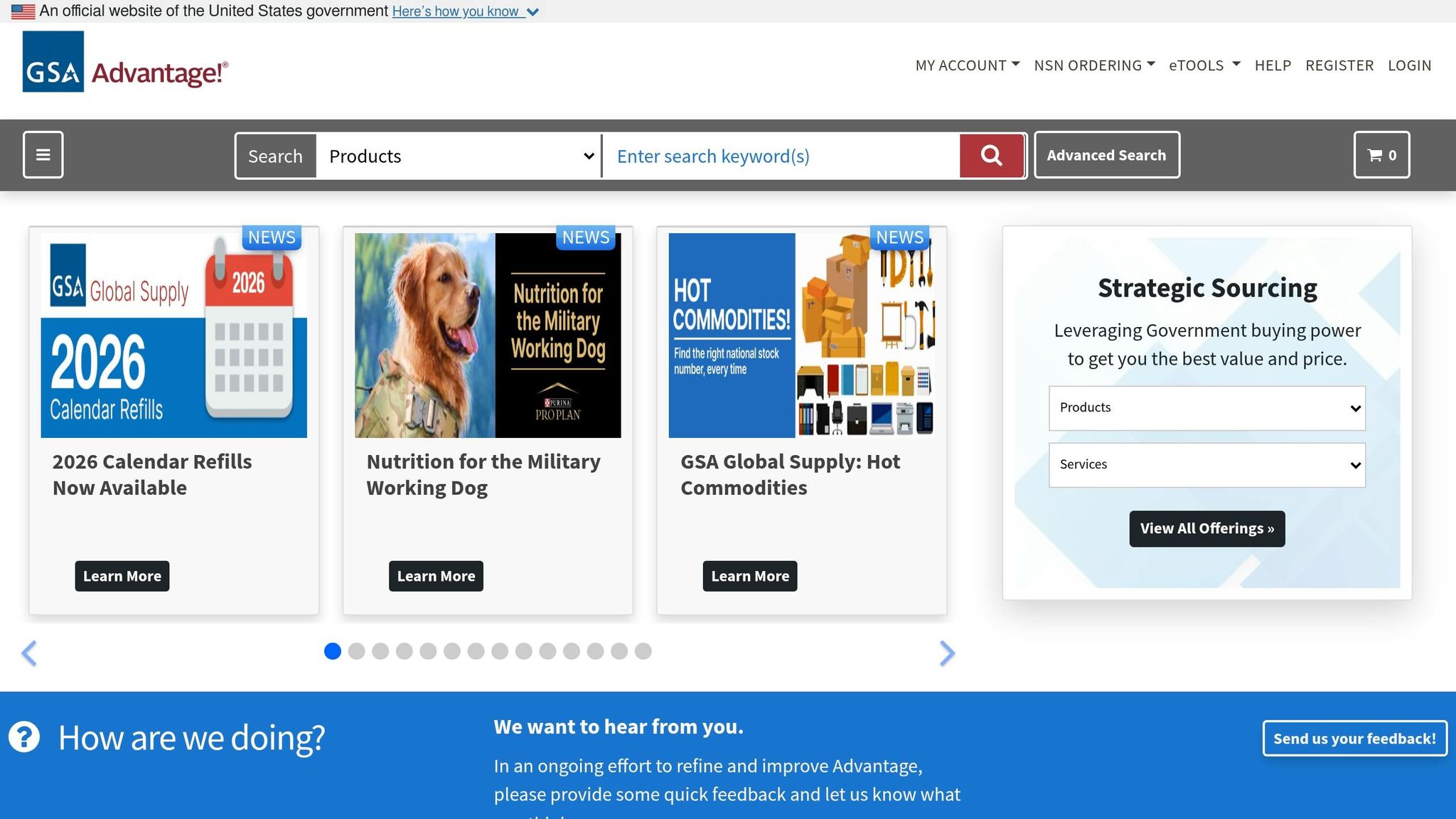
The platform’s powerful search tools allow buyers to find vendors using keywords, stock numbers, contract numbers, or company names. For instance, when a procurement officer searches for "office chairs" or enters a specific part number, optimized listings appear in the results. This generates passive leads, eliminating the need to constantly monitor solicitation boards or submit repeated proposals. Consider this: in FY2023, purchases through the GSA Schedule surpassed $65 billion, reflecting a 14% increase from the previous year. Clearly, federal agencies rely heavily on this platform for their procurement needs.
Another standout feature is the "Compare Available Sources" tool, which lets buyers evaluate products side by side. It displays pricing, delivery terms, and other details, helping procurement professionals make informed decisions quickly. Even though only authorized buyers can complete transactions, the catalog is viewable to over 450,000 government procurement professionals. This means your products gain visibility even during the early stages of the decision-making process.
The efficiency of GSA procurement is another major advantage. Traditional open-market procurement cycles can stretch to 278 days, whereas GSA orders are completed in roughly 15 days. This streamlined process not only encourages faster sales but also increases the likelihood of repeat purchases, turning one-time buyers into long-term customers.
To make the most of this continuous exposure, focus on optimizing your product listings. Use generic terms and keywords that buyers are likely to search for, and ensure your descriptions are clear and detailed. High-quality images and strategic keyword placement can significantly boost buyer confidence and improve your digital presence. These efforts help your products stand out and solidify the lasting visibility that sets GSA Advantage apart.
Sales Process Efficiency: Streamlined Ordering vs. Lengthy Competitions
Ordering through GSA Advantage compared to navigating traditional open-market federal contracting is like the difference between a quick online purchase and a drawn-out negotiation. GSA Advantage serves as a federal e-commerce platform, allowing buyers to search, compare, and purchase products electronically using government purchase cards – much like shopping on a commercial website. With pre-negotiated pricing and terms, this platform eliminates the need for lengthy back-and-forth negotiations. In contrast, open-market federal contracting involves a much more time-intensive process.
Open-market contracting requires agencies to solicit proposals and negotiate terms for each purchase individually. This multi-step process often stretches procurement timelines significantly. Federal agencies lean toward GSA Schedule contracts precisely because they bypass these cumbersome steps.
Here’s how the procurement cycle compares between the two approaches:
| Procurement Stage | GSA Advantage | Open-Market |
|---|---|---|
| Solicitation | 0 days (pre-competed) | 10-30 days |
| Evaluation/Bidding | 0-1 days | 20-60 days |
| Negotiation | 0 days (pre-negotiated) | 10-30 days |
| Award | 1-7 days | 10-30 days |
| Total Cycle Time | 1-10 days | 50-150+ days |
These time savings don’t just simplify the process – they also cut administrative costs and speed up revenue generation. For vendors, this means quicker payments and fewer bureaucratic hurdles. For example, Panel Built, a supplier of modular buildings, notes that agency staff can order their structures on GSA Advantage in mere minutes, without needing additional negotiations. This efficiency accelerates project timelines and eliminates the delays tied to traditional procurement methods.
Features like automated catalog updates and real-time tracking make transactions even smoother, ensuring transparency and swift order progression. Federal agencies are required to review at least three Schedule contractors on GSA Advantage before making a purchase, giving vendors a structured and predictable path to secure contracts. By dramatically reducing order cycle times, GSA Advantage sets the stage for consistent and efficient federal contracting success.
Buyer Relationships: Repeat Business vs. One-Time Transactions
GSA Advantage transforms one-off sales into enduring buyer relationships. Unlike open-market bids, where each transaction requires fresh negotiations, GSA Advantage functions as a digital storefront. Federal buyers can easily reorder from vendors without the hassle of re-competing. Agencies can search for vendors by name, relying on their pre-vetted status to simplify purchases and build trust. Tools like Blanket Purchase Agreements further streamline the process, allowing agencies to quickly address recurring needs. This model fosters repeat business, which is a cornerstone of the long-term revenue stability that GSA Advantage offers.
The numbers back this up. Companies with a GSA Schedule see an average annual revenue increase of nearly $927,000. In 2022, federal agencies spent a staggering $42 billion through GSA Schedules – a 22% jump from the previous year. With only about 4% of small businesses holding GSA contracts, vendors face far less competition compared to open-market bids, which often attract between 200 and 500 proposals for a single opportunity.
"Open bidding helps you chase the market; The GSA Schedule helps the market chase you."
– B2G Connect
The difference in buyer relationships is stark. GSA contracts allow for a performance period of up to 20 years – five base years with three additional five-year renewal options. This extended timeline helps vendors establish trust and familiarity with agency buyers, who appreciate the reduced administrative burden of dealing with pre-vetted suppliers. On the other hand, open-market contracts typically result in sporadic, project-based revenue, with every deal requiring new negotiations.
| Feature | GSA Advantage | Open-Market Contracting |
|---|---|---|
| Repeat Purchase Rate | High; buyers reorder without re-bidding | Low; every transaction requires new bids |
| Sales Volume Predictability | High; stable pricing over 5–20 years | Low; irregular wins tied to projects |
| Buyer Relationship | Long-term; recurring business from loyal customers | Transactional; mostly one-off projects |
| Competition per Opportunity | Limited to pre-approved GSA vendors | High; often 200–500 competitors per bid |
The Cooperative Purchasing Program takes these benefits even further by extending GSA’s reach beyond federal agencies to state, local, and tribal governments. This expansion increases the potential for repeat business. By securing a GSA Schedule, vendors position themselves for a steady and scalable revenue stream, moving away from the unpredictability of chasing one-off contract awards – a clear path to sustained success in government contracting.
GSA Focus: Simplifying the Path to Long-Term Success
Securing a GSA Schedule Contract opens the door to long-term federal opportunities, but the process – spanning 6 to 12 months – can be challenging. That’s where GSA Focus steps in, offering a full-service solution that allows small businesses to focus on their core operations while experts handle the complexities. This approach works hand-in-hand with GSA Advantage, which connects businesses to federal contracting opportunities.
GSA Focus takes care of everything: document preparation, compliance checks, and negotiation support. Their services include full eOffer submissions, covering pricing, past performance, technical data, and managing clarifications during the GSA review process. This makes the process up to five times faster than going it alone, with clients needing to dedicate just about four hours of their time.
With over 550 GSA Contract awards under their belt, GSA Focus has helped clients generate more than $500 million in federal sales. On average, businesses working with GSA Focus see an additional $927,000 in revenue, achieving an ROI between 52× and 87×. With a 98% satisfaction rate from over 600 clients, their track record speaks volumes.
"MacGyver Solutions is one of GSA Focus’ success stories – having them do the heavy lifting on the initial contract was a huge help."
– Mike Jackson, Founder, MacGyver Solutions, Inc
But GSA Focus doesn’t stop at contract acquisition. Their "GSA Maintenance on Autopilot" service ensures compliance with FAR and TAA regulations, along with quarterly reporting. They also offer the "GSA Accelerator" program, which includes a pipeline system, three months of proposal writing to build a template library, and targeted marketing to federal buyers. This all-encompassing support ensures small businesses not only secure their GSA Schedule but also unlock the full potential of long-term revenue through GSA Advantage.
Pros and Cons
When it comes to federal contracting, GSA Advantage and open-market federal contracting represent two distinct paths, each with its own set of trade-offs. Deciding between these options requires a clear understanding of their benefits and challenges, as well as how they align with your business goals. Below, we’ll break down the key differences to help you weigh your options effectively.
GSA Advantage stands out for its streamlined procurement process and built-in credibility. With access to over 450,000 government users, it offers significant exposure to federal buyers. Deals can be finalized in just a few days, compared to the 4–6 months typical of open-market contracts. Its fixed pricing structure eliminates lengthy negotiations, and small businesses automatically contribute to the 23% federal small business contracting goal, making them more appealing to buyers. However, this path isn’t without its hurdles. The application process is lengthy – taking 6–12 months – and requires specialized expertise. Additionally, vendors must pay a 0.75% Industrial Funding Fee (IFF) on all sales and meet a minimum sales requirement of $100,000 within the first five years. The "Most Favored Customer" clause, which mandates offering the government your lowest price, can also cut into profit margins. Surprisingly, about 60% of GSA Schedule holders fail to generate revenue from their contracts, emphasizing the importance of active marketing efforts.
On the other hand, open-market contracting offers greater flexibility. Vendors can set their own pricing and negotiate custom terms for each deal. There’s no upfront vetting process or ongoing fees, making it an accessible option for businesses of all sizes. However, this approach comes with its own challenges. High-value opportunities often attract 200–500 competing vendors, making the process highly competitive. Each procurement cycle takes 4–6 months, and the cost of hiring professional bid writers can add up quickly – with no guarantee of success. Revenue here is unpredictable, making it harder to establish consistent growth. Additionally, vendors must undergo a vetting process for each transaction, and small businesses don’t receive automatic recognition or credit toward federal contracting goals.
Here’s a quick side-by-side comparison of the two approaches:
| Factor | GSA Advantage | Open-Market Contracting |
|---|---|---|
| Procurement Timeline | Finalized in days | 4–6 months per contract |
| Entry Barrier | High (6–12 months approval) | Low (accessible via SAM.gov) |
| Competition Level | Limited to pre-approved vendors | 200–500 vendors per bid |
| Pricing Structure | Fixed, pre-negotiated (MFC clause) | Flexible, vendor-determined |
| Ongoing Fees | 0.75% IFF on all sales | None |
| Buyer Access | 450,000+ government users | Individual agency outreach |
| Contract Duration | Long-term (up to 20 years) | Short-term or one-off awards |
| Small Business Benefits | Automatic goal tracking | No automatic recognition |
| Revenue Predictability | Potential for recurring orders | Sporadic and unpredictable |
Ultimately, your choice will depend on your business’s resources, capacity, and long-term goals. GSA Advantage requires a significant upfront investment but can offer stability and recurring opportunities over time. Meanwhile, open-market contracting provides easier entry and more flexibility but comes with higher competition and less predictable returns.
Conclusion
Federal contracting doesn’t have to be a game of sporadic, one-off deals. GSA Advantage offers a completely different approach, with contracts lasting up to 20 years and tapping into a pool of over $39 billion in annual opportunities. Thanks to its integration with federal procurement systems, GSA vendors enjoy higher FAR priority, meaning government agencies are encouraged to buy from you instead of going through lengthy competitive bidding processes. This transforms one-time sales into a steady stream of business.
Unlike open-market contracts, which can take months to finalize and often involve fierce competition, GSA Advantage transactions can close in just days. Federal buyers can make purchases directly without worrying about vendor approvals, as the contracting process is already taken care of. This creates an environment where repeat purchases become the norm, not the exception.
For businesses serious about breaking into federal contracting, it all comes down to strategy. If recurring revenue and building long-term relationships with government agencies are part of your goals, GSA Advantage offers the structure to make that happen. While there’s an upfront investment of time and the 0.75% Industrial Funding Fee, the long-term benefits – like continuous visibility and streamlined ordering – make it worthwhile.
That said, the platform isn’t a "set-it-and-forget-it" solution. Vendors need to actively market their offerings, respond to RFQs on GSA eBuy, and stay compliant to fully unlock its potential. While these efforts require dedication, the payoff is clear: a reliable path to long-term revenue that open-market contracting struggles to match.
If the approval process seems daunting, working with experts like GSA Focus can simplify things. Their done-for-you service covers document preparation, compliance, and negotiation, making it easier for small businesses to secure federal contracts. With their help, businesses can take full advantage of GSA Advantage, paving the way for sustained success in federal contracting – something the open market rarely delivers.
FAQs
Is a GSA Schedule worth it for my business?
A GSA Schedule opens doors to a massive market, granting access to more than $220 billion in federal spending annually. It also offers long-term contracts – lasting up to 20 years – and boosts your reputation as a trusted, government-approved vendor.
The perks? Streamlined procurement processes and the chance for consistent revenue streams. However, it’s not all smooth sailing. Getting on the schedule comes with upfront costs, ongoing compliance requirements, and the need to actively market your offerings.
Preparation is key to making it work. Interestingly, over 60% of GSA Schedule holders report no initial sales, highlighting the importance of a solid plan to maximize the opportunity.
What do I need to qualify for GSA Advantage?
To be eligible for GSA Advantage, your business needs to meet certain criteria. These include having a minimum of two years of operating history, showing financial stability through profit and loss statements and balance sheets, and complying with trade agreements and federal regulations. These standards are in place to ensure businesses are equipped to handle federal contracting requirements effectively.
How do I actually get sales after I’m listed?
To boost sales on GSA Advantage, start by refining your product listings. Focus on clear, keyword-rich titles that make your products easy to find. Pair these with concise descriptions that highlight key benefits, compliance details, and features federal buyers care about. Pricing is critical – ensure your rates are competitive and align with GSA-approved guidelines.
Don’t overlook visuals – high-quality images can make a big difference in attracting attention. Keep your inventory and delivery details accurate to build trust and avoid potential issues. Regularly update your listings, address reviews proactively, and take advantage of tools like GSA eBuy to improve visibility and connect with federal buyers.
By consistently fine-tuning your approach, you’ll not only enhance your presence on GSA Advantage but also strengthen your position in federal contracting over time.
Related Blog Posts
- Top 7 GSA Schedule Benefits for Small Businesses
- GSA Advantage vs Open Market: Key Differences
- How GSA Advantage Simplifies Federal Buying
- How a GSA Federal Contract Can Transform Your Small Business