
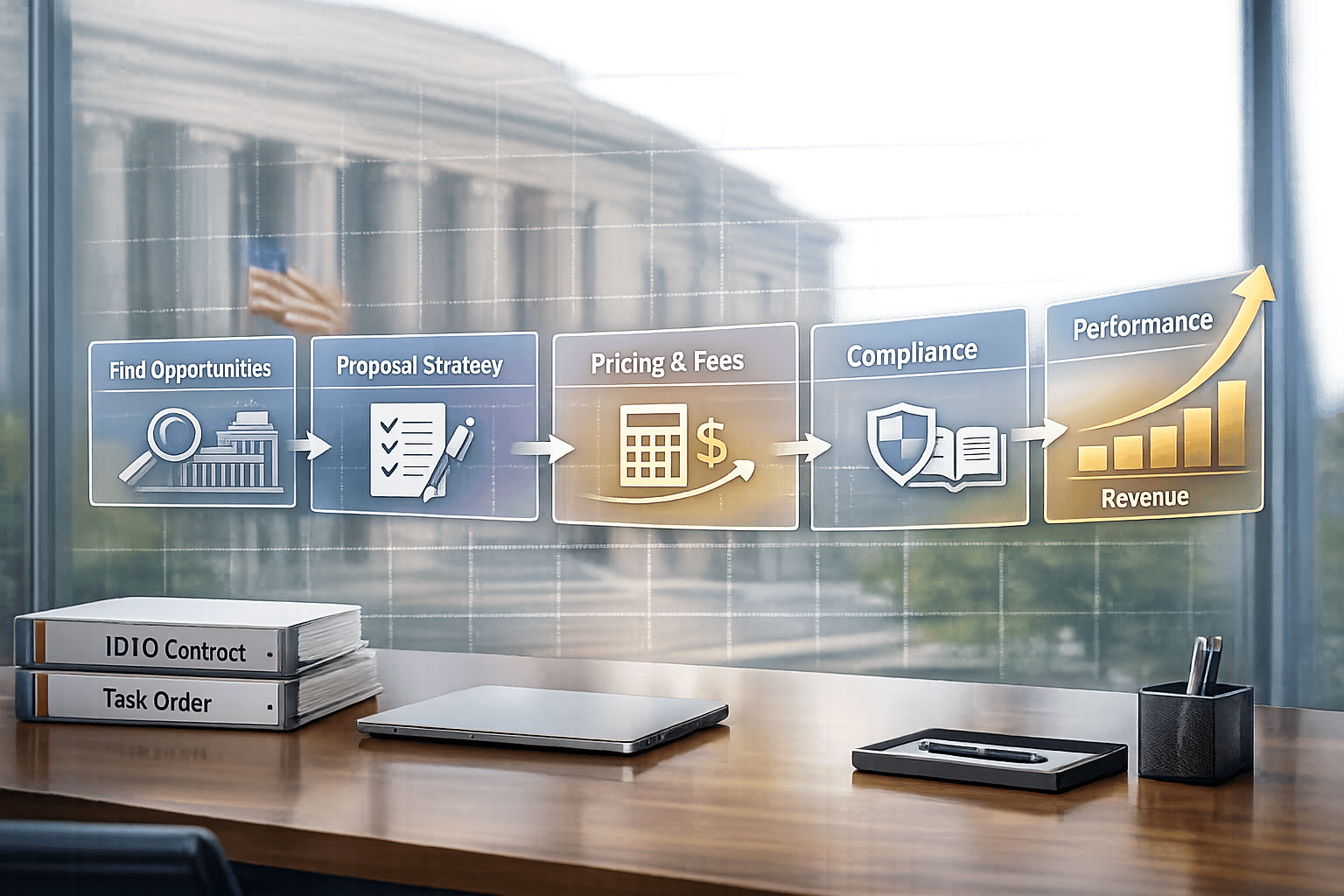
Task orders are the key to turning federal contracts into revenue. They are specific requests for services or goods issued under broader contract vehicles like GSA Schedules, IDIQs, or GWACs. These orders simplify the procurement process by allowing agencies to bypass lengthy open-market bidding, offering pre-qualified contractors a chance to compete in smaller, focused competitions.
For small businesses, task orders provide unique opportunities:
- Smaller competition pools: Only pre-approved contractors compete.
- Set-asides for small businesses: Agencies can reserve task orders for specific socioeconomic groups like 8(a) or HUBZone businesses.
- Streamlined process: Minimal submissions and shorter response times (7–30 days).
- Protest protection: Awards under $10M (civilian) or $25M (DoD) are generally protest-proof.
Winning task orders requires aligning proposals with agency needs, competitive pricing, and compliance with contract terms. Platforms like GSA eBuy and SAM.gov are vital for finding opportunities, while tools like CPARS ratings and proactive networking at Industry Days can enhance your chances.
Success lies in understanding the process, preparing competitive bids, and maintaining strong performance records. Task orders are where the real work and revenue happen, making them essential for federal contractors.
How to Win More Task Orders on Your Contract Vehicles | Government Contracting
How Task Orders Work Within the GSA Schedule

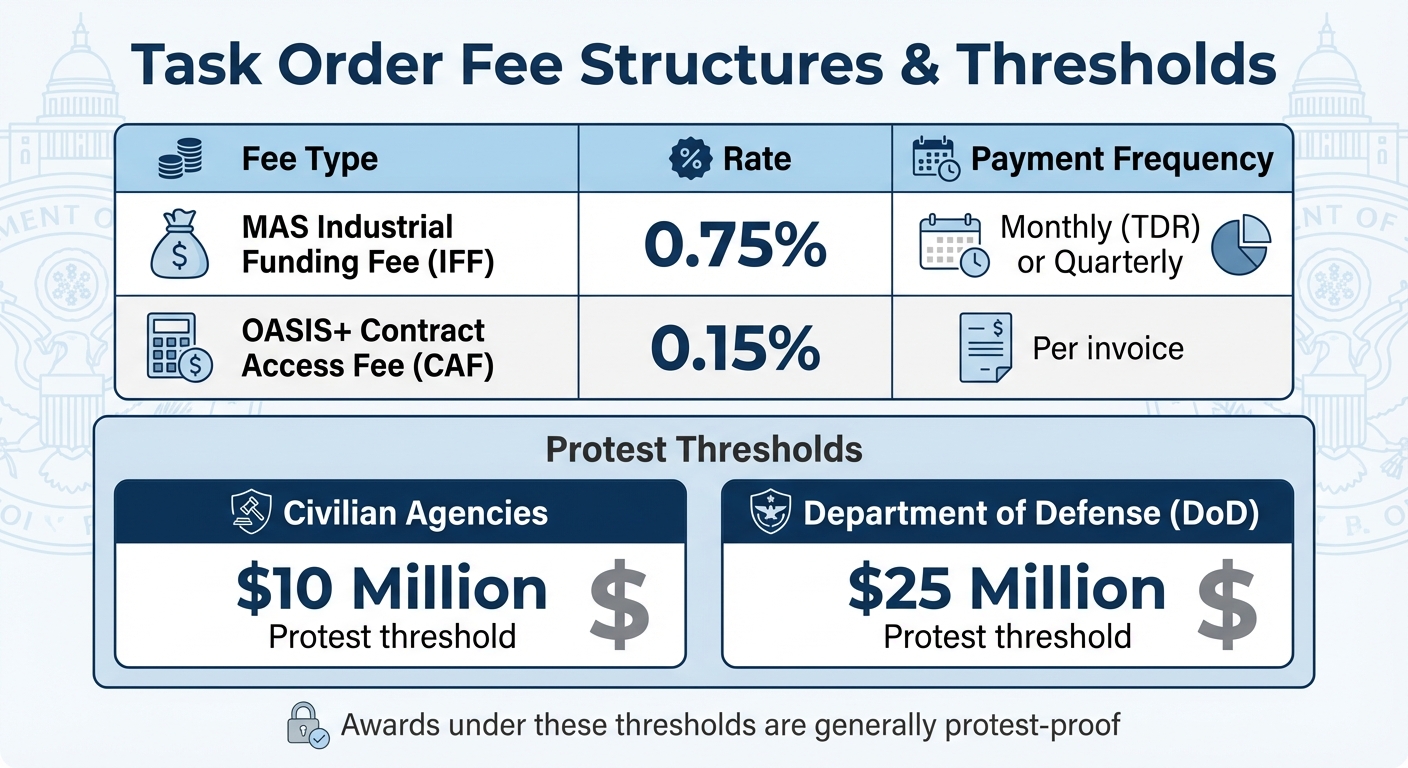
GSA Task Order Fee Structures and Protest Thresholds Comparison
Key Features of GSA Schedule Task Orders
GSA Schedule task orders are governed by the Fair Opportunity principle, ensuring all eligible contract holders have a chance to compete. These opportunities are typically posted on eBuy, an online platform where agencies share their requirements and contractors can submit proposals.
To participate, your task order must align with the SINs (Special Item Numbers) and NAICS (North American Industry Classification System) codes listed in your GSA Schedule. For instance, SINs for Cloud Services or IT Equipment define the products or services you’re authorized to offer. The NAICS code further narrows eligibility by specifying the primary purpose of the work. If you believe a task order’s NAICS code doesn’t accurately reflect its scope, you can appeal its designation under FAR 19.103.
Agencies issue solicitations containing a Performance Work Statement (PWS), Statement of Work (SOW), or Statement of Objectives (SOO) to outline their needs. Your proposal must respond to these requirements while staying within the scope of your master contract. Task orders can vary in structure – they might be fixed-price, cost-reimbursement, time-and-materials, or labor-hour contracts. Response deadlines typically range from 7 to 30 days. If you’re bidding on cost-reimbursement work, the Ordering Contracting Officer (OCO) will check whether your accounting system meets the necessary standards before awarding the contract.
While these features are essential, understanding the boundaries and performance expectations of task orders is equally important.
Scope and Limitations of Task Orders
Task orders come with specific boundaries and fee obligations. For example, the Period of Performance can extend up to five years and six months beyond your master contract’s expiration, giving agencies the flexibility to manage long-term projects. Minimum order thresholds usually align with the Simplified Acquisition Threshold, but specialized areas – like Enterprise Solutions – might have higher minimums, sometimes reaching $250 million.
Fees also play a significant role. For Multiple Award Schedule (MAS) contracts, an Industrial Funding Fee (IFF) of 0.75% applies to all sales. Meanwhile, OASIS+ task orders incur a Contract Access Fee (CAF) of 0.15% per invoice [7, 11]. These fees must be clearly listed as separate line items in your proposals and invoices. If you’re part of the Transactional Data Reporting (TDR) program, you’ll pay the IFF monthly; otherwise, fees are due within 30 days after the end of each quarter.
Performance expectations are equally strict. GSA can place contractors in "Dormant Status" for failing to meet performance standards, which prevents them from competing for new task orders, though they must still complete ongoing work. Additionally, performance on each task order is documented in the Contractor Performance Assessment Reporting System (CPARS), which can significantly impact your chances in future competitions [4, 12].
Here’s a quick breakdown of the fee structures:
| Fee Type | Rate | Payment Frequency |
|---|---|---|
| MAS Industrial Funding Fee (IFF) | 0.75% | Monthly (TDR) or Quarterly |
| OASIS+ Contract Access Fee (CAF) | 0.15% | Per invoice |
| Civilian Protest Threshold | $10 million | N/A |
| DoD Protest Threshold | $25 million | N/A |
How to Find and Respond to Task Order Opportunities
Where to Search for Task Orders
Finding task order opportunities means staying active on key federal contracting platforms. One of the most essential tools is GSA eBuy, where agencies post OASIS+ and GSA Schedule solicitations. Make sure your vendor profile is up-to-date so agencies can easily find you during their market research. If you’re an OASIS+ contract holder, this platform is non-negotiable. As GSA emphasizes: "GSA eBuy is the tool the government uses for OASIS+ task order solicitations and market research. As an OASIS+ contractor, you are required to monitor and respond to all task order solicitations through GSA eBuy".
Another critical resource is SAM.gov, the government’s central hub for contracting opportunities over $25,000. Beyond active solicitations, it also features pre-solicitation notices and "Sources Sought" announcements. These early notices give you a chance to prepare before formal RFPs are issued and can even influence whether a requirement is set aside for small businesses.
For direct engagement, attending Industry Days is invaluable. These events allow you to connect with program personnel, learn about specific mission needs, and explore teaming possibilities. Additionally, APEX Accelerators (previously known as PTACs) offer free training and guidance on navigating the federal contracting process. For deeper market insights, tools like USASpending.gov and Schedule Sales Query Plus can help you analyze which agencies are purchasing your services and how much they’re spending.
Once you’ve identified a promising opportunity, the next step is creating a proposal that aligns with the evaluation criteria.
Preparing a Competitive Proposal
When you find a task order that matches your capabilities, your proposal needs to stand out. Agencies typically evaluate submissions based on the technical approach, past performance, management strategy, and quality control. Tailor your response depending on the requirement type: for Statements of Work (SOW), focus on delivering exactly what’s requested; for Performance Work Statements (PWS), explain your methodology in detail; and for Statements of Objectives (SOO), propose a plan that includes performance metrics and quality assurance measures.
Pricing is another critical aspect. While you want to remain competitive, your pricing must also be deemed reasonable. Ordering Contracting Officers (OCOs) are required to document that your price is "fair and reasonable" at the task order level, and negotiations are encouraged. If you’re submitting a proposal under OASIS+, remember to separately list the Contract Access Fee, as this is a mandatory requirement. For cost-reimbursement proposals, ensure your accounting system meets government standards, as this will be reviewed before any award is made.
Timing is everything – late proposals won’t be considered. To avoid missing deadlines, sign up for automated notifications on platforms like GSA eBuy or SAM.gov to stay informed of any updates or amendments. As GSA advises: "Take your time crafting your response… You want to ensure your response thoroughly addresses the contract requirements". Double-check the closing date and submit your proposal with plenty of time to spare. A well-prepared proposal not only increases your chances of winning but also sets the stage for successful task order execution.
Best Practices for Task Order Management
Managing task orders successfully requires strict adherence to compliance standards and a proactive approach to sidestepping common challenges – both of which are essential for securing future opportunities.
Executing Task Orders with Compliance in Mind
Winning a task order is just the first step. To maintain your competitive edge and reputation, compliance during execution is essential. Start with the basics: renew your SAM.gov registration annually and update it with any changes to your business. Similarly, stay on top of certification renewals for programs like 8(a), HUBZone, WOSB, and SDVOSB.
For financial compliance, contractors under a MAS contract must remit a 0.75% Industrial Funding Fee (IFF) on reported sales each quarter, with payments due within 30 days after the quarter ends. If you’re an OASIS+ contractor, remember that the Contract Access Fee (CAF) is 0.15% and must be listed as a separate line item on every invoice. For cost-reimbursement task orders, ensure your accounting system meets government standards before bidding – this requires approval from a Cognizant Federal Agency Official (CFAO).
Your CPARS ratings play a crucial role in securing future task orders, so monitor them closely and maintain a strong relationship with your Contracting Officer’s Representative (COR) to ensure you’re meeting all expectations. For those managing product deliveries, keep your accounts active on the Advantage PO Portal and OMS Vendor Portal to track order statuses. Additionally, schedule holders must sign mass modifications within 90 days of receipt and keep price lists updated on the Vendor Support Center.
By establishing robust compliance routines, you’ll be better prepared to tackle common challenges.
Steering Clear of Common Pitfalls
Even with solid execution practices, certain pitfalls can disrupt task order management. Federal task orders often come with detailed deliverables, performance metrics, and reporting requirements that can be missed without a structured approach. After receiving an award, review every task order clause and create a detailed compliance plan to address deadlines and deliverables.
For small businesses, overlapping task orders can stretch resources thin. To avoid this, build relationships with dependable subcontractors early on, so you have support when workloads increase. If your task order includes subcontracting goals – such as the OASIS+ unrestricted target of 50% for small business subcontracting – document your compliance thoroughly to avoid penalties.
Centralized approval processes can create bottlenecks if a key person becomes unavailable. To keep projects moving, implement conditional workflows or multi-level approvals. Similarly, scope creep – when agencies request changes without formal task order modifications – can derail projects. Always document change requests and confirm authorization and funding with your Ordering Contracting Officer (OCO).
Lastly, avoid relying on spreadsheets or informal systems as your business grows. Disconnected platforms can lead to operational inefficiencies, with 46% of businesses reporting issues because their systems are scattered. Centralize your documentation and adopt project management tools to improve visibility and streamline workflows, especially since 34% of organizations identify lack of visibility as their biggest operational challenge.
Advanced Strategies for Task Order Success
Once you’ve nailed down compliance routines and streamlined your execution practices, it’s time to take things up a notch. By adopting more advanced strategies, you can position your business to not just manage task orders but to drive revenue growth through strategic opportunities.
How to Maximize Task Order Opportunities
To maximize your success with task orders, start by focusing on the right contracts. Look for IDIQ contracts that have at least three recent orders with similar scopes and a track record of small business success. A great resource for this research is USAspending.gov, where you can analyze winning prices and staffing mixes for comparable projects. This helps ensure your bids are competitive while still profitable.
Engage early in the process by responding to RFIs and Sources Sought notices. This allows you to shape requirements, influence NAICS codes, and even impact set-aside decisions. Pair this with active networking at agency Industry Days. These events are goldmines for meeting program personnel, understanding specific mission needs, and identifying potential teaming partners to strengthen your proposals.
Instead of chasing every opportunity, focus on high-potential ones. Use a bid/no-bid grid to evaluate factors like NAICS alignment, CPARS scores, price compatibility, and compliance risks. This disciplined approach ensures your resources are directed toward opportunities with the highest likelihood of success. To respond quickly when the right opportunity arises, maintain a modular proposal library. This library should include past technical responses, resumes, and pricing templates, enabling you to meet tight deadlines with ease.
Your federal branding is another critical piece of the puzzle. Create a dedicated federal-facing webpage that prominently displays your GSA Schedule number, Special Item Numbers (SINs), and downloadable capability statements. This builds trust during the buyer’s research phase, signaling that your company is a serious contender in the federal space. With a 2025 Executive Order expected to centralize federal procurement through GSA and projected spending increases of fourfold, strategic positioning has never been more important.
If managing all of this feels overwhelming, expert support can make a world of difference.
Using GSA Focus for Expert Support
Navigating GSA contracts and competing for task orders involves a lot of administrative work, which can pull you away from your core business activities. That’s where GSA Focus comes in. They handle the heavy lifting, from securing your initial contract to maintaining compliance and preparing proposals, so you can focus on delivering results and growing your business. With GSA Focus, the time commitment on your end is reduced to just three hours, and they boast a 98% approval rate – far higher than the typical 50–60% for self-managed applications.
Speed is another major advantage. While a do-it-yourself approach to contract applications can take anywhere from 3–12 months and often gets bogged down by pricing or compliance errors, GSA Focus can streamline the process, cutting the timeline by 4–6x. This efficiency translates directly into revenue opportunities, with clients reporting an average added revenue of $927,000.
But their support doesn’t stop at initial acquisition. GSA Focus also assists with contract modifications, pricing updates, and proposal preparation as your federal portfolio grows. Their compliance services help protect you from risks like dormant status or off-ramping, ensuring you consistently meet performance standards across multiple task orders.
With federal procurement becoming more centralized and competition heating up, having expert guidance can mean the difference between seizing opportunities and getting bogged down in administrative tasks. By working smarter, not harder, you’re better positioned to thrive in this competitive space.
Conclusion
Securing a base contract is just the beginning; the real challenge – and opportunity – lies in winning task orders. While a GSA Schedule or IDIQ contract grants you access to federal procurement opportunities, each task order becomes its own competition. Success depends on showcasing your technical expertise and offering competitive pricing to stand out among other contract holders.
To win task orders, you need to stay visible, respond quickly to solicitations, and build strong relationships. Federal agencies ensure all contract holders get a fair shot at orders over $3,500, but it’s up to you to market your capabilities. With response times often limited to 7–30 days, being prepared and proactive is critical.
Your CPARS ratings, earned from each completed task order, are a key factor in future opportunities. Consistently meeting compliance requirements, delivering on promises, and maintaining a strong performance record can give you a competitive edge over time. On the flip side, small mistakes – such as missing reporting deadlines or exceeding contract ceilings – can lead to penalties, including dormant status and missed chances.
Handling the administrative demands of federal contracting can be overwhelming, but it doesn’t have to pull you away from your core business. GSA Focus simplifies these processes, offering support that allows you to focus on delivery and growth. Their proven track record of high approval rates demonstrates how expert assistance can make your operations more efficient and effective.
As federal procurement becomes more centralized and competitive, success will favor businesses that pair strategic foresight with operational excellence. Knowing when to seek expert guidance can make all the difference in staying ahead in this evolving landscape.
FAQs
What’s the difference between a base contract and a task order?
A base contract serves as a general agreement between a government agency and a contractor, laying out the overarching terms, conditions, and scope for a predetermined period. In contrast, a task order is a more specific directive issued under that base contract. It outlines the precise services or products required, along with details on pricing, scope, and performance expectations. Think of the base contract as the foundation, while task orders are the actionable steps built upon it.
How do I know if a task order is within my GSA Schedule scope?
To figure out if a task order falls within the scope of your GSA Schedule, start by checking whether the requested services, products, or professional offerings match what your contract authorizes. Make sure the task order adheres to the scope outlined in your agreement and follows the applicable GSA ordering rules. Carefully review your contract to confirm everything aligns before agreeing to the task order.
How can I improve my CPARS ratings on task orders?
To boost your CPARS ratings, prioritize a few essential strategies. First, familiarize yourself with the CPARS criteria, which include quality, schedule, cost control, management practices, and regulatory compliance. Clear and consistent communication with Contracting Officers (COs) and Contracting Officer Representatives (CORs) is also critical. Always strive to deliver high-quality work on time to meet or surpass expectations.
Make it a habit to review your evaluations carefully for any errors. If you spot discrepancies, respond professionally and within the 14-day window provided for contractor comments. Additionally, keep a close eye on performance metrics, address any deficiencies quickly, and consistently aim to outperform expectations. Excelling in these areas not only improves your ratings but also strengthens your chances for future opportunities.
Related Blog Posts
- How to Read GSA Solicitation Documents
- How GSA Ordering Works
- GSA Ordering Rules: What to Know
- Ultimate Guide To GSA Contracting Results