

Contracting Officers (COs) play a critical role in federal procurement, acting as the only officials authorized to legally bind the U.S. government in contracts. Their responsibilities include planning, evaluating proposals, awarding contracts, monitoring performance, and resolving disputes. Ethics are central to their role, ensuring the proper use of taxpayer dollars and maintaining public trust.
Key ethical principles for COs include:
- Integrity: Avoid actual and perceived conflicts of interest. Report any violations or improper conduct immediately.
- Impartiality: Treat all vendors fairly, ensuring no preferential treatment. Use Conflict of Interest Acknowledgements and safeguard sensitive information.
- Transparency: Document all interactions and decisions to create a clear audit trail.
COs must also comply with laws like the Procurement Integrity Act, which prohibits sharing sensitive information and accepting gifts. Violations can result in severe penalties, including fines and imprisonment. Accurate recordkeeping and proactive reporting of ethical concerns are essential for compliance.
To ensure contractors also uphold ethical standards, COs monitor contractor ethics programs, enforce disclosure requirements, and ensure proper training. These efforts help prevent fraud, waste, and abuse while promoting accountability in federal contracting.
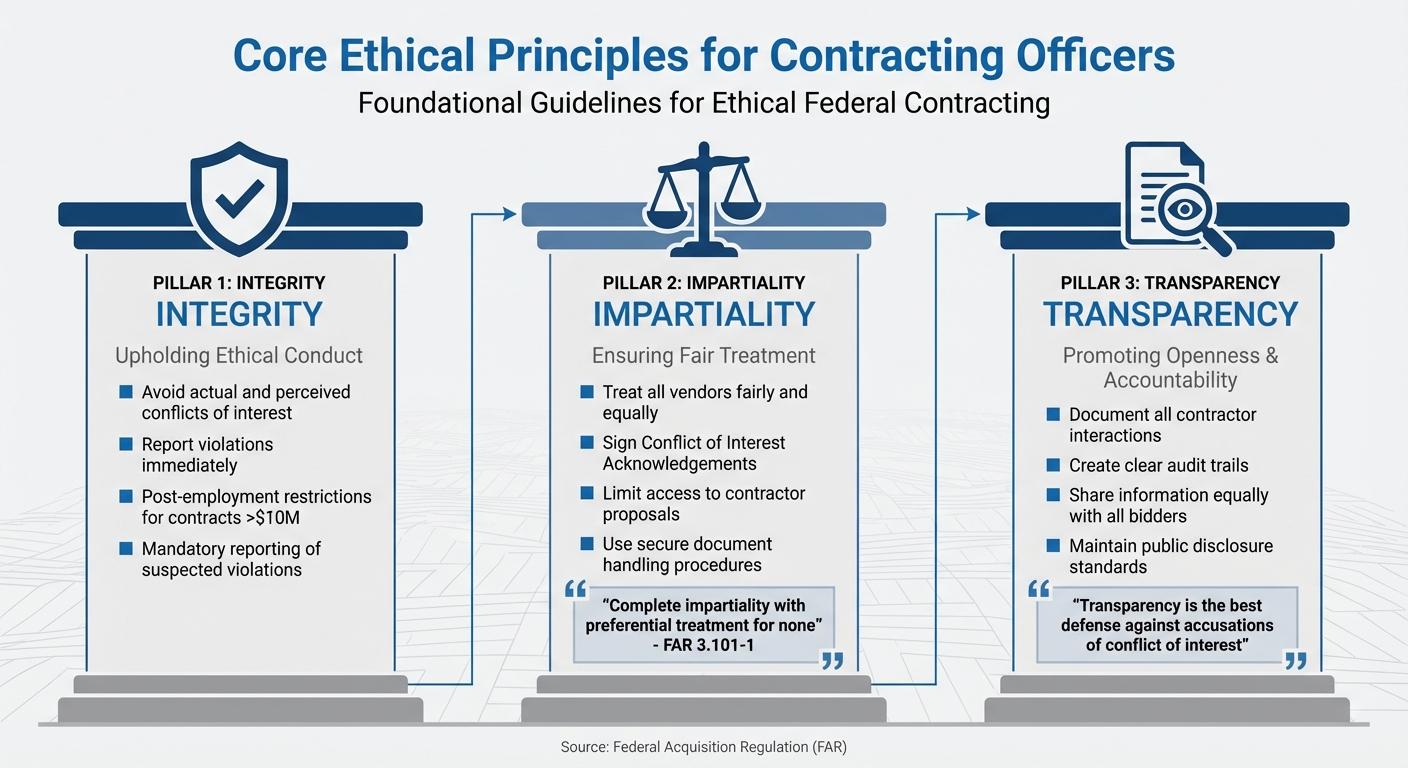
Three Core Ethical Principles for Federal Contracting Officers
Government Contracting – FAR Part 3 – Improper Business Practices And Personal Conflicts Of Interest
Basic Ethical Principles for Contracting Officers
To uphold public trust and ensure responsible use of taxpayer dollars, contracting officers follow three core ethical principles: integrity, impartiality, and transparency. These principles, rooted in the Federal Acquisition Regulation (FAR), shape every procurement decision they make and form the foundation of their responsibilities.
Integrity and Accountability
Integrity requires conducting government business with the highest ethical standards. Contracting officers must avoid not only actual conflicts of interest but also situations that could give the impression of one. For example, if a contractor approaches an officer with a job offer during an active procurement, the officer must immediately report the contact in writing and either decline the offer or step away from the procurement process.
To reinforce this principle, there are strict post-employment restrictions for contracts exceeding $10 million, as well as mandatory reporting of suspected violations, such as those involving the Gratuities clause, antitrust laws, or the Covenant Against Contingent Fees. These measures ensure accountability and help maintain the integrity of the procurement process.
Impartiality is another critical element that goes hand-in-hand with integrity.
Impartiality in Procurement Processes
"Government business shall be conducted in a manner above reproach and, except as authorized by statute or regulation, with complete impartiality and with preferential treatment for none."
– Federal Acquisition Regulation (FAR) 3.101-1
Impartiality means treating all vendors fairly and equally during the procurement process. Before reviewing any bid, evaluators are required to sign a Conflict of Interest Acknowledgement, confirming they have no biases or financial interests that could influence their judgment. To further safeguard impartiality, access to contractor proposals is strictly limited to authorized personnel, and all source selection materials must be clearly marked with the legend: "Source Selection Information – See FAR 2.101 and 3.104."
Physical security measures, such as using opaque envelopes for interoffice mail and locked storage for sensitive documents, are also essential. If an employee’s involvement in the process raises concerns about impartiality or financial conflicts, they are obligated to notify their Deputy Ethics Official and the Source Selection Authority in writing. These steps ensure that every decision is made with fairness and transparency.
Transparency in Decision-Making
"Transparency is the best defense against accusations of a conflict of interest."
– Alan McCain, Instructor, Graduate School USA
Transparency is key to maintaining trust in the procurement process. Contracting officers are required to document all interactions with contractors – whether through meetings, phone calls, or site visits – to create a clear and accessible record of their actions. If a clarification provided to one supplier could offer an advantage, the information must be anonymized and shared with all bidders to ensure a level playing field.
Ultimately, contracting officers must handle every aspect of their work in a way that they would feel comfortable disclosing publicly. This commitment to openness not only reinforces ethical practices but also strengthens confidence in the fairness of government procurement.
Primary Ethical Responsibilities in Federal Contracting
Federal contracting officers are tasked with upholding integrity, impartiality, and transparency while adhering to legal and ethical requirements. These responsibilities are designed to prevent corruption, bias, and undue influence, ensuring public funds are managed responsibly.
Avoiding Conflicts of Interest
Contracting officers must proactively identify and address potential conflicts of interest during the acquisition process. These conflicts are categorized as:
- Personal Conflicts of Interest (PCI): Involving an individual’s financial interests or personal relationships.
- Organizational Conflicts of Interest (OCI): Where an organization’s activities could compromise objectivity or create an unfair advantage.
For OCIs, officers need to watch for three key scenarios: unequal access to nonpublic information, biased ground rules in drafting specifications, and impaired objectivity due to financial interests. When a conflict arises, the officer must propose a resolution strategy. The preferred approach is to eliminate the conflict entirely. If that’s not feasible, mitigation measures – such as establishing firewalls – can be implemented. Waivers, however, should be a last resort and require written justification from the head of the contracting activity.
These rules are particularly critical for high-value contracts. Agencies must also retain records of employment-related contacts for two years. Additionally, contractors are obligated to report any PCI violations involving their employees as soon as they are discovered.
By addressing conflicts of interest, contracting officers lay the groundwork for ethical and legally compliant procurement practices.
Following the Procurement Integrity Act
The Procurement Integrity Act (PIA), outlined in 41 U.S.C. 2101–2107 and implemented through FAR 3.104, safeguards fair competition by regulating the handling of sensitive information and the behavior of government officials. Under the PIA, contracting officers are prohibited from disclosing contractor bid, proposal, or source selection information before awarding a contract.
The Act also requires that any government official involved in procurement who is approached by a bidder about non-Federal employment must report the contact in writing. They must either decline the opportunity or recuse themselves from the procurement process. This rule applies to critical tasks like drafting statements of work, evaluating proposals, or negotiating contracts – not administrative duties.
Violating the PIA carries serious consequences. Individuals can face civil penalties of up to $50,000 per violation, plus twice the amount of any involved compensation. Organizations may be fined up to $500,000 per violation. For intentional violations, penalties can include imprisonment of up to five years. Contractors are also required to report any violations they discover within 14 days.
Prohibition of Gifts and Improper Influence
Government employees are strictly prohibited from accepting gifts, favors, or monetary items from individuals or entities with an interest in contracting outcomes. This rule applies not only to cash but also to entertainment, travel, or favors intended to influence contract decisions.
If a suspected violation occurs, it must be immediately reported to the contracting officer and the Office of Inspector General (OIG). Reports should include details such as the date, time, location, and the parties involved. Verified violations can lead to severe consequences, including the termination of the contractor’s right to perform under the contract. Additionally, exemplary damages – ranging from three to ten times the cost of the gratuity – may be assessed.
Before accepting any item that might qualify for a limited exception, contracting officers should consult their Designated Agency Ethics Official (DAEO) or legal counsel to ensure compliance.
These ethical safeguards are essential to maintaining trust and accountability in federal contracting. By adhering to these principles, contracting officers help ensure fair and lawful procurement processes.
Documentation and Reporting: Maintaining Compliance
Accurate records and timely reporting are the backbone of ethical federal contracting. They provide a clear audit trail, ensuring compliance and protecting both the government and contractors from potential disputes.
Keeping Accurate Procurement Records
Contracting officers are responsible for maintaining thorough documentation throughout the procurement process. According to FAR 13.501, contract files must include a written description of the award process, the number of offers received, and the reasoning behind the award decision. For acquisitions in the $900K–$20M range that are sole-source or brand-name, written justifications approved by the advocate for competition are required.
Beyond basic contract files, more detailed documentation is often necessary. In cost-reimbursement scenarios, officers must maintain Contracting Officer’s Authorizations (COAs), which include technical and cost evaluations, qualifications statements, commitment letters, and detailed cost proposals. Additionally, records should cover all cost and travel-related authorizations. Ethics documentation is another critical area, requiring certifications from contractors to confirm that employees in influential positions have no personal conflicts of interest.
To safeguard sensitive procurement information, contracting officers should require Conflict of Interest Acknowledgement and Nondisclosure Agreements from all authorized individuals. Physical security measures, like secure storage during non-duty hours and double wrapping for interoffice mail, are also essential to maintain document integrity.
Some best practices for effective recordkeeping include using standardized templates for authorizations, maintaining a COA log to track submission and approval dates, and ensuring all document submissions are verified and timestamped. Cross-checking signatures and dates against authorized records can prevent disputes during audits. As the British Academy For Training & Development advises:
"Contracting officers should… act with the highest integrity to ensure that the procurement process is ethical and without corruption or malpractices".
These practices align with broader standards of integrity and transparency, ensuring that any discrepancies or ethical concerns can be addressed efficiently.
Reporting Violations or Ethical Concerns
Once detailed records are in place, prompt reporting of ethical concerns becomes critical to maintaining the integrity of the procurement process. If a contracting officer suspects violations of the Gratuities clause or the Procurement Integrity Act, they are required to report the matter in writing to the Office of Inspector General (OIG) and, in some cases, the Department of Justice (DOJ). Reports must include all relevant documents, dates, times, and a detailed account of the incident. To strengthen accountability, witness statements should be signed.
Contractors also have mandatory disclosure obligations for contracts exceeding $6 million with performance periods longer than 120 days. They must report criminal law violations, fraud, or significant overpayments. Voluntary disclosure, when done promptly, demonstrates good faith and can lead to reduced penalties.
The reporting process typically begins with the Contracting Officer. If the CO is implicated, the report should be directed to the Chief of the Contracting Office. Proper documentation of these reports ensures transparency and supports any necessary legal or administrative actions. It also allows the Head of Contracting Activity to assess whether the procurement process has been compromised. Contractors are encouraged to establish internal reporting systems, like hotlines, to identify issues early and prevent them from escalating into serious compliance breaches.
Encouraging Ethical Practices Among Contractors
Contracting officers play a crucial role in promoting ethical behavior among contractors. Their responsibilities go beyond basic compliance checks, focusing on ensuring that vendors have strong internal ethics programs to prevent misconduct.
Monitoring Contractor Ethics Programs
For contracts exceeding $6 million and lasting longer than 120 days, contracting officers must confirm that contractors have a written ethics code and internal control systems in place. These systems include regular reviews, audits, and anonymous reporting tools to detect and address misconduct. High-level personnel must oversee these programs, ensuring they have the necessary resources to function effectively.
For Environmental Protection Agency (EPA) contracts worth $1 million or more, contractors are required to display EPA Office of Inspector General Hotline Posters unless they provide an equivalent internal reporting mechanism. Contracting officers also ensure that ethics clauses in prime contracts are extended to qualifying subcontracts. Additionally, Contracting Officer’s Representatives (CORs) act as the "first line of defense", documenting interactions, inspecting deliverables, and identifying red flags such as billing irregularities or quality compromises.
Contractors are obligated to maintain a disclosure process for at least three years after the final payment. During this period, they must inform the agency Office of the Inspector General and the contracting officer if credible evidence of fraud, conflicts of interest, bribery, or False Claims Act violations arises. These monitoring efforts are essential for protecting procurement integrity and lay the groundwork for effective training initiatives.
Training and Education for Ethical Compliance
Monitoring alone isn’t enough – training is key to turning policies into active compliance. Under FAR 52.203-13, contractors working on contracts over $6 million with performance periods of more than 120 days must provide ethics training for their employees. These training programs address critical topics such as the Procurement Integrity Act, conflicts of interest, rules on gifts and gratuities, safeguarding sensitive information, and whistleblower protections.
Contracting officers should ensure training is tailored to specific roles, with employees involved in contract management receiving specialized instruction on procurement rules. Interactive, scenario-based learning – like online modules featuring real-world dilemmas – can make training more engaging and help employees better understand their ethical responsibilities.
Examples of such training include the "Federal Contracting: Ethics Compliance and Enforcement" course offered by Graduate School USA and the "Ethics in Federal Contracting" course from Management Concepts. Attorneys Amy C. Hoang and Edward Arnold from Seyfarth Shaw LLP emphasize the value of these efforts, stating:
"A well-structured compliance program can prevent legal issues, improve organizational ethics, and support a healthy relationship with federal agencies."
Conclusion: The Importance of Ethics in Federal Contracting
Ethics in federal contracting play a crucial role in protecting taxpayer dollars and maintaining public trust. Contracting officers act as guardians of public resources, ensuring that every procurement decision aligns with democratic principles while actively preventing fraud, waste, and abuse throughout the acquisition process.
The consequences of ethical violations are severe, ranging from legal penalties to a loss of public confidence in the system. Unethical actions also disrupt fair competition and tarnish the government’s reputation. Alan McCain, an instructor at Graduate School USA, highlights this importance:
"In federal contracting, integrity is not just a virtue; it is a mandate".
Adhering to ethical standards goes beyond legal compliance – it’s about fostering fair competition and safeguarding public funds. Contracting officers can achieve this by maintaining detailed records of all interactions, refusing gifts from prohibited sources, and seeking guidance when faced with ethically challenging situations. These steps ensure transparency and protect both the procurement process and the officer’s professional integrity. The values of impartiality, transparency, and accountability are the cornerstones of ethical federal contracting. As McCain aptly puts it:
"Government business shall be conducted in a manner above reproach".
FAQs
When should a contracting officer recuse themselves?
A contracting officer must step aside if there’s any chance their impartiality might be questioned. This could happen if they have a financial interest or a personal relationship with anyone involved in the matter. Recusal involves completely removing themselves from the situation to prevent any conflict of interest.
What information is protected under the Procurement Integrity Act?
The Procurement Integrity Act safeguards contractor bid or proposal information and source selection information. This means such details cannot be knowingly shared or acquired before the award is finalized. The goal? To maintain fair competition and prevent conflicts of interest in the procurement process.
What should a contractor’s ethics program include to stay compliant?
A contractor’s ethics program needs to cover several critical areas to ensure integrity and compliance. It should start with a written code of business ethics that clearly outlines the company’s values and expectations. Regular employee training is essential to help staff understand these standards and how to apply them in their roles.
To monitor and enforce compliance, the program should include internal controls and reporting mechanisms, such as hotlines, that allow employees to report misconduct confidentially. Periodic reviews of practices help identify and address potential issues proactively, while disciplinary measures ensure accountability for violations. Additionally, any significant ethical concerns must be reported promptly to government officials, demonstrating transparency and responsibility.
These steps not only uphold ethical standards but also help contractors meet their compliance obligations effectively.
Related Blog Posts
- Role of Contracting Officers in GSA Contracts
- Checklist for Contracting Officers During Bid Protests
- 5 Key Roles in Federal Acquisition Teams
- How Relationships Help Win Federal Contracts