

When managing a GSA Schedule contract, disputes can be costly and damaging, both financially and reputationally. Issues like pricing violations, compliance failures, or missed deadlines can lead to audits, penalties, or even contract termination. The key to avoiding these risks? Prevention.
Here’s what you need to know upfront:
- Common Triggers: Pricing inconsistencies, labor misalignments, and scope violations often spark disputes.
- Compliance Essentials: Stay on top of pricing disclosures, quarterly reporting deadlines, and SAM.gov updates.
- Record-Keeping: Maintain accurate, time-stamped documentation for audits and dispute resolution.
- Proactive Communication: Regularly engage with Contracting Officers to address potential issues early.
- Alternative Dispute Resolution (ADR): Offers a faster, less expensive way to resolve conflicts compared to litigation.
Advanced Compliance Issues and Changes in the GSA Multiple Award Schedule Program
What Are GSA Disputes and What Causes Them
A GSA dispute refers to a formal disagreement related to a GSA Schedule contract. These disputes can surface at various stages – before the contract is awarded, during its performance, or even after its completion. Knowing the different types of disputes and their triggers can help identify potential problems early, enabling you to address them proactively.
The Federal Acquisition Regulation (FAR) Part 33 and the General Services Administration Manual (GSAM) Part 533 outline three main categories of disputes: protests, claims, and appeals. Protests challenge solicitation or award decisions due to alleged flaws in the award process. Claims involve requests for payment, contract adjustments, or other remedies tied to the contract. Appeals arise when a Contracting Officer’s (CO) final decision on a claim is disputed, typically escalating to the Civilian Board of Contract Appeals (CBCA) or the U.S. Court of Federal Claims (COFC). Recognizing these categories and their triggers is crucial for preventing disputes from escalating.
Types of GSA Disputes
The resolution process for disputes depends on their type, as well as the venue where they are addressed. Protests can be filed directly with the awarding agency, which aims to resolve them within 35 days. Alternatively, they can be submitted to the Government Accountability Office (GAO), which provides recommendations within 100 days or 65 days under an expedited process.
Claims must be filed in writing within 6 years of the claim’s accrual. For claims exceeding $100,000, formal certification is required. Once the CO issues a final decision, you have 90 days to appeal to the CBCA or 12 months to take the matter to the COFC. Importantly, contract performance must continue in line with the CO’s decision during this process.
Common Causes of GSA Schedule Disputes
While formal disputes like protests and claims are well-defined, operational and compliance missteps often lead to conflict. One major issue is pricing inconsistencies – when GSA pricing doesn’t match your commercial pricing or Basis of Award, it can raise red flags during audits. Similarly, labor category misalignments occur when the work performed doesn’t align with the labor categories specified in your contract, leading to potential scope violations.
Non-compliance with solicitation terms is another frequent issue, ranging from missing required specifications to failing to meet small business subcontracting goals. Scope violations happen when task orders exceed the original contract’s scope, duration, or maximum value. Protests related to task orders are only allowed if the order exceeds $10 million for most agencies or $25 million for the Department of Defense (DoD), NASA, and the Coast Guard. Additionally, misrepresenting your small business status can lead to investigations and even suspension, making accurate socioeconomic certifications essential.
"Prior to submission of an agency protest, all parties shall use their best efforts to resolve concerns raised by an interested party at the contracting officer level through open and frank discussions." – FAR 33.103(b)
The government clearly prioritizes resolving disputes through open communication before they escalate. By understanding these common triggers and addressing them early, you can avoid costly conflicts and maintain compliance with GSA requirements.
How to Prevent GSA Disputes
Disputes with the GSA often arise from preventable issues like compliance oversights and communication breakdowns. By focusing on compliance, diligent contract management, and expert support, you can significantly reduce these risks.
Staying on Top of GSA Compliance Requirements
Compliance starts with accurate pricing disclosures under FAR 52.215-20. Your pricing must reflect current, complete, and accurate data. Any mismatch between your GSA pricing and commercial pricing could lead to audits and disputes. Additionally, make sure your products and services are correctly categorized under their respective Special Item Numbers (SINs). Misclassification is a frequent cause of contract complications.
For contract modifications, use the eMod portal and provide thorough documentation, clear justifications, and obtain Contracting Officer (CO) approval. Submitting price increases without updating your commercial price lists can lead to rejected modifications or even contract termination. Properly managing pricing and modifications is essential, but ongoing contract management is equally critical.
Effective Contract Management to Avoid Issues
Regular self-audits are key to staying compliant. Conduct quarterly reviews of sales reports via GSA’s eLibrary, verify invoices against your Schedule pricing, and ensure timely remittance of the 0.75% Industrial Funding Fee. You can also perform annual mock audits modeled after DCMA procedures to catch potential issues before official reviews. Keep in mind that you’re required to maintain records for three years after a sale.
Accurate and well-organized documentation is your best defense against disputes. Maintain time-stamped emails, ensure invoices align with your Schedule pricing, and keep delivery receipts to establish a clear audit trail. If problems like supply chain delays arise, address them immediately with written communication to your CO. Filing a Request for Equitable Adjustment (REA) promptly can prevent minor issues from escalating into formal claims. Monthly check-ins with your CO to review sales, modifications, and compliance metrics can also help you stay aligned and avoid surprises.
Leveraging Expert Support to Prevent Disputes
If your internal resources are stretched thin, expert assistance can help you navigate GSA requirements more effectively. Many small businesses lack the in-house expertise needed to handle the complexities of GSA contracts. This is where services like GSA Focus come in. They manage tasks such as pricing analysis, SIN validation, automated documentation for modifications and audits, and ongoing compliance monitoring. By outsourcing these responsibilities, you can avoid common errors that often lead to disputes.
Expert support complements your internal processes, creating a more robust prevention strategy. Start by assessing your current contract status through a consultation. From there, implement compliance dashboards for real-time tracking and schedule bi-annual reviews. It’s also a good idea to train your staff on systems like eMod and iRAPT. This proactive approach aligns with GSA’s preference for resolving issues early through open communication rather than formal litigation.
Alternative Dispute Resolution (ADR) in GSA Contracts
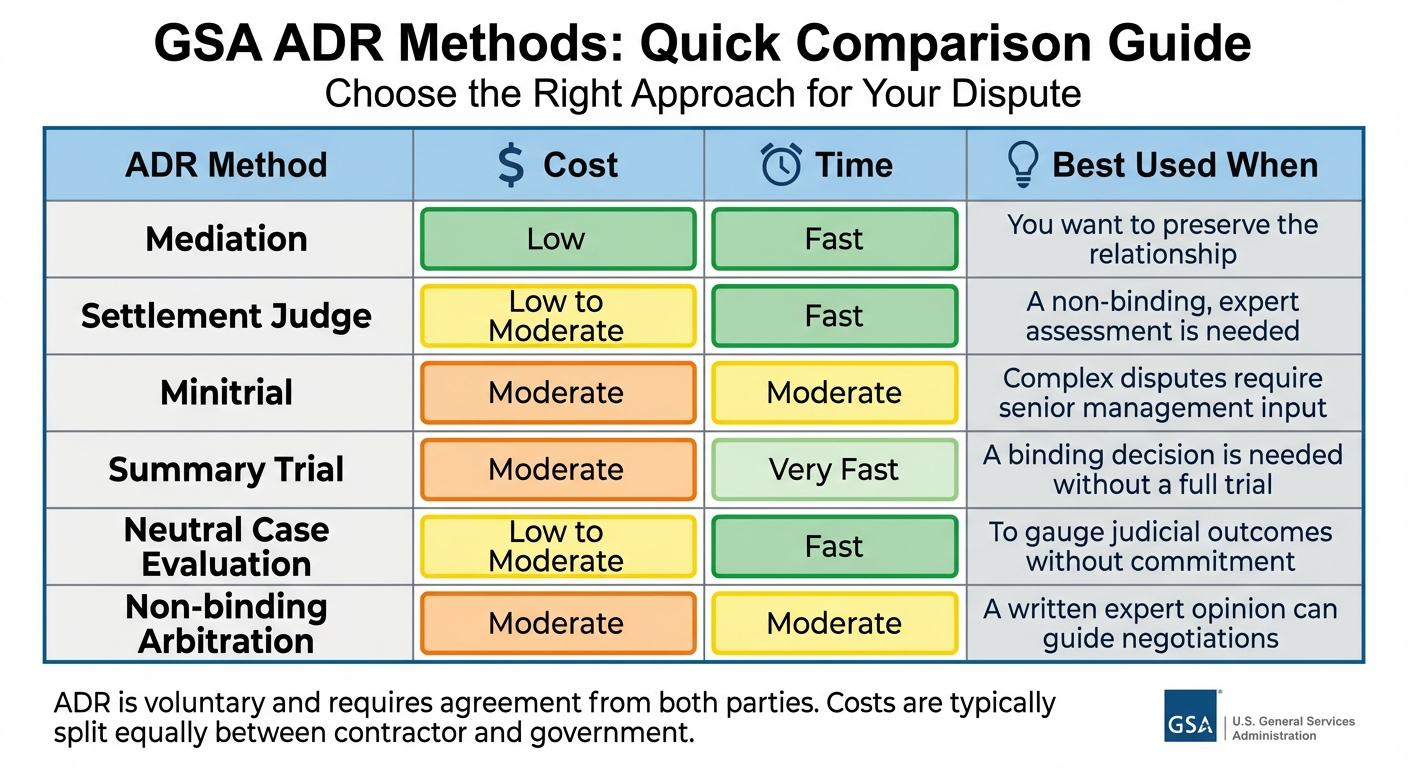
GSA Alternative Dispute Resolution Methods Comparison Chart
Even with the best preventive measures, disputes can still arise in GSA contracts. When they do, Alternative Dispute Resolution (ADR) offers a quicker and more cost-effective alternative to litigation. GSA’s policy underscores this approach: "It is GSA’s policy to use ADR to effect the prompt, efficient and just resolution of disputes.". ADR is entirely voluntary, requiring both parties – the contractor and the government – to agree on the procedures. While preventive measures are ideal, ADR serves as a practical fallback when disagreements surface.
ADR can be initiated at any point where a contracting officer has the authority to resolve the issue, even after a final decision has been issued. However, it’s important to note that this doesn’t pause the clock on appeal deadlines. Confidentiality is a cornerstone of ADR, encouraging open discussions without fear of future repercussions. If a contracting officer declines an ADR request, they must provide a written explanation outlining their reasons. Below, we’ll explore the various ADR methods available and how they can help resolve disputes without resorting to lengthy court battles.
ADR Methods and When to Use Them
Different situations call for different ADR methods. Here’s a breakdown of some common approaches:
- Mediation: A neutral party helps both sides reach a voluntary agreement without imposing a decision.
- Settlement Judge: A judge provides a non-binding assessment of each side’s case, offering a “reality check” from a judicial perspective.
- Minitrials: Designed for complex cases, senior management from both sides hear streamlined presentations before negotiating.
- Summary Trial: Offers a binding decision within about 10 days, making it ideal for quick resolutions [20,23].
- Neutral Case Evaluation: A neutral expert gives a non-binding advisory opinion based on the evidence, helping predict how a judge might rule.
- Non-binding Arbitration: Results in a written expert opinion to guide settlement talks. Binding arbitration is also possible, though the agency head can vacate binding awards within 30 days.
To help you decide, here’s a quick comparison of ADR methods:
| ADR Method | Cost | Time | Best Used When |
|---|---|---|---|
| Mediation | Low | Fast | You want to preserve the relationship. |
| Settlement Judge | Low to Moderate | Fast | A non-binding, expert assessment is needed. |
| Minitrial | Moderate | Moderate | Complex disputes require senior management input. |
| Summary Trial | Moderate | Very Fast | A binding decision is needed without a full trial. |
| Neutral Case Evaluation | Low to Moderate | Fast | To gauge judicial outcomes without commitment. |
| Non-binding Arbitration | Moderate | Moderate | A written expert opinion can guide negotiations. |
ADR is particularly effective for disputes involving factual disagreements, stalled negotiations, or situations where ADR costs are expected to be lower than litigation. However, ADR may not be suitable for cases involving criminal violations, significant legal precedents, or major policy questions. Contractors are encouraged to express their willingness to use ADR early in the claims process, as contracting officers often seek input on this option. If a third-party neutral is involved, the cost is generally split equally between the contractor and the government.
Why ADR Works Better Than Litigation
ADR offers clear advantages over traditional litigation, especially regarding time and expense. Court cases can drag on for years, racking up significant legal fees, while ADR aims to resolve disputes much faster and at a fraction of the cost. By sidestepping formal rules of evidence and transcript requirements, ADR simplifies the process and reduces expenses [20,23]. Importantly, ADR gives both parties control over the procedures, avoiding the rigidity of court rules.
Another major benefit is the preservation of business relationships. ADR’s confidential and collaborative nature – particularly in methods like mediation – helps resolve disputes without the hostility often seen in court. This can be crucial if you’re planning long-term partnerships with federal agencies. Additionally, because ADR involves decision-makers with the authority to settle disputes, any agreements reached can be implemented immediately, without additional layers of approval. For those seeking finality, options like Summary Trials deliver binding, non-appealable decisions far more swiftly than traditional appeals.
ADR not only saves time and money but also helps maintain trust and cooperation – key ingredients for successful government contracting.
Documentation and Record-Keeping Requirements
Preventative measures and alternative dispute resolution (ADR) can often resolve disagreements, but when disputes escalate, solid documentation becomes your strongest shield. It’s not just about being organized – it’s about building a reliable foundation for your legal position. Without proper records, your ability to defend or substantiate claims diminishes significantly. Documentation forms the backbone of the "Appeal File" for the Civilian Board of Contract Appeals and the "Litigation Report" used in the Court of Federal Claims. When it’s time to prove your case, your records will serve as the evidence that either supports or undermines your arguments.
Keeping Accurate and Complete Records
Effective record-keeping begins with understanding what to save and how to structure it. Every GSA contract generates a trail of documents, from the original contract and its modifications to invoices, emails, and other correspondence. These records not only demonstrate timeliness but also provide the proof needed to validate your claims. For example, something as simple as a certified mail receipt confirming your appeal submission could determine whether your case is accepted or dismissed.
To stay organized, categorize your records into three main groups:
- Contractual Documents: Includes the original contract and any modifications.
- Correspondence: Emails, letters, and other forms of communication.
- Claims: Formal submissions and decisions from the contracting officer.
Additionally, keep personnel records handy, as they may be crucial for witness testimony. As outlined in the General Services Administration Manual:
"Generally, the Appeal File shall include all documents referenced in and supporting the agency’s position, including, the contract, the claim, and the contracting officer’s decision."
Building Clear Audit Trails
An audit trail provides a chronological roadmap of your contract’s history, making it easier to trace key events and decisions. Federal guidelines require that appeal files be assembled in chronological order, with the oldest documents appearing first, to clearly outline the contract’s progression. The government must submit a completed Appeal File within 20 days of receiving a notice of appeal, so having a well-organized and accessible record system is critical for meeting these tight deadlines.
To ensure clarity, paginate all multi-page documents and manually add any missing page numbers. Also, create a detailed index that includes each exhibit’s description, date, and file number. This level of organization not only strengthens your position but also reduces the risk of delays or disputes. When auditors or contracting officers request documentation, having a system in place allows you to quickly locate and provide the necessary materials.
Conclusion
Avoiding GSA disputes starts with a solid strategy that prioritizes preparation and attention to detail long before issues arise. Keeping meticulous records – like CSP disclosures, financial statements, and timestamped communications – lays the groundwork for a strong defense if disputes occur. Transparent pricing, backed by reliable data, allows you to justify GSA discounts and sidestep common pricing conflicts.
Staying compliant means consistently adhering to FAR and GSAM requirements, assigning clear responsibilities, and securing written confirmation of all negotiated terms. Documenting everything – from discount structures to Economic Price Adjustment clauses – creates a reliable audit trail that supports your business during reviews or disputes. This trail strengthens the preventive measures already outlined.
Alternative Dispute Resolution (ADR) offers a faster and less adversarial path than litigation. The GSA Office of the Procurement Ombudsman can step in early to address concerns, while the MAS Liaison provides targeted help with Multiple Award Schedule issues. As the Ombudsman explains:
"We intervene to de-escalate and facilitate the resolution of complaints. We gather evidence from you and internal GSA teams to recommend solutions".
Using these resources before disputes escalate into formal protests can protect relationships and save both time and money.
For small businesses navigating GSA contracting, having expert support can make all the difference. Whether you’re applying for your first contract or managing ongoing compliance, professional guidance ensures your documentation, pricing strategies, and contract management align with federal standards. As mentioned earlier, specialists like GSA Focus provide full-service support tailored to small businesses, covering everything from document preparation to compliance and negotiation. With their help, contractors can establish a strong foundation that reduces dispute risks right from the start.
FAQs
What are the earliest warning signs of a GSA dispute?
Missed deadlines are often an early indicator of a GSA dispute. These delays can stem from poor organization, unexpected changes in project scope, or resource-related challenges. If left unaddressed, such issues may result in project setbacks, financial penalties, or, in the worst-case scenario, the termination of the contract.
Which compliance tasks should I check monthly to stay audit-ready?
To ensure you’re always prepared for an audit, make it a habit to review your monthly sales reports, verify pricing compliance, and keep all necessary documentation up to date. Regular attention to these tasks helps you stay compliant and ready for any potential audits.
When should I use an REA instead of filing a claim?
Use a Request for Equitable Adjustment (REA) when seeking a more informal, negotiation-focused way to resolve unexpected contract changes or delays. An REA works well for handling modifications or scope changes triggered by government actions, especially if you want to bypass the formal certification and procedural steps involved in filing a claim.
Related Blog Posts
- Top 5 Compliance Issues in GSA Contracts
- Common GSA Compliance Mistakes And Fixes
- Common GSA Audit Issues and How to Avoid Them
- Alternative Dispute Resolution for GSA Contracts