

Federal contracting is a competitive space where businesses often need to team up to win larger contracts. Teaming arrangements allow small businesses to overcome challenges like limited resources or lack of clearances. By collaborating with the right partners, drafting clear agreements, and managing performance effectively, businesses can secure contracts that would otherwise be out of reach.
Key Takeaways:
- Choose the Right Partners: Vet potential partners thoroughly – check financial stability, certifications, and past performance.
- Draft Clear Agreements: Define roles, workshare, pricing, and responsibilities in detail to avoid disputes.
- Manage Performance: Set up effective communication systems and track progress to ensure contract success.
Teaming isn’t just about filling gaps; it’s about building strong partnerships that improve your chances of winning federal contracts. By starting small and focusing on long-term collaboration, you can position your business for growth in the federal marketplace.
Teaming Agreement Best Practices for Government Contractors
Choosing the Right Teaming Partners
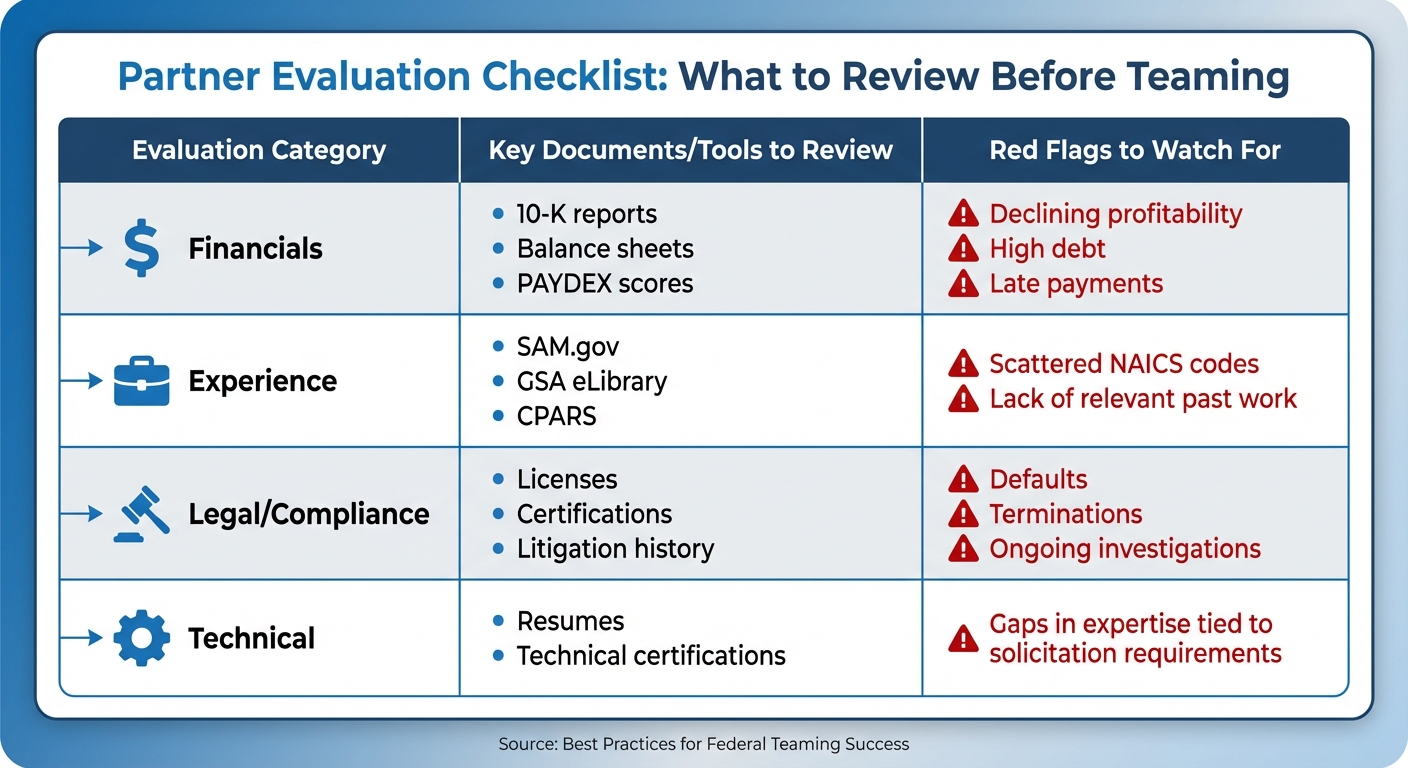
Partner Evaluation Checklist for Federal Teaming Success
Picking the right teaming partner is no small task. FedBiz Access, a firm with over two decades of experience in government business development, puts it bluntly: “Choosing the right teaming partner is akin to entering a marriage in the business world; it requires patience, thorough vetting, and a clear understanding of mutual business goals”. A misstep here can lead to more than just a failed proposal – it could harm your reputation in federal contracting or even result in disqualifications due to affiliation issues.
Start by confirming that your potential partner is legitimate and active. Check their SAM.gov registration, verify their socioeconomic certifications (like 8(a), HUBZone, or SDVOSB), and review their NAICS codes. Be wary of partners with a scattered range of NAICS codes – jumping between IT services, construction, and logistics might indicate a lack of depth in specialized areas. If they claim to have a GSA Schedule, cross-check their offerings via the GSA eLibrary. This extra step ensures their claims align with what’s been vetted by the GSA, simplifying your due diligence process. For small businesses, services like GSA Focus (https://gsascheduleservices.com) can help streamline this verification and ensure compliance with federal guidelines.
Financial stability is just as critical as technical expertise. Before diving into sensitive details, have them sign an NDA. Then, dig into their financials – review balance sheets, cash flow reports, and credit scores from Dun & Bradstreet or FICO’s Small Business Scoring Service (SBSS). Red flags like late payments or high debt levels could signal trouble. For publicly traded companies, their SEC 10-K reports offer valuable insights into profitability, working capital, and debt management. A financially unstable partner might struggle to meet their obligations once the contract begins.
Past performance is another key indicator. Use tools like FPDS.gov and USAspending.gov to analyze their contract history, focusing on relevant work rather than just contract vehicles. Check their ratings on the Contractor Performance Assessment Reporting System (CPARS). Additionally, look into which prime contractors have previously hired them as subcontractors – this can provide a window into their industry reputation. If your focus is on a specific federal agency, teaming with a partner who already has established relationships there can give you an edge. Finally, ensure their technical strengths align with the requirements of your solicitation.
Assessing Partner Capabilities and Track Record
To gauge a partner’s technical competence, match their skills and certifications against the needs of your target solicitation. Request resumes and technical certifications from their personnel to confirm expertise. Conduct a Requirements Gap Analysis (RGA): break down the Performance Work Statement (PWS) into specific tasks and have potential partners self-assess their capabilities for each. Ask them to back up their claims with concrete past performance data to ensure there’s no gap in covering project requirements.
| Evaluation Category | Key Documents/Tools to Review | Red Flags to Watch For |
|---|---|---|
| Financials | 10-K reports, Balance sheets, PAYDEX scores | Declining profitability, high debt, late payments |
| Experience | SAM.gov, GSA eLibrary, CPARS | Scattered NAICS codes, lack of relevant past work |
| Legal/Compliance | Licenses, Certifications, Litigation history | Defaults, terminations, ongoing investigations |
| Technical | Resumes, Technical certifications | Gaps in expertise tied to solicitation requirements |
This thorough evaluation process paves the way for a partnership that not only supports immediate contracts but also sets the stage for long-term success.
Don’t overlook clearances, licenses, and compliance standards. Investigate any history of contract terminations or ongoing government probes. If your collaboration involves shared infrastructure or sensitive data, scrutinize their cybersecurity measures. For GSA Multiple Award Schedule (MAS) Contractor Team Arrangements, ensure all members meet socioeconomic requirements and follow subcontracting rules under FAR 52.219-14.
Before jumping into a major contract, test the waters. Collaborate on smaller bids to get a sense of their business culture, communication style, and reliability. Set up multiple meetings to evaluate their responsiveness and transparency. A solid partner will be upfront about both the strengths and potential challenges of the partnership.
Aligning Business Goals and Targets
Credentials and financial stability are just part of the equation. A successful partnership also hinges on shared goals and a compatible vision. Discuss which federal agencies you both aim to target and make sure your company cultures align. For instance, a partner focused on Department of Defense contracts may not be the best match if your focus is on civilian agencies like the Department of Health and Human Services.
Be mindful of affiliation risks. Small businesses need to ensure their teaming arrangements don’t trigger SBA rulings that could disqualify them from small business set-asides. Pay close attention to the ostensible subcontractor rule – relying too heavily on a subcontractor for critical contract requirements could result in affiliation issues. Your teaming agreement should clearly define that the prime contractor retains managerial control, staying compliant with SBA regulations.
Finally, think about the long-term potential of the partnership. Is your partner interested in building a relationship that spans multiple contracts, or are they only in it for a single opportunity? Federal agencies often prefer partnerships with proven track records. If your goals align and you successfully execute an initial contract together, it can strengthen future proposals and open doors to larger opportunities.
Creating Clear Teaming Agreements
Once you’ve selected your partner, it’s time to formalize roles and responsibilities with a detailed teaming agreement. This step is crucial to avoid misunderstandings, disputes, or even legal complications down the road.
One common pitfall is drafting agreements that are too vague. Courts often dismiss "agreements to agree" unless they include clear details like scope, pricing, and performance timelines. Use firm language such as "shall award" instead of softer terms like "will negotiate". To strengthen the agreement, negotiate and attach the full subcontract as an exhibit before submitting your proposal.
Key Elements to Include in a Teaming Agreement
A well-crafted teaming agreement should cover several critical areas to ensure a smooth partnership and protect both parties. Start by identifying all parties involved, including names, addresses, relevant GSA Schedule numbers (if applicable), and Points of Contact for both the prime contractor and subcontractor.
Define Proposal Responsibilities
Clearly outline who is responsible for each part of the proposal. This includes assigning tasks for sections of the proposal, providing past performance data, and managing pricing.
Detail the Scope of Work
Specify workshare percentages, resources, equipment, and labor contributions from each party. For small business federal service contracts, remember that the prime contractor must perform at least 50% of the personnel costs to avoid affiliation or "pass-through" violations.
Subcontract Terms
Clarify whether the subcontract is guaranteed if the prime contract is awarded. Use enforceable language like "shall award" to eliminate ambiguity. Include pricing structures upfront, detailing whether the model will be Firm Fixed Price, Time & Materials, or another approach, along with specific rates and payment terms.
Exclusivity and Termination
Define whether the subcontractor can work with other primes for the same solicitation and whether the prime can engage additional partners for the same scope. Termination clauses should cover triggers like losing the award, government rejection of the subcontractor, or failure to finalize a subcontract within a set timeframe.
Non-Disclosure and Dispute Resolution
Protect sensitive pricing and performance data with non-disclosure terms. Ensure compliance with FAR whistleblower exceptions (FAR 52.203-18 and 52.203-19) so employees can report waste, fraud, or abuse. For GSA Contractor Team Arrangements (CTAs), include a clause stating that payment disputes will be resolved within the team, without government intervention.
"The CTA document should also acknowledge that any dispute involving the distribution of payment between the team lead and the team members will be resolved by the team members, without any involvement by the government" – TurboGSA
By addressing these elements, your agreement can serve as a solid foundation for collaboration and mitigate potential risks.
Defining Roles and Workshare Distribution
Building on the agreement’s framework, it’s essential to clearly allocate responsibilities and workshare. Ambiguity leads to confusion, so be precise about who handles each task, when they’ll do it, and their share of the contract.
Define the roles of the team lead and members at every project stage, from proposal creation to contract closeout. For instance, if you’re pursuing an IT modernization contract, specify whether the prime contractor will manage system architecture while the subcontractor handles cybersecurity implementation. Such clarity helps avoid SBA affiliation issues, like those triggered by the "ostensible subcontractor" rule.
Performance and Liability
Document each team member’s responsibilities, performance obligations, and liability to ensure accountability.
"The CTA document should address each team member’s responsibilities and performance requirements so that liability is clearly established" – TurboGSA
Pricing and Financial Details
Specify unit prices or hourly rates, explain how pricing is calculated, and outline how project management or incentive fees will be divided. For GSA Schedule CTAs, each contractor must report its sales and pay the Industrial Funding Fee (IFF) directly to the GSA.
Independence and Replacement Procedures
State that all team members remain independent contractors responsible for their own employees. Include clear guidelines for replacing team members or the lead, noting that government approval is usually required.
Lastly, ensure the agreement aligns with the members’ individual GSA Schedule contracts, as government contract terms will take precedence. By addressing these details, you’ll set the stage for a successful and efficient collaboration.
Managing Performance and Communication
Once you have a solid teaming agreement in place, the next step is maintaining consistent performance and effective communication. These two factors are critical to ensuring that your team meets its commitments and satisfies government expectations. Without clear processes, even the best-laid plans can unravel, leading to confusion, missed deadlines, or disputes. Establishing and sticking to formal systems from the start is essential for success throughout the contract lifecycle.
Setting Up Communication Systems
Kick off the project with a team charter that outlines essential communication protocols. This should include working hours, feedback loops, and decision-making procedures. As the GSA TTS Handbook puts it:
"It takes healthy multidisciplinary collaboration to build effective, resilient technology products in a rapidly changing environment." – GSA TTS Handbook
Regular meetings are crucial for keeping everyone on the same page. Daily standups are great for addressing immediate blockers, while biweekly sprint meetings can help with planning and evaluating progress.
It’s also vital to clarify roles and responsibilities. For example, ensure that everyone understands that only the Contracting Officer (CO) can modify the contract, while the Contracting Officer’s Representative (COR) oversees compliance. Knowing when and how to escalate issues can prevent unnecessary delays and confusion.
For team discussions, use shared spaces instead of private messaging to promote transparency. When working remotely, video calls can help build trust, and documenting decisions in shared tools ensures everyone stays informed.
Tracking and Improving Team Performance
Good communication sets the stage for effective performance monitoring. In federal contracting, tracking performance involves both internal accountability and external evaluations. For Multiple Award Schedule (MAS) Contractor Team Arrangements, your written agreement should clearly define each party’s tasks and performance expectations to avoid ambiguity.
The government primarily evaluates performance through the Contractor Performance Assessment Reporting System (CPARS). While CPARS automatically assigns evaluations to the party generating the most revenue, ordering agencies can manually include other team members. Having all team members evaluated can enhance your credibility for future proposals.
Each team member is also responsible for tracking their own sales and paying the Industrial Funding Fee (IFF) of 0.75% of reported sales directly to the GSA. To avoid conflicts, your teaming agreement should address potential disputes over payments, scope, and quality. Predefined escalation paths and termination triggers can provide a structured way to handle issues professionally.
If a team member needs to be replaced after receiving an order, you’ll need to follow the approval process outlined in your agreement and obtain the government buyer’s consent.
Using Teaming to Win More Contracts
In federal contracting, the game is no longer just company-versus-company – it’s team-versus-team. Strategic teaming builds on the groundwork of clear partnerships and defined roles. When you assemble the right partners, you’re not just filling capability gaps – you’re creating a powerful advantage that can boost your evaluation scores and improve your chances of winning contracts.
Strengthening Your Proposals
A well-rounded team showcases the capability, depth, and redundancy that evaluators prioritize. To achieve this, start with a Requirements Gap Analysis (RGA). Break down the Performance Work Statement (PWS) into task areas and assess how your team measures up. Neil McDonnell, President of GovCon Chamber, puts it simply:
"A strong team brings 100% coverage of all requirements"
Your proposal should include at least three past performance references for each major task area. This directly enhances your technical evaluation scores.
Agencies also scrutinize teaming arrangements for potential risks. Partnerships with a proven track record of working together on smaller contracts are seen as more reliable than untested collaborations. Starting with smaller bids helps build that history. When you can show that your team has successfully worked together before, evaluators see an established partnership with workflows and alignment – not a risky, unproven arrangement. This kind of solid foundation strengthens your proposal and opens the door to larger opportunities.
Reaching Larger Contracts and New Markets
Teaming can unlock opportunities that might otherwise be out of reach. For example, through GSA Contractor Team Arrangements (CTAs), team members can sell under any Special Item Number (SIN) listed on any member’s Multiple Award Schedule contracts. This expands your market reach and allows you to bid on opportunities requiring specialized certifications, security clearances, or bonding capacity that you may not hold on your own.
Nearly 80% of awarded contract work involves a subcontractor. For small businesses, teaming with large primes provides access to the financial resources and stability needed for complex contracts. On the flip side, large businesses can tap into small business set-aside markets through strategic partnerships. Partnering with an incumbent contractor or a firm with a strong reputation at your target agency can also give you an edge. Their insider knowledge of the contract’s nuances can make your proposal more competitive.
The key is finding partners whose products or services complement yours. Together, you can create a complete solution that delivers real value and demonstrates a unified approach.
Conclusion
Success in federal teaming hinges on three core principles: choosing the right partners, drafting enforceable agreements, and actively managing team performance. These elements work together to ensure stability and effectiveness. Without carefully vetting potential partners, you risk working with unreliable companies or violating SBA affiliation rules. Without clear agreements outlining scope, pricing, and responsibilities, you could face legal challenges if disputes arise. And without consistent performance management, even the most promising partnerships can falter.
Paul R. Hurst, Chair of Steptoe‘s Government Contracts Group, puts it succinctly:
"Competition for federal programs today often pits team versus team, not company versus company".
Your ability to secure federal contracts often depends on the strength and reliability of your team. Strong partnerships can unlock larger, more complex opportunities while increasing your win rate.
To succeed, start small. Build trust and test compatibility with potential partners before tackling major projects. Use resources like SAM.gov and GSA eLibrary to verify credentials, and rely on financial tools like Dun & Bradstreet’s PAYDEX score to confirm reliability. Draft detailed agreements that clearly define work share percentages, responsibilities, and pricing – steering clear of vague templates that courts may deem unenforceable "agreements to agree".
When grounded in clear legal agreements, strong teaming relationships offer a competitive edge. The right partner can help you access opportunities you couldn’t pursue alone, strengthen your past performance record for future bids, and position your business for growth in the federal marketplace.
By integrating these practices into your strategy, you can reduce risks, secure more contracts, and foster lasting partnerships. A well-managed teaming approach, combined with expert guidance, sets the stage for long-term success in federal contracting.
For more insights and comprehensive support tailored to small businesses navigating the federal marketplace, visit GSA Focus at https://gsascheduleservices.com. Let us help simplify your journey to federal contracting success.
FAQs
How do I avoid SBA affiliation when teaming?
To ensure compliance with SBA rules and avoid affiliation issues, it’s crucial to maintain a clear distinction between your business operations and those of your teaming partners. Start by drafting a well-defined teaming agreement that outlines each party’s responsibilities, the scope of work, and who holds decision-making authority. Steer clear of exclusive arrangements or clauses that could imply control or dependency between the parties.
Additionally, it’s wise to regularly consult with legal counsel experienced in SBA regulations. This step helps you stay on the right side of compliance and protect your eligibility for set-aside contracts.
What makes a teaming agreement enforceable?
A teaming agreement becomes enforceable when it lays out the scope of work, responsibilities, and key terms with clear and precise language. To hold up legally, it must be in writing, include mutual consent from all parties, and avoid ambiguous phrases like "agreements to agree" or promises of future negotiations. The key to enforceability lies in the agreement’s clarity and specificity.
When should we use a GSA CTA vs a subcontract?
When multiple GSA Schedule contractors want to work together on a project, a GSA CTA (Contractor Team Arrangement) is the way to go. This setup allows each contractor to collaborate equally, maintain direct communication with the government, and handle their own invoicing. It’s a great approach when all parties involved hold GSA Schedules and share the workload.
On the other hand, a subcontract works best when a prime contractor takes the lead, delegates specific tasks to a subcontractor, and stays responsible for communicating with the government. This is especially useful if the subcontractor doesn’t have a GSA Schedule.
Related Blog Posts
- Types of GSA Teaming Agreements Explained
- Roles in GSA Teaming Agreements Explained
- Ultimate Guide to Teaming Agreements for Small Businesses
- Best Practices for Small Business Teaming Success