

Securing a GSA Schedule contract is just the start – success hinges on tracking performance metrics to maintain compliance and improve contract outcomes. These metrics help contractors meet obligations, enhance CPARS ratings, and position themselves for future opportunities. Key areas to monitor include:
- Timely Deliveries: Meeting deadlines impacts customer satisfaction and CPARS ratings.
- Sales Reporting & Compliance: Accurate reporting of sales and Industrial Funding Fee (IFF) payments ensures adherence to GSA rules.
- CPARS Ratings: Performance in quality, cost control, timeliness, and management directly affects future contract awards.
- Customer Experience: Metrics like Net Promoter Score (NPS) and Customer Satisfaction Score (CSAT) provide insights into service quality.
- Cost Efficiency: Managing budgets and forecasting costs are vital for non-fixed-price contracts.
What Is Contract Performance Management For Government Contracts?
Key GSA Metrics to Track for Contract Success
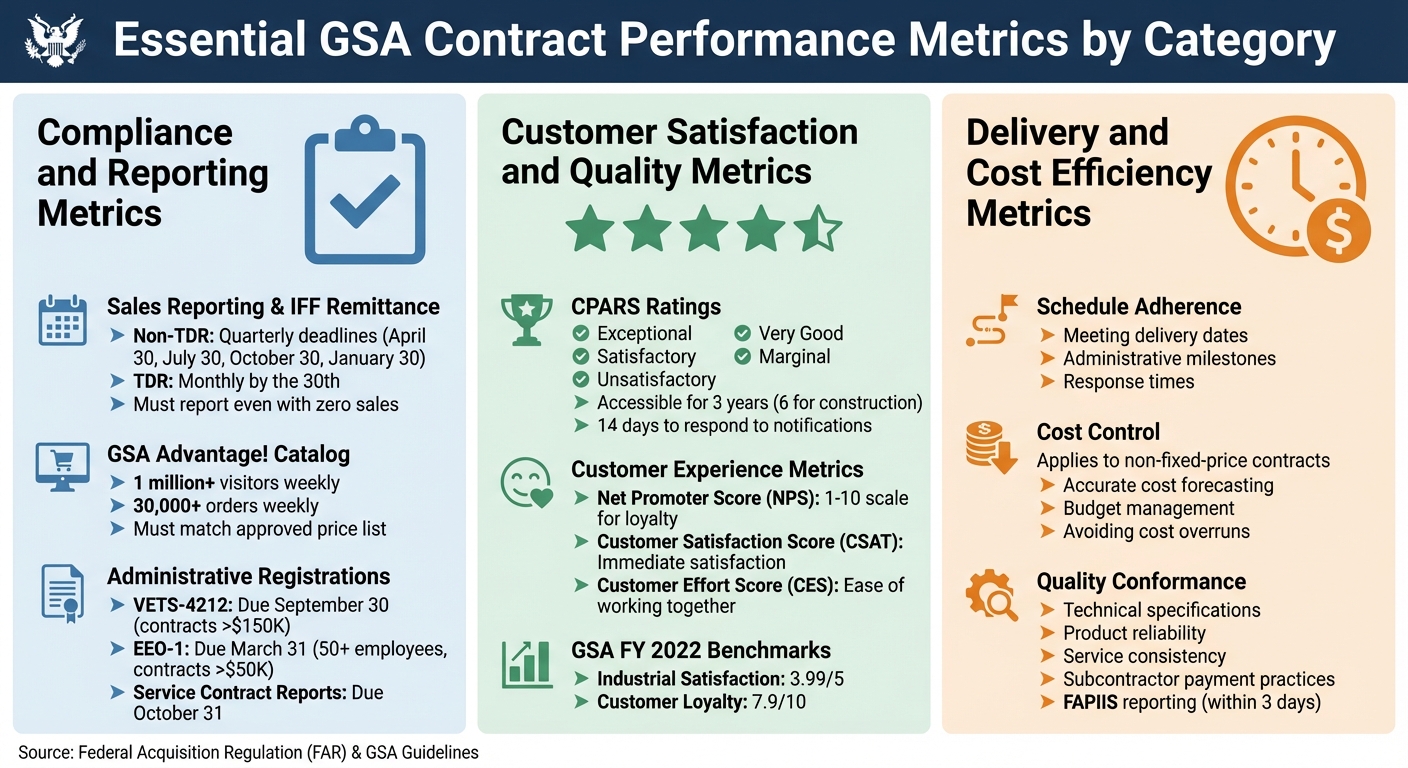
Essential GSA Contract Performance Metrics by Category
Tracking the right metrics can set top-performing contractors apart from the rest. By focusing on specific GSA metrics, you can maintain compliance, improve CPARS ratings, and drive contract growth. These metrics fall into three main categories, each offering a comprehensive view of your contract’s overall health.
Compliance and Reporting Metrics
Staying compliant with GSA requirements starts with sales reporting and IFF remittance. Contractors must report all GSA sales through 72A reporting and pay the Industrial Funding Fee (IFF), even if no sales occurred during the reporting period. Non-TDR contractors need to meet quarterly deadlines (April 30, July 30, October 30, and January 30), while TDR contractors report monthly by the 30th.
Another critical area is Basis of Award (BOA) monitoring, which ensures that discount practices align with the Price Reductions Clause. Any deviation could require pricing adjustments. Additionally, your GSA Advantage! catalog must accurately reflect your approved price list. Inaccuracies can impact the platform’s performance, which sees over 1 million visitors and generates more than 30,000 orders weekly.
Contractors must also keep up with administrative registrations throughout the contract term. For example, contracts over $150,000 require VETS-4212 reporting by September 30, while firms with 50 or more employees and contracts exceeding $50,000 must submit EEO-1 reports by March 31. Service Contract Reports are due by October 31.
While these metrics focus on compliance, they lay the groundwork for delivering quality and meeting customer expectations.
Customer Satisfaction and Quality Metrics
Your CPARS ratings are a critical factor in securing future contract opportunities. Federal agencies use a five-point scale to evaluate performance: Exceptional, Very Good, Satisfactory, Marginal, and Unsatisfactory. As outlined in the Federal Acquisition Regulation:
"The evaluation should reflect how the contractor performed… and be based on objective facts supported by program and contract or order performance data".
These ratings remain accessible for three years (six years for construction contracts) and heavily influence source selection. Contractors have 14 days to respond to notifications, making regular CPARS monitoring a must.
Beyond CPARS, tracking customer experience metrics like Net Promoter Score (NPS), Customer Satisfaction Score (CSAT), and Customer Effort Score (CES) can provide valuable insights. NPS measures long-term loyalty on a 1–10 scale, while CSAT captures immediate satisfaction. CES focuses on how easy it is for agencies to work with you – lower effort often leads to higher loyalty. In FY 2022, GSA achieved a 3.99 out of 5 on the Industrial Satisfaction Survey and a 7.9 out of 10 on the Customer Loyalty Survey, benchmarks contractors should aim to meet or exceed.
Delivery and Cost Efficiency Metrics
Schedule adherence is a key metric for evaluating how well you meet delivery dates and administrative milestones. Agencies closely monitor your ability to meet deadlines and maintain a proactive approach to customer needs, as required by the FAR. Consistent delays, even in administrative tasks, can negatively affect your performance ratings.
For contracts other than firm-fixed-price arrangements, cost control metrics are crucial. Agencies assess your ability to forecast and manage costs effectively. The FAR emphasizes:
"Cost control (not applicable for firm-fixed-price or fixed-price with economic price adjustment arrangements)".
Accurate cost forecasting and staying within budget play a significant role in CPARS evaluations.
Finally, quality conformance evaluates your ability to meet technical specifications, ensure product reliability, and maintain service consistency. Agencies also monitor subcontractor payment practices; repeated delays or unjustified reductions in payments to small business subcontractors can severely impact your performance record. Any findings of defective cost or pricing data must be reported to the FAPIIS module of CPARS within three calendar days, creating a permanent public record.
These metrics, when tracked diligently, contribute to a cycle of continuous improvement, positioning your contract for long-term success.
| Evaluation Factor | Key Metric Indicators |
|---|---|
| Schedule/Timeliness | Meeting delivery dates, administrative milestones, and response times |
| Cost Control | Accurate cost forecasting, staying within budget, and avoiding cost overruns |
| Technical Quality | Adherence to specifications, consistent workmanship, and product/service reliability |
| Management | Proactive customer focus, effective subcontractor management, and reporting accuracy |
Building a Performance Metrics Framework for GSA Contracts
Creating a structured performance metrics framework for GSA contracts transforms raw data into actionable insights, helping you stay proactive rather than reactive. Instead of waiting for issues to arise, this approach allows you to identify trends early and maintain consistent results throughout the contract lifecycle. The GSA’s performance management philosophy sums it up perfectly: "What doesn’t get measured doesn’t get managed." Once you have the data, the next step is to set clear performance goals and benchmarks to turn these insights into measurable targets.
Setting Clear Performance Goals and Benchmarks
To be effective, your metrics framework should reflect the way federal agencies measure their own success. GSA evaluates performance across five key areas: Customer, Standards Adoption, IT Modernization, Financial, and Marketplace Operation. These dimensions establish a shared standard for success.
Start by defining baselines for each metric. For example, in FY 2023, GSA set a target of completing 80% of capital projects on budget and exceeded it by achieving 86.6%. Similarly, the Multiple Award Schedule (MAS) aimed for 35% small business spending and actually reached 37.05%. These benchmarks provide realistic and achievable targets for your own performance goals.
To ensure consistency in data collection and analysis, use Performance Measure Definition Forms (PMDFs). These forms outline the methodology, data sources, and frequency for each metric. As noted in GSA Order 2170.1B, "The Federal Government must report high-quality data to maintain the trust placed in it by the American people and to support better data-driven decisions."
Integrating Metrics into Contract Management Processes
Metrics are only useful if they are woven into your daily operations. Tools like Contract Lifecycle Management (CLM) software can streamline this process by automating tasks such as tracking obligations, sending task alerts, monitoring milestones, and generating real-time status reports.
A centralized data repository enhances efficiency by automating key-term extraction, which helps you quickly identify patterns. Additionally, Quality Assurance Surveillance Plans (QASPs) provide a structured framework for monitoring contract performance. Assigning clear roles – typically split between the Contracting Officer (CO) and the Contracting Officer’s Representative (COR) – ensures that performance standards are consistently met.
Set up automated notifications for critical deadlines, and conduct regular audits and risk assessments to document findings and maintain compliance with contract terms.
Balancing Short-Term and Long-Term Metrics
A balanced approach to metrics involves integrating short-term indicators, such as service quality and SLAs, with long-term measures like ROI and cost avoidance. This combination ensures that you are addressing immediate operational needs while also planning for the future.
For example, GSA’s Shared Services Performance Management Framework unfolds in three phases. By Phase 3 (FY25+), the focus shifts to long-term outcomes such as solution adoption, cost savings, and ROI. This phased approach avoids overwhelming your team with too many metrics at once while building a comprehensive view of performance over time. By managing both short-term operations and long-term goals, you can meet today’s demands while preparing for future opportunities.
Using Metrics to Drive Continuous Improvement
Metrics aren’t just numbers on a report – they’re tools to identify challenges early and guide meaningful improvements. The Contractor Performance Assessment Reporting System (CPARS) evaluates your performance in five critical areas: quality, cost control, timeliness, management, and small business subcontracting. These ratings have a direct impact on your eligibility for future awards.
Regular Monitoring and Reporting
Frequent reviews of your CPARS evaluations and Transactional Data Reporting (TDR) can help you catch negative trends before they escalate. By analyzing TDR data, you can pinpoint patterns and adjust pricing or contract terms to align with government category management standards. For Multiple Award Schedule (MAS) contracts, missing reporting deadlines isn’t just a minor oversight – it can trigger compliance issues that could damage your standing.
Proactively engaging with evaluators before the initial CPARS submission is another way to address potential concerns early. As GSA.gov warns:
"A negative past performance rating, which could be due to the evaluator’s mistake or omission, might affect your ability to get future awards".
If you believe a rating is unfair, you have 60 days to submit a rebuttal along with evidence to support your case. With this level of insight, you can transition to a structured improvement approach to tackle problem areas.
Applying a Metric-Driven Improvement Cycle
Once you’ve established your metrics framework, ask yourself some key questions: What’s needed? When is it needed? Who will supply it? How will success be measured?. Tools like the GSA Performance Based Acquisition Utilization Tool can help you evaluate expiring non-PBA contracts and explore whether alternative acquisition methods might yield better results. This tool is especially useful for identifying areas where contracts are running efficiently versus those that need adjustments.
For example, if timeliness is slipping, examine your delivery processes and resource allocation to uncover the root cause. From there, implement targeted solutions and track whether your metrics improve. Document each step to create a repeatable process for future improvements.
Measuring the Impact of Changes with Before-and-After Analysis
After implementing changes, it’s essential to measure their effectiveness. A before-and-after analysis can reveal whether your adjustments delivered the intended results. As noted in GSA Order 2170.1B:
"Verification and validation of performance data should generate a sufficient level of confidence that performance information presented is credible as appropriate to its intended use".
Set a regular schedule to verify your metrics and ensure they remain reliable for ongoing trend analysis.
Take CPARS metrics, for instance. If you introduced a new scheduling system, compare your timeliness scores before and after the change. Or, if you revamped your subcontracting strategy, see whether you hit or exceeded your small business participation goals. Use the 60-day CPARS comment period to submit data-backed evidence of improvements, especially if previous ratings reflected issues you’ve resolved.
| Key CPARS Metric | What Before-and-After Analysis Reveals |
|---|---|
| Quality | Whether process changes resulted in better products or services |
| Timeliness | If new scheduling methods reduced delays |
| Cost Control | Whether efficiency measures curbed cost overruns (especially in cost-plus contracts) |
| Management | If organizational adjustments improved coordination and problem-solving |
| Small Business Subcontracting | Whether updated strategies met or exceeded participation targets |
Long-Term Planning Using GSA Metrics
Aligning Metrics with Business Goals
To effectively use GSA metrics, you need to align them with your business goals – focusing on contract efficiency, performance, and risk management. This alignment transforms raw data into actionable strategies for sustained growth.
Take small business participation as an example. By connecting your metrics to agency priorities, such as sustainability, cybersecurity, or small business engagement, you can exceed standard targets. Positioning your offerings within the Category Management framework not only ensures compliance but also highlights your expertise in supporting government sourcing goals. As Maria Votlucka, Marketing Manager at CobbleStone Software, explains:
"Choosing the right KPIs is the foundation of a strong contract management program".
Regularly reviewing your KPIs – ideally on a quarterly basis – ensures they remain relevant as your business objectives and federal regulations evolve. With well-aligned metrics guiding your strategy, you can focus on proactive forecasting to maintain and improve performance.
Forecasting and Scenario Planning
Once your metrics are aligned, forward planning becomes essential to stay ahead of market changes and capitalize on opportunities. Historical CPARS data is a powerful tool for evaluating long-term performance in areas like quality, timeliness, and cost control.
Keep an eye on expiring non-PBA contracts at the service, regional, and contracting office levels to identify potential recompetes. This also allows you to assess whether alternative acquisition methods might offer a competitive edge for future bids. Tools like the GSA Performance Based Acquisition Utilization Tool can further help pinpoint efficient spending categories.
TDR data offers valuable insights for pricing adjustments and anticipating market trends. Monitoring backorder and cancellation rates can help you refine delivery terms in real time. GSA’s performance thresholds – shipment or backorder reporting above 95%, on-time performance above 75%, and cancellations below 15% – are critical benchmarks. Falling short of these can lead to compliance issues, potentially jeopardizing your presence on GSA Advantage and eBuy.
Procurement forecasts are another vital resource. They reveal upcoming agency initiatives, such as workspace changes, which most federal agencies plan every four to seven years. In fact, 92% of CFO Act agencies have shown interest in workplace tools like Federal Coworking and Fast Track Space for real estate planning. If your offerings align with these trends, you can position your business as a front-runner.
| KPI Category | Focus Area | Long-Term Strategic Value |
|---|---|---|
| Efficiency | Turnaround time, automated workflows | Cuts operational costs and boosts agility |
| Efficacy | Contract value, renewal rates, SLA performance | Drives revenue and ensures mission alignment |
| Risk | Compliance, clause tracking, obligation alerts | Shields against financial and legal risks |
Automating risk tracking is another smart move. By flagging risky clauses and monitoring obligations, you can avoid missed renewals and compliance lapses. Additionally, platforms like SAM.gov, FPDS, and USAspending.gov can help analyze spending patterns to identify agencies that frequently purchase your services. This data-driven approach shifts your focus from reacting to problems to planning for growth.
How GSA Focus Helps Contractors Optimize Metrics

Expert Support for GSA Schedule Metrics
For small businesses managing multiple contracts and navigating compliance requirements, keeping up with GSA performance metrics can feel like a full-time job. That’s where GSA Focus steps in, turning complex data into actionable insights that directly improve contract outcomes.
One standout feature is their custom dashboards, designed to transform raw data into easy-to-understand visuals. These tools make it simple to track trends, detect potential problems early, and evaluate the results of strategic adjustments. They also integrate with government resources like the GSA Performance Based Acquisition (PBA) Utilization Tool, helping you pinpoint high-efficiency spend areas and identify expiring non-PBA contracts to better plan for the future.
This streamlined approach to monitoring doesn’t just simplify oversight – it also makes tackling compliance tasks far less daunting.
Simplifying Compliance and Performance Tracking
Compliance goes beyond just avoiding penalties; it’s a cornerstone of staying competitive in federal contracting. GSA Focus takes the stress out of mandatory reporting by automating tasks like the 0.75% Industrial Funding Fee (IFF) and Transactional Data Reporting (TDR). This ensures deadlines are met and reporting is accurate, keeping your business on solid footing.
Additionally, they assist with verifying Trade Agreements Act (TAA) compliance, ensuring your products are either made or substantially transformed in the U.S. or approved countries. By adhering to these standards, GSA Focus not only meets regulatory requirements but also strengthens the overall quality of your contracts. With an impressive 98% success rate in GSA contract acquisition and management, their comprehensive services save you time while keeping the door open to lucrative federal contracting opportunities.
Conclusion
GSA performance metrics are the backbone of building a strong, competitive federal contracting business. Keeping an eye on compliance indicators like the IFF and TDR ensures your contract stays on track and avoids penalties. At the same time, tracking metrics related to quality, delivery, and cost efficiency allows you to identify areas for improvement early and showcase your value in the federal marketplace. This systematic approach has been proven to deliver measurable success across federal agencies.
Take, for example, the U.S. Air Force, which reported saving $2.38 billion through effective cost-related performance tracking as of March 2021. Similarly, the Department of Homeland Security achieved $477 million in savings through category management activities during fiscal year 2024.
"Using a balanced set of performance measures, including both process- and outcome-oriented measures – and obtaining complete and reliable performance information – can help federal agencies identify improvement opportunities, set priorities, and allocate resources." – U.S. Government Accountability Office (GAO)
For small businesses, managing metrics oversight can be a daunting task. That’s where GSA Focus comes in. With automated tools, custom dashboards, and expert guidance, they simplify compliance tracking so you can concentrate on growing your business. With a 98% success rate in GSA contract acquisition and management, GSA Focus turns metrics into actionable business results, bridging the gap between streamlined compliance and long-term growth.
FAQs
How do GSA performance metrics influence CPARS ratings and future contract opportunities?
GSA performance metrics, including sales reporting, pricing compliance, on-time delivery, and quality standards, are pivotal in shaping your CPARS (Contractor Performance Assessment Reporting System) evaluations. Excelling in these areas can earn you a Very Good or even Exceptional CPARS rating, which not only enhances your reputation but also improves your chances of securing future contracts.
However, falling short on these metrics can lead to lower CPARS ratings, which might put contract renewals and new opportunities at risk. By consistently tracking and refining your GSA performance metrics, you can ensure compliance, maintain a competitive advantage, and unlock more opportunities in federal contracting.
What compliance requirements do GSA Schedule contractors need to follow?
GSA Schedule contractors have a range of compliance requirements they need to meet to maintain their contracts and ensure smooth operations. These include adhering to the Federal Acquisition Regulation (FAR) and specific GSA Schedule terms. Key obligations involve maintaining accurate pricing, delivering high-quality products or services, and protecting government data in accordance with privacy regulations.
Contractors must also submit quarterly sales reports and ensure timely payment of the Industrial Funding Fee (IFF). Staying on top of pricing compliance is another critical aspect – this includes keeping price lists current, honoring the “most favored customer” pricing clause, and thoroughly documenting any price changes. Additionally, contractor performance is evaluated through the Contractor Performance Assessment Reporting System (CPARS), where strong ratings play a crucial role in securing contract renewals and future opportunities.
For many small businesses, navigating these requirements can be overwhelming. That’s why they turn to experts like GSA Focus, who simplify compliance processes, automate tracking, and help ensure all obligations are met on time. This strategic approach not only keeps contractors audit-ready but also strengthens their performance records.
How can small businesses monitor and improve their GSA contract performance?
Small businesses can keep a close eye on their GSA contract performance by tracking essential metrics like quarterly sales, Industrial Funding Fee (IFF) payments, on-time delivery rates, and adherence to quality standards. These metrics are critical because they directly impact your CPARS (Contractor Performance Assessment Reporting System) ratings – scores that government agencies rely on when evaluating contractors. By reviewing these figures regularly, ideally every quarter, you can stay aligned with GSA and FAR requirements while ensuring your business is always prepared for audits.
To simplify the process, think about implementing a contract management system. Such tools can automate reporting tasks and send alerts for crucial deadlines, saving time and reducing errors. It’s also a good idea to assign clear responsibilities – like designating a dedicated Contract Manager – and conduct regular internal audits to confirm the accuracy of sales reports, IFF payments, and pricing data. Setting SMART goals (Specific, Measurable, Achievable, Relevant, Time-bound) for objectives like revenue growth and CPARS ratings can provide a clear roadmap for progress and help you showcase improvements when it’s time to discuss contract renewals.
Related Blog Posts
- How to Track GSA Contract Compliance
- How to Manage GSA Contract Performance
- Ultimate Guide To GSA Contract Performance Metrics
- How to Monitor Performance Risks in GSA Contracts