

Federal agencies rely on the GSA Schedule to manage supply chain logistics efficiently, with $45 billion in transactions recorded in 2023. The program organizes services under five key SINs (Special Item Numbers), each tailored to specific logistics needs:
- 874-501: Comprehensive supply and value chain management.
- 874-502: Integrated logistics support for lifecycle planning.
- 874-503: Distribution and transportation logistics services.
- 874-504: Deployment logistics for rapid, mission-critical operations.
- 541614SVC: Broad supply chain strategy and planning.
Each SIN addresses unique challenges, from inventory management to emergency deployments, ensuring federal agencies can procure services quickly and cost-effectively under FAR Subpart 8.4. Contractors must meet strict compliance, pricing, and performance standards to qualify. For small businesses, navigating GSA requirements can be complex, but firms like GSA Focus simplify the process, helping businesses secure contracts and thrive in federal markets.
Buying Services Through GSA Schedules – Basics of Buying Part 1
1. SIN 874-501: Supply and Value Chain Management Services
SIN 874-501 is tailored to support federal agencies with a full spectrum of supply and value chain management services. From high-level strategic planning to the nitty-gritty of daily warehouse operations, this SIN was part of the former LOGWORLD Schedule 874 V, offering agencies the chance to overhaul their supply chains using commercial logistics expertise. Its primary focus? Providing seamless, end-to-end management to improve availability, responsiveness, and cost efficiency.
Core Services
Contractors under SIN 874-501 deliver both strategic and operational support, combining expert consulting with hands-on services. These include:
- System assessments
- Material requirements planning
- Inventory optimization
- Asset tracking
- Warehouse operations
- Vendor management
- Implementation of logistics information systems
This integrated approach allows agencies to streamline their logistics needs under a single contract, removing the hassle of juggling multiple procurements. For example, LOGWORLD contracts have demonstrated how contractors assist with system evaluations, inventory management, and operational execution, all tailored to meet the unique missions of various federal agencies.
Federal Agency Applications
Federal agencies rely on these services for critical missions. Organizations like FEMA, NOAA, and the U.S. Postal Service use SIN 874-501 to maintain operational stability and ensure they can respond efficiently during emergencies.
Requirements for Contractors
To provide services under SIN 874-501, contractors must meet stringent performance and compliance standards. Small businesses aiming for this SIN need to showcase prior experience in supply chain roles – whether in warehouse operations, inventory management, or logistics consulting. Additionally, they must:
- Develop commercial price lists with labor categories aligned to MAS standards.
- Adhere to GSA pricing policies.
- Implement robust compliance systems for federal property management, records retention, and cybersecurity.
Given the technical demands, contractors must also be prepared to integrate advanced tools like warehouse management systems, asset tracking technologies (e.g., barcoding or RFID), and agency ERP systems into their operations. These capabilities ensure they can meet the complex needs of federal agencies effectively.
2. SIN 874-502: Acquisition Logistics
SIN 874-502 focuses on providing Integrated Logistics Support (ILS) throughout a system’s entire lifecycle, from its initial design to eventual upgrades and sustainment. Unlike SIN 874-501, which emphasizes day-to-day operational logistics, SIN 874-502 is tailored for agencies seeking long-term solutions to keep their systems reliable, cost-effective, and maintainable – from concept development to retirement. This approach connects strategic planning with hands-on execution.
Core Services
Under SIN 874-502, contractors offer a comprehensive range of ILS services that include everything from needs assessments and concept development to drafting acquisition plans and milestone reports. They also create essential acquisition documents, such as market research and program strategies, to streamline federal procurement processes.
The services extend further to include:
- Drafting specifications, maintenance procedures, and technical manuals.
- Managing configuration and lifecycle data for systems.
- Identifying, planning, acquiring, and managing material requirements.
- Overseeing supply chain integration and vendor management.
- Planning acquisition milestones and analyzing field issues to recommend solutions.
These tasks ensure that federal systems are supported effectively and remain functional across their entire lifespan.
Federal Agency Examples
Several federal agencies, including NOAA, FEMA, and various federal management support centers, have relied on SIN 874-502 for critical logistics needs. For instance:
- NOAA has utilized these services for configuration and data management, ensuring their systems remain aligned with long-term objectives rather than focusing solely on operational support.
- FEMA has applied SIN 874-502 services for platform management and conducting needs assessments tied to system acquisition.
- Other agencies have engaged these services for tasks like market research, acquisition planning, and preparing milestone documentation for complex systems.
Prerequisites
To qualify for SIN 874-502, contractors must meet specific requirements:
- Hold an active GSA Schedule contract.
- Demonstrate expertise in needs assessments, acquisition planning, and ILS, supported by a proven track record of past performance.
- Comply with the Trade Agreements Act (TAA) and adhere to GSA’s pricing standards.
- Be well-versed in Federal Acquisition Regulation (FAR) requirements and agency-specific logistics policies due to the technical nature of the work.
This combination of technical knowledge and compliance ensures contractors are equipped to handle the complex demands of acquisition logistics.
3. SIN 874-503: Distribution and Transportation Logistics Services
SIN 874-503, also known as SIN 541614, focuses on the logistics of moving supplies, equipment, and personnel across federal operations. Whether by road, air, water, rail, or pipeline, this service ensures federal agencies have access to efficient delivery networks and cost-effective freight solutions.
Core Services
Contractors under SIN 874-503 specialize in analyzing and improving distribution systems. They evaluate existing networks to identify ways to cut costs, optimize warehouse locations, and streamline routing to reduce travel distances and consolidate shipments. Key services include:
- Freight Forwarding and Consolidation: Contractors handle domestic and international shipments, combining smaller loads into full truckloads or containers, coordinating carrier selection, and managing required documentation.
- Distribution Center Operations: From transportation routing to shipment tracking, contractors manage the entire process. They provide performance dashboards that monitor on-time deliveries, damage rates, and unit costs.
These services offer practical benefits for federal agencies, especially when managing operations across vast regions or when precise, synchronized deliveries are critical – like for installations, depots, or disaster response efforts.
Federal Agency Examples
Federal agencies such as the Department of Defense, the Department of Homeland Security (including FEMA), the U.S. Postal Service, and GSA’s Office of General Supplies and Services are frequent users of SIN 874-503. They rely on these services to handle tasks like depot-to-installation distribution, emergency and disaster response shipments, maintaining spare-parts supply chains, and ensuring the steady delivery of program materials nationwide.
For example, a civilian agency might use this SIN to reevaluate its logistics network, optimize warehouse locations, and redesign routes to cut down on lead times for remote areas. A contractor could then operate a centralized distribution center, managing carrier selection and tracking shipments – all through the GSA Schedule ordering process.
Prerequisites
Contractors must meet several requirements to qualify under SIN 874-503. These include:
- Safety Programs: Demonstrating robust safety protocols.
- IT Systems: Providing reliable systems for shipment tracking.
- Regulatory Compliance: Adhering to federal transportation and trade regulations, including the Trade Agreements Act (TAA).
- GSA MAS Requirements: Proving past performance and offering fair, competitive pricing.
Federal agencies often require service-level agreements tied to specific metrics, such as on-time pickup and delivery rates, carrier utilization, and cost per unit moved. Contractors are also expected to provide regular performance reports and recommendations for continuous improvement, ensuring agencies receive consistent and reliable service.
4. SIN 874-504: Deployment Logistics Services
SIN 874-504 is tailored to meet the unique logistics demands of military and civilian force deployments – scenarios where federal agencies must quickly mobilize personnel, equipment, and supplies. Unlike the more routine distribution operations under SIN 874-503, this SIN focuses on rapid, mission-driven deployments. The emphasis here is on speed, precision, and coordination, making it an essential service for time-sensitive and high-pressure situations.
Core Services
Contractors under SIN 874-504 go beyond basic transportation. They provide a wide range of deployment support services, including contingency planning, resource staging, inventory and property management, movement, storage, and even industrial relocation. These services are designed to ensure that resources are mobilized efficiently and effectively.
To achieve this, contractors integrate commercial carriers, third-party logistics providers, and federal assets into seamless deployment strategies. They also implement advanced communications and logistics systems, such as tracking tools, visibility platforms, and command-and-control systems, to maintain real-time oversight of supplies and equipment throughout the deployment process.
Federal Agency Applications
The real-world value of SIN 874-504 is evident across several federal agencies. For example:
- The Department of Defense (DoD) depends on these services for troop movements, equipment deployment, pre-deployment staging, and theater sustainment operations.
- FEMA and the Department of Homeland Security (DHS) utilize them to deliver emergency supplies, temporary housing, and communication systems to disaster-stricken areas with speed and efficiency.
- The U.S. Postal Service (USPS) has leveraged deployment logistics to manage critical materials and ensure uninterrupted operations of its automated mail infrastructure during peak demand or emergencies. This involves the rapid deployment of parts, technicians, and support systems to field locations.
Contractor Requirements
To qualify for SIN 874-504, contractors must demonstrate a proven track record in deployment missions, particularly with agencies like FEMA, DoD, DHS, or USPS. They need to show they can operate successfully in challenging environments, whether it’s a disaster zone, a remote overseas location, or a temporary facility set up on short notice.
Key capabilities include providing real-time visibility tools – such as dashboards and tracking systems – to monitor inventory and shipments throughout the deployment. Contractors are also expected to conduct planning exercises and validate communication protocols to ensure readiness for high-stakes missions where every second counts.
SIN 874-504 plays a crucial role in federal procurement by addressing the specialized logistics needs of agencies tasked with urgent and complex operations.
5. SIN 541614SVC: Supply and Value Chain Management
SIN 541614SVC falls under the Professional and Logistical Services category within the GSA MAS program. Unlike the more hands-on, operational SINs in the 874 series, this SIN takes a broader, strategic view of supply chain management, focusing on end-to-end processes. It encompasses everything from planning and acquisition to managing logistics systems, setting it apart from its operational counterparts.
Core Services
Contractors operating under SIN 541614SVC provide services designed to refine and streamline federal supply chains. Key offerings include:
- Strategic logistics planning and global supply chain integration
- Program management support and turnkey implementation
- Vendor-managed inventory and supply chain integration planning
- Field problem analysis and spares modeling
- MRO (Maintenance, Repair, and Overhaul) process management and disposal or recycling coordination
- Packing, crating, and shipping management
These services focus on delivering comprehensive, ready-to-use solutions, enabling federal agencies to bypass the complexities of open-market contracting.
Federal Agency Success Stories
SIN 541614SVC has proven its value through successful partnerships with federal agencies. Organizations such as NOAA, EPMSC, CPC, and FEMA have leveraged the LOGWORLD contract (GSA contract GS10F0303L) to strengthen their supply chain operations. Here’s how some of these partnerships have made an impact:
- NOAA: Improved platform management support.
- EPMSC: Provided advanced decision support solutions.
- CPC: Enhanced configuration management capabilities.
- FEMA: Developed better fulfillment systems to boost emergency response efforts.
These projects have included everything from supply chain integration planning and inventory management to MRO process optimization and specialized inventory preservation.
Prerequisites
To offer services under SIN 541614SVC, contractors must hold a GSA Multiple Award Schedule (MAS) contract within the Logistics category. They also need to demonstrate established commercial sales practices for supply chain services and adhere to FAR Subpart 8.4 requirements for federal supply schedules. Pricing transparency during negotiations is a must.
For small businesses entering this space, the process can be daunting. It often involves navigating extensive documentation and meeting strict regulatory standards. However, this framework ensures that contractors are fully prepared to meet federal requirements, simplifying compliance for those pursuing opportunities in this sector.
Strengths and Limitations of Each SIN
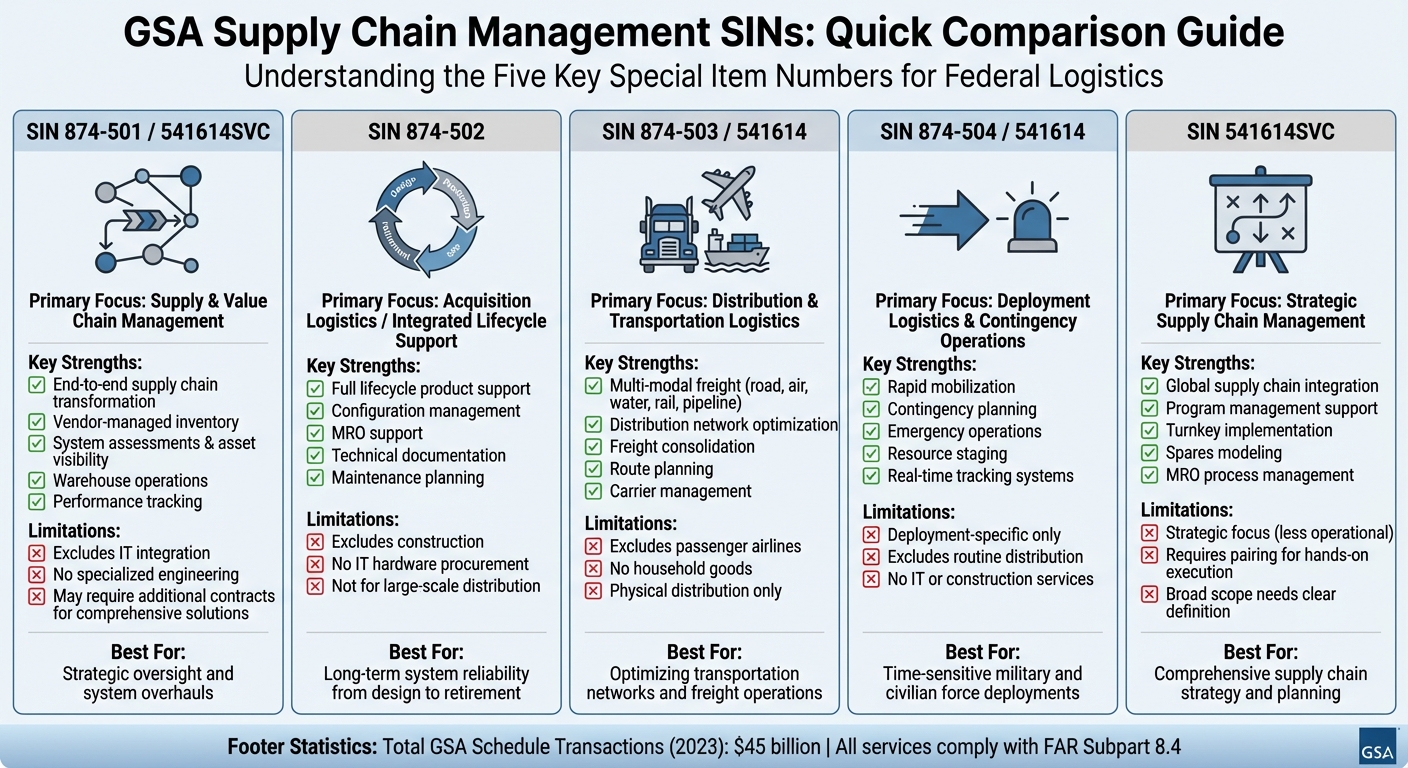
GSA Supply Chain Management SINs Comparison Guide
After reviewing the detailed functionalities of each SIN, let’s break down their strategic advantages and constraints. Each SIN in supply chain management offers specific benefits and trade-offs that federal agencies must carefully consider when selecting a contracting solution. These decisions are crucial for aligning SIN capabilities with unique logistics goals.
SIN 874-501 / 541614SVC stands out for its end-to-end supply chain transformation capabilities. It provides services like vendor-managed inventory and logistics process re-engineering, helping agencies overhaul their supply chain systems. Its strength lies in strategic oversight, enabling system assessments, asset visibility, and performance tracking to refine or replace existing operations. However, its broad scope does not cover non-logistics services such as IT integration or specialized engineering. For comprehensive solutions – like computer center operations – agencies may need to pair this SIN with additional contracts.
SIN 874-502 focuses on full life-cycle support for products and systems, including integrated logistics, recycling, MRO (maintenance, repair, and operations) support, and property disposal. This SIN is ideal for managing assets throughout their lifecycle, offering configuration management and funding plans. However, its emphasis on acquisition-phase logistics excludes areas like construction, IT hardware procurement, and non-logistics engineering, often requiring supplementary contracts to address these gaps.
SIN 874-503 / 541614, which specializes in distribution and transportation, excels in managing freight via road, air, water, rail, or pipeline. It offers strengths like distribution system analysis, fleet management, carrier routing, and freight forwarding, making it a great fit for agencies focused on optimizing transportation networks. Its limitations include the exclusion of commercial passenger airlines (covered under the City Pair Program), household goods, and small package services. Additionally, it is tailored to physical distribution, not broader supply chain strategy or lifecycle management.
SIN 874-504 / 541614, designed for deployment logistics, delivers rapid responses through contingency planning, asset management, and integrated resource coordination. It is particularly strong in emergency operations, offering expertise in medical inventory management and public/private sector coordination. However, it is restricted to deployment-specific logistics, excluding routine distribution, IT services, and construction. Agencies with ongoing operational needs may need to secure additional contracts to fill these gaps.
The following table provides a quick comparison of these SINs:
| SIN | Primary Focus | Key Strengths | Typical Limitations |
|---|---|---|---|
| 874-501 / 541614SVC | Supply & value chain management across the enterprise | Comprehensive supply chain redesign, inventory policies, warehousing, asset visibility, and decision-making support | Too broad for transportation-centric needs; may overlap with other SINs, requiring clear scope definition |
| 874-502 | Acquisition logistics / integrated lifecycle support | Excellent for maintenance planning, supportability analysis, technical documentation, and logistics funding | Not ideal for large-scale physical distribution or freight operations; tailored to specific programs |
| 874-503 / 541614 | Distribution and transportation logistics services | Strong in optimizing transportation networks, freight consolidation, route planning, and distribution center siting | Limited to physical distribution; excludes broader strategy and lifecycle management |
| 874-504 / 541614 | Deployment logistics and contingency operations | Specialized in contingency planning, mobilization, surge capacity, and integrating public/private resources | Not suitable for routine logistics; requires additional support for steady-state operations |
Federal agencies should carefully map their performance work statement (PWS) tasks to the SIN descriptions in the GSA eLibrary to avoid scope conflicts. It’s also essential to distinguish between advisory and consulting services (offered by SINs like 874-501 and 874-502) versus operational execution (provided by SINs like 874-503 and 874-504). Using FAR 8.4 ordering procedures allows streamlined competitions while still evaluating vendor past performance in comparable logistics missions.
This analysis lays the groundwork for understanding how GSA Focus simplifies the GSA Schedule acquisition process.
How GSA Focus Simplifies GSA Schedule Acquisition
For small businesses in the supply chain and logistics sector, navigating the GSA Schedule acquisition process can feel like an uphill battle. With over 100 pages of forms, countless hours of preparation, and the intricate requirements of MAS, SIN, FAR Subpart 8.4, and pricing standards, it’s no wonder many firms feel overwhelmed. Smaller logistics companies – like 3PL warehouses or freight management services – often lack the dedicated resources to tackle this process effectively.
This is where GSA Focus steps in to make things easier. They simplify the entire process, starting with mapping a company’s commercial offerings to the right SINs and categories. For instance, if a small freight and distribution company provides services like network optimization or inventory planning, GSA Focus ensures those offerings are aligned under SIN 541614SVC. They craft tailored narratives that fit GSA’s supply chain requirements and then assemble the complete MAS offer package. This includes everything from administrative forms and technical proposals to past performance summaries (highlighting metrics like on-time delivery and operational continuity) and pricing templates that meet GSA’s fair pricing standards while allowing flexibility for commercial needs.
With over 18 years of experience and established relationships within the GSA, GSA Focus speeds up the process significantly – making it 4-6 times faster than doing it yourself. They manage all communications with GSA contracting officers, addressing common rejection issues that often trip up small businesses. For the business owner, this means spending just 3 hours on the process while GSA Focus handles the rest. Their track record speaks volumes: a 98% success rate, over 600 satisfied clients (57% of whom had no prior government contracting experience), and an average revenue boost of $927,000 per client, equating to an 87x return on investment.
But GSA Focus doesn’t stop at securing the award. Their support extends to post-award services like creating GSA catalogs, managing contract modifications, and ensuring compliance. For example, they might assist a small transportation planning firm in building a labor category matrix that aligns job descriptions, education requirements, and rates with commercial practices – a critical step that often stumps newcomers. They also break down FAR Subpart 8.4 procedures into actionable advice, explaining how agencies issue RFQs through eBuy, compare competing offers, and evaluate proposals. This guidance ensures that small businesses can compete effectively without being forced into unsustainable pricing.
In short, GSA Focus transforms what feels like an insurmountable task into a manageable, efficient process, helping small businesses thrive in the federal contracting space.
Conclusion
The five SINs discussed here – 874-501, 874-502, 874-503, 874-504, and 541614SVC – cover every stage of the federal supply chain lifecycle. Each plays a distinct role: SIN 874-501 and 541614SVC focus on strategy, 874-502 handles lifecycle planning, 874-503 manages distribution, and 874-504 supports rapid deployment. Together, they provide federal agencies with a complete set of tools for designing, executing, and maintaining logistics operations, from long-term strategic planning to emergency response.
These services align seamlessly with federal contracting rules under FAR Subpart 8.4, which prioritizes efficient access to commercial supplies and services at competitive, volume-based pricing. Operating within the Multiple Award Schedule (MAS) framework, these SINs offer agencies benefits like pre-negotiated terms, faster procurement processes, and reduced administrative burdens. Depending on the mission, agencies can choose the SIN that best fits their needs – whether it’s strategic consulting (874-501/541614SVC), lifecycle support (874-502), operational logistics (874-503), or contingency planning (874-504). This flexibility ensures agencies can meet critical logistics demands without the delays of traditional acquisition cycles.
For small businesses, navigating the GSA Schedule process can be a daunting task. This is where GSA Focus steps in, simplifying the process by managing everything from document preparation and compliance to negotiations. Their expertise removes the barriers that often prevent smaller companies from competing in the federal marketplace.
Whether you’re a third-party logistics provider targeting SIN 874-503, a supply chain consultant focused on 541614SVC, or a deployment logistics expert pursuing 874-504, GSA Focus ensures your business meets GSA standards. They also offer ongoing support for catalog updates, modifications, and marketing, allowing you to concentrate on your core operations. For small businesses eager to access the $45 billion GSA Schedule program, partnering with GSA Focus provides a straightforward and dependable path to success in federal contracting.
FAQs
What are the key advantages of using the GSA Schedule for supply chain management?
Using the GSA Schedule for supply chain management can open up valuable opportunities for businesses aiming to work with the federal government. Here’s why it’s worth considering:
- Streamlined competition: By narrowing the vendor pool, the GSA Schedule gives your business a better chance to stand out and secure contracts.
- Quicker sales process: With pre-negotiated terms and pricing, the procurement timeline moves faster, helping you close deals more efficiently.
- Consistent revenue: Federal contracts often provide a steady, recession-resistant income stream, offering financial stability.
- Simplified pricing structure: A one-time price negotiation eliminates the need for constant adjustments, allowing you to focus on delivering high-quality products or services.
These advantages not only cut down on administrative headaches but also create a pathway for growth through federal contracting.
What steps can small businesses take to navigate the GSA Schedule process successfully?
Small businesses can streamline their journey through the GSA Schedule process by getting their documentation in order, familiarizing themselves with federal contracting rules, and tapping into expert advice. Partnering with seasoned consultants can make the process much easier, ensuring everything is done correctly while saving valuable time.
With professional guidance, businesses can lighten their workload, speed up approval, and set themselves up to secure steady government contracts. This strategy allows small businesses to concentrate on growing their operations while fulfilling federal procurement requirements.
What are the main differences between the SINs for supply chain management services?
The differences between Special Item Numbers (SINs) in supply chain management services come down to their distinct areas of specialization:
- Logistics and Transportation: Includes services such as freight management, courier operations, and transportation coordination.
- Inventory and Warehouse Management: Focuses on storage solutions, distribution services, and inventory control strategies.
- Procurement and Supply Services: Centers on procurement assistance, purchasing, and supply chain consulting.
Each SIN is tailored to address a specific aspect of supply chain management, offering federal agencies the flexibility to select services that align with their unique contracting requirements.
Related Blog Posts
- GSA Ordering Rules: What to Know
- Which GSA SINs Make Sense for Small Businesses in 2025?
- What Services Can You Sell Under a GSA Schedule?
- Selling Services via GSA Schedule: A Complete Walkthrough