

Navigating GSA negotiations can be daunting, but preparation is the key to success. This guide breaks down the process into five actionable steps:
- Gather Documentation: Compile essential documents like financial statements, CSP disclosures, and compliance forms to avoid delays.
- Develop a Pricing Strategy: Use your commercial pricing baseline to calculate GSA discounts, ensuring competitiveness while protecting your margins.
- Research the Market and Competitors: Analyze competitor pricing and terms using tools like GSA Advantage! and CALC to benchmark your offers.
- Plan Your Negotiation: Assign roles, define pricing limits, and prepare for Contracting Officer (CO) questions with a clear strategy.
- Practice and Execute: Rehearse mock negotiations and document final agreements to ensure clarity and compliance.
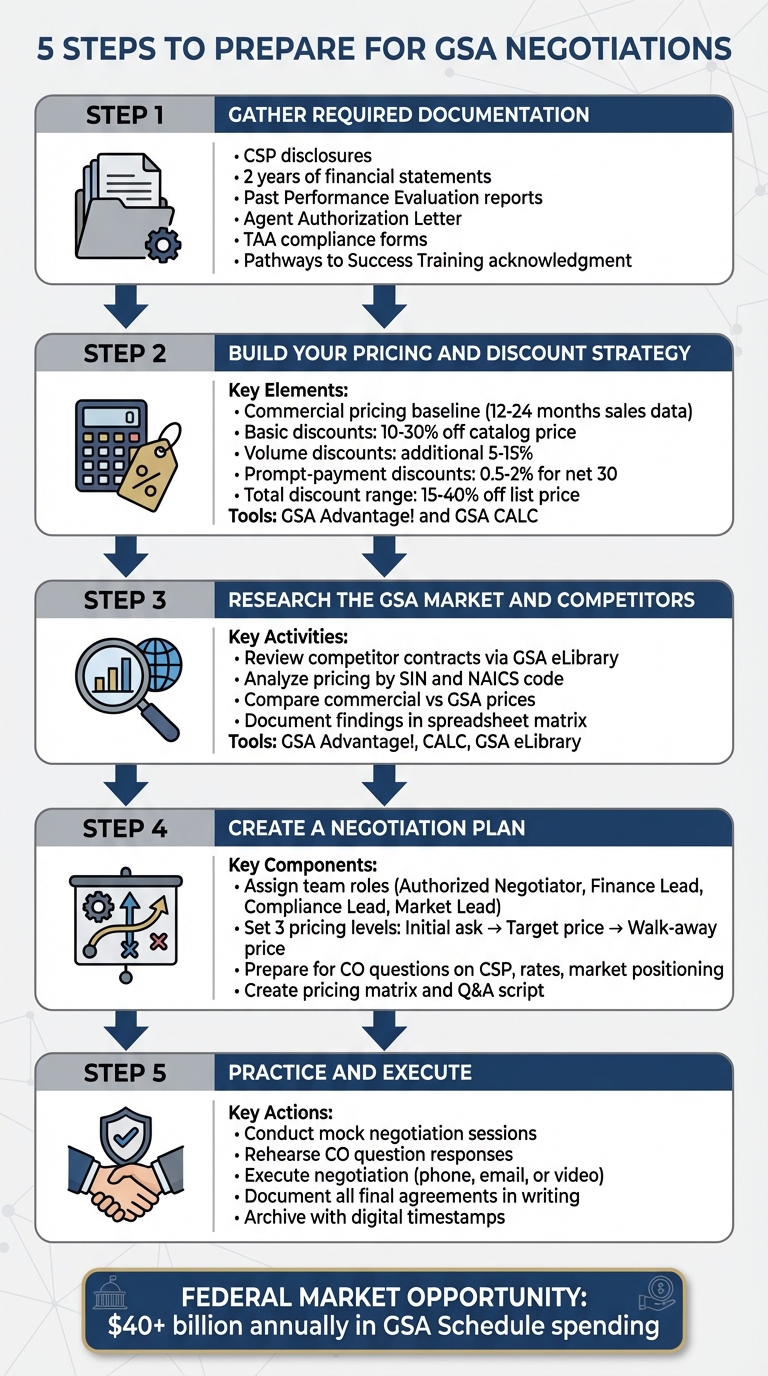
5 Steps to Prepare for GSA Negotiations Process Flow
Step 1: Gather Required Documentation
Essential Documents to Prepare
Getting your documentation in order is the first step toward a smooth GSA negotiation process.
To start, your GSA offer must include several key documents that demonstrate your financial stability, ability to perform, and commitment to fair pricing. These essential items include CSP disclosures, two years of financial statements, and Past Performance Evaluation reports.
You’ll also need an Agent Authorization Letter (if you’re working with a consultant), a Letter of Supply, and detailed descriptions of your products or services. Don’t forget to include forms that confirm TAA compliance, adhere to ETS guidelines, and meet FAR compliance requirements. Lastly, complete the Pathways to Success Training and make sure to acknowledge it in the eOffer system.
Having these documents ready will save you time and help avoid unnecessary delays in the process.
Step 2: Build Your Pricing and Discount Strategy
Setting Your Pricing Baseline
Your commercial pricing baseline serves as the starting point for determining your GSA pricing. This baseline reflects what you charge non-government customers in the open market. To establish it, review your sales data from the last 12–24 months. Focus on identifying your average unit prices, typical discounts (usually between 10–20%), and standard payment terms.
For instance, if your product sells for $100 commercially and your average customer discount is 15%, your baseline price would be $85. Be sure to document at least 500 sales to demonstrate consistency. As part of this process, prepare your Commercial Sales Practices (CSP) data, which should include price lists, invoices, discount schedules, and any volume rebates. It’s critical to exclude government-specific sales from this analysis. Once your baseline is set, you can calculate GSA-specific discounts tailored to this foundation.
Calculating Your GSA Discounts
GSA discounts build on your commercial baseline and typically factor in three elements: basic discounts (10–30% off your catalog price), volume discounts (an additional 5–15% for larger orders), and prompt-payment discounts (generally 0.5–2% for net 30 terms).
To give yourself room for negotiation, propose GSA discounts that are 5–10% higher than your commercial averages. For example, if your standard commercial discount is 20%, consider offering GSA a basic discount of 25–35%, plus a 5% volume discount. Contracting Officers often aim to secure greater discounts to meet fair pricing requirements, so starting with a higher discount proposal can protect your margins while demonstrating flexibility.
Use a discount comparison matrix to align your proposed GSA discounts with your commercial averages and similar contracts already awarded. Aim for a total discount range of 15–40% off your list price, supported by your historical sales data and cost analysis.
Using GSA Tools to Compare Pricing
GSA provides two free tools to help benchmark your pricing against competitors.
- GSA Advantage! (gsaadvantage.gov) allows you to search by Special Item Number (SIN) to see competitors’ catalog prices, discounts, and contract terms. For example, if you search for "Schedule 70 IT Hardware", you might find competitors pricing their products at $80 per unit with a 28% discount. This data can support your proposed pricing of $85 with a 25% discount.
- GSA CALC (calc.gsa.gov) compiles historical GSA pricing data by SIN, labor category, or location. It generates reports showing average market prices. For example, if CALC reports an average price of $110 for IT consulting services, you could propose $115, backed by your commercial sales data. Export charts and screenshots from CALC to use as evidence during negotiations. These visuals can demonstrate your understanding of the market and reinforce your pricing strategy when dealing with Contracting Officers.
Step 3: Research the GSA Market and Competitors
Reviewing Competitor Contracts
Before stepping into negotiations, you need to know what Contracting Officers see as "fair and reasonable" pricing. Start by reviewing awarded GSA contracts for products or services similar to yours. Use tools like GSA eLibrary (GSAeB) and GSA Advantage! to search by your Special Item Number (SIN), NAICS code, or relevant keywords.
Pay attention to key pricing details: competitors’ commercial list prices, GSA prices, base discounts, volume or tiered discounts, payment terms, and any value-added services that might justify premium pricing. For example, if a competitor offers a 10% base discount and an additional 5% for orders over $100,000 with net-30 payment terms, this gives you a solid benchmark to compare against.
If you’re providing services, use CALC (calc.gsa.gov) to compare labor categories, experience levels, education requirements, and rates. Make sure you’re comparing apples to apples – a cybersecurity analyst with five years of experience and a CISSP certification shouldn’t be compared to an entry-level IT support technician. For products, focus on comparable brands, models, and configurations, and note any bundled warranties or support that could impact pricing.
Gather all this data and organize it into a clear framework to guide your negotiation strategy.
Organizing Your Research
Set up a detailed spreadsheet to keep your research organized. Include columns for competitors’ SINs, product or service descriptions, commercial prices, GSA prices, base and additional discounts, payment terms, key differentiators, data sources, and negotiation notes.
In the notes section, summarize how each data point impacts your pricing approach. For instance: "Competitor A’s price is 8% lower, but they don’t offer onsite support. This can justify our slightly higher rate due to stronger service levels".
Be thorough in documenting your sources. Note the tool or database you used (e.g., GSA Advantage!, CALC, or specific contract numbers), the date you accessed the information, and how you ensured the data was comparable. Assign a pricing lead to maintain this matrix and practice referencing it during mock negotiation sessions. This preparation ensures you’ll have quick access to critical data when it’s time to negotiate.
Step 4: Create a Negotiation Plan
Assigning Team Roles
Start by appointing an Authorized Negotiator to represent your company. This person must be an employee listed in your eOffer, with the authority to make decisions on the spot within preset limits, respond to Contracting Officer (CO) questions, and finalize terms by signing off.
Next, assemble a support team to back the negotiator. Assign a finance lead to handle cost models, keep track of discount scenarios, and protect your profit margins. Add a contracts or compliance lead to ensure your proposal complies with GSA MAS solicitation rules, FAR/GSAM guidelines, and company policies. This person will also oversee terms like Economic Price Adjustment (EPA) clauses, delivery windows, and warranties. Include a market or business development lead to provide competitive intelligence and insights into federal demand, helping to prioritize which products or services are most strategic during negotiations.
Before negotiations begin, hold a team meeting to assign responsibilities for key topics like pricing, Commercial Sales Practices (CSP), technical details, and compliance questions. If you’re working with a consultant, such as GSA Focus, they can either coach your negotiator or act as one. Consultants can help craft responses, avoid risky commitments, and even provide an Agent Authorization Letter to formally represent your company in discussions with the GSA.
Once your team is set, establish clear negotiation objectives.
Setting Your Targets and Limits
Start by analyzing your commercial list prices, typical discounts by customer segment, and fully burdened costs. Use the research you conducted in Step 3 on awarded contracts to establish a baseline for what the CO might consider fair and reasonable pricing.
For each product or service, define three pricing levels:
- Your initial ask (set high to leave room for negotiation)
- Your target price (your ideal outcome)
- Your minimum acceptable price (your walk-away point)
Organize these pricing levels in a simple matrix by Special Item Number (SIN) or line item. Include clear guidelines for tradeoffs, such as offering a slightly deeper discount in exchange for more favorable EPA terms or a reduced scope of work.
Beyond pricing, prioritize other negotiation terms. Key elements to consider include:
- Standard discounts off your commercial list price
- Volume or quantity discounts
- Prompt payment discounts
- EPA clause structure (e.g., index-based adjustments or fixed percentage caps)
Rank these terms by their importance to your business. Core rates and base discounts should take precedence, followed by EPA terms. Volume and prompt payment discounts can serve as conditional concessions, while secondary features like delivery windows can act as additional bargaining tools. A simple priority table can help your team stay aligned on what matters most.
Having clear limits and priorities will give your team the confidence to negotiate effectively.
Preparing for Contracting Officer Questions
A well-prepared team is critical to handling inquiries from the CO.
GSA Contracting Officers typically focus on a few key areas:
- CSP disclosures and discounting practices: This includes details on your Most Favored Customer (MFC), the discounts they receive, and the conditions tied to those discounts.
- Rate justifications: Be ready to explain your proposed rates with cost breakdowns, labor category definitions, and market comparisons.
- Differences between commercial and GSA pricing or terms: Be prepared to clarify these distinctions.
- Market positioning: Highlight what sets your offerings apart from other vendors on the schedule.
Prepare concise, data-backed responses to these questions. For example:
- Use sample invoices to demonstrate commercial discounts.
- Provide detailed cost breakdowns for services or manufacturer price lists for products.
- Summarize your competitive research to show how your rates align with the market.
For CSP-related inquiries, document your standard pricing and discount policies. Identify which customer class serves as your functional Most Favored Customer and explain how your proposed GSA discounts compare. If you’ve offered deeper discounts to certain outliers, be ready to justify these exceptions to show they aren’t standard practice.
Equip your team with practical tools for live negotiations:
- A pricing matrix that includes the commercial list price, typical commercial discount, proposed GSA price, target price, and walk-away price for each item or SIN.
- A concession log to track offers and requests during discussions.
- A roles and responses map that assigns team members to specific categories of questions.
- A Q&A script with pre-drafted responses to likely CO questions.
Finally, conduct mock Q&A sessions using these tools. This practice will ensure your Authorized Negotiator and team can confidently navigate live negotiations, whether they take place over the phone, via video call, or through email.
Step 5: Practice and Conduct Your Negotiation
How GSA Negotiations Work
GSA negotiations typically kick off once the Contract Specialist (CS) or Contracting Officer (CO) has addressed all clarifications related to your proposal. At this point, the CS schedules a negotiation session, which might take place over the phone, via email, or through video conferencing. The discussions often involve back-and-forth communication. For simpler adjustments, email exchanges are common, while more complex terms usually require real-time calls.
During these negotiations, the CO uses market research tools like CALC (for services) and GSA Advantage (for products) to evaluate whether your pricing is considered "fair and reasonable." Your proposed GSA rates are compared to competitor contracts offering similar products or services. Be prepared for the CO to request additional discounts, which could include larger standard discounts, prompt payment terms, or volume-based discounts. Negotiations continue until both sides reach an agreement that balances competitive pricing with your business objectives.
With an understanding of the negotiation process, your next step is to prepare thoroughly through practice.
Rehearsing Your Negotiation
Building on the negotiation plan you developed in Step 4, practice is key to executing your strategy effectively. Rehearsing not only boosts your confidence but also helps you pinpoint any weaknesses in your discount proposals before the actual negotiation begins. Conduct mock sessions where someone plays the role of the CO, challenging your pricing and discount strategies. Use real data from tools like CALC or GSA eLibrary to back up your position. For example, if similar labor categories show average discounts of 18–22%, practice explaining how your offer aligns with or stands out from these benchmarks based on your qualifications or service quality.
Focus your mock negotiations on addressing common CO questions. These might include justifying your proposed rates compared to competitor contracts, explaining your Most Favored Customer (MFC) pricing, or defending your Commercial Sales Practices (CSP) data from the past year. Prepare responses to market research challenges and practice how you’ll handle scenarios where the CO cites lower-priced competitors. By using the same market data tools as the CO, you can be ready to counter challenges quickly and effectively.
Once you’ve honed your negotiation skills, the next step is to ensure all agreements are clearly documented.
Recording Final Agreements
After reaching an agreement, it’s crucial to document all terms in writing immediately. This includes confirming agreed pricing, discounts (such as GSA rates, MFC terms, volume tiers, and prompt payment discounts), and any other conditions. Use email or formal modification documents from the CO to ensure everything is recorded clearly. Archive these agreements with digital timestamps and share the finalized terms with your negotiation team. This documentation will be your safeguard during audits.
Additionally, keep a record of all negotiation-related communications and market data references. Before signing, have your finance and compliance teams review the finalized terms to ensure everything aligns with your business requirements. If you’re working with GSA Focus, they can assist in documenting the agreements and updating your contract files as part of their support services. These records will serve as the foundation for managing your contract and making any future modifications.
GSA Schedule – Part 2 of 3: Getting Onto The GSA Schedule Proposal Prep
Conclusion
Navigating GSA negotiations successfully boils down to thorough preparation across five key steps: gathering the necessary documentation, crafting a solid pricing strategy, researching competitors, developing a detailed negotiation plan, and practicing your approach. Each of these steps is vital for securing terms that work in your favor.
Skipping even one of these steps can lead to serious setbacks. Since GSA contracts span five years with renewal options, the terms you negotiate are locked in for the long haul. Poor preparation could result in delayed awards or unfavorable terms that undercut your profitability. On the other hand, businesses that come to the table with organized records, competitive pricing supported by market data, and well-rehearsed negotiation points often experience smoother processes, quicker awards, and stronger margins in the federal market.
For many small businesses, federal contracting can feel overwhelming due to the intricate GSA requirements. This is where expert support can make a world of difference. Specialists like GSA Focus can simplify the process by managing document preparation, ensuring compliance, and offering seasoned negotiation guidance under an Agent Authorization Letter. With this kind of assistance, your team can concentrate on your core business while minimizing the risk of costly errors.
The five-step framework outlined here not only helps with securing your initial award but also sets the stage for renewals and future adjustments. Whether you tackle the process internally or work with GSA professionals, it’s essential to treat these negotiations as a strategic business move rather than a one-time task. Keep your commercial records current, refresh your market research regularly, and maintain a detailed negotiation playbook to ensure you’re ready for any GSA-related opportunity.
The federal market offers over $40 billion annually in GSA Schedule spending, creating immense potential for businesses that are prepared and proactive. With the right mix of preparation, research, and professional execution, your company can secure a GSA contract that leads to steady revenue and long-term growth.
FAQs
What are the key mistakes to avoid during GSA contract negotiations?
To navigate GSA contract negotiations successfully, steering clear of a few frequent missteps is key. First, having a solid, well-researched pricing strategy is crucial. Without competitive pricing, you risk having your offer rejected or ending up with terms that don’t favor your business. Second, don’t neglect compliance requirements. Even small errors or incomplete documentation can throw a wrench in the entire process. Third, don’t underestimate the importance of the negotiation phase. This is your chance to secure terms that work best for your business – overlooking it could mean missed opportunities.
Feeling overwhelmed? Bringing in experienced professionals can help simplify the process, ensuring you’re fully prepared to tackle the challenges and come out ahead.
How can I create a pricing strategy that stays competitive while ensuring profitability?
To create a pricing strategy that strikes the right balance between staying competitive and ensuring profits, begin by diving into market research. Look at current industry rates to get a clear picture of standard pricing benchmarks. Pay attention to what federal agencies typically pay, aligning your pricing accordingly to meet their expectations. At the same time, don’t lose sight of your own costs and desired margins – profitability is just as critical.
Strong negotiation skills can also play a key role in achieving fair pricing terms. With thorough preparation and, if needed, professional guidance, you can confidently present a pricing approach that aligns with your business objectives while meeting government requirements.
Why is market research important for successful GSA negotiations?
Market research plays a key role in grasping government requirements, assessing competitive pricing, and staying on top of industry trends. It allows businesses to shape their proposals effectively, fine-tune pricing strategies, and pinpoint ways to differentiate themselves during negotiations.
Digging into market data helps you strategically position your business for success. It also enables you to negotiate better contract terms while ensuring your products or services align with compliance standards and meet customer expectations.
Related Blog Posts
- GSA Negotiation Objectives Explained
- Ultimate Guide to GSA Counteroffer Negotiations
- How to Set GSA Prices for Federal Contracts
- How GSA Negotiates Pricing