
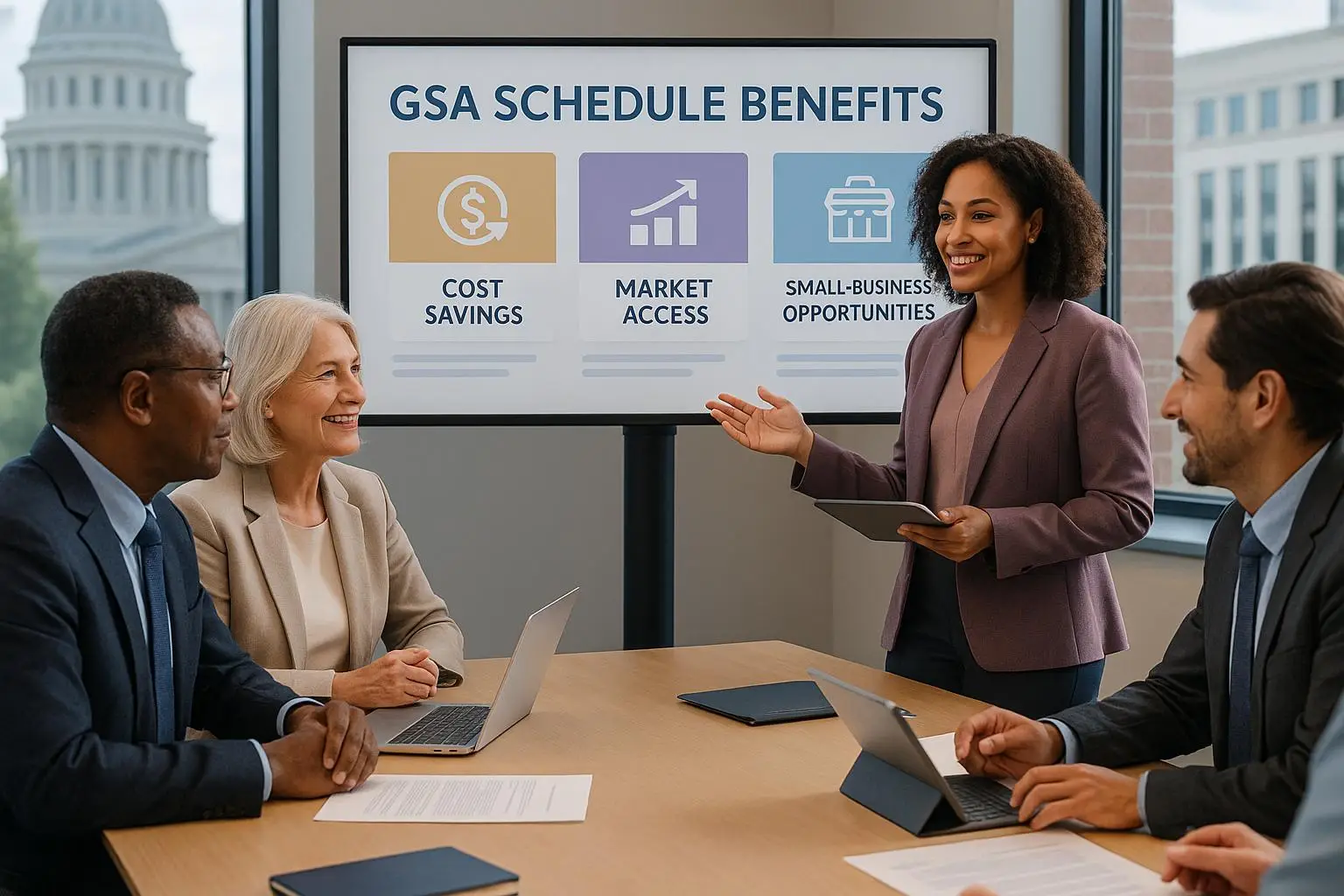
A GSA Schedule is a long-term contract with the U.S. General Services Administration that simplifies how businesses sell to government agencies. It offers pre-approved pricing, streamlined procurement, and access to a massive federal market. With $45 billion spent through GSA Schedules in 2023, these contracts are a key avenue for businesses looking to engage in government sales.
Key Takeaways:
- Cost Savings: Pre-negotiated pricing reduces expenses for agencies and contractors.
- Long-Term Contracts: Up to 20 years of market access with a 5-year base and three 5-year extensions.
- Market Access: Direct visibility on federal platforms like GSA Advantage! and eBuy.
- Simplified Sales: Shorter sales cycles and reduced competition compared to traditional contracts.
- Small Business Opportunities: Only 4% of small businesses have GSA Schedules, leaving room for growth.
GSA Schedules streamline the government procurement process, offering businesses a reliable way to secure federal contracts while saving time and resources. Below, we answer five common questions to help you decide if a GSA Schedule aligns with your goals.
GSA Schedules – What You Need To Know
How Do GSA Schedules Save Money?
GSA Schedules offer financial benefits for both government agencies and businesses, creating a win-win scenario. Agencies enjoy streamlined purchasing processes and competitive pricing, while businesses see reduced sales costs and faster deal closures. These savings are baked into the structure of how GSA Schedules operate, impacting every phase of the procurement process.
Pre-negotiated pricing lies at the heart of the system. When a company secures a GSA Schedule contract, it agrees to provide pricing that matches or beats what its best commercial customers receive. This "most favored customer" clause ensures discounted rates for the entire contract term. Agencies, in turn, avoid the hassle of negotiating prices for every purchase since the baseline pricing has already been vetted and approved by GSA.
But the benefits go beyond pricing. GSA Schedules are indefinite-delivery, indefinite-quantity (IDIQ) contracts, meaning all key terms – pricing, conditions, and compliance – are pre-established. This setup allows agencies to place orders without launching a full competition for each procurement, cutting down on labor costs and administrative overhead.
Volume also plays a big role in driving savings. By aggregating federal demand, GSA gives contractors access to thousands of federal offices and eligible state and local entities through a single Schedule contract. This scale encourages vendors to offer competitive pricing. As sales volumes grow across multiple agencies, contractors can spread fixed costs more efficiently, negotiate better supplier deals, and pass on those savings in the form of lower GSA prices and additional discounts at the task-order level.
Agencies can further maximize savings by consolidating recurring needs under Blanket Purchase Agreements (BPAs) tied to Schedule contracts. BPAs guarantee volume, which often secures even steeper discounts and leads to significant yearly cost reductions.
Lower Procurement Costs for Government Agencies
For federal agencies, the streamlined processes of GSA Schedules translate directly into lower procurement costs. Since contractors are pre-vetted, agencies save time and resources that would otherwise go toward due diligence for each purchase.
Standardized terms and conditions under the Federal Acquisition Regulation (FAR) and the GSA Acquisition Manual (GSAM) eliminate the need for exhaustive legal reviews on every order. Tools like GSA Advantage! and eBuy simplify market research and price comparisons, making procurement faster and more efficient. This contrasts sharply with traditional open-market procurement, which requires a full acquisition cycle, increasing both labor costs and lead times. Over the course of a fiscal year, these efficiencies can result in substantial cost avoidance.
GSA also includes safeguards to maintain long-term value. For example, the Economic Price Adjustment (EPA) clause limits how often and by how much prices can increase, protecting agencies from sudden cost spikes. Additionally, GSA and its Office of Inspector General conduct pre-option audits focused on pricing and compliance before renewing a five-year option, ensuring that agencies continue to receive fair pricing.
Lower Customer Acquisition Costs for Businesses
For contractors, GSA Schedules significantly reduce customer acquisition costs, offering a stable and efficient way to secure federal business. Once on a Schedule, vendors gain access to a pre-qualified pool of federal buyers through standardized terms and centralized marketing platforms. This setup slashes bid and proposal costs compared to pursuing standalone contracts.
The sales cycle is also much shorter. Instead of spending months on a single procurement, businesses – especially small ones – can secure multiple, predictable orders with streamlined proposals. This efficiency lowers the risk of investing heavily in bids that don’t result in revenue and allows businesses to focus more on billable work rather than unproductive business development efforts.
"One-time price negotiation – Lock in fair pricing upfront with our expert help." – GSA Focus
This one-time negotiation eliminates the need for repeated price discussions, freeing up resources for delivery and new opportunities.
"GSA means less time spent marketing… selling… and negotiating contracts (since you only need to negotiate once and you’re done…)" – GSA Focus
Marketing efforts also become more targeted. With a GSA Schedule, companies can reduce broad marketing expenses – like mass mail campaigns or general exhibit events – because the Schedule itself provides visibility and an approved contracting channel. While relationship-building and targeted outreach remain essential, businesses can focus their budgets on strategic, account-based activities that deliver higher returns.
A shorter sales cycle also means quicker awards and faster revenue recognition, which is especially beneficial for small businesses with limited cash reserves. By comparing factors like awarded prices, procurement cycle times, and labor hours before and after adopting a Schedule, businesses can measure the annual savings and cost efficiencies made possible by this streamlined process.
For companies new to GSA Schedules, partnering with a consultant like GSA Focus can amplify these savings. A full-service consultant helps reduce the time and effort needed to secure and manage a Schedule contract, allowing internal teams to concentrate on sales and delivery rather than compliance and administrative tasks.
How Long Do GSA Schedule Contracts Last?
GSA Schedule contracts start with a five-year base period, followed by three optional five-year extensions. Altogether, this setup offers businesses up to 20 years of access to the federal marketplace, creating a reliable and long-term opportunity to sell to the government. This extended timeline also provides a solid framework for strategic business planning.
These contracts operate as IDIQ (Indefinite Delivery, Indefinite Quantity) agreements, allowing government agencies to place orders anytime during the contract’s term without requiring renegotiation or a new solicitation. For contractors, this means consistent access to federal buyers and a stable revenue stream.
The long-term nature of these contracts also supports business growth. Companies can confidently invest in federal-focused capabilities, hire specialized personnel, and develop expertise. Additionally, the 20-year potential allows businesses to spread initial costs over time, maximizing returns on their upfront investments.
When a contract reaches its maximum term, contractors in good standing can apply for a new MAS (Multiple Award Schedule) contract to maintain their federal market presence. GSA offers a streamlined submission process for experienced contractors with strong compliance histories and sufficient sales records. This approach ensures a smooth transition to a new Schedule, often allowing overlapping coverage between the old and new contracts.
Renewal and Extension Options
Renewing a GSA Schedule contract isn’t automatic. Each five-year extension requires GSA’s review to ensure the contractor meets key performance standards, including financial stability, accurate pricing, timely reporting, and successful audits. Typically, the GSA Office of Inspector General conducts audits about a year before an option period expires to help inform the renewal decision.
The renewal process begins well in advance of the current term’s expiration. GSA reviews the contractor’s performance and requests updated documentation, such as financial statements, revised price lists, and proof of compliance with administrative requirements. Once renewal is approved, contractors must upload their updated price lists to the GSA eLibrary within about 30 days to maintain visibility on government purchasing platforms.
Contractors should begin preparing for renewal at least six months before an option period ends. This preparation is especially critical for businesses with active Blanket Purchase Agreements (BPAs) or ongoing task orders, as early planning helps prevent service disruptions.
As the contract nears its 20-year limit, forward planning becomes even more important. Under a recent policy change, contractors can now submit a new offer for a replacement contract at any time during their existing term, rather than waiting until the 14th year. This added flexibility is particularly useful for businesses with complex product lines or multiple active BPAs that require continuous coverage.
For contractors who have exhausted all extension options and qualify for the streamlined submission process, preparation typically takes 34–40 hours. However, working with a consultant can reduce this time to about 15–25 hours. To qualify for the streamlined process, contractors generally need to maintain the same Special Item Numbers (SINs), achieve at least $25,000 in annual GSA sales, and uphold a clean compliance record.
Managing renewals and extensions effectively is a critical business function. By staying compliant, keeping accurate records, and preparing early for option periods, companies can secure long-term federal market access. For many businesses, a well-managed GSA Schedule becomes a cornerstone of sustained government revenue. Up next, we’ll dive into the market access benefits that GSA Schedules provide.
What Market Access Do GSA Schedules Provide?
GSA Schedules offer more than just cost savings and contract stability – they open the door to a much broader market. With a GSA Schedule, businesses gain direct access to federal agencies, along with eligible state, local, tribal, and educational institutions. Federal agencies, including civilian departments and the Department of Defense, are the primary customers, as GSA Schedules are multiple-award IDIQ contracts used across the entire federal government. Additionally, programs like Cooperative Purchasing (for IT and security-related products), Disaster Purchasing, and other GSA initiatives enable state and local entities to buy through these contracts. This means a single Schedule contract can connect you to thousands of purchasing activities nationwide, significantly increasing your public-sector customer base.
In fiscal year 2021, GSA Multiple Award Schedule contracts accounted for roughly $39 billion in spending. By 2023, that number had climbed to $45 billion. Clearly, this isn’t a small niche – GSA Schedules are a key procurement channel for federal agencies, covering recurring needs like IT equipment, office supplies, and professional services.
What truly makes this market access powerful is how government buyers search for and evaluate vendors. Without a GSA Schedule, you’re competing in a fragmented market where agencies conduct separate research, issue individual solicitations, and negotiate one-off contracts. With a Schedule, however, your business gains visibility on two essential platforms: GSA Advantage! and GSA eLibrary.
Visibility on Government Platforms
GSA Advantage! is the government’s go-to e-commerce platform. It’s where federal, state, and local buyers search, compare, and purchase products from Schedule holders. By uploading your catalog to GSA Advantage!, your products become searchable by keyword, part number, or SIN. This centralized platform puts your offerings directly in front of contracting officers who often have obligated funds and are required to prioritize governmentwide contract vehicles before looking to the open market. Every day, businesses on GSA Schedules have access to over $50 million in opportunities. Additionally, around 44% of government awards receive only one bid, which underscores the advantage of being visible on this platform.
GSA eLibrary, on the other hand, serves as a research tool for government buyers. It lists contractors’ awarded SINs, contract numbers, contract periods, and points of contact. Agencies use eLibrary during the early stages of market research to identify pre-vetted contractors, ensure their needs align with the contractor’s SINs, and confirm eligibility for Schedule orders. Keeping your eLibrary profile up to date – with accurate SINs, clear capability descriptions, and current contact information – ensures that you’re included in RFQs and RFIs issued via systems like eBuy.
Typically, buyers start with GSA eLibrary to confirm which SINs and contractors meet their needs. Once they’ve narrowed their options, they move to GSA Advantage! to compare specific products, pricing, and details before placing orders. For contractors, maintaining a strong presence on both platforms supports the entire procurement process – from initial discovery to final purchase.
To make the most of these platforms, treat your GSA Advantage! catalog as a professional e-commerce storefront. Use clear, keyword-rich descriptions that align with the terms government buyers search for. Ensure pricing, specifications, and images are current, and map your items to the relevant SINs to improve search visibility. On GSA eLibrary, verify that your contract data, SINs, and brief descriptions are accurate and aligned with agency needs. This attention to detail not only attracts buyers but also makes the procurement process smoother.
Easier Procurement for Government Buyers
GSA Schedules simplify the buying process for government agencies by offering pre-negotiated pricing, standardized terms, and compliance with federal regulations. These features reduce the need for extensive competition at the order level. Contracting officers can use the streamlined procedures outlined in FAR Subpart 8.4, which typically involve shorter lead times and less paperwork compared to open-market purchases.
This efficiency benefits contractors as well. Agencies often prefer Schedule vendors for recurring needs because the process is faster and carries less risk. As a result, businesses on GSA Schedules often see a steady flow of orders and task-order opportunities. Federal contracts also tend to be larger than typical commercial deals, and the market is less crowded with competitors.
Once you’re on a Schedule, agencies can issue task or delivery orders directly under FAR 8.4. Contractors who secure spots on BPAs or frequently used task-order vehicles often experience predictable demand, shorter sales cycles, and reduced effort on bids and proposals.
For instance, imagine an IT hardware reseller that previously relied on sporadic agency purchases. After obtaining a GSA Schedule and listing its catalog on GSA Advantage!, the reseller starts receiving unsolicited micro-purchase and simplified-acquisition orders from federal installations searching for specific items. Similarly, a professional services firm with MAS Professional Services SINs and an updated eLibrary profile begins receiving RFQs through eBuy from agencies filtering vendors by SIN and past performance. These examples show how a GSA Schedule can turn previously overlooked vendors into easily discoverable, pre-approved sources for government buyers nationwide.
To measure the success of your market access strategy, track your sales volume attributed to the Schedule, the number and value of orders through GSA Advantage!, and the RFQs or RFPs that reference your Schedule or SINs. Watch for trends like shorter sales cycles, repeat orders from the same agencies, and inclusion on BPAs or multi-year task orders. These are clear signs that you’re effectively leveraging the market access provided by GSA platforms.
Don’t forget about state and local opportunities. Identify which of your products or services qualify under Cooperative Purchasing or Disaster Purchasing programs, and focus on state and local agencies – such as public safety departments – that frequently use these initiatives. This strategy can extend your reach beyond federal buyers, opening up new revenue streams through the same contract vehicle.
What Are the Main Advantages of a GSA Schedule?
A GSA Schedule offers businesses a streamlined path to selling products and services to federal, state, and local government agencies. The standout benefit? The "compete once, sell many times" approach. Once you secure your Schedule with pre-negotiated pricing, you can sell repeatedly without needing to enter lengthy competitive bidding processes. This not only reduces the time and effort spent on proposals but also accelerates your sales cycle.
Government agencies also benefit from the pre-negotiated pricing and standardized terms. They can directly place orders from your Schedule, speeding up procurement while minimizing administrative tasks on both sides.
Another major advantage is the contract’s longevity. GSA Schedules include a 5-year base period with three optional 5-year extensions, offering up to 20 years of market access. This extended timeframe allows businesses to plan strategically and build steady revenue streams. In 2023 alone, $45 billion was spent through the GSA Schedule program, underscoring its importance in federal procurement.
GSA Schedule vs. Standard Government Contracting
Holding a GSA Schedule offers distinct advantages compared to traditional government contracting. Here’s how the two approaches differ:
| Aspect | GSA Schedule (MAS) | Standard Open-Market Contracting |
|---|---|---|
| Contract Duration | 5-year base + three 5-year options (up to 20 years) | Typically 1 base year + up to 4 optional years (up to 5 years) |
| Time to Initial Award | 3–6 months on average | 6–12+ months for major competitive awards |
| Competition Requirements | Simplified competition among pre-vetted Schedule holders | Full and open competition required |
| Pricing Negotiations | One-time upfront negotiation for future orders | Pricing negotiated separately for each contract |
| Administrative Burden | Single master contract with standardized terms | New terms and compliance reviews for each contract |
| Sales Cycle Length | Shorter due to streamlined processes | Longer due to repeated competition and negotiation |
While the initial effort to secure a GSA Schedule may seem daunting, the payoff is significant. Once awarded, businesses enjoy shorter sales cycles for subsequent orders and Blanket Purchase Agreements (BPAs). Notably, about 44% of government awards receive only one bid, suggesting that GSA Schedule holders often face less competition compared to open-market contracts.
The streamlined nature of the GSA Schedule simplifies marketing, selling, and negotiating. With a master contract in place, agencies trust Schedule holders as pre-vetted suppliers. To qualify, companies must pass a rigorous review process that evaluates financial stability, delivery capabilities, past performance, ethics, and compliance with the Trade Agreements Act. This vetting process ensures agencies can confidently work with reliable vendors.
Building Long-Term Relationships with Government Buyers
One of the most valuable aspects of a GSA Schedule is the opportunity to build lasting relationships with government buyers. Unlike one-off contracts, a Schedule keeps your business visible in the federal marketplace for years, enabling you to establish trust and familiarity with agencies over time.
Recurring orders and BPAs help cement these relationships. Agencies prefer working with contractors they know and trust, especially when they’ve delivered strong results in the past. Over time, a GSA Schedule evolves from a simple contract into a platform for strategic partnerships.
To maximize these benefits, businesses should stay proactive. Use your Schedule to pursue multi-year task orders and BPAs that generate steady revenue. Keep your GSA Advantage! listings updated and respond promptly to opportunities on GSA eBuy to maintain visibility. Tracking which agencies place orders with you can also help anticipate future needs and tailor your offerings.
Recent policy updates have made the process even more flexible. Contractors can now submit new offers during the term of an existing contract, ensuring uninterrupted market access as they transition from expiring agreements. To qualify for these streamlined processes, businesses must demonstrate at least $25,000 in annual GSA Schedule sales and maintain strong performance.
Maintaining good past performance, accurate pricing disclosures, and timely reporting is crucial for long-term success. GSA audits and option reviews ensure pricing stays competitive and contractors remain compliant. For small businesses, the advantages are even greater. Many agencies reserve task orders under MAS specifically for small businesses, opening doors to opportunities that might otherwise go to larger competitors. Delivering quality work consistently can position you as a trusted vendor, leading to sole-source orders, preferred vendor status, and referrals to other agencies.
With the right approach, a GSA Schedule can become more than just a contract – it can serve as a reliable sales channel and a foundation for growth in the government sector.
Conclusion
GSA Schedules offer small businesses a clear pathway into the federal marketplace, bringing advantages like cost efficiency, simplified contracts, and long-term market access. By eliminating the need for constant bidding, these schedules streamline procurement through pre-negotiated pricing and standardized terms. With contracts lasting up to 20 years, they present a chance for consistent and reliable revenue.
For small businesses, securing a GSA Schedule opens doors to larger contracts and more stable income streams compared to many commercial opportunities. Contrary to popular belief, the federal market isn’t as crowded as one might expect, giving an edge to those willing to navigate its unique requirements. However, the benefits come with challenges, including the need for strict regulatory compliance and proactive marketing efforts.
The process of obtaining and maintaining a GSA Schedule is not without effort. It typically requires a 3–6-month application process, detailed documentation, and ongoing adherence to compliance standards. Failing to meet sales thresholds or properly handle contract modifications can jeopardize a company’s standing.
To overcome these hurdles, partnering with experts can make a world of difference. Companies like GSA Focus specialize in providing end-to-end support for acquiring and managing GSA Schedules. They handle everything from document preparation to compliance and negotiations, reducing the workload for businesses from over 100 hours of paperwork to just a few hours of involvement. With a 98% success rate and a refund guarantee, their services significantly lower the risks associated with the process.
Whether you choose to pursue a GSA Schedule on your own or with professional assistance, success lies in treating it as a long-term investment. Maintaining compliance, staying active on platforms like GSA eBuy and GSA Advantage!, and consistently delivering quality work are essential to building trust with government buyers. Done right, a GSA Schedule can become a dependable and rewarding sales channel.
FAQs
How can small businesses use a GSA Schedule to succeed in federal contracting?
Small businesses can leverage a GSA Schedule to simplify their entry into federal contracting, creating a direct pathway to connect with government buyers. Tools like GSA eBuy and GSA Advantage act as invaluable platforms, enabling businesses to display their products and services to a broader audience and potentially achieve steady sales.
What’s more, having a GSA Schedule can significantly reduce sales cycles. With pre-negotiated pricing and terms already in place, the procurement process becomes much easier for government agencies. This helps small businesses stand out as dependable and efficient partners within the federal marketplace.
What steps should I take to renew my GSA Schedule contract and maintain access to federal opportunities?
Renewing your GSA Schedule contract is crucial to maintaining uninterrupted access to government contracting opportunities. The process begins with checking your contract’s expiration date and starting the renewal process at least 12 months ahead of time. This early preparation ensures you have enough time to meet compliance standards and address any necessary updates.
During the renewal process, it’s important to confirm that your pricing, terms, and product or service offerings remain current and competitive. Double-check that all required documentation is accurate and complete to avoid any hiccups. Keeping your contract updated throughout its term can also make the renewal process much more manageable. By staying organized and ahead of deadlines, you can prevent delays and continue tapping into the federal marketplace without interruption.
What makes the GSA Schedule process different from standard government contracting when it comes to compliance and administrative requirements?
The GSA Schedule process stands out due to its stringent compliance requirements and extra administrative steps, setting it apart from typical government contracting. To qualify, businesses must meet precise eligibility standards, submit comprehensive documentation, and consistently follow reporting and pricing rules.
Though the process might feel daunting, it opens doors to valuable opportunities like easier access to federal buyers and the possibility of securing long-term contracts. With proper support and preparation, tackling these requirements becomes far less intimidating, enabling your business to tap into the vast potential of federal contracting.
Related Blog Posts
- 5 Ways GSA Schedules Boost Federal Market Position
- Top 7 GSA Schedule Benefits for Small Businesses
- How Agencies Use GSA Schedules to Order
- How GSA Advantage Simplifies Federal Buying