
The Enterprise Infrastructure Solutions (EIS) program is transforming federal IT infrastructure with modern, scalable, and secure telecommunications solutions.
Launched in 2017, this $50 billion, 15-year contract replaces outdated systems like Networx and WITS 3. EIS provides agencies with cutting-edge technologies such as SD-WAN, Zero Trust Architecture, and IPv6 to meet today’s IT and security demands. It simplifies procurement, supports small business participation, and ensures cost transparency.
Key Highlights:
- Scope: Covers IT needs like high-speed internet, IP Voice, and advanced security protocols.
- Modernization: Transitions from legacy systems to next-gen solutions like 5G and machine learning-powered networks.
- Flexibility: Multiple-award IDIQ contract allows agencies to scale services as needed.
- Support: GSA offers tools and guidance for smooth migration.
EIS delivers improved efficiency, stronger security, and better IT spending management, making it the preferred choice for federal agencies moving beyond legacy contracts.
1. Enterprise Infrastructure Solutions (EIS)
Scope and Features
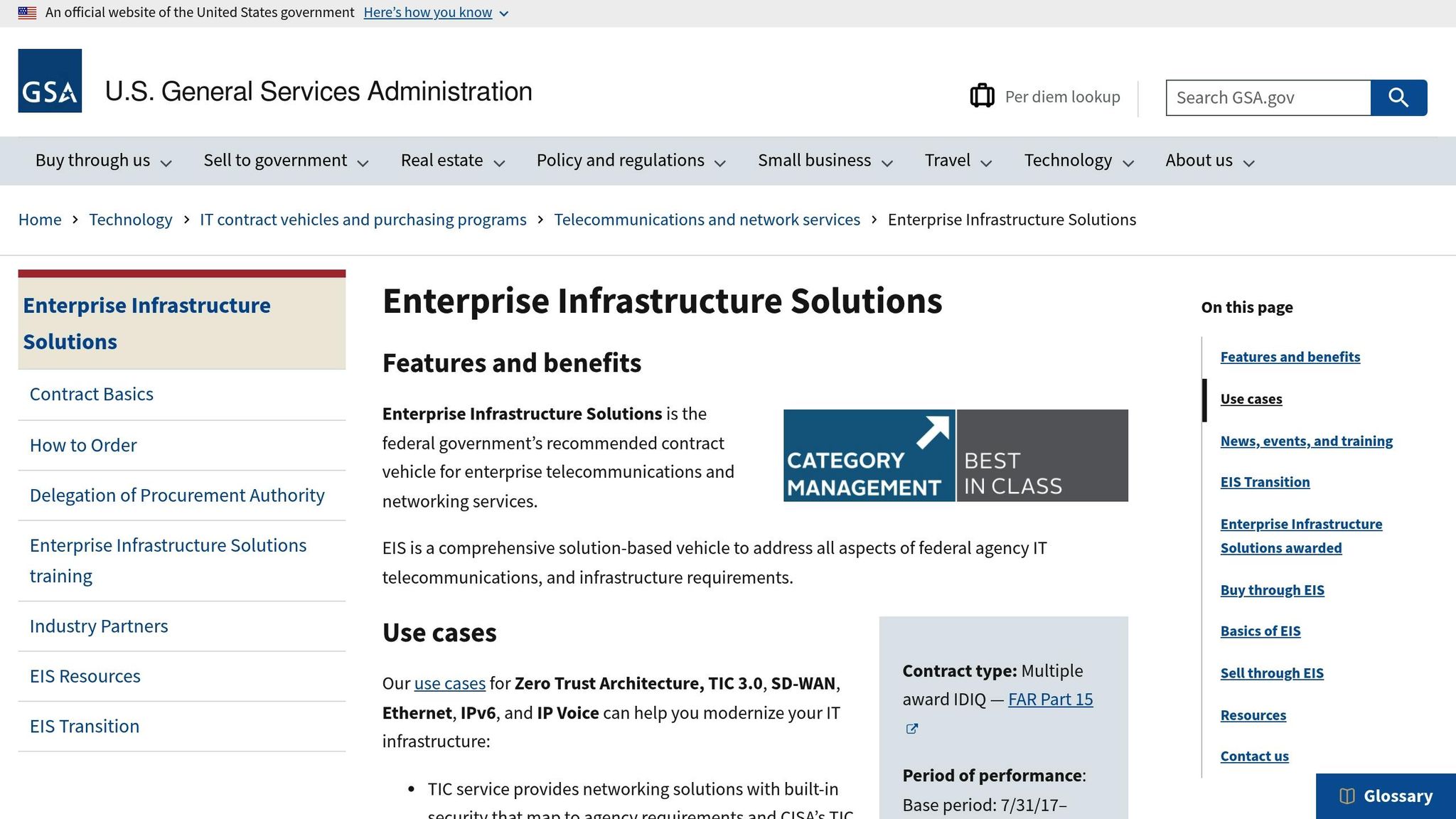
The Enterprise Infrastructure Solutions (EIS) program is a government-wide contract vehicle designed to meet nearly all federal IT telecommunications and infrastructure needs. Recognized as "Best-in-Class" by the Office of Management and Budget, EIS has become the go-to choice for agencies aiming to modernize their IT services.
Through EIS, agencies gain access to a broad array of services, including high-speed internet, government hosting, SD-WAN, Ethernet, IPv6, IP Voice, and advanced security encryption protocols – all within a single contract. The program also supports cutting-edge technologies like zero-trust architecture, TIC 3.0 compliance, and software-defined networking, aligning with the latest cybersecurity standards.
This comprehensive offering provides agencies with the tools they need to modernize their IT infrastructure, setting the stage for enhanced efficiency and security.
Modernization Capabilities
EIS drives IT transformation with a four-tier approach: maintaining existing systems while planning for upgrades, improving efficiency through consolidation, utilizing software-defined capabilities with consumption-based pricing, and implementing real-time, machine learning-powered enterprise solutions.
This framework helps agencies transition from outdated physical systems and MPLS connections to next-generation solutions like 5G intelligent edge networks, machine learning-enhanced security, and network Platform-as-a-Service (PaaS) offerings. These advancements allow agencies to stay ahead in a rapidly evolving technological landscape.
Contract Structure and Flexibility
EIS operates as a multiple-award, indefinite-delivery/indefinite-quantity (IDIQ) contract with a 15-year term and a $50 billion ceiling. Its flexible structure allows agencies to order only the services they require and scale as their needs change. By including a mix of pre-vetted vendors, including small businesses, the contract encourages competition while supporting federal small business contracting goals. It also delivers cost savings through greater price transparency and improved spend visibility.
This flexible setup accommodates diverse government purchasing patterns, streamlining the procurement process and reducing timelines. It enables agencies to efficiently acquire integrated solutions while maintaining the agility needed to meet modernization goals.
Transition Support
To ensure a smooth transition from legacy contracts to EIS, the General Services Administration (GSA) provides extensive support. A dedicated Transition Coordination Center and tools like TI and AAI help agencies track active services, contract line items, and bandwidth requirements, simplifying the shift to EIS.
In June 2018, the EIS Network Modernization Forum released key guidance documents, such as the High Quality Proposal Timeline and Alternatives to Full Service Option papers, to assist agencies in managing their transitions. With detailed user guides and expert advice, agencies can fully leverage EIS’s capabilities while minimizing potential challenges during the migration process. This robust support framework ensures a seamless shift to modern IT solutions.
2. Legacy IT Service Contracts (Networx, WITS 3)
Scope and Features
Before the introduction of EIS, federal agencies relied on older contracts like Networx and WITS 3 to handle telecommunications and network services. Networx was a massive undertaking, serving over 135 federal agencies and sub-agencies with a combined value that topped $20 billion.
These contracts offered essential services – voice, data, video communications, managed network solutions, and basic security. However, they were built on aging technologies that struggled to keep up with modern demands. WITS 3, designed specifically for agencies in the Washington, D.C. area, provided localized telecom services using older technologies like TDM and MPLS. While these systems were pivotal at the time, their limitations became clear as technology advanced.
Contract Structure and Challenges
Legacy contracts like Networx and WITS 3 were built around fixed service categories, which made scaling or adapting services a slow and cumbersome process. This rigidity led to lengthy procurement cycles, leaving agencies unable to quickly adjust to changing needs. Additionally, the complex procurement process and strict requirements made it difficult for small businesses to participate. These structural issues underscored the need for a shift toward more flexible and responsive contracting solutions.
Limitations in Modernization
The outdated frameworks of these contracts only allowed for incremental updates, which hindered the adoption of newer IT capabilities. Agencies found it challenging to integrate cloud services, implement advanced security measures, or adopt unified communication systems. The slow pace of updates also made it difficult to align with evolving federal cybersecurity standards. These shortcomings highlighted the need for contracts like EIS, which are designed to address these gaps and support modern IT demands.
Transition Support
As Networx and WITS 3 approached their expiration, the GSA introduced extension periods to ensure a smooth transition to EIS and avoid service disruptions . By 2023, federal agencies were required to complete their migration to EIS to prevent interruptions and avoid additional costs . The limitations of these legacy systems made it clear that modern, scalable solutions were not just beneficial but essential.
The shift from these legacy contracts to EIS represents a crucial step in federal IT modernization, aimed at enhancing efficiency, strengthening security, and improving service delivery across government operations.
Modernization and Acquisition Approaches for EIS Solicitations
Advantages and Disadvantages
When considering EIS’s modern features and its robust support system, the benefits and challenges become evident. Agencies face a critical choice: embrace the flexible, forward-looking EIS or stick with outdated legacy contracts. The table below offers a clear comparison of these options.
EIS provides significant cost savings, leveraging aggregated buying power that totals $50 billion over 15 years. This also improves spend visibility, making it easier to track and manage IT expenditures effectively.
Unlike legacy contracts, which rely on older technologies like TDM and MPLS, EIS supports advanced solutions such as SD-WAN, Zero Trust, and IPv6. Agencies using EIS have reported better network performance and streamlined operations.
However, transitioning to EIS is no small feat. It requires detailed migration planning, adherence to tight timelines, and maintaining current performance levels throughout the process.
EIS also encourages small business participation by lowering entry barriers and removing geographic coverage requirements. While this creates more opportunities in federal contracting, navigating the initial GSA contracting process can be daunting. Services like GSA Focus offer comprehensive assistance, helping with documentation, compliance, and negotiation to simplify the process.
| Aspect | EIS Advantages | EIS Disadvantages | Legacy Contract Advantages | Legacy Contract Disadvantages |
|---|---|---|---|---|
| Technology | Supports SD-WAN, Zero Trust, IPv6, and cloud services | – | – | Relies on outdated technologies like TDM/MPLS |
| Flexibility | Offers scalable, adaptable service options | Requires detailed service integration planning | – | Rigid categories, slow to adapt |
| Security | Advanced protocols with 24/7 support | – | – | Limited security capabilities |
| Procurement | Streamlined, solution-based acquisition | Complex setup and transition planning | – | Lengthy cycles, higher administrative overhead |
Sticking with legacy contracts comes with risks: limited access to modern technologies, higher operational costs, and potential service disruptions as these agreements expire. By 2023, agencies were required to complete their migration to avoid interruptions and additional expenses.
EIS’s designation as a Best-in-Class solution by the OMB underscores its importance as a preferred governmentwide option. It maximizes federal buying power while aligning with IT modernization efforts.
That said, the compressed transition timeline poses a significant challenge. As legacy contracts are phased out, agencies must carefully balance the urgency of migration with meticulous planning to safeguard their IT infrastructure for the future.
Conclusion
EIS presents a straightforward and budget-friendly solution for agencies aiming to modernize their IT infrastructure, backed by a 15-year, $50 billion contract.
What sets EIS apart is its technical edge over previous contracts. It supports advanced technologies like SD-WAN, Zero Trust Architecture, and IPv6 – capabilities that older agreements simply couldn’t handle. Its Best-in-Class status further highlights its value and reliability.
With legacy contracts such as Networx and WITS 3 reaching their end and a mandatory transition deadline in 2023, agencies face increasing risks if they delay moving to EIS.
On top of operational improvements, EIS offers financial perks. Volume-based pricing and better spend tracking give agencies greater control over their IT budgets. It also levels the playing field for small businesses by removing geographic restrictions, expanding opportunities in federal contracting. Additionally, GSA Focus provides hands-on support to navigate the complexities of the GSA Schedule Contract process.
To stay ahead in the push toward digital government, agencies need to make EIS a priority. Its combination of flexibility, competitive pricing, and comprehensive support equips agencies to thrive in a rapidly evolving digital landscape. By embracing EIS, agencies can enhance their operational efficiency, strengthen security, and optimize spending – key steps toward modernizing federal IT systems and achieving long-term success.
FAQs
What are the key advantages of switching from legacy contracts like Networx and WITS 3 to the EIS program?
Transitioning to the Enterprise Infrastructure Solutions (EIS) program brings a range of advantages for organizations looking to stay ahead in technology. With EIS, agencies gain access to modern IT and telecom solutions that align with cutting-edge technologies and offer better scalability to meet future demands. This shift can lead to smoother operations and increased efficiency.
On top of that, EIS simplifies the procurement process by consolidating multiple services into a single contract. This not only reduces administrative hassles but also ensures compliance with federal regulations. Another key benefit is cost savings – EIS is structured to provide competitive pricing, making it a more budget-friendly option compared to older contracts like Networx and WITS 3.
How does the EIS program maintain security and comply with modern cybersecurity standards?
The Enterprise Infrastructure Solutions (EIS) program prioritizes security and compliance by following rigorous federal cybersecurity standards, including those outlined by the National Institute of Standards and Technology (NIST). These standards play a crucial role in protecting sensitive data and defending against ever-changing cyber threats.
To meet the demands of federal agencies, EIS integrates robust security measures like encryption, continuous monitoring, and incident response planning. By embracing these modern strategies, the program ensures a reliable and secure IT infrastructure for government operations.
What assistance does the GSA offer to agencies transitioning to the EIS program, and how can they ensure a seamless migration?
The GSA offers robust support to agencies moving to the Enterprise Infrastructure Solutions (EIS) program. This support includes help with planning, managing contracts, and technical assistance to ensure agencies meet the program’s standards. Additionally, agencies can tap into a range of training materials and resources designed to simplify the migration process.
For a successful transition, it’s important to plan ahead. Agencies should start by thoroughly assessing their current IT services and reach out to GSA representatives for personalized guidance. Keeping up with GSA timelines and maintaining a proactive approach can help reduce disruptions and make the migration process smoother.
Related Blog Posts
- How GSA Plans $3.4B Infrastructure Upgrades
- Energy Efficiency Standards in GSA Contracts
- How Agencies Use GSA Schedules to Order
- What Services Can You Sell Under a GSA Schedule?