
GSA Schedule
What It Is, Who It’s For, and Is it Relevant to Your Business?
While exploring how to sell to the government, you’ve likely encountered the term GSA Schedule — AKA Multiple Award Schedule (MAS) contract.
It’s often described as a powerful entry point into federal contracting. But also as paperwork-heavy, and slow. Both are accurate.
You’re probably asking: “Is the GSA Schedule Program actually worth it for my business?”
Below will answer that strategically and realistically.
What Is a GSA Schedule?
(And How It Works in Federal Procurement)
A GSA Schedule is a long-term government-wide contract administered by the U.S. General Services Administration (GSA). It allows approved companies to sell commercial products and services directly to federal agencies under pre-negotiated pricing and terms.
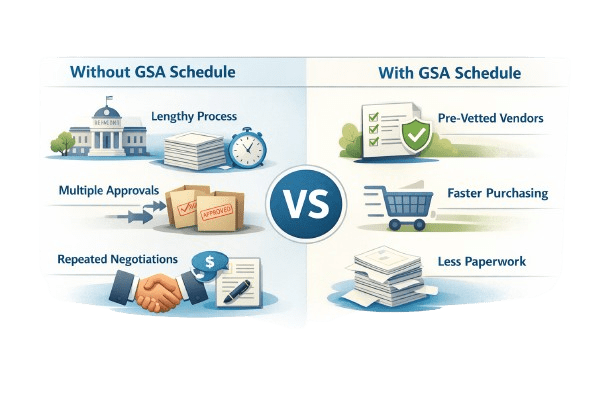
Instead of negotiating a brand-new contract every time an agency needs IT services, equipment, or professional services, agencies can purchase through the Schedule program. And their purchase will be “Streamlined” (less boxes for them to check).
So, you’re gaining access to a federal purchasing channel
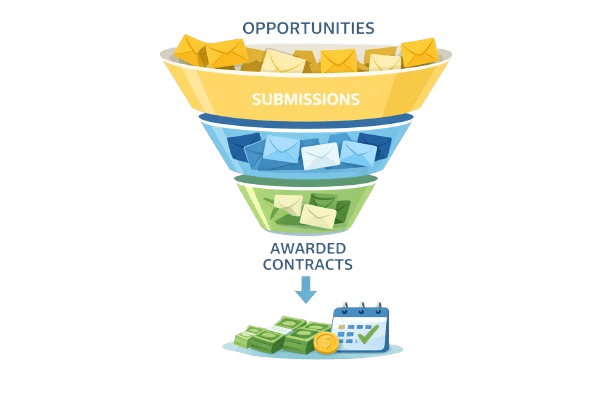
…and access does not guarantee revenue, but it does guarantee high-dollar, low-competition GSA opportunities, sent by email for 20-years.
Talk to a GSA Expert?
Book a Free Discovery Call to Explore…
✅ Your Specific GSA Benefits
✅ Map out GSA Sales Potential & ROI
✅ Learn the GSA Process & Timeline
✅ Pricing for DIY & “Done for You” Services
Pros and Cons of Getting a GSA Schedule
Before diving deeper into eligibility and application details, let’s frame this properly. Most businesses that regret pursuing a GSA Schedule misjudged one of those tradeoffs.
The key question is whether a GSA Schedule is a tool that aligns with your growth strategy.
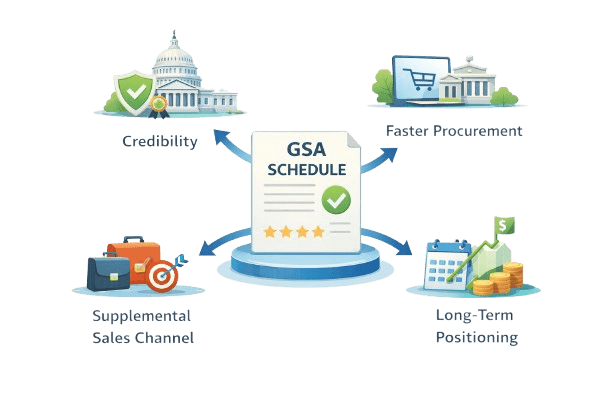
Pros of a GSA Schedule
- Recognized federal contracting vehicle
- Pre-negotiated pricing and terms
- Increased credibility with contracting officers
- Access to government procurement channels
- Potential for long-term positioning (contracts may extend up to 20 years)
- Simplified purchasing for repeat agency clients
Cons of a GSA Schedule
- Significant upfront documentation and compliance requirements
- No guaranteed contract awards
- Ongoing reporting and administrative obligations
- Pricing scrutiny and negotiation
- Requires active marketing and relationship-building
Why the GSA Schedule Exists
To decide whether this path makes sense for you, you need to understand how federal procurement works.
Government agencies operate under strict acquisition rules designed to ensure:
- Fair and reasonable pricing
- Transparency
- Competition
- Reduced procurement risk
As a result, Contracting Officers (CO’s) prefer pre-vetted vendors and structured purchasing vehicles. The GSA Schedule program exists to meet these needs and reduce administrative burden.
Rather than issuing a new Request for Quote (RFQ) for every purchase, agencies can use the GSA Schedule program to:
- Buy from approved Schedule holders
- Use pre-established pricing
- Reduce procurement timelines and risk
If you plan to sell into federal markets, aligning with buyer preference matters.
Are agencies already using GSA Schedules to purchase what you offer?
If the answer is yes, ignoring this channel will most definitely limit your access to low-competition GSA opportunities.
Is a GSA Schedule Right for You?
(Quick Qualification Check)
A GSA Schedule typically makes more sense if you:
- Already sell B2B successfully
- Can document past performance
- Have financial stability
- Plan to pursue federal contracting long-term
It may not be the right move — at least right now — if:
- You have $0 Sales
- You’re still refining your core offering
- Your pricing changes frequently
- You need immediate short-term revenue
Most businesses that struggle with GSA Schedule contracts weren’t unqualified. They were just early.
If your business operations are still stabilizing, focus on operational maturity.
Talk to a GSA Expert?
Book a Free Discovery Call to Explore…
✅ Your Specific GSA Benefits
✅ Map out GSA Sales Potential & ROI
✅ Learn the GSA Process & Timeline
✅ Pricing for DIY & “Done for You” Services
What a GSA Schedule Does
If awarded, your company:
✅ Becomes an approved Schedule contractor
✅ Receives assigned Special Item Numbers (SINs)
✅ Lists offerings within the GSA Advantage system
✅ Gains a recognized federal purchasing vehicle
That can significantly reduce procurement friction.
What It Does Not Do
It does not:
❌ Guarantee federal contract awards
❌ Automatically generate agency demand
❌ Replace business development
❌ Eliminate competition completely
Most successful Schedule holders integrate it into a broader federal sales strategy. While, underperforming Schedule holders assume the contract alone will produce revenue.
The contract creates access. Your strategy creates sales.
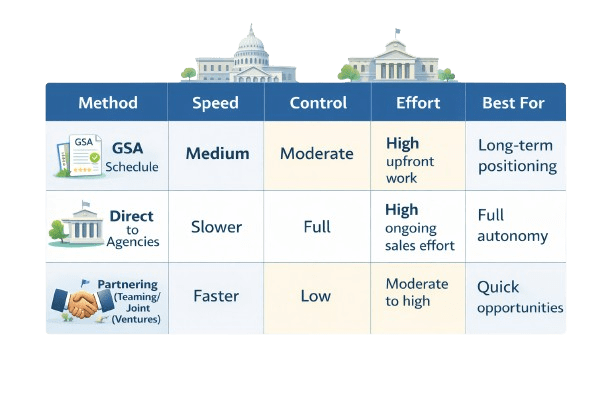
GSA Schedule vs. Other Federal Contracting Paths
Understanding alternatives strengthens your decision.
Open Market Federal Sales
- Full pricing flexibility
- Longer procurement cycles
- Requires separate negotiations per contract
- Suitable for targeted opportunities
Subcontracting Under Prime Contractors
- Faster entry into federal work
- Lower control
- Revenue tied to prime contract performance
- Valuable for gaining federal experience
GSA Schedule (MAS Contract)
- Structured purchasing vehicle
- Medium procurement speed
- High upfront compliance effort
- Long-term market positioning
Many experienced government contractors use multiple strategies simultaneously.
Your path depends on your growth stage, capacity, and federal target market.
GSA Schedule Requirements and Eligibility
If you’re considering moving forward, it helps to understand high-level eligibility standards.
Generally, you must demonstrate:
- At least two years in business (with exceptions)
- Commercial sales history
- Financial stability
- Past performance documentation
- Compliance with federal acquisition regulations (FAR)
- Proper registrations (SAM.gov, UEI, etc.)
The GSA evaluates pricing to ensure it is fair and reasonable compared to your commercial market.
If you cannot clearly document your pricing practices, the review process becomes more difficult.
Preparation is often the difference between a smooth review and a prolonged negotiation.
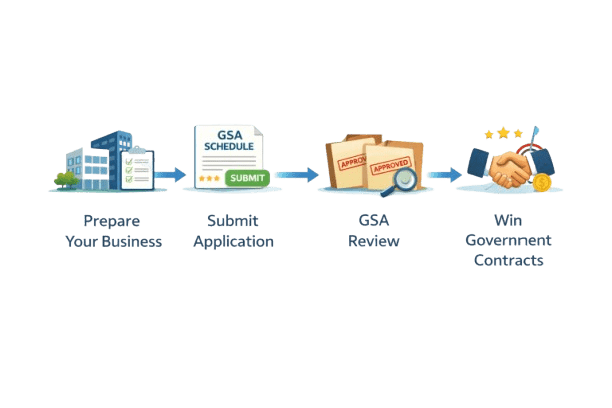
The GSA Schedule Application Process
(High-Level Overview)
The broad process includes:
- Internal preparation and documentation gathering (GSA Docs)
- Offer submission through the eOffer system
- GSA review and clarification requests
- Pricing negotiation
- Contract award
Timelines vary widely depending on:
- Submission completeness
- Responsiveness to clarification requests
- Complexity of offerings
Most businesses underestimate how detail-oriented this review process can be. The GSA Schedule is designed to reduce federal risk, and thorough review is part of that mandate.
What Happens After You Receive a GSA Schedule
Award is not the finish line.
Most successful contractors:
- Identify target agencies
- Build relationships with contracting officers
- Monitor federal opportunities
- Align offerings with agency needs
If you pursue a GSA Schedule, planning your post-award strategy before submission dramatically improves outcomes.
After award, you must also:
- Maintain pricing accuracy
- Submit required sales reports
- Pay the Industrial Funding Fee (IFF)
- Keep registrations current
- Request contract modifications when needed
You are listed in GSA systems, but agencies do not automatically purchase from you.
Talk to a GSA Expert?
Book a Free Discovery Call to Explore…
✅ Your Specific GSA Benefits
✅ Map out GSA Sales Potential & ROI
✅ Learn the GSA Process & Timeline
✅ Pricing for DIY & “Done for You” Services
Common Misconceptions About GSA Schedules
Correcting these misconceptions early protects your time and resources.
“If I get a GSA Schedule, agencies will find me.”
Not necessarily. Visibility does not equal demand.
“Only large businesses qualify.”
Small businesses hold many Schedule contracts.
“It guarantees steady government revenue.”
Revenue depends on strategy and positioning.
“It’s required to sell to the government.”
It is not mandatory for all federal sales.
Frequently Asked Questions About GSA Schedule
How hard is it to get a GSA Schedule?
It is detail-oriented and compliance-driven. Preparation significantly impacts difficulty.
How long does the GSA Schedule application take?
Timelines vary, often several months depending on complexity and responsiveness.
Do small businesses compete successfully on GSA?
Yes, particularly when aligned with agency demand and proper positioning.
What is the Multiple Award Schedule (MAS)?
The MAS program is the consolidated GSA Schedule structure covering multiple categories and Special Item Numbers.
Can you lose your GSA Schedule?
Yes, if compliance requirements are not maintained.
Do you need a consultant?
Not required, but some businesses use advisors to navigate documentation and negotiation.