

A workflow for government contract pricing is a structured, repeatable process that produces bids which are realistic, defensible, and compliant with federal regulations. Without one, your cost estimates are guesswork, your documentation is thin, and your proposals are easy targets for cost realism adjustments under FAR Subpart 15.4. Small and medium-sized businesses that build this process correctly gain a measurable edge in federal procurement. This guide walks you through every stage, from accounting setup to final proposal review, so you can compete with confidence.
What is the workflow for government contract pricing?
The government contract pricing workflow is the industry term for the end-to-end process of building, documenting, and submitting a price proposal that satisfies federal evaluation standards. It covers cost estimation, indirect rate application, subcontractor quote collection, contingency planning, and audit-ready documentation. FAR Subpart 15.4 and GSA pricing standards are the two primary regulatory references that govern this process. Every step you take must trace back to one of those frameworks.
The goal is not just to win a bid. The goal is to win at a price you can actually perform at, with documentation that survives a Defense Contract Audit Agency (DCAA) review. Cost realism analysis allows evaluators to adjust your proposed costs upward if your labor mix does not match your technical approach. That adjustment can knock you out of competitive range even after you submit.

Pro Tip: Map every cost line in your proposal back to a specific FAR Part 31 cost category before you submit. If you cannot trace it, evaluators cannot validate it.
What prerequisites and tools do you need before building your pricing workflow?
Your accounting system is the foundation. A chart of accounts that maps directly to FAR Part 31 cost categories prevents excessive reclassification and creates consistent audit trails. If your accounts are structured around internal management preferences rather than federal cost categories, you will spend hours reclassifying costs every time you build a proposal. That is time you do not have during a bid cycle.
Before you write a single cost line, you need these elements in place:
- FAR Part 31-aligned chart of accounts that separates direct labor, direct materials, fringe benefits, overhead, and G&A costs cleanly
- A historical cost library containing actual labor hours, loaded rates, and project costs from past performance
- Templates for cost realism memos and subcontractor quote collection letters with clear validity period requirements
- Forward Pricing Rate Agreement (FPRA) or Forward Pricing Rate Proposal (FPRP) documentation showing your current indirect rates
- Escalation and contingency tracking tools, whether spreadsheet-based or purpose-built for government proposals
Maintaining a cost library of historical labor hours and project costs lets your team build new defensible proposals efficiently rather than starting from scratch each time. That library is your institutional memory. Treat it as a living document, not an archive.
Pro Tip: Build your cost library inside your accounting system, not in a separate spreadsheet. When your accounting data and your proposal data live in the same place, reconciliation takes minutes instead of days.
How do you build and execute the step-by-step pricing process?
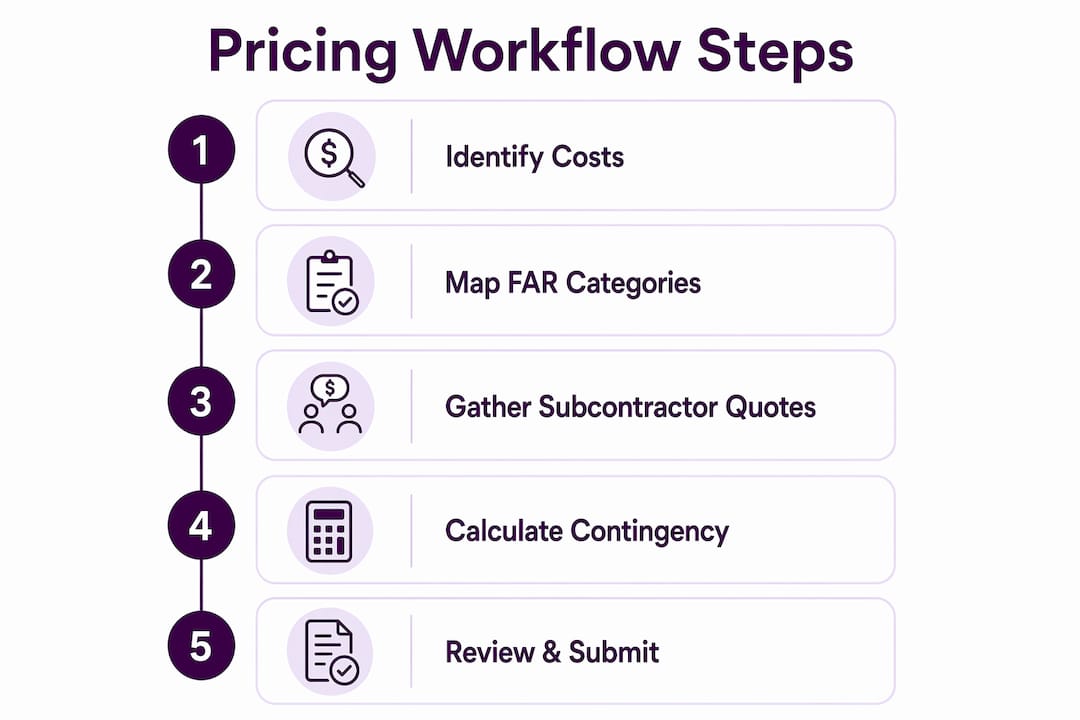
The government procurement pricing process follows a clear sequence. Skipping steps or reordering them creates gaps that evaluators flag. Follow this order every time.
Collect firm, signed subcontractor quotes. Quotes must be valid for 90–180 days and signed by an authorized representative. Unsigned or verbal quotes do not satisfy cost realism requirements.
Prepare direct cost estimates with a basis of estimate (BOE). Your BOE must trace each labor category, hour estimate, and material cost to a specific data source. BOE documentation tracing each cost figure to data sources is the standard required to pass proposal quality reviews.
Apply indirect rates consistently. Use the rates from your current FPRP or FPRA. Do not mix rates from different fiscal years or use rates that have not been reconciled with your accounting system.
Include a contingency between 3% and 12%. The right percentage depends on your risk analysis. Technical complexity, schedule uncertainty, and supply chain exposure all drive that number up. Fixed-price bids require this range per FAR 15.404-1(d) and 2026 industry guidance.
Create a one-page price realism executive summary. GSA guidelines require this summary plus supporting spreadsheets covering labor, burden, and contingency. The summary gives evaluators a fast path to your key assumptions.
Review escalation and risk assumptions before you finalize. Labor rates, material costs, and subcontractor prices all change over a multi-year contract. Your proposal must account for that movement with documented escalation factors.
Integrating labor categories, risk registers, and escalation assumptions into your pricing process is not optional. It is the difference between a proposal that wins and one that gets adjusted before evaluation even begins.
What common mistakes should contractors avoid in pricing workflows?
Most pricing failures come from the same handful of errors. Knowing them in advance is the fastest way to protect your bid.
- Missing or unsigned subcontractor quotes. Failure to provide firm quotes increases audit exposure risk and can lead to direct bid disqualification.
- Chart of accounts misaligned with FAR cost categories. When your accounts do not match FAR Part 31, every proposal requires manual reclassification. That creates errors and audit flags.
- Thin BOE documentation. A BOE that says “based on experience” without citing actual data sources fails proposal quality reviews. Evaluators need a traceable path from your cost figure to your data.
- Ignoring escalation and contingency. A proposal with no escalation factors on a three-year contract will almost certainly underprice year two and year three. That is a performance risk you absorb, not the government.
- Disconnect between accounting data and proposal data. When your FPRP reconciliation does not match your accounting system, DCAA auditors flag the gap immediately.
- Underestimating cybersecurity costs. SIEM tools and security personnel are real recurring indirect costs that belong in your overhead or G&A pools under DoD CMMC requirements. Leaving them out understates your true cost structure.
Pricing is not just math. Successful contractors align their chart of accounts directly with FAR cost categories to avoid costly reclassification and audit risks. The contractors who win consistently treat their accounting system as a pricing tool, not just a bookkeeping function.
How do you maintain and update your pricing workflow over time?
A pricing workflow is not a one-time build. It requires regular maintenance to stay compliant and competitive. Here is the maintenance cycle that keeps your process current.
Review indirect rates quarterly. Compare your actual rates against your FPRP projections. When actuals drift from projections, update your FPRP before your next proposal cycle begins.
Add new project data to your cost library after every contract. Each completed project gives you real labor hours, actual material costs, and subcontractor performance data. That data makes your next BOE more defensible.
Refresh subcontractor quote templates annually. Validity periods, signature requirements, and scope descriptions all need to reflect current GSA and FAR guidance. Outdated templates produce quotes that evaluators reject.
Update your proposal checklist when FAR or GSA guidance changes. The GSA Schedule contract maintenance checklist is a practical starting point for tracking compliance updates across your pricing documentation.
Hold a quarterly alignment meeting between your capture, pricing, and finance teams. Finance and capture collaboration is the mechanism that maps work breakdown structures to labor categories and keeps your assumptions consistent across the proposal.
The table below shows the core maintenance tasks, their frequency, and the team responsible.
| Maintenance Task | Frequency | Owner |
|---|---|---|
| Indirect rate reconciliation | Quarterly | Finance |
| Cost library update | After each contract | Pricing team |
| Subcontractor quote template review | Annually | Contracts/pricing |
| Proposal checklist update | When FAR/GSA guidance changes | Compliance lead |
| Capture-pricing-finance alignment meeting | Quarterly | Capture manager |
Cybersecurity costs deserve special attention in your annual review. DoD CMMC requirements mean that security tools and personnel are now expected line items in your overhead or G&A pools. Contractors who do not include these costs understate their true indirect rate and create a compliance gap that auditors will find.
Key Takeaways
A defensible government contract pricing workflow requires FAR-aligned accounting, firm subcontractor quotes, documented BOEs, and quarterly maintenance to stay competitive and audit-ready.
| Point | Details |
|---|---|
| FAR alignment is non-negotiable | Your chart of accounts must map to FAR Part 31 categories before you write your first cost line. |
| Firm quotes protect your bid | Subcontractor quotes must be signed and valid for 90–180 days to satisfy cost realism requirements. |
| BOE documentation wins reviews | Every cost figure needs a traceable data source or evaluators will adjust your proposal upward. |
| Contingency is required, not optional | Include 3–12% contingency in fixed-price bids based on a documented risk analysis. |
| Maintenance keeps you competitive | Quarterly rate reviews and cost library updates prevent compliance gaps and pricing drift. |
Why workflow discipline separates winners from also-rans
Most small business owners I work with treat pricing as a one-time calculation. They build a spreadsheet for one bid, win or lose, and then start over from scratch on the next one. That approach costs them in two ways. First, they spend enormous time rebuilding estimates that already exist in past project data. Second, their proposals lack the documentation depth that evaluators expect from experienced contractors.
The businesses that win federal contracts consistently have one thing in common. They invest in their systems before they need them. A GSA contract pricing process built on a solid accounting foundation and a maintained cost library produces proposals faster and with fewer errors. That speed matters when a solicitation drops with a 30-day response window.
My honest advice: do not wait until you lose a bid on a cost realism adjustment to fix your accounting structure. Fix it now, while you have time to do it right. The upfront investment in a FAR-aligned chart of accounts and a real cost library pays back on the first proposal you build with it. Partner with a financial advisor who knows government contracting, and get your capture and pricing teams talking to each other before the next solicitation hits.
— Josh
How Gsascheduleservices supports your pricing workflow
Building a compliant pricing process from scratch takes time, and most small business owners are already stretched thin running their operations. Gsascheduleservices works with small and medium-sized businesses to assess their current pricing readiness, identify gaps in their documentation, and put the right systems in place before the next bid cycle. The team understands GSA pricing compliance from the inside out and can help you build a process that holds up under DCAA scrutiny. If you want to know where your current pricing workflow stands, a discovery consultation is the fastest way to find out.
FAQ
What is a workflow for government contract pricing?
A government contract pricing workflow is a structured, repeatable process for building cost proposals that comply with FAR Subpart 15.4 and GSA pricing standards. It covers cost estimation, indirect rate application, subcontractor quotes, and audit-ready documentation.
How much contingency should I include in a fixed-price government bid?
Small contractors should include a contingency between 3% and 12% in fixed-price bids, based on a documented risk analysis covering technical complexity and schedule uncertainty per FAR 15.404-1(d).
What happens if my subcontractor quotes are not firm or signed?
Unsigned or informal quotes fail cost realism evaluation requirements and can lead to bid disqualification. Quotes must be signed by an authorized representative and remain valid for 90–180 days.
Why does my chart of accounts matter for government pricing?
A chart of accounts aligned with FAR Part 31 cost categories prevents costly reclassification during proposal preparation and creates a consistent audit trail that DCAA reviewers can follow without flagging discrepancies.
How often should I update my pricing workflow?
Indirect rates need quarterly reconciliation, cost library data should be added after every completed contract, and proposal checklists should be updated whenever FAR or GSA guidance changes.
Recommended
- Discovering Government Contractor Salary: A Comprehensive Guide
- Understanding What Are Government Contracts: A Comprehensive Guide
- Understanding What Are Government Contracts: A Comprehensive Guide
- Explore the Different Types of Government Contracts