

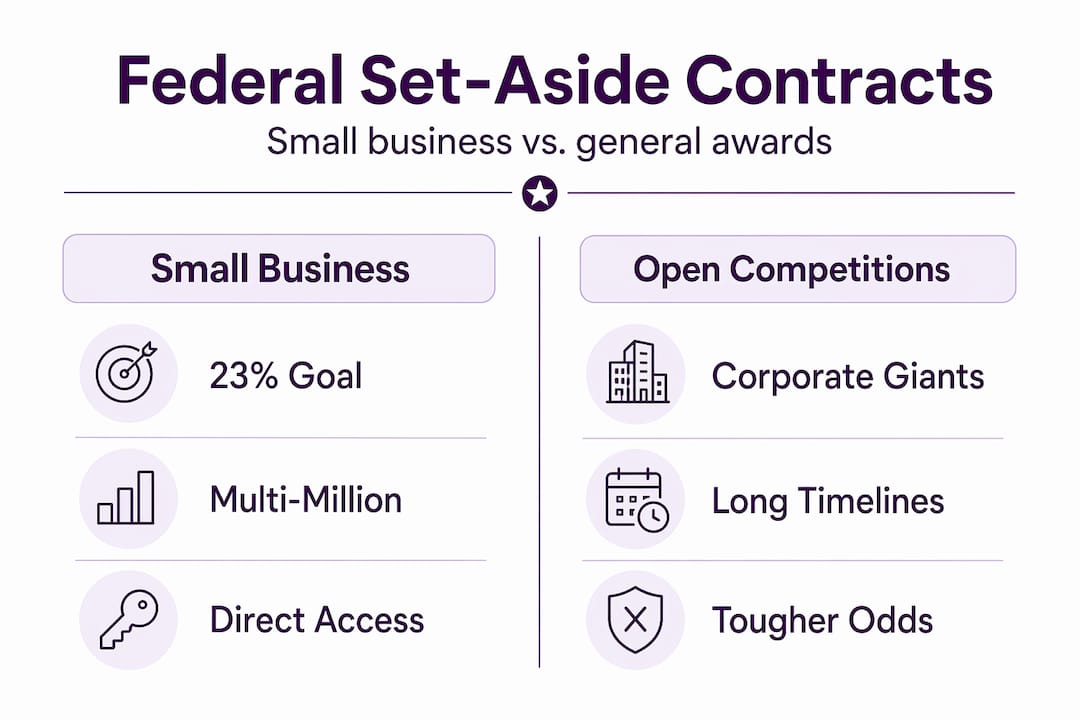
Most small business owners assume federal contracting is a game rigged for corporate giants. That assumption is expensive. Why federal contracting matters becomes clear the moment you learn that the federal government is mandated to allocate 23% of prime contracting to small businesses — and in FY2025, small businesses captured around 36% of GSA Multiple Award Schedule (MAS) awards. That gap between perception and reality is exactly where opportunity lives. This guide walks you through GSA Schedules, registration on SAM.gov, compliance obligations, and the practical strategies that turn a federal contract into actual revenue.
Table of Contents
- Understanding federal contracting’s role for small businesses
- What a GSA Schedule is and why it matters to your business
- Registering on SAM.gov: Your gateway to federal contracting
- Navigating compliance and financial realities in federal contracting
- Applying federal contracting knowledge: Strategies for small business success
- Why compliance is your greatest competitive advantage in federal contracting
- Start your federal contracting journey with expert GSA Schedule support
- Frequently asked questions
Understanding federal contracting’s role for small businesses
The federal government’s preference for small businesses is not goodwill. It is law. Congress sets statutory goals that require agencies to direct a meaningful share of contracts to small firms, and those goals come with real enforcement pressure. This is a policy-driven market tilt that you can position your business to benefit from directly.
The most important mechanism to understand is the “Rule of Two.” Under this rule, contracting officers are required to set aside a contract for small businesses when there is a reasonable expectation that at least two small businesses can perform the work at a fair price. That means a large contractor cannot simply walk in and take an opportunity that two small companies are qualified to fill. The small business set-asides explained in detail show just how broadly this rule applies across contract sizes.
Beyond the Rule of Two, several programs extend additional advantages:
- 8(a) Business Development Program: For small businesses owned by socially and economically disadvantaged individuals. Qualifying companies can receive sole-source awards without competition.
- HUBZone Program: For businesses located in Historically Underutilized Business Zones. Agencies get credit toward goals by awarding these businesses contracts.
- Women-Owned Small Business (WOSB) Program: Set-asides reserved specifically for women-owned firms in industries where they are underrepresented.
- Service-Disabled Veteran-Owned Small Business (SDVOSB): Sole-source and set-aside contracts for veterans who became disabled during service.
“Small businesses secured around 36% of GSA MAS awards in FY2025, far exceeding the 23% statutory minimum the federal government is required to meet.”
Set-asides are not limited to small, low-value purchases either. Multi-million-dollar contracts across IT, professional services, construction, and logistics carry set-aside designations. The federal marketplace is deliberately structured to keep smaller competitors competitive. What you actually need is the right access point.
Having seen the deliberate small business focus in federal contracting, let’s explore the critical tool that gives you access: the GSA Schedule.
What a GSA Schedule is and why it matters to your business
A GSA Schedule, formally called a Multiple Award Schedule (MAS) contract, is one of the most misunderstood tools in federal contracting. Many business owners treat it like a passive revenue stream that runs on its own. It is not. But used actively, it is one of the most powerful sales vehicles available to a small business.
A GSA Schedule is a long-term government-wide contract with pre-negotiated pricing, allowing simplified purchases by all federal agencies as well as eligible state and local governments. Contracts last up to 20 years, structured as a base period with renewal options. That long duration gives you a stable platform to build agency relationships and grow federal revenue steadily.
Here is what makes the GSA Schedule structurally valuable compared to competing for individual contracts:
| Factor | Individual contract competition | GSA Schedule |
|---|---|---|
| Procurement timeline | Months to over a year | Days to weeks |
| Pricing negotiation | Per contract | Pre-negotiated once |
| Access to buyers | Limited to one agency | All federal agencies plus state/local |
| Credibility signal | Must be established per bid | Pre-vetted by GSA |
| Duration | One contract at a time | Up to 20 years |
The GSA Schedule benefits and process go deeper than speed and access. Having a Schedule tells buyers that GSA has already reviewed your pricing, experience, and qualifications. That vetting removes a significant barrier to purchase. Federal buyers using platforms like GSA Advantage and eBuy can find your offerings and place orders without running a full competition, as long as they stay within thresholds and follow ordering procedures.
Pro Tip: Your GSA Schedule catalog is essentially your federal storefront. If it is outdated, vague, or poorly described, buyers will move to a competitor who made the effort to present their offerings clearly. Review it quarterly.
The GSA MAS sales strategies that separate top performers from inactive schedule holders nearly always come down to one thing: treating the Schedule as a tool that requires active investment, not a trophy to hang on the wall.
Now that you understand the GSA Schedule’s purpose and advantages, let’s look at the essential first step: registering in SAM.gov.
Registering on SAM.gov: Your gateway to federal contracting
Before you can receive a federal contract or even be considered for one, your business must be registered in SAM.gov, the System for Award Management. No registration means no contracts and no payments. It is that simple.

SAM.gov registration is mandatory and free, typically taking 7 to 14 business days when all information is submitted correctly. You will need your Employer Identification Number (EIN), a Login.gov account, your NAICS codes (North American Industry Classification System codes that describe your business activities), and banking details for electronic funds transfer. Scammers actively target new registrants, advertising paid services to register on your behalf through unofficial websites. Use only SAM.gov directly.
Here is the core registration process:
- Create a Login.gov account. This is your secure government authentication credential and is required before accessing SAM.gov.
- Gather your Unique Entity ID (UEI). SAM.gov now assigns a UEI rather than a DUNS number. You get this during registration.
- Complete entity registration. Enter your legal business name, physical address, NAICS codes, and product/service codes.
- Submit banking and remittance information. Electronic funds transfer is required for payments. Errors here cause payment delays.
- Review and submit. Processing takes 7 to 14 business days. You will receive a confirmation email when active.
Pro Tip: Before you begin, pull your most recent bank statement and IRS EIN confirmation letter. Missing either will stall your registration and add days to the process.
Annual renewal is not optional. A lapsed SAM.gov registration freezes your ability to receive contract awards and payments, and reactivating it takes the same 7 to 14 business days. Set a calendar reminder at least three weeks before your registration anniversary date. Many small businesses lose payments simply by letting this slip.
The SAM.gov registration guidance available covers the nuances that catch first-time registrants off guard, from selecting the right NAICS codes to avoiding common submission errors.
Having completed registration, the next challenge is compliance and managing financial realities essential for success in federal contracting.
Navigating compliance and financial realities in federal contracting
Federal contracts pay after delivery. Not before. Not halfway through. After. This single financial reality derails more small business federal contractors than any other factor, and most discover it only after signing.
Cash flow delays of 60 to 120 days are common from contract award to first payment, factoring in delivery, invoicing, and agency payment cycles. You need working capital to cover payroll, materials, and overhead during that window. Build this into your financial planning before you pursue your first contract, not after.
The good news is the Prompt Payment Act protects you. This federal law requires agencies to pay invoices within 30 days of receipt or owe you interest on the late balance. Here is what most contractors do not know:
- The interest rate is set by the Treasury and compounds daily on overdue balances.
- You do not need to request the interest penalty. Agencies are required to pay it automatically.
- Most small contractors never track invoice due dates closely enough to notice or claim late payment interest.
- Claiming your rights under this act is fully legal and does not damage agency relationships.
“Compliance is a competitive moat; those mastering federal compliance create barriers that exclude less-prepared competitors.”
Beyond cash flow, federal compliance covers a broad range of obligations:
- Accounting systems: You need cost accounting practices that can withstand a government audit. Many small businesses use software that is not structured for this.
- Cybersecurity: Depending on your contract type, you may need to meet CMMC (Cybersecurity Maturity Model Certification) requirements.
- Subcontracting plans: Larger contracts often require a written plan outlining how you will use small business subcontractors.
- Reporting and certifications: You must certify your business size annually and report correctly on any socioeconomic program status.
Pro Tip: Keep a compliance calendar that tracks renewal dates, reporting deadlines, and audit windows in one place. Missing one deadline can trigger a cure notice or contract termination.
The GSA MAS compliance updates affecting schedule holders are frequent and consequential. Staying current is not a one-time task.
Applying federal contracting knowledge: Strategies for small business success
A GSA Schedule is, as one expert put it, a “hunting license”: it authorizes you to sell, but you have to do the hunting. The contractors who generate consistent federal revenue treat their Schedules like active sales channels, not passive credentials.
Here is what active management looks like in practice:
- Monitor GSA eBuy weekly. Agencies post Requests for Quotations (RFQs) on eBuy, and speed matters. Buyers often close opportunities within days. A weekly review keeps you in the game.
- Update your GSA Advantage catalog. Stale descriptions, outdated pricing, and missing options cost you opportunities. Your catalog competes visually against every other Schedule holder in your category.
- Document past performance meticulously. Every completed contract is evidence of capability. Write up what you delivered, the scope, the agency, and the outcome. This documentation becomes your most valuable asset when competing for larger work.
- Build relationships with agency contracting officers. Federal buying is relationship-influenced even when it is rule-governed. Introduce yourself, attend industry days, and respond professionally to every interaction.
For building a winning proposal habit, this sequence works well:
- Identify the RFQ and read every requirement carefully before deciding to respond.
- Match your past performance examples directly to the stated requirements.
- Price competitively within your pre-negotiated Schedule rates.
- Submit before the deadline with a clear, readable response. Many contracting officers review dozens of submissions quickly.
- Request a debrief on every loss to understand where to improve.
Pro Tip: The steps to GSA Schedule success that consistently produce results all share one trait: the business owner treats federal contracting as a dedicated business development channel, not a side effort.
Preparation before submission matters more than volume of submissions. One well-matched, thoroughly prepared proposal beats five sloppy attempts every time.
Why compliance is your greatest competitive advantage in federal contracting
Here is an opinion you will not hear often: compliance requirements in federal contracting are not a burden. They are a gift to well-prepared small businesses.
Every time a competitor cuts corners on accounting documentation, skips a required certification, or lets their SAM.gov registration lapse, they disqualify themselves. The compliance bar in federal contracting is high enough that a meaningful percentage of potential competitors never clear it. That reduces your actual competition far more than any marketing strategy could.
“Successful small businesses treat compliance not as a burden, but as a competitive moat” that keeps less-prepared competitors out of the market. We have seen this play out repeatedly with our clients. The ones who invest in solid accounting systems, clean past performance records, and consistent registration hygiene win contracts that others cannot even bid on.
The psychological shift here matters. When you view compliance as a cost, you minimize it. When you view it as a filter that reduces your competition, you invest in it. The business that keeps impeccable records, meets every reporting deadline, and maintains clean pricing history across their GSA Schedule becomes genuinely hard to displace.
There is also a scalability argument. Higher-value contracts, especially those above the simplified acquisition threshold of $250,000, attract agency scrutiny proportional to dollar size. The business that has already built clean compliance infrastructure moves into that tier smoothly. The business that patched compliance together as it went gets caught.
Ongoing compliance monitoring is not about avoiding penalties. It is about being ready when a major opportunity appears, because those opportunities do not wait.
Start your federal contracting journey with expert GSA Schedule support
Understanding why federal contracting matters is the foundation. Acting on that knowledge is where most small businesses stall, not from lack of motivation, but from the weight of the application process, compliance requirements, and registration details that demand precision.
That is exactly what we help with at GSA Schedule Services. From readiness assessments to application preparation, pricing negotiation, and ongoing compliance management, our team handles the complexity so you can focus on delivering your services. Our clients get to market faster, avoid the costly errors that delay approvals, and stay compliant through every renewal cycle. If you are ready to assess your eligibility and start building your federal revenue channel, a discovery call is the right first move.
Frequently asked questions
Why does the federal government set aside contracts specifically for small businesses?
To meet statutory goals, the government mandates 23% of prime contracting go to small businesses in order to support economic diversity and growth. This creates legally enforced market access for firms that would otherwise struggle to compete against large contractors.
Is having a GSA Schedule guaranteed revenue for my business?
No. A GSA Schedule is a “hunting license” that authorizes you to sell to federal agencies, but you must actively market, monitor buying platforms, and build relationships to generate actual sales.
How long does the SAM.gov registration process typically take?
Registration typically takes 7 to 14 business days when all required information including EIN and banking details is accurately submitted from the start.
What financial challenges should I anticipate when starting federal contracts?
Federal contracts pay after delivery, and the gap from award to first payment typically runs 60 to 120 days, so you need working capital to cover operations during that window before revenue arrives.
How can I ensure I am compensated for late payments by federal agencies?
Track your invoice submission dates and payment receipt dates carefully. The Prompt Payment Act requires agencies to pay interest on late payments, but most contractors never claim it because they are not monitoring the timeline closely enough.
Recommended
- Take Advantage of Federal Contracts For Your Business Startup
- Unlocking Government Contracts for Small Businesses
- Winning Government Contracts for Small Businesses
- Explore Government Contractor Financing – Your Path to Success