
A GWAC, or Government-Wide Acquisition Contract, is a pre-competed, multiple-award IDIQ contract specifically for federal IT products and services, authorized under 40 U.S.C. § 11302 and managed by designated Executive Agents including GSA, NIH, and NASA. If you run a small or medium-sized business and want a repeatable path into federal IT spending, GWACs are the most direct route available. They let any federal agency buy from a pre-qualified vendor pool without running a full open-market competition every time. That speed and structure is exactly why agencies prefer them, and why getting on one can change your federal revenue picture entirely.
What are GWACs and how do they actually work?
GWACs operate on a two-tier process that separates contract award from actual work. In the first tier, an Executive Agent such as GSA or NIH runs a full, open competition and selects a pool of qualified vendors. Those vendors hold the base GWAC contract. In the second tier, federal agencies issue task orders against that contract, competing the work among the pre-qualified pool rather than the entire market.
The Executive Agent awards contracts through a rigorous upfront evaluation, then agencies issue task orders to meet specific IT needs. Task order competitions follow FAR 16.505, which requires agencies to give fair opportunity to all GWAC holders unless a specific exception applies, such as urgency or a logical follow-on. This keeps the process competitive while still being far faster than starting from scratch.

Speed is one of the defining features of this model. Task order awards under GWACs happen within weeks compared to months for open-market procurements. For agencies under budget pressure or tight mission timelines, that difference is significant. For vendors, it means you need to be ready to respond fast once you hold a contract.
Pro Tip: Register in SAM.gov and keep your profile current before you even apply for a GWAC. Agencies check vendor profiles before issuing task order solicitations, and an outdated profile can disqualify you before the competition begins.
The legal framework governing task order competitions also limits protest rights. Task orders under GWACs are often shielded from GAO protests below certain monetary thresholds. Agencies benefit from faster awards as a result, but contractors have fewer formal dispute options at the task order level. Knowing this going in shapes how you approach each competition.
What are the main types of GWACs and who manages them?
Several major GWAC vehicles are active right now, each with a different focus, eligibility requirement, and managing agency. Choosing the right one depends on your business size, socioeconomic status, and the IT services you provide.
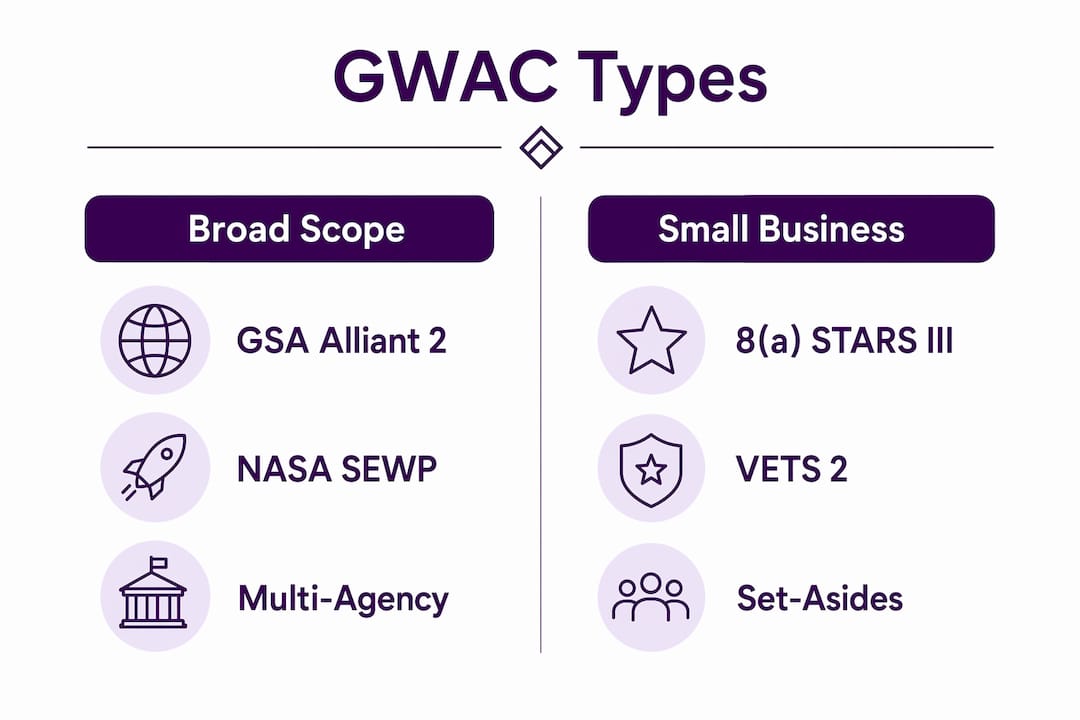
GSA Alliant 2, 8(a) STARS III, and NASA SEWP are the three most widely used vehicles. Alliant 2 covers broad IT services with high ceiling values and is open to large and small businesses. 8(a) STARS III targets SBA-certified small businesses and focuses on IT services. NASA SEWP V emphasizes IT products and is known for rapid procurement timelines.
| GWAC Vehicle | Managing Agency | Primary Focus | Eligibility |
|---|---|---|---|
| Alliant 2 | GSA | Broad IT services | Large and small businesses |
| 8(a) STARS III | GSA | IT services | SBA 8(a) certified small businesses |
| VETS 2 | GSA | IT services | Service-disabled veteran-owned small businesses |
| NIH CIO-SP4 | NIH | IT for health research | Small and large businesses |
| NASA SEWP V | NASA | IT products and solutions | Pre-qualified vendors |
Beyond the table above, a few distinctions matter for your strategy:
- 8(a) STARS III is one of the highest-value small business set-aside vehicles in federal IT. If your firm holds an SBA 8(a) certification, this is your most direct path to large agency IT contracts.
- VETS 2 is reserved exclusively for service-disabled veteran-owned small businesses (SDVOSBs). It covers a wide range of IT services and gives qualifying firms access to government-wide demand.
- NIH CIO-SP4 is particularly strong for firms with health IT, data analytics, or cybersecurity capabilities, since NIH and its partner agencies are heavy users of those services.
Specific vehicles like 8(a) STARS III and VETS 2 provide small and medium-sized businesses access to billions in federal IT spending with a narrower competitive field. That reduced competition is the core advantage of set-aside GWACs.
How do GWACs benefit small and medium-sized businesses?
The biggest practical benefit of a GWAC is access. Once you hold a contract, every federal agency that uses that vehicle can buy from you without a new full competition. That is a fundamentally different position than chasing individual agency solicitations one at a time.
Here is what that access translates to in practice:
- Reduced procurement friction. Agencies already trust the GWAC pool. You skip the credibility-building phase that open-market vendors face on every new bid.
- Faster task order cycles. Because the base contract is already in place, agencies move from requirement to award in weeks rather than months. More cycles per year means more revenue opportunities.
- Emerging technology access. GWACs like Alliant 2 and NIH CIO-SP4 explicitly cover cloud computing, cybersecurity, artificial intelligence, and data analytics. These are the fastest-growing areas of federal IT spending.
- Competitive positioning. On a set-aside GWAC like 8(a) STARS III, you compete only against firms in the same socioeconomic category. The field is smaller and the playing field is more level.
GWACs reduce procurement risk by using vetted contractor pools, which benefits agencies and vendors alike. Agencies trust the pool. Vendors get recurring access to buyers who are already authorized to spend.
Pro Tip: Do not wait for a task order to appear before you start building relationships. Attend agency industry days, respond to Requests for Information (RFIs), and introduce your firm to contracting officers well before solicitations drop. Agencies often know who they want to see in the competition before the formal process begins.
Understanding federal procurement basics also helps you position your firm correctly across multiple vehicles, not just GWACs. The firms that win consistently treat contract vehicles as one part of a broader federal sales strategy.
How do GWACs compare with GSA Schedules and agency IDIQs?
GWACs and GSA Schedules are both federal contract vehicles, but they work very differently. Knowing which one fits your situation prevents wasted time and misdirected resources.
GWACs differ from GSA Schedules in three critical ways: they are restricted to IT, they have finite competition windows rather than rolling applications, and they operate on a fixed pool of awardees. GSA Schedules accept new applicants on a continuous basis and cover hundreds of product and service categories beyond IT.
| Feature | GWACs | GSA Schedules | Agency-Specific IDIQs |
|---|---|---|---|
| Scope | IT only | Broad (products and services) | Agency-defined |
| Entry timing | Periodic competitions | Rolling applications | Periodic competitions |
| Government-wide use | Yes | Yes | No (agency-specific) |
| Set-aside options | Yes (multiple vehicles) | Limited | Varies |
| Competition for work | Task order competitions | Direct agency orders | Task order competitions |
GSA Schedules and GWACs serve different purposes. GSA Schedules offer rolling entry and broader scopes, while GWACs provide government-wide access strictly for IT via cyclic multiple-award contracts. If your business sells IT services and you qualify for a set-aside GWAC, that vehicle typically delivers higher-value contracts than a Schedule alone. If you sell a mix of products and services, a GSA Schedule may be the better starting point. Many successful federal contractors hold both. You can read more about why GSA Schedules appeal to federal buyers to understand how the two vehicles complement each other.
What challenges should businesses know before pursuing GWACs?
Holding a GWAC contract does not guarantee revenue. The contract is the entry ticket. Winning task orders is the actual work, and it requires a different set of skills than winning the base contract.
The most common challenges SMBs face after award include:
- Task order competition intensity. Every other GWAC holder is your competitor for each task order. On Alliant 2, that pool can include hundreds of firms. You need a strong capture strategy and a fast proposal team.
- Speed requirements. Vendors often underestimate the speed required to respond to GWAC task orders. Proposal windows can be as short as five to ten days. If you do not have templates, past performance write-ups, and pricing models ready, you will miss opportunities.
- Limited protest rights. As noted earlier, task orders below certain thresholds cannot be protested to the GAO. If you believe a competition was unfair, your formal options are limited.
- Contract period constraints. GWACs have defined periods of performance, typically five years with options. If you miss the on-ramp competition, you may wait years for the next one.
- Misconception about passive income. Some firms assume that holding a GWAC means agencies will find them. Agencies do not browse vendor lists. You must market your capabilities directly to contracting officers and program managers.
Successful GWAC vendors develop capture strategies well before task orders are released because of abbreviated proposal windows. The firms that consistently win task orders treat capture planning as a year-round discipline, not a reactive scramble.
Key takeaways
GWACs are the most direct path for qualified IT vendors to access government-wide federal spending, but winning task orders requires preparation, speed, and a clear capture strategy.
| Point | Details |
|---|---|
| GWACs defined | Pre-competed IDIQ contracts for federal IT, managed by GSA, NIH, and NASA. |
| Two-tier process | Base contract award comes first; task order competitions follow for actual work. |
| Set-aside vehicles | 8(a) STARS III and VETS 2 give eligible SMBs a smaller, more focused competitive field. |
| Speed is critical | Task order windows can be as short as five days, so prepare proposals and pricing in advance. |
| GWACs vs. Schedules | GWACs are IT-only with periodic entry; GSA Schedules accept rolling applications across broader categories. |
My honest read on GWACs after years in federal contracting
The single biggest mistake I see small businesses make with GWACs is treating contract award as the finish line. It is not. It is the starting line. I have watched firms spend months preparing a strong GWAC application, win a spot on 8(a) STARS III or Alliant 2, and then go quiet. They wait for the phone to ring. It never does.
The firms that actually generate revenue from GWACs do three things differently. First, they start capture planning before the task order drops. They track agency budgets, attend industry days, and build relationships with program managers months in advance. By the time the solicitation appears, they already know what the agency wants. Second, they invest in proposal infrastructure. Templates, past performance narratives, pricing models, and teaming agreements are all built and ready. When a five-day window opens, they respond in two. Third, they balance GWACs with other vehicles. A GSA Schedule gives you access to a broader buyer base. Government procurement strategies that combine GWACs with Schedule contracts consistently outperform single-vehicle approaches.
One more thing worth saying directly: not every SMB should pursue a GWAC right now. If you do not have past performance in federal IT, a dedicated proposal team, and at least one active agency relationship, a GSA Schedule is the better first step. Build your track record there, then pursue a GWAC when you can compete on day one.
— Josh
Ready to explore your GWAC and GSA contract options?
Understanding GWACs is step one. Knowing which vehicle fits your business, whether you qualify for a set-aside, and how to position your firm for task order wins is where the real work begins. Gsascheduleservices works with small and medium-sized businesses to assess readiness, identify the right contract vehicles, and build a federal sales approach that generates consistent revenue. If you are ready to move from research to action, start with the GSA contract discovery portal to see which opportunities align with your capabilities. You can also explore key GWAC benefits to sharpen your understanding before your first consultation. Small business financing through Fordham Capital is also available if you need capital to support your federal contracting push.
FAQ
What does GWAC stand for in government contracting?
GWAC stands for Government-Wide Acquisition Contract. It is a pre-competed, multiple-award IDIQ contract vehicle used by federal agencies to purchase IT products and services from a vetted pool of vendors.
Who can use a GWAC to buy IT services?
Any federal agency can issue task orders against an active GWAC vehicle. The contract is government-wide, meaning agencies are not limited to the managing agency’s own procurement office.
How is a GWAC different from a GSA Schedule?
GWACs are restricted to IT, have periodic competition windows, and operate on a fixed vendor pool. GSA Schedules accept rolling applications and cover a much broader range of products and services beyond IT.
Can small businesses compete on GWACs?
Yes. Several GWACs are specifically designed as small business set-asides, including 8(a) STARS III for SBA-certified firms and VETS 2 for service-disabled veteran-owned small businesses, giving qualifying firms access to billions in federal IT spending.
How long does it take to win work through a GWAC?
Holding a GWAC contract does not guarantee immediate work. Task order proposal windows can be as short as five to ten days, so vendors must maintain ready proposal materials and active agency relationships to compete successfully.
Recommended
- How Small Businesses Can Get Started With A GSA Contract? 5 Steps!
- GSA GWACs: The Essentials
- What is a GSA GWAC + 3 benefits
- The GWAC List Going Into GSA FY 2021