

Most government contractors walk into their first GSA renewal with the same assumption: the government will simply extend the contract when it expires. That assumption costs people contracts every year. Understanding GSA contract option periods means knowing that nothing is automatic, nothing is guaranteed, and the window to act is shorter than most people expect. This article breaks down the structure of GSA option periods, the renewal timeline, what the government actually looks at before exercising an option, and the specific steps that separate contractors who keep their schedules from those who lose them.
Table of Contents
- Key takeaways
- How GSA contract option periods are structured
- The renewal timeline and what you need to do
- What the government considers before exercising your option
- Task order options vs. master contract options
- Best practices for securing your next option period
- My perspective on what contractors actually get wrong
- Get expert support for your next renewal
- FAQ
Key takeaways
| Point | Details |
|---|---|
| Options require formal exercise | GSA contracts are not auto-renewed; each option period must be formally exercised by the government. |
| Renewal prep starts early | The 7 to 12 month pre-expiration window is when contractors must submit documentation and engage their CO. |
| Funding can block renewal | Even strong contractor performance does not guarantee option exercise if agency budgets are constrained. |
| Task orders follow different rules | Task order option periods operate under separate FAR clauses and should not be confused with master contract options. |
| Proactive compliance wins | Maintaining your SAM.gov registration, sales thresholds, and updated pricing are non-negotiable for renewal success. |
How GSA contract option periods are structured
GSA MAS contracts have a 5-year base period followed by three 5-year option periods, giving contractors a potential 20-year contract life. That is a significant runway for federal sales, but only if you understand that each option period is its own milestone with its own requirements. The base period and every option period after it must be formally exercised by the government. Nothing rolls over on its own.
The distinction between MAS and non-MAS contracts matters here. MAS contracts, which include the standard GSA Schedule used by most small and mid-sized businesses, follow the 5-year increment structure described above. Non-MAS contracts, such as those awarded under specific agency solicitations, often have shorter option periods and different timelines. Understanding GSA contracts means recognizing which type you hold and what rules govern your specific vehicle.
One thing contractors regularly misunderstand is what “option period” actually means from the government’s perspective. An option is a unilateral right held by the government. They can choose to exercise it or not. Your job as a contractor is to make sure every condition that influences that decision works in your favor.
- GSA MAS base period: 5 years
- Option periods available: Three additional 5-year periods
- Maximum contract life: 20 years
- Exercise requirement: Each option requires a formal government action, not an automatic extension
- Minimum sales threshold: Contractors must meet the $25,000 minimum sales requirement to remain in good standing
Pro Tip: Treat each 5-year option period as a fresh negotiation, not a rubber stamp. Update your offerings, revisit your pricing, and check your compliance posture before the renewal window opens.
The renewal timeline and what you need to do
The renewal process for MAS option periods typically begins 7 to 12 months before the current period expires. That is not a suggestion. It is the operational window during which your Contracting Officer (CO) will reach out, expect documentation, and begin their internal review. Missing this window is one of the most common and damaging mistakes contractors make.

For non-MAS contracts, the review period is 60 to 90 days before expiration. The focus in those reviews centers on agency need, contractor performance, and available funding. The timelines are tighter, which means the preparation work needs to start even earlier to leave room for corrections.
Here is a practical sequence for managing the MAS renewal process:
- Mark your calendar at the 12-month mark. Set an internal reminder 12 months before your current period ends. Do not wait for GSA to contact you first.
- Review your SAM.gov registration. Your registration must be current and accurate. An expired SAM.gov registration can stop an option exercise cold.
- Compile updated pricing and commercial sales data. Your CO will need a refreshed Commercial Sales Practices form (CSP-1) that reflects current market pricing.
- Revisit your Small Business Subcontracting Plan. If your contract requires one, it must be updated to reflect actual performance against prior goals and realistic projections for the next period.
- Pull your sales reports. Document that you have met the minimum $25,000 sales threshold. Low or zero sales are a red flag for COs and one of the clearest reasons for non-renewal.
- Initiate contact with your Contracting Officer. Do not wait for them to come to you. A proactive outreach signals that you are organized and serious about continuing the contract.
Early engagement with your CO is not just courteous. It is a strategic advantage. COs manage dozens of contracts simultaneously. The contractors who communicate clearly and early tend to get smoother renewals.
Pro Tip: Set up a dedicated GSA contract calendar with quarterly check-ins, not just annual ones. Compliance issues caught at the 9-month mark are fixable. Compliance issues caught at the 30-day mark often are not.
What the government considers before exercising your option
Even if you have done everything right, the decision to exercise your option belongs entirely to the government. Understanding how GSA option periods work from the government’s perspective requires looking at this from the CO’s side of the table.
The review process involves several criteria, and a weakness in any one of them can affect the outcome:
- Performance record. Industrial Operations Analyst (IOA) reports assess contractor compliance across areas like pricing accuracy, order processing, and schedule maintenance. A negative IOA report can directly affect renewal success.
- Price reasonableness. The Price Reduction Clause (PRC) requires you to keep your GSA pricing consistent with what you offer your most-favored commercial customers. If your commercial prices have dropped, your GSA prices must follow. Pricing fairness is reviewed carefully at each option exercise.
- Sales performance. Meeting the minimum threshold is the floor, not the ceiling. Contractors with consistently low sales face harder scrutiny than those who actively market and sell through their schedule.
- Agency need. The government must still have a continuing need for your products or services. Market conditions change, agency priorities shift, and a contract that was critical five years ago may not carry the same weight today.
- Funding availability. This is the one factor entirely outside your control.
Budget constraints and continuing resolutions can block option renewals regardless of how well a contractor has performed. Even flawless execution does not guarantee an option will be exercised if the agency simply does not have the appropriated funds.
This reality is not a reason for pessimism. It is a reason to diversify your federal sales pipeline so that no single option exercise represents your entire government revenue.
Task order options vs. master contract options
This is an area where a lot of contractors get confused, and the confusion can lead to real compliance problems. Your master GSA Schedule contract and the individual task orders issued against it are governed by different rules when it comes to option periods.
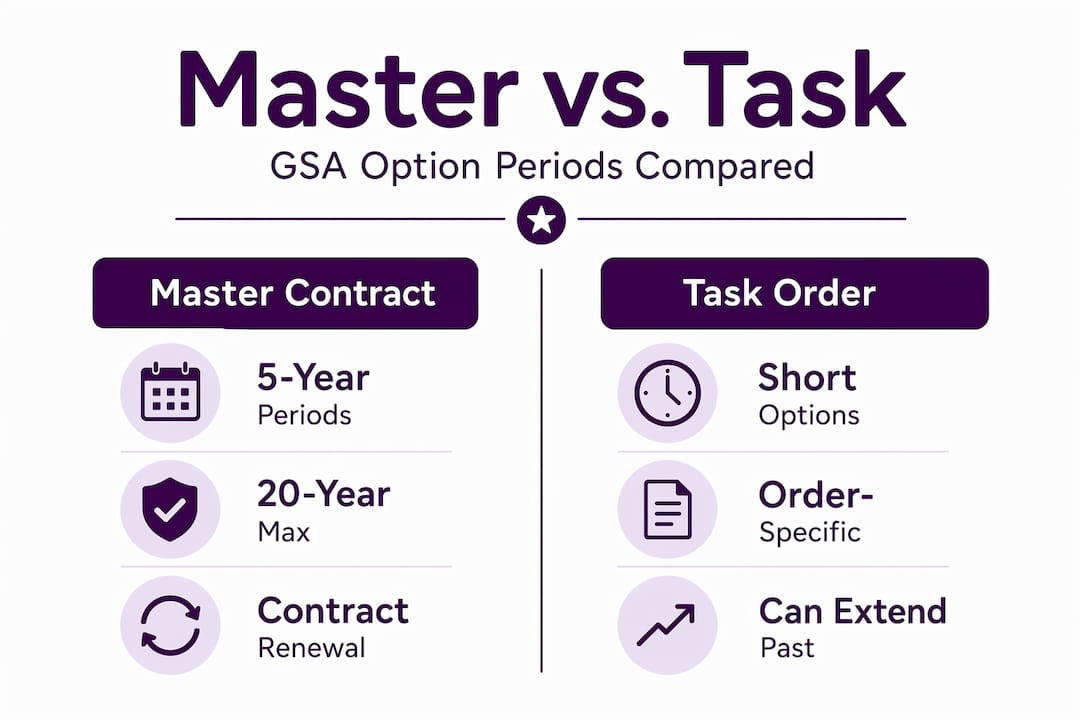
The table below clarifies the key differences:
| Feature | Master contract options | Task order options |
|---|---|---|
| Duration increment | 5-year periods | Varies by task order |
| Maximum life | Up to 20 years | Cannot exceed master contract term |
| Extension beyond master term | Not applicable | Up to 6 months under FAR 52.217-8 |
| Governing authority | GSA Contracting Officer | Ordering agency CO |
| Automatic exercise | No | No |
Task order option periods can extend up to six months beyond the master contract’s expiration date under FAR 52.217-8, but this is not a free pass. The task order cannot run longer than the overall master contract performance period allows, and the extension must be formally exercised by the ordering agency.
Think of it this way. Your master contract is the permission slip that allows agencies to issue task orders to you. If the master contract expires, that permission disappears. Task order extensions under FAR 52.217-8 exist to give ordering agencies a short runway to close out active work, not to substitute for renewing the master contract itself.
Task order option periods have unique rules and should never be treated as a workaround if your master contract renewal is in trouble. Address the master contract first.
Best practices for securing your next option period
Success with GSA contract extensions is mostly about consistency, not heroics. The contractors who keep their schedules decade after decade are not doing anything magical. They are doing the basics well, every single year.
Here is what that looks like in practice:
- Monitor your renewal deadline actively. Build an internal tracking system so the 12-month mark never sneaks up on you. A shared team calendar works fine. The key is accountability.
- Stay current on your GSA Advantage! pricelist. An outdated pricelist is both a compliance violation and a marketing problem. Agencies looking at your schedule expect current information.
- Track your sales against the minimum threshold quarterly. If you are falling behind mid-period, you have time to adjust your marketing and outreach before renewal comes up. Review these contract maintenance steps regularly to stay ahead.
- Avoid Price Reduction Clause violations. Any time you lower your commercial prices, check your GSA contract terms to determine whether a corresponding adjustment is required. The Price Reduction Clause can catch contractors off guard during renewals if commercial pricing changes went undocumented.
- Build a relationship with your CO before renewal season. One of the most underrated best practices for GSA contracts is simply staying visible to your CO throughout the contract life, not just when renewal is approaching.
- Document everything. Keep records of every communication, modification, and sales report. When renewal comes up, you want a clean, complete file that makes the CO’s review easy.
Pro Tip: If you are just starting out, a review of the GSA contract acquisition process will give you the foundational understanding that makes option period management much clearer from day one.
My perspective on what contractors actually get wrong
I have worked with a lot of contractors navigating GSA renewals, and the pattern I see most often is not incompetence. It is complacency. Contractors land their initial award, start generating some federal revenue, and then treat the contract like a utility that will just keep running. They stop paying close attention.
The wake-up call usually comes when a CO sends a notice and the contractor realizes they have six weeks to produce documentation they should have been maintaining for years. At that point, they are playing catch-up in a process that rewards preparation.
What I have learned is that the contractors who genuinely understand GSA option period guidelines treat each 5-year period as a new chapter. They revisit their pricing. They update their capabilities. They ask whether the contract still fits their business model or whether modifications make sense. That mindset keeps contracts alive and revenue growing.
The other thing I want to be direct about is the funding issue. I have seen contractors do everything right and still not get their option exercised because of a continuing resolution or a budget freeze. That is the reality of federal contracting. The answer is not to work harder on compliance. The answer is to hold your GSA schedule as part of a broader federal sales strategy, not the whole thing.
Treat every option period as an opportunity you have to earn, not a formality you have to complete.
— Josh
Get expert support for your next renewal
If your option period is coming up in the next 12 to 18 months, now is the time to get organized. The documentation requirements, pricing reviews, and CO communications involved in a GSA renewal are manageable with the right support, but they are easy to mishandle when you are running a business at the same time. Gsascheduleservices specializes in helping small and mid-sized businesses prepare for exactly this. From compliance checks and updated subcontracting plans to CO liaison support and pricing reviews, the team handles the details so you can focus on delivering results. Start with a free discovery session to map out your renewal timeline and identify any gaps before they become problems.
FAQ
What is a GSA contract option period?
A GSA contract option period is a formal extension of your existing contract that the government must actively choose to exercise. GSA MAS contracts include three 5-year option periods after the initial 5-year base period, for a maximum 20-year contract life.
How long before expiration should I start the renewal process?
For MAS contracts, the renewal process typically begins 7 to 12 months before the current period expires. Non-MAS contracts have a shorter review window of 60 to 90 days before expiration.
Can the government decline to exercise my option even if I perform well?
Yes. Budget constraints and funding issues can prevent an option exercise even when a contractor has a strong performance record. Agency appropriations and continuing resolutions are factors entirely outside contractor control.
What is the difference between task order options and master contract options?
Master contract options extend the GSA Schedule itself in 5-year increments up to 20 years. Task order options govern individual work orders and can extend up to six months beyond the master contract term under FAR 52.217-8, but cannot substitute for a master contract renewal.
What documents do I need to submit during a GSA option renewal?
You typically need an updated Commercial Sales Practices form (CSP-1), a refreshed Small Business Subcontracting Plan, current SAM.gov registration, and sales documentation. Review the renewal steps for a complete list based on your contract type.
Recommended
- Don’t Lose Your GSA Contract | GSA Contract Cancellation
- GSA Contract changes from 2019 to 2020
- GSA Contract Eligibility & Return on Investment
- GSA Multiple Award Schedule – Solicitation 006 sneak peek (210419)