

Being trade agreements act compliant means every product you offer under a federal contract must originate in the United States or a country designated under the Trade Agreements Act (TAA), as defined by the Federal Acquisition Regulation (FAR). This rule is not a pricing preference or a tiebreaker. It is an eligibility requirement, and failing it can cost you your contract. For business owners and government contractors pursuing GSA Multiple Award Schedule (MAS) opportunities, understanding the TAA’s origin rules, updated 2026 thresholds, and certification requirements is the difference between winning federal business and being disqualified before the evaluation even begins.
What does “trade agreements act compliant” mean for federal contracts?
TAA compliance is the legal obligation, rooted in 19 U.S.C. § 2512 and implemented through FAR subpart 25.4, requiring that end products offered under covered federal contracts be either U.S.-made or substantially transformed in a designated country. The GSA, the Department of Defense, and virtually every civilian agency apply this rule to contracts above specific dollar thresholds. Understanding trade compliance at this level means knowing three things: which contracts are covered, which countries qualify, and whether your product meets the origin standard.
Designated countries fall into four categories under FAR 25.003: World Trade Organization Government Procurement Agreement (WTO GPA) members, countries with U.S. Free Trade Agreements (FTAs), Caribbean Basin countries, and least-developed countries. Canada, Germany, Japan, South Korea, and the United Kingdom are among the most commercially significant WTO GPA members. Mexico and Australia qualify through FTAs. China, India, and Russia are not designated countries, which matters enormously for electronics, tools, and industrial supplies sourced from those markets.

TAA compliance is an eligibility rule, not a pricing preference, for what end products contractors can offer under federal contracts. That distinction trips up more contractors than any other single misconception in federal procurement.
What are the updated TAA thresholds and designated countries in 2026?
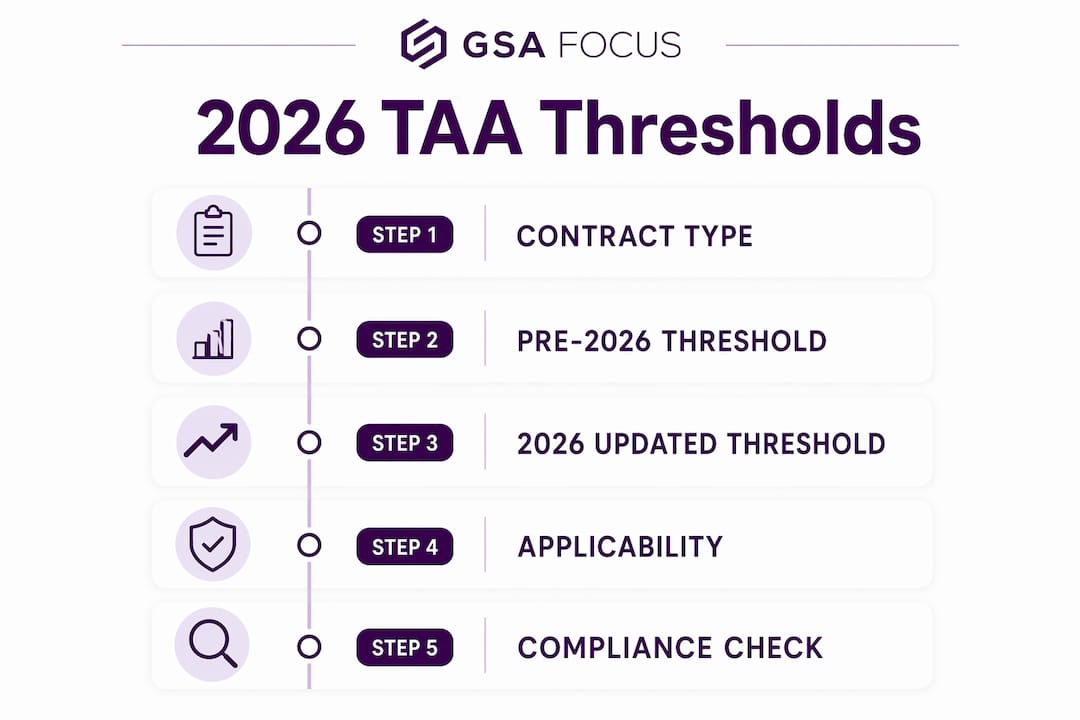
The 2026 FAR threshold updates revised the dollar amounts that trigger TAA applicability, effective March 13, 2026, aligning U.S. procurement rules with revised WTO GPA and FTA commitments. These changes affect both supply contracts and construction contracts under FAR subpart 25.4.
| Contract type | Pre-2026 threshold | 2026 updated threshold |
|---|---|---|
| Supplies and services (WTO GPA) | $183,000 | $191,000 |
| Construction (WTO GPA) | $7,032,000 | $7,358,000 |
| FTA partner supplies | Varies by partner | Updated per partner FTA |
| Least-developed countries | No threshold | No threshold |
The practical implication: if your contract value sits just below the old threshold but above the new one, your TAA obligations just changed. Contractors who rely on static internal tables rather than live FAR references are the most exposed. Updating internal TAA applicability logic is critical to avoid certification errors when thresholds shift.
The TAA and the Buy American Act (BAA) are related but distinct. The BAA applies to lower-value contracts and generally requires U.S.-made products with U.S. components. The TAA, which applies above the thresholds above, replaces the BAA’s domestic preference with a broader designated-country standard. You cannot substitute one for the other, and treating them as interchangeable is a common and costly mistake.
Pro Tip: Bookmark FAR 25.003 directly at acquisition.gov and check it before every new solicitation. Threshold tables in third-party guides go stale; the FAR does not.
How does substantial transformation affect TAA compliance determinations?
Substantial transformation is the legal test that determines a product’s country of origin for TAA purposes. A product is considered to originate in the country where it was substantially transformed into a new and different article of commerce, with a distinct name, character, and use. This standard comes from U.S. Customs and Border Protection (CBP) case law and is incorporated by reference into FAR compliance determinations.
The most important thing to understand: origin depends on where a product gains a new name, character, or use, not where it was shipped from or where final assembly occurred. A laptop assembled in Ireland from Chinese components is not automatically Irish-origin. If the components arrive as functional subassemblies and the Irish facility only installs them in a chassis, that is likely not substantial transformation. If the Irish facility performs circuit board integration, firmware programming, and quality testing that creates a commercially distinct product, that may qualify.
Common scenarios where contractors get this wrong:
- Electronics: Buying finished circuit boards from a non-designated country and adding a housing in a designated country does not transform the product.
- Medical supplies: Repackaging syringes or gloves in the U.S. from Chinese stock does not change their origin.
- Hand tools: Attaching handles to imported tool heads in a U.S. warehouse is assembly, not transformation.
- Software-loaded devices: Loading proprietary software onto imported hardware can qualify as transformation if it creates a product with a fundamentally different commercial use.
Pro Tip: Build an evidence file for every product you certify as TAA compliant. Include supplier declarations, manufacturing process descriptions, CBP binding rulings if available, and photos of the production steps. Documenting manufacturing steps and locations is your primary defense if a contracting officer or inspector general questions your origin claim.
What are the practical steps to demonstrate and maintain TAA compliance?
Compliance with trade agreements is a process, not a one-time certification. The following workflow reflects best practices aligned with FAR guidance for contractors selling on GSA MAS and other covered vehicles.
Determine whether TAA applies. Check the contract’s dollar value against current FAR thresholds. Confirm whether the solicitation includes FAR clause 52.225-5 (Trade Agreements) and 52.225-6 (Trade Agreements Certificate). If both are present, TAA applies.
Identify the country of origin for each end product. Work with your suppliers to confirm where each product was manufactured or substantially transformed. Do not rely on country-of-origin labels alone. Those labels reflect customs requirements, not necessarily FAR definitions.
Verify designated country status. Cross-reference each origin country against the current designated country list in FAR 25.003. This list changes when new FTAs take effect or WTO GPA membership shifts.
Collect supplier certifications and supporting documentation. Obtain written origin declarations from each supplier. For products with complex supply chains, request CBP binding rulings or manufacturer affidavits describing the transformation process.
Complete FAR 52.225-6 accurately. FAR 52.225-6 mandates a Trade Agreements Certificate certifying the origin of all offered end products. List every product and its origin. Do not leave fields blank. Blank or incomplete FAR certifications create compliance risk and legal exposure.
Maintain records by SKU and product line. Keep your evidence file organized at the product level, not just the contract level. When you add new products to a GSA schedule, repeat the origin verification before listing them.
Train your sales and procurement teams. Sales staff who quote products without checking TAA status create liability. Procurement staff who switch suppliers without updating origin records create the same risk. Both need to understand the common TAA compliance mistakes that trigger enforcement.
Monitor for supplier changes. If a supplier shifts manufacturing to a non-designated country, your certification becomes inaccurate the moment that change occurs. Build supplier change notifications into your procurement contracts.
What risks do contractors face for TAA non-compliance on GSA MAS contracts?
Non-compliance with trade agreements regulations carries consequences that go well beyond a warning letter. GSA MAS contractors face a specific set of enforcement mechanisms because the schedule is a standing contract vehicle used by thousands of agencies simultaneously.
GSA Advantage allows contracting officers to flag noncompliant product listings related to TAA compliance, and agencies use supply chain data to cross-check certified origins against publicly available product information. If your GSA Advantage listing implies a non-designated country origin that contradicts your certified origin, you are required to correct it. GSA requires consistency between marketing and certified origins, and that requirement extends to product descriptions, photos, and manufacturer references on your schedule listing.
| Enforcement action | Trigger | Potential consequence |
|---|---|---|
| Product removal | Non-compliant listing on GSA Advantage | Immediate delisting of affected SKUs |
| Contract modification | Pattern of non-compliant offerings | Scope reduction or contract restructuring |
| Contract termination | Willful or repeated non-compliance | Full termination for default |
| False Claims Act liability | Knowingly false origin certifications | Treble damages and civil penalties |
| Suspension and debarment | Serious or systemic violations | Exclusion from all federal contracting |
The False Claims Act exposure deserves particular attention. Submitting a knowingly false TAA certification is not a paperwork error. It is a federal civil violation that carries penalties of up to three times the contract value plus per-claim fines. Courts have found contractors liable even when the false certification was made by a lower-level employee without executive knowledge, if the company lacked adequate compliance controls.
Pro Tip: Treat your GSA schedule as a living compliance artifact. Review your TAA compliance with your GSA contract every time you add products, change suppliers, or renew your contract period. A quarterly internal audit takes less time than responding to a contracting officer’s inquiry.
Key takeaways
TAA compliance is a mandatory eligibility requirement for federal contracts above FAR thresholds, and the 2026 updates make accurate, current documentation more critical than ever.
| Point | Details |
|---|---|
| TAA is an eligibility rule | Products must originate in the U.S. or a designated country; non-compliant products cannot be offered regardless of price. |
| 2026 thresholds changed | The WTO GPA supply threshold rose to $191,000 effective March 13, 2026; update your internal applicability logic now. |
| Substantial transformation is the origin test | Origin is where a product gains a new name, character, and use, not where it ships from or gets packaged. |
| Documentation is your defense | Maintain supplier declarations, manufacturing records, and CBP rulings organized by SKU for every certified product. |
| False Claims Act risk is real | Knowingly false origin certifications expose contractors to treble damages and potential debarment from federal contracting. |
Why proactive TAA compliance is the only strategy that works
I have worked with enough federal contractors to say this plainly: the ones who treat TAA compliance as a checkbox exercise are the ones who call us in a panic after a contracting officer flags their schedule. The ones who build compliance into their procurement workflow from day one rarely have problems.
The 2026 FAR threshold changes are a good example of why reactive compliance fails. Contractors who had not updated their internal applicability tables since the last threshold revision were certifying incorrectly for weeks before they realized the rules had changed. That is not a legal gray area. That is a false certification sitting on a live federal contract.
What I find most underappreciated is the marketing alignment requirement. Your GSA Advantage listings, your catalog descriptions, your product photos. All of it must be consistent with your certified origin. I have seen contractors with perfectly accurate FAR certifications get flagged because their product page said “Made in China” for a product they had certified as U.S.-origin after transformation. The fix was simple, but the scrutiny it attracted was not.
The cost of building a solid evidence file before you submit a bid is measured in hours. The cost of defending a False Claims Act investigation is measured in years and dollars. That math is not complicated.
— Josh
How Gsascheduleservices can help you stay TAA compliant
TAA compliance is one of the most technically demanding parts of holding a GSA Schedule contract, and it does not get simpler as your product catalog grows. Gsascheduleservices works directly with small and medium-sized businesses to build the compliance infrastructure that keeps federal contracts active and audit-ready. From GSA schedule consultation covering origin verification and certification support to ongoing compliance monitoring as your supplier base evolves, the team at Gsascheduleservices handles the documentation work so you can focus on winning and delivering contracts. If you are preparing a new schedule submission or reviewing an existing one for TAA exposure, a discovery call is the fastest way to identify gaps before they become enforcement actions.
FAQ
What does it mean to be trade agreements act compliant?
Being trade agreements act compliant means every end product you offer under a covered federal contract is made in the United States or substantially transformed in a designated country as defined by FAR 25.003. It is a mandatory eligibility requirement, not a preference.
Are trade agreements mandatory for all federal contracts?
TAA obligations apply only to contracts above specific dollar thresholds set in FAR subpart 25.4. The 2026 update set the WTO GPA supply threshold at $191,000; contracts below applicable thresholds are governed by the Buy American Act instead.
What countries are designated under the Trade Agreements Act?
Designated countries include WTO GPA members such as Germany, Japan, South Korea, and the United Kingdom; FTA partners such as Canada, Mexico, and Australia; Caribbean Basin countries; and least-developed countries. China, India, and Russia are not designated.
What happens if a GSA contractor offers a non-TAA-compliant product?
GSA can remove the product from GSA Advantage, modify or terminate the contract, and refer the matter for False Claims Act investigation if the certification was knowingly false. Consequences scale with the severity and intent of the violation.
How do I prove substantial transformation for a product?
Maintain an evidence file that includes supplier declarations, a written description of each manufacturing or processing step, the location where each step occurs, and any CBP binding rulings. This documentation is your primary defense during a compliance review.
Recommended
- Government Contract Opportunities 2026: SME Guide
- Which Countries are Trade Agreement Act Compliant End Products?
- What does my company need to do to become TAA compliant? A Comprehensive Guide
- How and Why to assure TAA Compliance with your GSA Contract