

Most small businesses approaching their first GSA bid assume that a thin federal contracting history means automatic disqualification. That assumption is wrong, and it costs companies real opportunities. The role of past performance in GSA bids is more nuanced than a simple pass/fail check. Evaluators look at relevance, recency, and how well you document what you’ve done. Whether you have a full CPARS history or zero federal contracts, understanding exactly how this factor works changes how you compete and how you win.
Table of Contents
- Key takeaways
- The role of past performance in GSA bids and the FAR framework
- How evaluators actually assess your past performance
- Addressing limited past performance: what the FAR actually says
- Preparing a competitive past performance package
- My honest take on past performance strategy
- How Gsascheduleservices helps you build a stronger GSA submission
- FAQ
Key takeaways
| Point | Details |
|---|---|
| Neutral ratings protect new bidders | Contractors without relevant past performance receive a neutral rating, not a penalty, under FAR rules. |
| Relevance outweighs volume | Evaluators care more about whether your examples match the solicitation scope than how many contracts you’ve held. |
| CPARS records carry significant weight | Well-documented CPARS reports create objective evidence that generic references cannot match. |
| New contractors have real pathways | Subcontracting and the SBA Mentor-Protégé program let newer firms build documented performance history. |
| Tailored submissions score better | Mapping your examples directly to solicitation Sections L and M makes evaluator scoring faster and more favorable. |
The role of past performance in GSA bids and the FAR framework
Past performance in federal contracting is not just a reference check. It is a governed evaluation process with specific rules, documentation standards, and rating systems. The primary regulation is FAR Subpart 42.15, which covers how contractor performance information is collected, maintained, and used. Under this framework, evaluations include both numerical ratings and written narratives that describe how a contractor performed against technical requirements, cost targets, schedule commitments, and management expectations.
The GSA Multiple Award Schedule (MAS) solicitation incorporates past performance as one of several formal evaluation criteria. When you submit a MAS offer through eOffer, you are required to provide past performance documentation aligned with the specific Special Item Numbers (SINs) you are pursuing. This is not a generic package you recycle across applications.
There is an important distinction that many contractors miss. Past performance can function as both an evaluation factor and a responsibility determination. As an evaluation factor, it contributes to your competitive score. As a responsibility check, negative performance records can affect your basic eligibility for award, separate from how you score against other bidders. Both dimensions matter.
Past performance evaluations use a five-level rating system covering categories including technical quality, cost control, management, and compliance with socio-economic goals. Each rating is backed by a narrative that reflects contract complexity and size. A rating without context tells evaluators very little. The narrative is where your credibility is built or lost.
Pro Tip: Request copies of your CPARS reports before starting any GSA proposal. Evaluators will see them. You need to know what they say and address any gaps in your narrative proactively.
How evaluators actually assess your past performance
Knowing that past performance matters is one thing. Understanding what evaluators actually look for when they review your submission is where strategy begins.
The single most important factor is relevance. Evaluators prioritize recent and relevant contracts aligned with the solicitation’s scope and type. A ten-year-old contract for services completely unrelated to your target SIN does almost nothing for your score. An evaluator reading your submission is mentally asking one question: “Does this contractor’s history make me confident they can do this specific job?” Every example you include needs to answer that question directly.

Recency is the second filter. The standard preference is performance within the past three years. Work completed four or five years ago may be considered, but it carries less weight. If your best relevant examples are older, you can still include them, but you should pair them with current references or supplemental evidence showing continued capability.
Here is how the main documentation types stack up in practice:
| Documentation type | Strength | Limitation |
|---|---|---|
| CPARS reports | Objective, government-verified, hard to dispute | Only available for federal contracts above threshold |
| Customer references and letters | Flexible, can cover commercial work | Subjective, easier for evaluators to discount |
| Past performance narratives | You control the framing and emphasis | Only as strong as the specificity and evidence you provide |
| Commercial contract examples | Useful when federal history is limited | Must be clearly tied to the relevant scope |
One critical tactic most contractors underuse: crosswalking. Mapping contract examples to solicitation requirements means you are showing evaluators exactly where your past work aligns with what they are looking for. You are not making them guess. You are doing the analysis for them, which makes scoring faster and more favorable.
Pro Tip: When using commercial contracts as past performance evidence, include specific metrics: dollar value, contract duration, client type, and measurable outcomes. Vague descriptions get discounted quickly.
- Pull all relevant federal contract records from SAM.gov and USAspending.gov before writing a single word of your submission.
- Sort your contracts by recency first, then by relevance to the SIN you are pursuing.
- For each example, document the scope, dollar value, period of performance, and any available CPARS ratings.
- Note areas where your performance was strong and where it could be perceived as a gap.
- Build your narrative around the strongest and most relevant examples, not the most impressive-sounding ones.
Addressing limited past performance: what the FAR actually says
Here is the fact that should change how newer contractors approach GSA bids. Under FAR 15.305(a)(2)(iv), offerors without relevant past performance receive a neutral rating. They are neither favored nor penalized. This applies in negotiated procurements and gives contractors without significant federal history a genuine opportunity to compete.
A neutral rating does not mean you are invisible. It means your past performance score does not help you. Your job then is to make every other part of your proposal work harder.
“In negotiated procurements under FAR 15, contractors without past performance are neither favored nor penalized; they receive a neutral rating.” — FAR 15.305(a)(2)(iv)
So what does this mean practically?
- Strengthen your technical approach section to a level that compensates for the neutral past performance rating.
- Price competitively and justify your pricing structure with specificity and transparency.
- Use your management plan to demonstrate organizational maturity and delivery capability.
- Consider subcontracting with established prime contractors to gain documented past performance on federal projects.
- Explore the SBA Mentor-Protégé program, which allows small businesses to leverage a mentor’s past performance in joint venture bids.
The Mentor-Protégé approach is particularly powerful for businesses that have strong commercial experience but limited government contracting history. Pairing with an established federal contractor creates documented past performance and opens competitive doors that would otherwise require years to unlock organically.
Another often-overlooked option: subcontractor past performance. If you have performed work as a subcontractor on federal contracts, that experience can be cited and documented in your GSA proposal. Many contractors do not realize this counts. Past performance gaps in GSA applications are far more manageable when you account for all the performance history you actually have, not just prime contract awards.
Preparing a competitive past performance package
Knowing what evaluators want and actually putting together a submission that delivers it are two different challenges. Here is a practical sequence to follow.
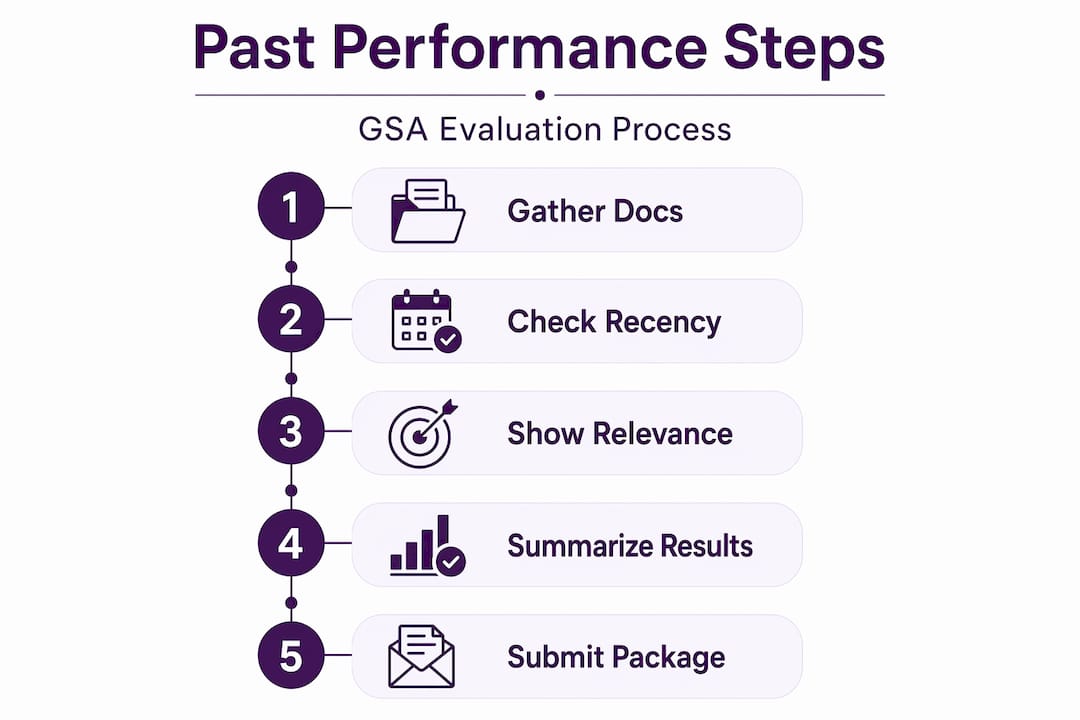
Start at SAM.gov and USAspending.gov. Search your company’s DUNS or UEI number to pull all prior federal contract awards. Note contract numbers, agencies, dollar values, and periods of performance. These are the raw materials for your submission.
Pull your CPARS reports. Request your full history through your contracting officer or through the CPARS portal. Review every rating and narrative. If a report contains inaccurate information, you have the right to submit a contractor comment. Do that before your proposal is due.
Build past performance cards. For each relevant contract, create a one-page summary covering the agency, contract number, dollar value, period of performance, scope description, CPARS ratings if available, and a point of contact reference. This format makes evaluation easy and looks professional.
Crosswalk to the solicitation. Review Sections L and M of the GSA MAS solicitation carefully. Tailoring narratives to evaluation criteria is one of the highest-value actions you can take. Create a simple table showing which past performance examples address which evaluation factors. Include it in your submission.
Follow up and use debrief feedback. If you do not win, request a debrief. Evaluators will tell you where your past performance package was weak and what would have strengthened it. That feedback is more valuable than any guide, because it is specific to your situation and the agency you are targeting.
The GSA contract acquisition process has specific documentation requirements that catch many first-time applicants off guard. Understanding the format expectations before you start writing saves significant rework.
My honest take on past performance strategy
I’ve reviewed dozens of GSA bid submissions across a range of company sizes and industries, and the single most consistent mistake I see is treating past performance as a box-checking exercise. Contractors list their contracts, attach a few ratings, and move on. That approach leaves points on the table every single time.
What actually tips decisions is the quality of the narrative and how clearly it maps to what the evaluator needs to score. I’ve seen smaller contractors with modest federal histories outscore larger firms simply because their submissions were specific, organized, and directly connected to the solicitation’s evaluation language. Volume of contracts is nearly irrelevant if none of them clearly address the scope.
I’ve also watched contractors panic over neutral ratings due to lack of past performance. The panic is understandable but misplaced. A neutral rating is not a wound. It is a clean slate. What you do with your technical approach and pricing after that is entirely within your control.
My honest advice: monitor your CPARS history the way you monitor your financials. Most contractors only look at their CPARS when they are about to submit a proposal, which is far too late to correct anything. Reviewing contractor performance records regularly means you catch problems early and address them proactively. That discipline separates contractors who build reputations from those who are constantly surprised by their own ratings.
— Josh
How Gsascheduleservices helps you build a stronger GSA submission
Understanding the gsa past performance process is one thing. Executing it correctly under real submission deadlines is another challenge entirely. Gsascheduleservices works directly with small and medium-sized businesses to prepare GSA Schedule proposals that meet evaluation standards from the start. The team helps you locate and organize your performance records, structure your past performance cards, and align your documentation with solicitation requirements in Sections L and M.
If you are dealing with common GSA rejection issues or starting your first MAS offer without a deep federal contracting history, expert guidance makes a measurable difference in your submission quality and your chances of award. Explore how Gsascheduleservices can support your GSA bid from readiness assessment through final submission.
FAQ
What is the role of past performance in GSA bids?
Past performance is a formal evaluation factor in GSA MAS solicitations, assessed alongside technical approach and price. Evaluators review the recency, relevance, and documentation quality of your prior contracts to gauge your ability to perform the requested work.
Does having no past performance disqualify you from a GSA bid?
No. Under FAR 15.305(a)(2)(iv), contractors without relevant past performance receive a neutral rating rather than a negative one, meaning they are neither penalized nor advantaged. Strong technical and price proposals can still result in a competitive bid.
How far back can past performance examples go for a GSA application?
GSA evaluators generally prefer performance within the past three years, as recency is a primary relevance filter. Older examples may be included as supplemental evidence but typically carry less weight in the evaluation.
What is a CPARS report and why does it matter for GSA bids?
A CPARS report is a government-generated contractor performance assessment covering technical quality, schedule, cost control, and management. Well-documented CPARS ratings provide objective evidence that customer references alone cannot replicate, making them highly influential in GSA bid evaluations.
Can commercial contracts count as past performance in a GSA proposal?
Yes. Commercial contract experience can be used as past performance evidence, particularly for contractors with limited federal history. Include specific metrics such as dollar value, scope, client type, and measurable outcomes to give evaluators enough detail to assess relevance.
Recommended
- (Infographic) 25 Reasons GSA Contracts are Rejected
- Avoid Rough Seas with your GSA Contract
- The Most Common Mistakes Companies Make When Pursuing a GSA Schedule Contract
- How to Price Your GSA Services and Win More GSA Awards