

A small business size standard is the numeric cutoff, set by the SBA for each NAICS code, that determines whether your company qualifies as “small” for federal contracting and related programs. It’s measured either by average annual receipts or number of employees, and the number that applies to you depends entirely on the NAICS code tied to a specific solicitation, not on your gut sense of whether your company feels small.
Here’s what to do right now if you need an answer fast:
- Find the NAICS code listed on the solicitation or the one that matches your primary business activity.
- Run that code through the SBA Size Standards Tool or check it against the official SBA Table of Size Standards.
- Compare your average annual receipts or employee count, including affiliates, against that threshold.
- If you’re registered in SAM.gov, confirm your profile reflects your current size status under the applicable code.
That’s the whole exercise in miniature. The rest of this guide covers the details that trip people up: how affiliation changes your numbers, how to calculate receipts and employees the way the SBA actually does it, and what happens if you get it wrong.
Key Takeaways
Confirming your small business size standard requires checking the correct NAICS code, including every affiliate’s receipts and employees, and rechecking after any ownership change or SBA rule update.
| Point | Details |
|---|---|
| Confirm the right NAICS code | Use the code on the solicitation itself, not a code from a prior contract or your own guess. |
| Check the official tool and table | Run your NAICS code through the SBA Size Standards Tool or the current Table of Size Standards. |
| Include affiliates in every calculation | Aggregate receipts and employees from any entity that controls or is controlled by your firm. |
| Update SAM.gov after any rule change | SAM does not auto-update; you must edit your profile once a new size standard takes effect. |
| Get expert review for complex ownership | Gsascheduleservices offers NAICS mapping, affiliation review, and documentation support for GSA Schedule applicants. |
Table of Contents
- What a Small Business Size Standard Means for Contracting
- How the SBA Measures Size: Receipts vs. Employees
- Affiliation and Aggregation: Whose Numbers Count?
- Finding Your NAICS Code and the Matching Size Standard
- Worked Examples: Calculating Receipts and Employees
- When Size Standards Change: Review Cycles and What to Do
- Penalties for Misrepresenting Your Size Status
- When to Bring in a Size Specialist or Consultant
- What Practitioners Wish More Business Owners Knew
- How Gsascheduleservices Supports Your Size Standard Analysis
- Where to Verify Size Standards Yourself
- Sources
- FAQ
What a Small Business Size Standard Means for Contracting
“Small” is a legal classification, not a description. The SBA assigns a size standard to every NAICS code, and a company can be genuinely small in the way most people use the word while still being classified as “other than small” for federal contracting purposes under a specific code. A 200 person engineering firm might be small under one NAICS code and large under another, depending on which code the contracting officer assigns to the solicitation.
Size standards use one of two measurements. Most manufacturing industries cap out at an employee count, commonly 500 employees, while many non-manufacturing and service industries use average annual receipts, often expressed in millions of dollars. There’s no universal number. A janitorial services firm and an aircraft manufacturer are held to entirely different yardsticks because their industries scale differently.
This classification touches more than one program. Small business set-asides are the most obvious use, but size standards also govern:
- Eligibility for SBA-guaranteed loans and surety bond programs.
- Subcontracting plan requirements on large prime contracts.
- Eligibility for a GSA Multiple Award Schedule under small business set-aside provisions.
- Access to socioeconomic certifications (8(a), HUBZone, WOSB, VOSB) that layer additional criteria on top of the base size standard.
The three sources you’ll return to again and again are the Size Standards Tool, the Table of Small Business Size Standards, and 13 CFR Part 121, which contains the actual regulatory text behind every number in the table. Practitioners often point out that firms get into trouble by treating the NAICS code on last year’s contract as permanent, when the code that governs eligibility is the one tied to the current solicitation.
How the SBA Measures Size: Receipts vs. Employees
The SBA doesn’t eyeball your company. It applies specific formulas defined in 13 CFR Part 121, and the formula depends on whether your NAICS code uses a receipts-based or employee-based standard.
Section 121.104 governs average annual receipts. Receipts generally means total income plus cost of goods sold, pulled from federal tax returns, and averaged over a set period. Section 121.106 governs employee counts, which include full-time, part-time, temporary, and leased workers, averaged over pay periods rather than a single snapshot.
- Determine your measurement period. Receipts are typically averaged over the firm’s most recently completed five fiscal years. Employees are averaged over the number of pay periods in the preceding 24 months.
- Pull the right receipts figure. Use total income (or gross receipts) plus cost of goods sold, as reported on your tax returns, not internal management figures that might net out differently.
- Count every employee category. Full-time, part-time, and temporary staff all count. So do employees leased from a staffing firm if you have control over their work.
- Include affiliates before you finalize the number. This step catches more businesses off guard than any other, and it gets its own section below.
- Compare against the table entry for your NAICS code. If your average falls at or under the threshold, you’re small under that code.
| Measurement basis | What’s counted | Averaging period |
|---|---|---|
| Average annual receipts | Total income plus cost of goods sold, per tax returns, including affiliates | Most recently completed 5 fiscal years |
| Number of employees | Full-time, part-time, temporary, and leased staff, including affiliates | Pay periods over the preceding 24 months |
Firms younger than the full measurement window use adjusted formulas rather than skipping the calculation entirely, since a business with only two years of receipts history still needs a defensible number for self-certification.
Affiliation and Aggregation: Whose Numbers Count?
Affiliation is where otherwise careful business owners get their size determination wrong. The rule is simple to state and easy to miss in practice: if another entity can control your company, or you can control another, their receipts and employees typically get added to yours, even if that control is never actively exercised.
Control can come from several directions:
- Common ownership. If one person or entity owns a controlling interest in two firms, both firms’ numbers usually get combined.
- Shared management. Overlapping officers or a shared board across separate companies can establish affiliation even without shared ownership.
- Contractual control. Exclusive licensing agreements, management contracts, or supply arrangements that give one party outsized influence over another’s operations can trigger affiliation.
- Investor control thresholds. A minority investor with veto rights over key decisions, board seats, or supermajority protections can be deemed to have control despite owning less than half the company.
- Joint ventures. Certain joint venture arrangements aggregate the partners’ numbers depending on the structure and the specific exception that applies.
A recent acquisition is a classic trigger point. If a private equity firm takes a controlling stake in your company, that firm’s other portfolio companies in the same or related industries can suddenly become affiliates whose receipts and employees count toward your total, sometimes pushing a comfortably small firm over the threshold overnight.
Pro Tip: The single most common mistake we see is a business owner who calculates size using only their own entity’s tax returns and employee roster, never checking whether a parent company, sister company, or controlling investor needs to be folded into the math. Document your ownership structure and any board or investor agreements before you self-certify, not after a competitor files a protest.
Finding Your NAICS Code and the Matching Size Standard
Getting the right answer starts with getting the right code. Here’s the process.
- Check the solicitation first. If you’re responding to a specific contract opportunity, the contracting officer has already assigned a NAICS code to that solicitation. That’s the code that governs your eligibility for that bid, regardless of what code you use for other purposes.
- Identify your primary NAICS code if no solicitation applies. Use the NAICS search tool to match your primary business activity, cross-checking against how you classified your business on federal tax filings and in SAM.gov. A solid NAICS code strategy makes future GSA and set-aside bids far less error-prone.
- Run the code through the Size Standards Tool. The tool takes a NAICS code and returns the applicable size standard directly, which is faster than scanning the full table by hand.
- Cross-reference the official table for confirmation. The Table of Small Business Size Standards lists the effective date, so you can confirm you’re looking at current numbers rather than an outdated cached version.
- Verify the effective date against the eCFR or Federal Register. Size standards change periodically, and a table you downloaded eighteen months ago might not reflect the current threshold.
- Use the dataset if you track multiple codes. Firms bidding across several NAICS codes can pull the SBA’s public dataset and API in JSON or XLSX format to automate checks rather than manually looking up each code.
If your firm operates in more than one primary industry, correctly mapping NAICS codes to GSA SINs matters just as much for schedule eligibility as it does for straightforward size determination.
Worked Examples: Calculating Receipts and Employees
Numbers make this concrete. Here are two scenarios that mirror what most firms actually run into.
Example 1: A consulting firm with three years of receipts history.
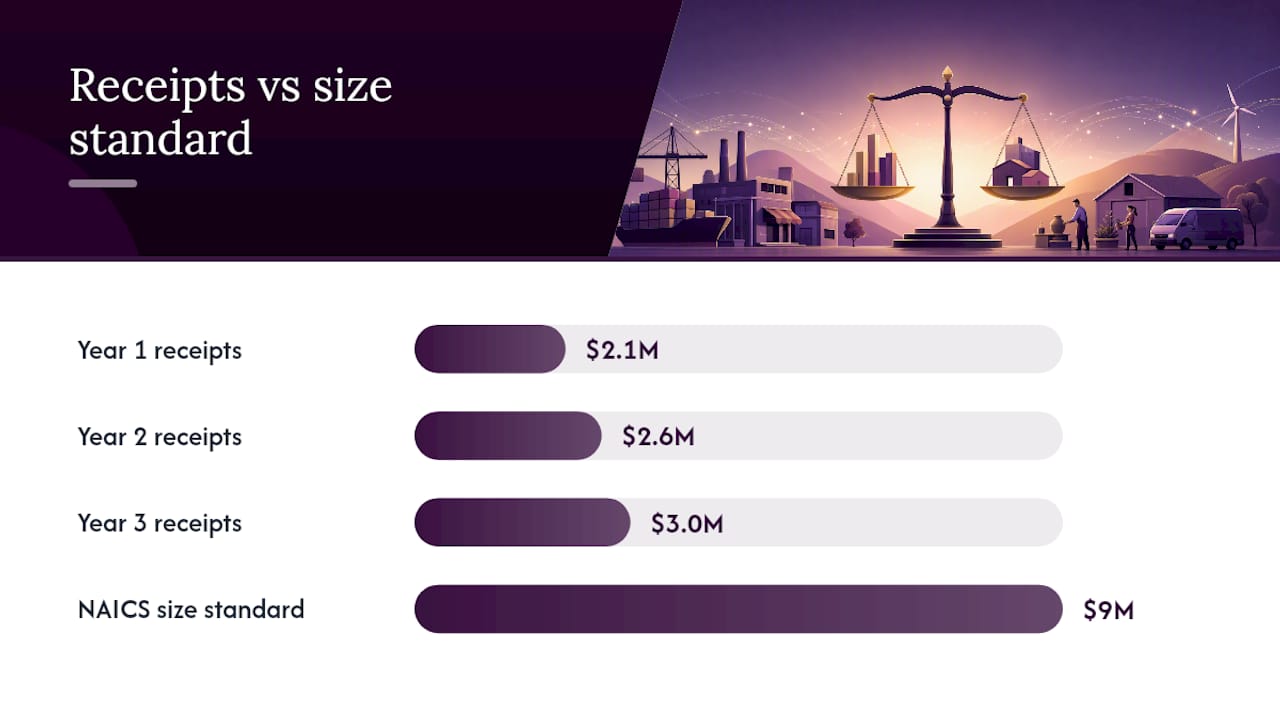
Say your firm has receipts of $2.1 million, $2.6 million, and $3.0 million over its three completed fiscal years, and your NAICS code carries a $9 million size standard. With fewer than five years of history, the SBA doesn’t simply average the years you have and call it done. It applies an adjusted formula that accounts for the shorter operating history, so a young, fast-growing firm isn’t unfairly penalized for a short track record, nor unfairly credited for it either. The mechanics of that adjustment matter less than the habit it demands: keep clean, tax-return-backed receipts figures for every year you’ve operated, because you’ll need them the moment a size standard question comes up.
Example 2: A specialty trade contractor measured by employees.
A firm with a NAICS code carrying a 500 employee standard needs to average headcount across the pay periods in the preceding 24 months, counting full-time, part-time, and any leased personnel from staffing agencies. A firm that runs lean most of the year but staffs up seasonally with temporary labor can’t exclude those workers just because they’re not permanent hires. If the same firm also has a minority stake in a related company that shares equipment or personnel, that entity’s headcount likely needs to be added in too, following the affiliation rules covered above.
| Scenario | Basis | Key rule to apply |
|---|---|---|
| Firm with under 5 years of receipts history | Average annual receipts | Adjusted formula for shorter operating history, not a straight average |
| Firm with fewer than 24 months of payroll data | Number of employees | Average over the pay periods actually available |
| Firm with a controlling investor or parent company | Either basis | Affiliate receipts and employees included regardless of active control |
Pro Tip: Keep quarterly payroll snapshots and annual tax-return receipts figures in one folder, updated as you file, rather than reconstructing them from memory when a contracting officer or size protest asks for documentation. Auditors and size specialists move faster when the paper trail already exists.
When Size Standards Change: Review Cycles and What to Do
Size standards aren’t permanent. The SBA’s Office of Size Standards reviews them periodically, and the agency has authority to propose adjustments to reflect inflation and shifting industry economics, which means the threshold that made you “small” last year might not hold this year, and vice versa.
- Watch for proposed rule changes. Significant revisions get published in the Federal Register before they take effect, giving the public a comment period.
- Note the effective date carefully. A proposed change and an effective change are two different things. The official table lists the actual effective date currently in force.
- Update your SAM.gov registration once a change takes effect. SAM does not automatically recalculate your size status when SBA updates a standard; your profile keeps showing the old classification until you go in and update it yourself.
- Reassess annually, not just when you notice a headline. Reviewing your size status once a year, or after any ownership change, catches problems before a bid deadline forces a rushed calculation.
Firms that treat their size status as a “set it and forget it” fact are the ones most likely to submit a bid with an outdated self-certification, which is a completely avoidable, entirely self-inflicted problem.
Penalties for Misrepresenting Your Size Status
Getting your size wrong on purpose, or carelessly, carries real consequences. 13 CFR § 121.108 addresses misrepresentation directly, and the penalties extend well beyond a slap on the wrist.
- Contract termination for the specific award in question.
- Civil penalties, which can include monetary damages tied to the value of the contract obtained under a false certification.
- Criminal penalties in cases involving deliberate false statements to a federal agency.
- Suspension or debarment from future federal contracting opportunities.
- Bid protests from competitors that can delay or unwind an award entirely, even when the misrepresentation was unintentional.
If you discover an error after the fact, whether it’s a missed affiliate or a stale NAICS code, the corrective path is straightforward: notify the contracting officer promptly, consult legal counsel or an SBA size specialist before responding formally, and document every remedial step you take. Contracting officers and the SBA distinguish between honest mistakes corrected quickly and patterns of careless or deliberate misrepresentation, and that distinction shapes how a case gets handled. Reviewing common reasons GSA contracts get rejected shows how often size and affiliation errors show up in real rejections, not just hypothetical ones.
When to Bring in a Size Specialist or Consultant
Some size determinations are genuinely simple: one entity, one NAICS code, no affiliates, stable ownership. Others are not, and pretending otherwise is how firms end up with a size protest on their hands.
- Recognize the complexity signals first. Recent acquisitions, minority investors with board seats, shared officers across companies, or joint venture arrangements all raise the odds that your size calculation involves more than your own books.
- Get a NAICS and affiliation review before you self-certify. A NAICS code consulting service can map your primary activity correctly and flag affiliation risks you might not have considered.
- Prepare documentation before you need it, not after. Tax returns, payroll records, ownership agreements, and investor documents should be organized and ready, since a size specialist or contracting officer will ask for exactly this evidence if a question arises.
- Get help with SAM.gov and self-certification mechanics. Updating a SAM profile correctly after a rule change, or certifying your size status through the proper steps, is easy to get wrong the first time.
- Time your review around bid deadlines. If a solicitation is imminent and you haven’t reviewed your size status in over a year, that’s the moment to move fast, not the moment to guess.
Gsascheduleservices provides exactly this kind of support for firms preparing GSA Schedule applications and ongoing compliance, including NAICS mapping, affiliation review, and documentation preparation, which shortens the runway between “I think we’re small” and “we can prove it.”
What Practitioners Wish More Business Owners Knew
Most size standard problems aren’t caused by dishonesty. They’re caused by owners who genuinely believe their own entity’s numbers are the whole picture, right up until a competitor’s protest or a contracting officer’s question reveals an affiliate nobody accounted for. The pattern shows up constantly: a founder brings on a strategic investor for growth capital, never thinks about size standards again, and two years later discovers that investor’s other portfolio companies just pushed them over the threshold on a contract they already won.
The fix isn’t complicated, but it does require treating size determination as an ongoing discipline rather than a one-time checkbox. Three things make the biggest difference in practice:
- Keep a running file of ownership and control agreements, updated every time an investor, board member, or ownership stake changes, so you’re never reconstructing affiliation history from memory under deadline pressure.
- Recheck your NAICS code against every new solicitation, rather than assuming the code that applied to last year’s contract still fits this year’s.
- Update SAM.gov the same week SBA publishes a size standard change, since a stale profile is an easy, entirely preventable protest target.
None of this requires a law degree. It requires the same discipline a good bookkeeper brings to monthly reconciliations, just applied to a different set of numbers.
How Gsascheduleservices Supports Your Size Standard Analysis
Working through affiliation rules, NAICS mapping, and receipts calculations while also assembling a GSA Schedule application is a lot to carry alone, and getting the size determination wrong can cost you the contract before you ever get to negotiate pricing. Gsascheduleservices handles the readiness assessment, NAICS and SIN mapping, affiliation review, and documentation preparation as part of full-service GSA Schedule support, so the size question gets answered correctly before it becomes a liability during negotiation or contract award.
The firm works with small and medium-sized businesses across industries pursuing GSA Schedule contracts, handling the paperwork and compliance details that eat up owner time and create the most room for costly mistakes. If you’re unsure whether your current size status holds up under a specific NAICS code, or you’ve had a recent ownership change you haven’t accounted for, request a discovery call to get a straight answer before you submit anything.
Where to Verify Size Standards Yourself
Every figure in this guide traces back to a small set of official sources, and bookmarking them saves time on every future bid.
- The SBA Size Standards Tool gives a quick, direct answer for a single NAICS code.
- The Table of Small Business Size Standards lists every NAICS code with its threshold and effective date in one document.
- The SBA size standards dataset and API supports bulk lookups for firms tracking multiple codes.
- 13 CFR Part 121 contains the full regulatory text behind receipts calculations, employee counts, affiliation, and penalties.
- The Census Bureau’s NAICS search tool helps confirm the correct code for your primary business activity.
- Industry benchmarking sources like Bizminer’s data on professional, scientific, and technical services or specialty trade contractors can help you sanity-check whether your revenue or headcount profile is typical for your NAICS code.
For direct questions that the tools and tables don’t fully resolve, the SBA’s Office of Size Standards maintains a network of size specialists who field exactly these inquiries, and reaching out before you self-certify is almost always cheaper than fixing a mistake after the fact.
Sources
- Get started with contracting – Small Business Administration
- SBA Table of Size Standards
- PART 121—SMALL BUSINESS SIZE REGULATIONS
- Small Business Size Standards – Dataset – U.S. Small Business Administration
- Size Standards Tool | U.S. Small Business Administration
FAQ
What Is the 20% Rule for SBA Size Standards?
There is no formal “20% rule” written into SBA’s size standard regulations; the applicable threshold is always the specific employee count or receipts figure listed for your NAICS code in the official table, not a flat percentage.
Is 500 Employees Always Considered Small Business?
No. Five hundred employees is a common cap for many manufacturing-related NAICS codes, but plenty of industries use different employee thresholds or revenue-based standards entirely, so you have to check your specific NAICS code rather than assume 500 applies universally.
How Do I Calculate My SBA Size Standard Status?
Average your annual receipts over your most recently completed five fiscal years, or average your employee count over the pay periods in the preceding 24 months, including any affiliates, then compare that number against the threshold listed for your NAICS code in the Table of Small Business Size Standards.
What Documentation Do I Need to Prove Small Business Status?
Federal tax returns showing total income and cost of goods sold, payroll records covering the relevant pay periods, and ownership or investor agreements that establish or rule out affiliation are the core documents a size specialist or contracting officer will want to see.
Can Gsascheduleservices Help Determine My Size Status?
Yes. Gsascheduleservices reviews NAICS classification, affiliation risk, and documentation as part of its GSA Schedule readiness support, which helps confirm your size status before it becomes an issue during a bid or contract negotiation.
Recommended
- What is federal procurement? A small business owner’s guide
- Guide to Becoming a Government Contractor: Your Path To Success
- How to Grow a Small Business Through a GSA Schedule
- Federal Government Procurement Forecast 2023 Guide