
Schedule 70 GSA no longer exists as a standalone contract. In 2020, GSA merged all 24 individual schedules into a single Multiple Award Schedule, with the old Schedule 70 becoming the IT Large Category under MAS. The term persists in conversation, and you will still hear contracting officers use it, but submitting a proposal that references “Schedule 70” by name risks confusion with reviewers expecting MAS IT terminology. What has not changed is the core value: a single, pre-competed contract vehicle that lets IT companies sell products, software, cloud services, and professional services directly to federal, state, and local agencies without a separate competitive bid for every order.
Key facts at a glance:
- Contract type: Indefinite-delivery, indefinite-quantity (IDIQ) under FAR Part 12 commercial buying standards
- Eligible buyers: Federal, state, local, and tribal agencies
- Scope: IT products, software licenses, cloud services, cybersecurity, and professional services
- Registration prerequisite: Active registration in SAM.gov with a Unique Entity Identifier (UEI)
- Cloud requirement: FedRAMP authorization required (or in progress) for cloud offerings sold to federal civilian agencies
- Submission platform: eOffer, GSA’s secure electronic proposal system
How to qualify for the MAS IT contract today
Eligibility for the MAS IT category is specific, and GSA enforces every requirement before award. Missing one item means a rejected offer, not a request for clarification.
Core eligibility requirements:
- Commercial experience: Your company must have a documented history of selling the proposed products or services commercially, not just to government clients.
- SBA size standard compliance: If you are pursuing small business set-asides, your NAICS code must place you within the applicable SBA size threshold.
- SAM.gov registration: Active registration with a valid UEI is mandatory before you can submit anything. No UEI, no offer.
- TAA compliance: All products must originate from Trade Agreements Act-designated countries. Non-compliant products cannot appear on your schedule.
- FedRAMP authorization: Cloud service providers must hold FedRAMP authorization or be actively pursuing it. This is a non-negotiable compliance condition for federal civilian agency sales.
- Financial documentation: GSA requires financial statements to verify your firm can perform at the proposed contract volume.
- Past performance: You need verifiable references showing successful delivery of comparable commercial work.
- SIN identification: You must map your offerings to the correct Special Item Numbers before submission. Misaligned SINs are one of the most common reasons offers stall.
Pro Tip: Complete the mandatory Readiness Assessment at gsa.gov/masroadmap before touching the eOffer system. GSA requires an authorized company officer to complete it, and skipping it disqualifies your submission outright. Treat it as a pre-flight checklist, not a formality.
What are the real benefits of holding a MAS IT contract?
The MAS IT category represents over $20 billion in annual IT sales. That number reflects real procurement volume across thousands of agencies, not a projection.
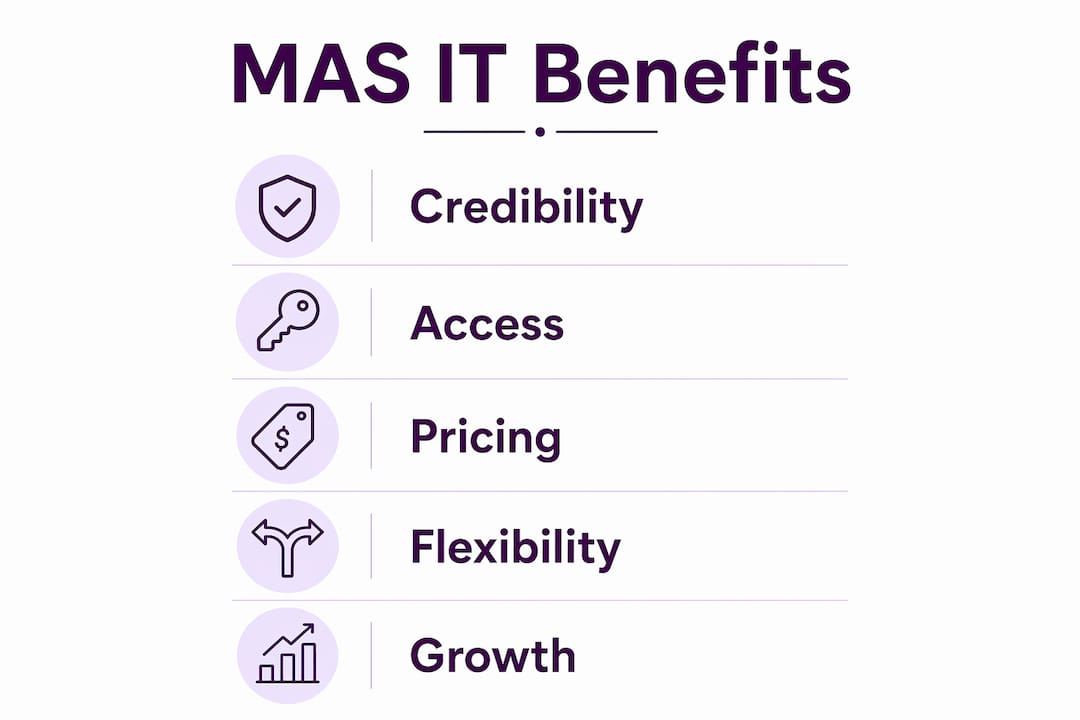
Concrete advantages for contractors:
- Single contract, multiple buyers: One award gives you access to federal agencies, plus state and local governments through cooperative purchasing, without re-competing for each client.
- Reduced transaction costs: Agencies order directly from your schedule instead of running a full competitive acquisition. That cuts your bid-and-proposal costs per order.
- Reserved task orders: Pre-qualified MAS IT vendors can compete for task orders set aside specifically for schedule holders, which non-schedule firms cannot touch.
- FAR Part 12 alignment: The entire framework operates under commercial buying standards, which means fewer government-unique clauses and terms closer to what you already use commercially.
- Pre-negotiated pricing: GSA-approved rates give agencies confidence and give you a defensible price ceiling for every order.
The contract also functions as a credibility signal. Agencies know MAS IT vendors have already cleared GSA’s vetting process, which shortens the trust-building phase with new contracting officers.
Strategies that actually convert your MAS IT contract into revenue

A MAS IT contract is a license to compete, not a guarantee of work. Firms that treat it as a passive credential rarely see meaningful revenue. The ones that do treat it as a marketing platform and actively pursue opportunities.
What works:
- Monitor GSA eBuy daily. Solicitations posted there go to schedule holders first. Waiting for agencies to find you on GSA Advantage is passive; responding to eBuy RFQs is active.
- Use a multi-SIN approach. Agencies often need integrated solutions, not point products. Holding SINs across cloud, cybersecurity, and IT professional services lets you respond to complex requirements as a single vendor.
- Build contracting officer relationships before a solicitation drops. Agencies are more likely to structure requirements around capabilities they already understand. Capability briefings and industry days are not optional networking; they are pipeline development.
- Keep your pricelist current. Outdated pricing or lapsed modifications signal a neglected contract and can disqualify you from task orders where currency matters.
- Align your marketing materials to your SINs. Your GSA contract number and approved SINs should appear on your website, capability statements, and email signatures. Agencies search by SIN when scoping solutions.
Pro Tip: When selecting SINs, map each one directly to a past commercial performance example you can document. GSA reviewers look for that alignment, and contracting officers use it to assess risk before awarding task orders. Vague SIN selections with thin past performance are the fastest path to a lower evaluated score.
Step-by-step: getting on the GSA IT schedule
This process follows GSA’s official MAS Roadmap sequence. Each step builds on the previous one, and skipping ahead typically means going back.
Complete the Readiness Assessment. An authorized officer of your firm must finish this self-evaluation at gsa.gov/masroadmap. It confirms your firm understands MAS requirements before you invest time in a full offer.
Register in SAM.gov. Obtain or verify your UEI at SAM.gov. Your registration must be active and your entity information current. Expired SAM registrations block award.
Identify your SINs and NAICS codes. Review the MAS IT solicitation (SAM.gov solicitation number 47QSMD20R0001) and the IT Category attachment. Match your offerings to specific SINs and select the correct NAICS code for each. The NAICS code determines your SBA size standard, so precision matters here.
Download and read the full solicitation. Pay particular attention to Solicitation Provision SCP-FSS-001, Instructions to Offerors. GSA’s own training materials call this the single most critical action you can take before submitting.
Prepare your offer documents. Gather corporate authorization documents, financial statements, past performance references, and a complete commercial pricelist. TAA compliance documentation is required for every product on your list.
Submit through eOffer. The eOffer system is the only accepted submission method. It is a web-based platform that walks you through each section of the offer and requires digital signatures from an authorized company officer.
Negotiate pricing and terms. GSA contracting officers will review your commercial pricelist and may request price reductions or clarifications. This is a negotiation, not a rubber stamp. Know your floor before you enter discussions.
Receive award and complete post-award training. GSA offers free pre- and post-award training. Complete it. Contractors who skip post-award training routinely miss reporting deadlines and modification requirements, which can trigger contract termination.
Manage ongoing compliance. File your Transactional Data Reporting (TDR) on schedule, keep your SAM.gov registration current, and submit modifications promptly when your offerings or pricing change. The step-by-step guide from Gsascheduleservices covers each of these phases in detail for contractors who want a structured walkthrough.
Pro Tip: Gsascheduleservices offers readiness assessments and offer preparation support specifically for IT contractors navigating the MAS application. If your first offer was rejected or you are unsure whether your SINs align with your actual capabilities, a professional review before resubmission saves months. Visit the Gsascheduleservices discovery page to see what that process looks like.
Key Takeaways
The MAS IT category, formerly Schedule 70 GSA, is an important federal IT contract vehicle with substantial annual sales volume available to pre-qualified vendors who actively market their contracts.
| Point | Details |
|---|---|
| Schedule 70 is now MAS IT | GSA retired the Schedule 70 name in 2020; all IT contracts now operate under the MAS IT Large Category. |
| SAM.gov registration is mandatory | You must hold an active UEI registration before submitting any offer or receiving any award. |
| FedRAMP is required for cloud | Cloud providers must have FedRAMP authorization or be actively pursuing it to sell to federal civilian agencies. |
| Multi-SIN approach wins more work | Combining related IT SINs lets you respond to complex agency requirements as a single integrated vendor. |
| The contract requires active marketing | Over $20 billion in annual IT sales flows through MAS IT, but only to vendors who pursue eBuy solicitations and build agency relationships. |
FAQ
What is the GSA Multiple Award Schedule?
The GSA Multiple Award Schedule (MAS) is a long-term, governmentwide IDIQ contract that connects federal, state, and local agencies with pre-qualified commercial vendors offering products, services, and solutions at pre-negotiated prices.
How do you get a GSA Schedule contract?
Register in SAM.gov with a valid UEI, identify the SINs that match your offerings, complete the mandatory Readiness Assessment, and submit your offer electronically through the eOffer system following the MAS solicitation instructions.
What is a GSA list?
A GSA list refers to the catalog of approved vendors and their offerings on the MAS program, searchable through GSA Advantage and GSA eLibrary by SIN, category, and NAICS code.
What are the main benefits of being on a GSA Schedule?
Schedule holders gain access to federal, state, and local buyers through a single contract, compete for reserved task orders unavailable to non-schedule firms, and operate under FAR Part 12 commercial standards that reduce administrative burden compared to traditional government contracting.
Recommended
- All About the GSA Information Technology Category going into FY 2021
- GSA IT Schedule 70 Contracts are Obtainable for the Everyday Business Owner
- How to get on the GSA IT Schedule 70, a Step-by-Step Guide
- GSA Schedule 70 In Five Steps