

Effective record keeping for GSA contracts means maintaining accurate, complete, and accessible documentation for federally mandated periods to stay compliant with FAR Subpart 4.7 and GSAR 552.215-71. The standard rule requires contractors to retain records for three years after final payment, and that clock starts later than most business owners expect. Poor documentation exposes you to audit findings, financial penalties, and contract suspension. The good news is that a disciplined filing system, built around the right categories and retention timelines, makes compliance predictable rather than stressful.
What records must you keep for GSA contracts?
GSA contract documentation falls into six core categories, each with its own retention rules. Getting the categories right matters because auditors do not limit their requests to what you expect. GSA auditors interpret access-to-records clauses broadly, often requesting documents beyond explicitly listed types.
The six record categories every contractor needs
- Financial and pricing records. Invoices, price schedules, and cost data used to establish your GSA pricing. These form the backbone of any audit review.
- Sales reports. Quarterly 72A reports filed through the FAS Sales Reporting Portal, including zero-sales periods.
- IFF remittance records. Documentation of every Industrial Funding Fee payment, matched to the corresponding sales report period.
- Price reduction documentation. Written records of any price reduction offered to your Most Favored Customer class, including the date and scope of the reduction.
- Compliance certificates and modification records. Signed contract modifications, mass modifications, and compliance acknowledgments.
- Audit files and correspondence. All communications with GSA Industrial Operations Analysts (IOAs), including responses to information requests.
How long do you actually keep them?
The three-year retention rule under FAR 4.703(a) applies to most GSA records, measured from the date of final payment. One critical nuance: each contract option period is treated as a separate contract for retention purposes. That means a five-year base contract with three option years generates four separate retention clocks.
GSA SmartPay electronic transaction records carry a longer requirement. SmartPay records must be retained for six years after final payment. The retention window also extends beyond contract expiration in most cases because audit rights persist for three years after final payment, which often occurs well after the performance period ends.
| Record Type | Retention Period | Notes |
|---|---|---|
| Financial and pricing records | 3 years after final payment | Separate clock per option period |
| 72A sales reports | 3 years after final payment | Includes zero-sales quarters |
| IFF remittance records | 3 years after final payment | Match to corresponding sales period |
| GSA SmartPay records | 6 years after final payment | Electronic transactions included |
| Price reduction documentation | 3 years after final payment | Must include date and MFC class detail |
How should you organize your GSA contract records?
A government contract filing system works best when it mirrors the audit process itself. Auditors request records by contract period, report quarter, and document type. Your filing structure should match that logic exactly.

Building a digital filing system that passes audits
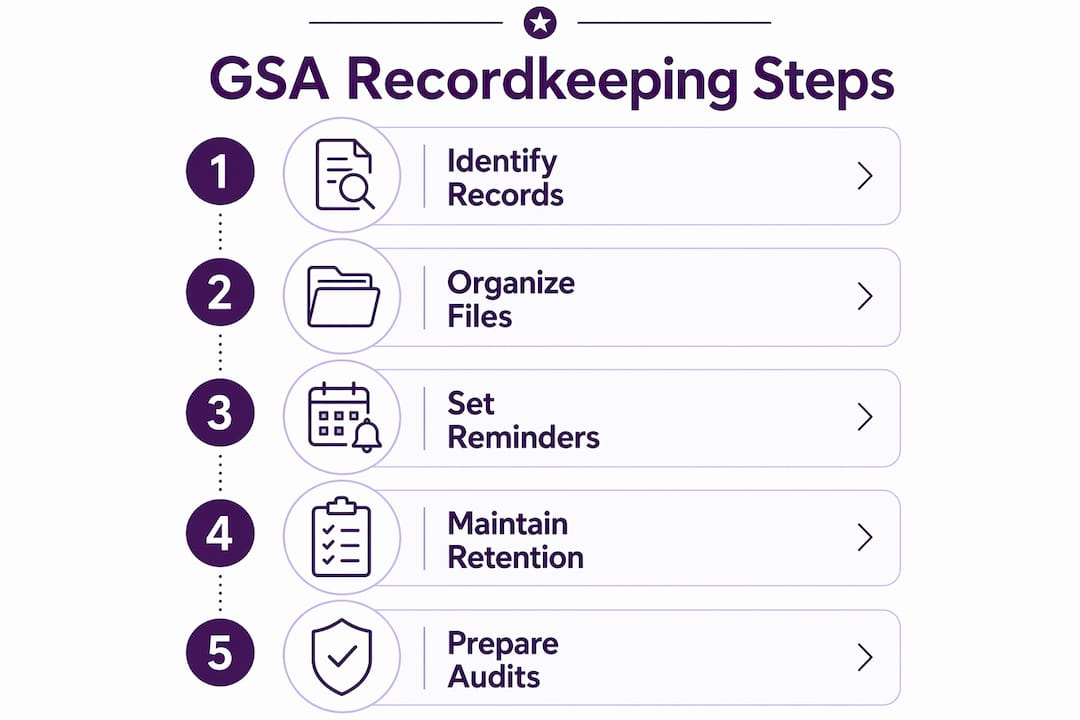
Electronic recordkeeping systems are permitted and encouraged under FAR 4.703©, provided they meet standards for document integrity, indexing, and retrieval. Scanned images can substitute for paper originals when quality and audit trail requirements are met. That gives you full flexibility to go paperless, but the system must be structured correctly.
A practical folder structure organizes files by contract number, then by year, then by document type. Within each year folder, subfolders for “Sales Reports,” “IFF Payments,” “Price Reductions,” and “Correspondence” keep retrieval fast. Every document should carry a consistent naming convention: contract number, document type, and date. For example, a file named “GS-35F-0001X_72A_Q2_2025” is instantly identifiable without opening it.
- Use secure cloud storage with role-based access controls so only authorized staff can modify records.
- Enable version history and audit trails on every document to show when files were created or changed.
- Index all documents with searchable metadata so you can pull a full quarter’s records in minutes.
- Store physical originals in a locked, climate-controlled location if you retain paper backups.
- Back up digital records to a secondary location, separate from your primary cloud environment.
Pro Tip: Write a one-page Standard Operating Procedure (SOP) for each recurring recordkeeping task, such as filing a 72A report or logging an IFF payment. Auditors expect to see not just records but also internal processes that prove your compliance logic is deliberate and consistent.
What is the step-by-step compliance process for GSA recordkeeping?
GSA compliance recordkeeping runs on a quarterly and annual cycle. Missing a single deadline can trigger a compliance notice or contract suspension. Building these tasks into your calendar as fixed events removes the risk of forgetting them.
Quarterly tasks
- File your 72A sales report. Quarterly reports are due within 30 days after the quarter ends. This applies even when you had zero sales. A missing zero-sales report carries the same penalty risk as a missing active-sales report.
- Remit your IFF payment. Calculate the Industrial Funding Fee (currently 0.75% of reported sales) and submit payment through pay.gov simultaneously with your sales report.
- Log and file all invoices. Match every invoice issued during the quarter to the corresponding sales report line item. Discrepancies between invoices and reported sales are a primary audit trigger.
- Review price reduction obligations. Check whether any price reductions were offered to commercial customers during the quarter. Contractors must notify GSA within 15 days of any price reduction to the Most Favored Customer class below disclosed Schedule pricing.
- Archive all correspondence. Save every email, letter, or portal message related to your GSA contract from the quarter into the appropriate folder.
Annual tasks
- Renew your SAM.gov registration. Your System for Award Management registration must stay active. A lapsed registration makes you ineligible to receive GSA orders.
- Review and document contract modifications. Any mass modification accepted during the year needs to be filed with a note explaining what changed and when you accepted it.
- Update your price list. If you adjusted commercial pricing during the year, verify your GSA pricing still complies with the Price Reduction Clause and document the comparison.
- Prepare for IOA reviews. GSA Industrial Operations Analysts conduct periodic reviews focusing on records from the past two to three years. Respond promptly to all information requests to avoid escalation.
- Document CPARS evaluations. Save all Contractor Performance Assessment Reporting System entries and any responses you submitted.
Pro Tip: Set calendar reminders 45 days before each quarterly deadline. That gives you two weeks to gather records and two weeks to review before filing. Rushing a 72A report at the last minute is how classification errors happen.
What are the most common GSA recordkeeping mistakes?
Common recordkeeping errors include premature destruction of records, misclassification of sales, and failing to file zero-sales reports. Each of these creates a different type of audit risk, and all of them are avoidable.
Auditors have broad authority to review contractor books and related records for three years after final payment. Destroying records before that window closes, even accidentally, can be treated as obstruction and trigger penalties far worse than the original compliance gap.
- Premature disposal. Business owners often purge files after a contract expires, not realizing the retention clock starts at final payment, not contract end. Keep a retention schedule that tracks each clock separately.
- Sales misclassification. Reporting a non-GSA sale as a GSA sale, or vice versa, distorts your IFF calculation and creates discrepancies auditors will flag. Your SOP for sales categorization must be explicit and consistently followed.
- Skipping zero-sales reports. A quarter with no GSA sales still requires a filed report. Skipping it is a compliance violation regardless of revenue.
- Inadequate price reduction records. Verbal agreements or informal emails do not satisfy the documentation standard. Every price reduction needs a written record with the date, customer class, and pricing details.
- Disorganized audit files. Auditors request two to three years of documentation during compliance reviews. If you cannot produce records quickly, the review escalates and penalties increase.
Pro Tip: Assign one person as your GSA records custodian. That person owns the filing system, the retention schedule, and the audit response process. Shared responsibility with no clear owner is how records go missing.
Key Takeaways
Disciplined GSA compliance recordkeeping protects your contract, reduces audit risk, and gives you a clear paper trail that supports every renewal and modification decision.
| Point | Details |
|---|---|
| Know your retention periods | Most records require 3 years after final payment; SmartPay records require 6 years. |
| Track each option period separately | FAR 4.703(a) treats each contract option as a separate contract with its own retention clock. |
| File quarterly reports without exception | 72A sales reports are due within 30 days after quarter end, even for zero-sales periods. |
| Build a structured digital filing system | FAR 4.703© permits electronic records when integrity, indexing, and retrieval standards are met. |
| Document your internal processes | Auditors expect SOPs proving your sales categorization and price reduction logic is deliberate. |
Why I treat recordkeeping as a business asset, not a burden
Most small business owners I work with view GSA recordkeeping as paperwork overhead. I understand that instinct. When you are focused on winning orders and delivering work, filing systems feel like a distraction. But that framing is wrong, and it costs people contracts.
A well-organized GSA contract compliance file is one of the most valuable assets your business owns. When an IOA review lands in your inbox, the difference between a two-week resolution and a six-month ordeal comes down entirely to how fast you can produce clean records. I have seen contractors with strong performance histories lose contracts not because of what they did wrong, but because they could not prove what they did right.
The other thing most guides miss is that good records make renewals easier. When your five-year contract comes up for renewal, your pricing history, sales trends, and compliance documentation tell a story. That story either supports a strong negotiating position or undermines it. Contractors who treat their GSA schedule contract files as living business documents consistently get better renewal outcomes than those who treat them as a compliance checkbox.
Invest in a real system early. The cost of setting it up correctly in year one is a fraction of the cost of reconstructing records under audit pressure in year three.
— Josh
How Gsascheduleservices supports your audit-ready recordkeeping
Gsascheduleservices works with small and medium-sized businesses at every stage of the GSA contract lifecycle, including the recordkeeping and compliance work that keeps contracts active and audit-ready. If you are unsure whether your current filing system meets FAR 4.703© standards, or if you have never built a retention schedule before, a readiness assessment is the fastest way to identify gaps before an IOA review does. Gsascheduleservices also provides guidance on quarterly reporting workflows, price reduction documentation, and SAM.gov renewal processes. Getting the compliance side right from the start protects the federal revenue you worked hard to secure.
FAQ
How long must GSA contractors keep their records?
Most GSA contract records must be retained for three years after final payment under FAR 4.703(a). GSA SmartPay electronic transaction records require six years after final payment.
What happens if you destroy records too early?
Early destruction of records can be treated as obstruction during an audit. Auditors have broad authority to review contractor books for three years post final payment, and missing records trigger penalties and compliance findings.
Do you need to file a 72A report with zero sales?
Yes. Zero-sales quarters still require a filed 72A report within 30 days after the quarter ends. Skipping the report is a compliance violation regardless of revenue.
Can you use digital records instead of paper for GSA contracts?
Electronic records are fully permitted under FAR 4.703© when they meet standards for document integrity, indexing, and retrieval. Scanned images can substitute for paper originals when quality requirements are satisfied.
What do GSA Industrial Operations Analysts look for during reviews?
IOAs focus on records from the past two to three years, including sales reports, price reduction documentation, IFF remittance records, and internal SOPs. Prompt, organized responses reduce the risk of escalation.
Recommended
- GSA Compliance: Don’t Get Lost | GSA Focus
- Navigating GSA Schedule Compliance
- Performance Metrics for GSA Contracts: 2026 Guide
- An Essential Checklist to Maintain Your GSA Schedule Contract