
NAICS codes are the classification system that determines your eligibility, visibility, and contract scope within every GSA procurement. The North American Industry Classification System assigns a numeric code to each business activity, and in federal contracting, that code carries legal weight. Contracting officers use it to set small business size thresholds, define what work falls inside a contract’s scope, and filter vendor searches on GSA Advantage and eBuy. Getting your NAICS codes right is not a paperwork detail. It is a foundational business development decision that shapes which contracts you can win.
How NAICS codes define your role in GSA procurement
The role of NAICS codes in GSA is to classify the principal purpose of each procurement and match it to a corresponding size standard under 13 CFR 121.201. That size standard then determines whether your company qualifies as a small business for that specific contract. The threshold is not a fixed number applied to your whole company. It shifts based on the code assigned to each solicitation.
Two IT services codes illustrate how much variation exists. NAICS 541512 (Computer Systems Design Services) carries a $34 million revenue threshold, while NAICS 518210 (Computing Infrastructure Providers) sets the bar at $40 million. A company with $36 million in annual revenue qualifies as small under 518210 but not under 541512. That distinction can determine whether you compete in a small business set-aside or face the full open market.

Small business status is verified per solicitation, not once at registration. A company can be small under one NAICS but large under another, and that status must be confirmed each time you bid. This is one of the most misunderstood aspects of GSA procurement NAICS codes.
Key risks of misclassification include:
- Bid protests. Competitors can challenge your small business certification if your assigned NAICS code does not match your actual work or revenue profile.
- Award loss. A sustained protest can strip you of a contract after award, along with the revenue attached to it.
- Credibility damage. Repeated misclassification signals poor compliance practices to contracting officers.
- Legal costs. Defending a protest consumes time and money that most small businesses cannot afford.
Pro Tip: Cross-reference your primary NAICS code against your three most recent years of revenue before submitting any GSA proposal. If most of your revenue comes from a different activity than the code you selected, realign before the contracting officer does it for you.
How do NAICS codes map to GSA special item numbers?
GSA’s Multiple Award Schedule (MAS) program organizes vendor offerings through Special Item Numbers, known as SINs. The GSA MAS program maps NAICS codes to 277 SINs organized within 12 broad Large Categories. Each SIN represents a specific product or service category, and each SIN connects to one or more NAICS codes. When a federal buyer searches GSA Advantage or eBuy, they filter by SIN and NAICS. If your SAM.gov registration does not reflect the right codes, you simply do not appear.
Misaligning NAICS codes between your business offerings and your GSA SINs causes invisibility in federal market research. Federal buyers use SIN and NAICS filters to locate vendors. Incorrect codes mean lost contract opportunities before you ever submit a proposal.
The table below shows how NAICS codes connect to SINs and what that means for vendor discovery:
| Element | What It Is | Why It Matters |
|---|---|---|
| NAICS Code | Six-digit industry classification | Sets size standard and defines your work category |
| SIN | GSA’s product/service subcategory | Determines where buyers find you on GSA platforms |
| SAM.gov Registration | Your official federal business profile | Must reflect NAICS codes that match your SINs |
| GSA Advantage/eBuy | Federal buyer search platforms | Filter results by SIN and NAICS simultaneously |
The practical implication is direct. If you hold a SIN for professional IT services but your SAM.gov registration lists a manufacturing NAICS code, buyers searching for IT vendors will not find you. Aligning your NAICS and SIN strategy is the single most effective way to increase your visibility in federal market research.
What scope restrictions do NAICS codes create in OASIS+?
OASIS+ is GSA’s primary vehicle for complex professional services, and it uses NAICS codes to define contract domains with strict boundaries. OASIS+ contract domains limit task order awards to orders whose principal-purpose NAICS code falls within the defined domain codes. If a contracting officer assigns a NAICS code outside the contract domain, the task order cannot be awarded under OASIS+. The work is simply out of scope.
Under FAR 19.102, contracting officers assign NAICS codes to capture the principal purpose of each procurement, reflecting the largest value component of the contract. For task orders under multiple-award contracts like OASIS+, this means the assigned code must match the domain the vendor holds. A vendor holding an OASIS+ domain for management consulting cannot receive a task order coded under an engineering domain, even if they have the capability.
Here is how to stay in scope and protect your contract:
- Know your domain codes. Before pursuing any OASIS+ task order, confirm that the solicitation’s NAICS code falls within your awarded domain.
- Review the principal-purpose determination. If a task order bundles multiple services, the NAICS code reflects the highest-value component. Make sure that component aligns with your domain.
- Engage the contracting officer early. If you believe a NAICS code is incorrectly assigned to a solicitation, raise the question during the pre-solicitation period, not after award.
- Document your scope analysis. Keep a written record showing how each task order NAICS code connects to your awarded domain. This protects you in a protest scenario.
Pro Tip: GSA publishes the full list of NAICS codes assigned to each OASIS+ domain on its website. Download that list and build it into your bid/no-bid checklist so scope compliance becomes automatic, not an afterthought.
Common misconceptions about NAICS codes and GSA contracts
The most costly misconception in GSA procurement is treating NAICS codes as purely descriptive labels. Choosing a NAICS code is a strategic decision that shapes your market positioning, the competitive pool you enter, and your capture strategy for specific contracts. Businesses that treat code selection as a box-checking exercise consistently leave money on the table or expose themselves to protest risk.
Secondary NAICS codes create a second common trap. Many contractors overlook them entirely, missing visibility opportunities. Others add them without checking size standards, which creates legal exposure. Secondary NAICS codes can increase visibility but require careful size standard compliance to avoid protests. Certification under a secondary NAICS code outside your size limits can trigger formal protests leading to penalties or award loss.
Best practices for managing NAICS codes in GSA contracting:
- Anchor your primary NAICS to your largest revenue source. The code must reflect where most of your business income actually comes from, not where you want to grow.
- Audit secondary codes annually. As your revenue mix changes, secondary codes that once fit may no longer be accurate. Remove codes that no longer reflect real work.
- Check size standards per solicitation. Size standard compliance must be verified per assigned NAICS code in each solicitation, even if different from your primary company code.
- Use the GSA SIN Finder. GSA’s SIN Finder tool maps your NAICS codes to eligible SINs, giving you a clear picture of where you can compete.
- Monitor solicitation NAICS codes before bidding. Read every solicitation’s assigned NAICS code before preparing a proposal. If it does not match your registered codes, you may be ineligible before you start writing.
The right NAICS code is not the one with the highest size threshold. It is the one that accurately reflects your work and positions you in the competitive pool where you can win.
Practical steps to use NAICS codes effectively in GSA procurement
Small and medium businesses that win GSA contracts consistently treat NAICS code management as an ongoing process, not a one-time registration task. The steps below translate the importance of NAICS in GSA into concrete actions you can take this quarter.
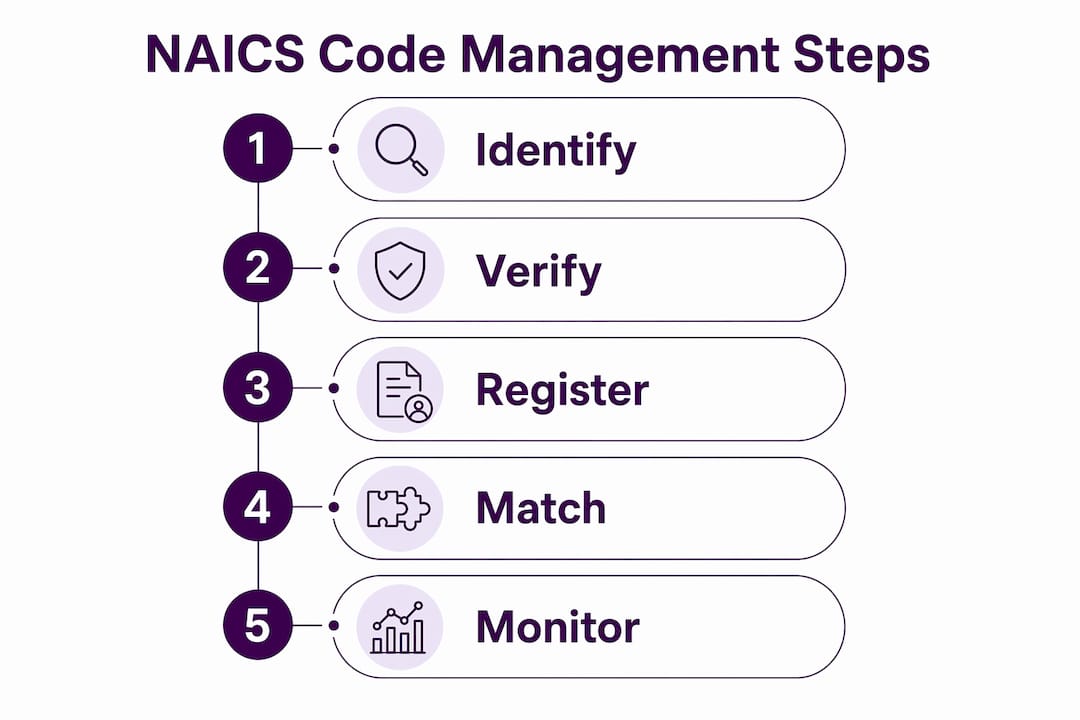
Determine your primary NAICS code from revenue data. Pull your last three years of revenue by service or product line. The NAICS code for your largest revenue category is your primary code. This is the code that defines your size standard for most solicitations.
Register accurately in SAM.gov. Your SAM.gov profile is the foundation of your federal identity. Every NAICS code you list there must reflect actual business activity. Add secondary codes only for services you actively deliver and for which you meet the size standard.
Use the GSA SIN Finder to identify eligible SINs. GSA’s SIN Finder cross-references your NAICS codes against the 277 available SINs. This tells you exactly which MAS categories you can pursue and where federal buyers will find you.
Monitor solicitation NAICS codes on SAM.gov. Set up saved searches on SAM.gov filtered by your primary and secondary NAICS codes. Review each solicitation’s assigned code before investing proposal resources. If the code falls outside your registered codes, contact the contracting officer to clarify eligibility before the solicitation closes.
The table below summarizes the key tools and their function in NAICS management:
| Tool | Primary Function |
|---|---|
| SAM.gov | Register and manage NAICS codes for federal contracting |
| GSA SIN Finder | Map NAICS codes to eligible GSA MAS SINs |
| OASIS+ Domain List | Confirm NAICS codes within awarded contract domains |
| SBA Size Standards Tool | Verify revenue thresholds per NAICS code |
Growing a small business through GSA starts with getting these foundational classifications right. Every other element of your federal marketing strategy builds on accurate NAICS registration.
Key takeaways
NAICS codes in GSA contracting are not administrative labels. They are the legal mechanism that determines eligibility, scope, and market visibility for every contract you pursue.
| Point | Details |
|---|---|
| Size standards vary by code | NAICS 541512 sets a $34M threshold while 518210 sets $40M; verify per solicitation. |
| SIN alignment drives visibility | Mismatched NAICS and SINs make you invisible to federal buyers on GSA platforms. |
| OASIS+ scope is code-specific | Task orders must match your awarded domain’s NAICS codes or they are out of scope. |
| Secondary codes carry legal risk | Adding secondary NAICS codes without size standard compliance can trigger bid protests. |
| SAM.gov accuracy is non-negotiable | Your registered NAICS codes must reflect actual revenue sources, audited annually. |
Why NAICS codes deserve more strategic attention than most businesses give them
I have worked with enough small businesses navigating GSA schedules to say this plainly: NAICS code selection is where most companies make their first and most expensive mistake. They pick a code that sounds right, register it in SAM.gov, and move on. Then they wonder why they are not appearing in federal searches or why a bid protest landed on their desk six months after award.
The uncomfortable truth is that NAICS codes function as a legal contract between your company and the federal government about what you do and how big you are. When that contract does not match reality, the consequences are not just administrative. They are financial and reputational.
What I find most underappreciated is the dynamic nature of size standards. The SBA updates size standards regularly, and a threshold that qualified you as small last year may not apply the same way today. Businesses that set their NAICS codes once and never revisit them are operating on outdated assumptions. The companies that win consistently treat NAICS management as a quarterly review item, not a one-time setup.
My advice is to treat your NAICS code selection with the same seriousness you give your pricing strategy. Both determine whether you compete and whether you win.
— Josh
Get expert help matching your NAICS codes to the right GSA schedule
NAICS code strategy is one of the most consequential decisions in your GSA contracting journey, and it is also one of the easiest to get wrong without expert guidance. Gsascheduleservices.com works with small and medium businesses to identify the right NAICS codes, map them to the correct SINs, and build a GSA schedule that positions you for real federal revenue. If you are ready to stop guessing and start winning government contracts with confidence, the GSA Schedule discovery service is the right starting point. The process is straightforward, and the guidance is specific to your business, not generic advice.
FAQ
What is the role of NAICS codes in GSA contracting?
NAICS codes classify the principal purpose of each GSA procurement and determine small business size standards under 13 CFR 121.201. They also control which SINs a vendor can hold and which contract domains they can access.
How do NAICS codes affect small business eligibility?
Small business status is determined per solicitation based on the NAICS code assigned by the contracting officer. A company can qualify as small under one code but not another, depending on the revenue threshold for each.
What happens if you use the wrong NAICS code on a GSA contract?
Selecting the wrong NAICS code risks bid protests, loss of award, and credibility damage with contracting officers. In set-aside competitions, misclassification can disqualify your offer entirely.
How do NAICS codes connect to GSA sins?
Each GSA SIN maps to one or more NAICS codes within the MAS program’s 12 Large Categories and 277 SINs. If your SAM.gov NAICS codes do not align with your SINs, federal buyers cannot find you in GSA Advantage or eBuy searches.
Can a business hold multiple NAICS codes in sam.gov?
Yes, businesses can register primary and secondary NAICS codes in SAM.gov. Secondary codes expand your visibility but require size standard compliance for each code to avoid protest exposure.
Recommended
- Government Contract Opportunities 2026: SME Guide
- Performance Metrics for GSA Contracts: 2026 Guide
- How to Access GSA Contract Opportunities: Quick Guide (2023)
- GSA Contract Eligibility Criteria – Quick Guide