
The federal government spends over $700 billion annually on goods and services, making it the largest single buyer in the world. If you want to know how to become a government contractor and claim a piece of that market, the path is structured but absolutely learnable. You will need the right legal standing, a SAM.gov registration, and a strategy for finding and winning contracts. This guide walks you through every major step, from qualifying your business to understanding the GSA Schedule, so you can start pursuing real opportunities and getting government contracts with confidence.
Table of Contents
- Key takeaways
- How to become a government contractor: qualifications first
- Registering on SAM.gov and getting your UEI
- Finding and evaluating government contract opportunities
- Submitting your first bid and winning early contracts
- Understanding the GSA Schedule process
- My honest take on what actually works
- How Gsascheduleservices can help you get there faster
- FAQ
Key takeaways
| Point | Details |
|---|---|
| Legal eligibility comes first | Your business must meet SBA size standards and comply with federal acquisition rules before applying for contracts. |
| SAM.gov registration is non-negotiable | You cannot receive federal contract awards without an active SAM.gov registration and a Unique Entity Identifier. |
| Start small with set-asides | Targeting small business set-asides and simplified acquisition contracts builds early wins and past performance. |
| Subcontracting accelerates credibility | Working under prime contractors gives you verifiable past performance that unlocks larger prime contracts later. |
| GSA Schedule opens a standing door | A GSA Schedule contract lets federal buyers purchase from you directly without a full competitive bidding process each time. |
How to become a government contractor: qualifications first
Before you submit a single bid, your business needs to meet specific legal and eligibility requirements. The SBA’s size standards vary by industry and are tied to your NAICS code, so the first task is identifying which codes accurately describe your products or services. Choosing the wrong NAICS codes is more costly than most new contractors realize. Contracting officers search by code when looking for eligible vendors, so misclassification means they will not find you.
Beyond size standards, you need to understand the certifications that can give your business a competitive edge:
- 8(a) Business Development Program: For socially and economically disadvantaged business owners. Participants can receive sole-source contracts up to $4.5 million for services.
- HUBZone Certification: For businesses operating and employing workers in historically underutilized business zones.
- Women-Owned Small Business (WOSB): Opens access to set-aside contracts in industries where women are underrepresented.
- Service-Disabled Veteran-Owned Small Business (SDVOSB): Gives veterans priority access to set-aside opportunities across agencies.
Federal contracts also come with legal strings. The Buy American Act requires that contractors supply domestically produced goods in most cases. Subcontracting limitations under the FAR dictate how much work you can pass to other firms. Understanding these rules early protects you from disqualification after award, which is a real and painful outcome for unprepared businesses.
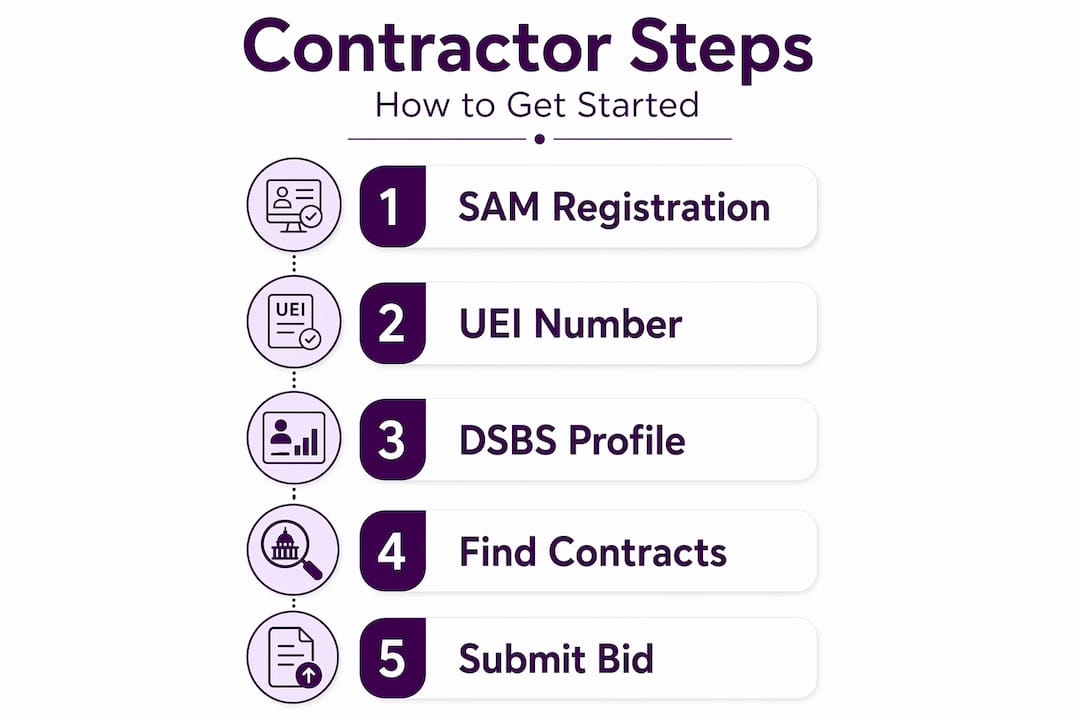
Pro Tip: Register with the SBA’s Dynamic Small Business Search (DSBS) database after your SAM.gov registration is complete. Contracting officers and prime contractors use it specifically to find small business partners, and being listed there costs nothing.
Registering on SAM.gov and getting your UEI
SAM.gov is the federal government’s official vendor database. Without an active registration there, you are legally ineligible to receive a federal contract award. Here is the process, step by step:
- Obtain your Unique Entity Identifier (UEI). Go to SAM.gov and create a login.gov account. The UEI is issued through SAM.gov itself at no cost. You no longer need a DUNS number; the UEI replaced it entirely.
- Gather your business data. You will need your EIN or TIN, your legal business name and address, bank account information for electronic funds transfer, and your NAICS codes.
- Complete your entity registration. Fill out all sections of the registration, including your business profile, points of contact, and representations and certifications. Incomplete profiles are a red flag to contracting officers.
- Wait for activation. SAM activation delays typically run 7 to 15 business days. This is not something you can rush, so start well before any bid deadline you have in mind.
- Set up alerts. Once registered, create saved searches on SAM.gov and activate email alerts for new opportunities matching your NAICS codes and keywords.
The distinction between entity registration and market surveillance matters here. You can search contract opportunities on SAM.gov without any account. But only registered users can submit bids, appear on interested vendor lists, and receive automated alerts. Think of it as the difference between watching a game from outside the fence and actually playing.
Pro Tip: Timing your SAM registration to your business development calendar is critical. If you identify a promising contract with a 30-day response window and your registration is still pending, you are shut out. Activate your SAM account before you start serious opportunity hunting.
Finding and evaluating government contract opportunities
Once your registration is active, the real work of building a pipeline begins. Federal agencies must advertise contracts over $25,000 on SAM.gov, which means the database is your most reliable source. But knowing how to filter and evaluate what you find is what separates contractors who win from those who waste months chasing the wrong bids.

SAM.gov Contract Opportunities includes four types of notices you should understand:
| Notice Type | What it means | Your move |
|---|---|---|
| Pre-solicitation | Agency signals upcoming contract before formal release | Monitor and prepare; reach out to contracting officer |
| Solicitation | Formal request for proposals or quotes | Evaluate fit and submit if qualified |
| Award | Shows who won an existing contract | Use for market research on competitors and pricing |
| Sole source | Agency plans to award without competition | Subcontracting opportunity if you know the awardee |
For deeper market research, use USASpending.gov and the Federal Procurement Data System (FPDS) to see which agencies spend in your category, how much they spend, and who currently holds those contracts. This tells you whether an agency is a realistic target before you invest weeks in a proposal.
When deciding whether to pursue a contract, check these factors:
- Does the NAICS code match your registrations?
- Is there a small business set-aside that applies to your certifications?
- Is the contract size within your capacity? The Simplified Acquisition Threshold of $350,000 is often the sweet spot for first-time contractors, as competition is lighter and the process is faster.
- Does the agency have a track record of awarding to businesses your size?
You can also find a comprehensive list of opportunities through curated government contracting resources that organize contract types and databases in one place.
Submitting your first bid and winning early contracts
Getting your first federal contract award requires both the right opportunity and a well-prepared response. Here is a proven approach for new contractors working toward their first win:
- Respond to Sources Sought notices and RFIs first. These are low-commitment requests where agencies gauge market interest. Responding to Sources Sought increases your chances of influencing how the final solicitation is structured, including whether it carries a small business set-aside.
- Build a capability statement. This one-to-two page document is your federal resume. It should include your core competencies, differentiators, past performance highlights, certifications, and contact information. Tailor it to the specific agency or opportunity, not a generic version.
- Make brief, professional contact with contracting officers. Introduce your business before a solicitation drops. A short email with your capability statement attached is appropriate. Do not pitch; simply make yourself visible and relevant.
- Apply a bid/no-bid filter to every opportunity. Ask whether your NAICS codes match, whether your past performance is relevant, whether the contract size fits your capacity, and whether you have a realistic price advantage. Disciplined bid/no-bid decisions are what separate contractors who scale from those who burn out chasing everything.
- Pursue subcontracting while building toward prime contracts. Subcontracting builds past performance that you will need to qualify for larger prime awards. It is not a fallback. It is a strategy.
Pro Tip: Before writing a full proposal, request a pre-proposal conference or ask the contracting officer for clarification on requirements. Agencies publish Q&A responses publicly, which means your smart questions benefit you and show the agency you read the solicitation carefully.
For guidance on pricing your bids competitively, smart contractor pricing strategies can help you understand market rates and structure your proposals to win on value, not just cost.
Understanding the GSA Schedule process
The GSA Schedule, formally known as the Multiple Award Schedule (MAS), is one of the most powerful tools available to small businesses entering federal contracting. A GSA Schedule contract means you have been pre-approved to sell specific products or services to federal agencies at pre-negotiated prices. Buyers can order from you directly, without going through a full competitive bidding process each time.
Here is what getting on the GSA Schedule involves:
- Eligibility check: Your business needs at least two years of operation and financial stability. GSA reviews your financial statements and past performance before approving an application.
- Offer preparation: You submit pricing, labor categories (for services), terms and conditions, and supporting documents through GSA’s eOffer system. The preparation process alone typically takes 4 to 6 months without professional help.
- Negotiation: GSA contracting officers may negotiate your pricing before granting approval. Being prepared to justify your rates with commercial invoices and market data speeds this up.
- Award and maintenance: Once awarded, your Schedule contract lasts up to 20 years in five-year increments. You must keep your SAM registration active and comply with reporting requirements.
GSA also maintains subcontracting directories for small businesses, connecting you with prime contractors who need qualified partners. This is often the fastest path to revenue while your own Schedule application is under review.
Pro Tip: Review the steps small businesses take to get a GSA contract before starting your application. Understanding what GSA evaluates during the offer review lets you prepare documentation correctly the first time, cutting weeks off the process.
My honest take on what actually works
I have worked with dozens of small businesses trying to break into federal contracting, and the pattern I see most often is this: they spend six months preparing to bid on prime contracts and then lose to established contractors with five years of past performance. It is demoralizing, and it is avoidable.
What actually accelerates growth is starting with subcontracting under a prime contractor in your space. It is not glamorous, but it is real revenue and real past performance you can cite in your next proposal. I have seen businesses go from zero federal experience to a GSA Schedule award in under two years by taking this path seriously.
The other thing I tell every client is to get their SAM registration done before they do anything else. Not when they find a good opportunity. Not when they are “almost ready.” Right now. The worst call I get is from a business owner who found a perfect contract, went to register, and then realized the response deadline passed during the 15-day activation window.
Targeted outreach and a tailored capability statement consistently outperform generic marketing. One well-researched email to the right contracting officer at the right agency beats blasting your profile to 50 departments. Government buyers are busy. They appreciate brevity, clarity, and relevance. Give them those three things and you will stand out from 80% of the competition.
— Josh
How GSA Focus can help you get there faster
Understanding the steps to become a contractor is one thing. Executing them correctly under federal compliance requirements is another. Gsascheduleservices works specifically with small and medium-sized businesses to handle the heavy lifting of GSA Schedule applications, from readiness assessments to offer preparation, pricing negotiation, and post-award compliance. If you have been putting off your GSA Schedule registration because the paperwork feels overwhelming, that is exactly the problem Gsascheduleservices was built to solve.
The team also helps clients identify the right contract opportunities, build winning capability statements, and position their businesses for long-term federal revenue. If you are serious about starting a government contracting business and want expert guidance from day one, book a personalized discovery session to see how the process maps to your specific situation. The federal market is large enough for your business. Getting in efficiently is the part worth getting right.
FAQ
What are the basic requirements for government contractors?
Your business must meet SBA size standards for your NAICS code, register on SAM.gov with an active Unique Entity Identifier, and comply with federal acquisition regulations including the Buy American Act where applicable.
How long does SAM.gov registration take?
SAM.gov registration typically takes 7 to 15 business days to activate after submission. Start the process well before any bid deadlines to avoid being locked out of opportunities during the activation window.
How do I bid on government contracts as a new business?
Begin by responding to Sources Sought notices and RFIs, which are lower-stakes than full proposals and help you build visibility with agencies. Then submit tailored proposals for small business set-aside contracts in your NAICS category.
What is the GSA Schedule and why does it matter?
The GSA Schedule is a long-term contract vehicle that pre-approves your business to sell directly to federal agencies at negotiated prices. It removes the need for a full competitive bid on every sale, making it significantly easier to generate recurring federal revenue.
How does subcontracting help new government contractors?
Subcontracting under an established prime contractor gives you documented past performance, which is one of the most important factors federal agencies evaluate when awarding prime contracts. It is one of the fastest ways to build the credibility needed for larger opportunities.
Recommended
- Guide to Becoming a Government Contractor: Your Path To Success
- Government Contract Opportunities 2026: SME Guide
- Explore Top US Government Contractor Jobs Today!
- Understanding What is a Government Contractor: A Guide