

Federal solicitation analysis is the process of systematically reviewing a government contract invitation to determine eligibility, evaluation factors, and submission requirements before committing resources to a bid. For small and medium-sized businesses, this process separates winning proposals from wasted effort. Federal solicitations typically range from 50 to 200+ pages, and missing one mandatory requirement can disqualify an otherwise strong proposal. Knowing how to analyze federal solicitations with a structured method is the single most reliable way to improve your win rate.
How to analyze federal solicitations: what you need before you start
Before you open a single solicitation, your business must meet baseline registration requirements. Without these, the analysis itself is pointless.
The first requirement is an active registration on SAM.gov, the System for Award Management. SAM.gov is the federal government’s central vendor database. An expired or inactive SAM.gov registration disqualifies your business from award, regardless of proposal quality. Renew your registration annually and verify your status before every submission deadline.

Your NAICS code, the North American Industry Classification System code, determines which solicitations you are eligible to pursue. Each solicitation lists one or more NAICS codes, and your business must match at least one to qualify. A mismatch in NAICS code alignment is one of the most common and avoidable eligibility failures for small businesses.
Set-aside designations also shape your eligibility. Solicitations marked as small business set-asides, 8(a), HUBZone, or SDVOSB restrict competition to businesses that meet specific size and certification standards. Read the set-aside type on the cover page before spending any time on the rest of the document.
Finally, some solicitations require a Facility Clearance, or FCL. FCL processing takes 12–18 months, making it a hard eligibility filter. If a solicitation requires a clearance your company does not hold, do not pursue it until you have started the clearance process.
Which sections of a solicitation should you read first?
Order matters when reading federal solicitations. Reading from page one to the end wastes time and buries the most critical information. The recommended sequence puts eligibility and scoring first, details second.
Section A: Cover page. Confirm the solicitation number, agency, NAICS code, set-aside type, and submission deadline. This takes five minutes and tells you whether to keep reading.
Section M: Evaluation criteria. Read this before anything else in the body. Section M dictates proposal scoring, and every word you write in your proposal must map back to these factors. Experienced proposal managers recommend reading Section M twice before drafting a single sentence.
Section L: Instructions to offerors. Section L tells you exactly how to format and organize your proposal. Page limits, font requirements, volume structure, and submission method all live here. Treat Sections L and M as one integrated set, not two separate documents.
Section C: Statement of Work or Performance Work Statement. After you understand how you will be scored and what format is required, read the actual work scope. Section C defines what the government expects you to deliver.
Section J: Attachments and exhibits. Section J often contains wage determinations, data rights clauses, and government-furnished equipment lists. These details carry mandatory compliance obligations that do not appear in the main body.
Pro Tip: Set up SAM.gov email alerts for the solicitation number the moment you begin your analysis. Solicitations behave like living documents, and amendments can change key requirements at any point before the deadline.
How to build a compliance matrix for federal bids
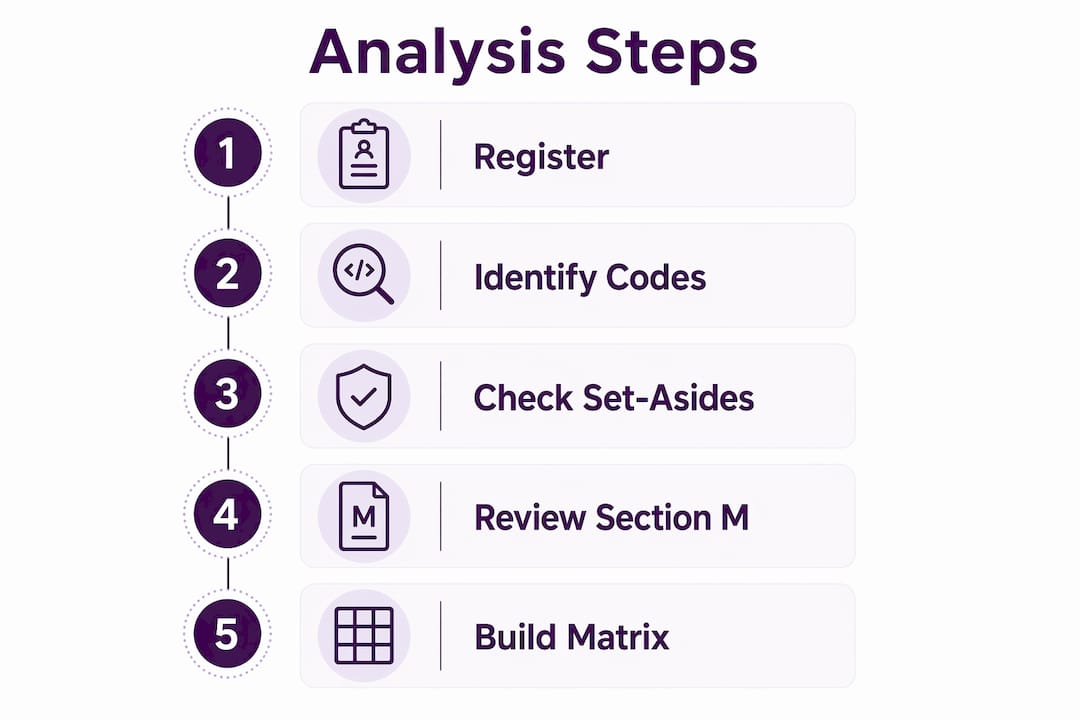
A compliance matrix is a spreadsheet that maps every mandatory requirement in a solicitation to a specific section of your proposal. It is the most reliable method to confirm that nothing gets missed.
Build your matrix by scanning Sections C, L, M, and J for every sentence containing “shall,” “must,” or “will.” These words signal mandatory requirements under the Federal Acquisition Regulation, or FAR. Each requirement gets its own row. The columns track the source section, the requirement text, the proposal section that addresses it, and the owner responsible for writing that section.
| Matrix Column | What to Record |
|---|---|
| Source section | The solicitation section where the requirement appears (e.g., Section C, L, M, J) |
| Requirement text | The exact “shall” or “must” statement copied from the solicitation |
| Proposal section | The volume and section of your proposal that responds to this requirement |
| Status | Draft, in review, or complete |
| Owner | The team member responsible for writing or reviewing this response |
The L-to-M crosswalk is the most effective compliance method available. It means mapping every Section L instruction to the Section M evaluation factor it supports. Proposals that treat Sections L and M as separate silos consistently score lower because evaluators cannot find the required content in the required place.
Track every amendment in your matrix as a new row or a highlighted update. When the government releases Q&A responses, add those clarifications as notes tied to the relevant requirement. Missing an amendment is one of the fastest paths to disqualification.
Pro Tip: Color-code your compliance matrix by status. Red means not started, yellow means in progress, green means complete and reviewed. A single glance at the spreadsheet tells your whole team where the gaps are.
What are the most common red flags in federal solicitations?
Certain patterns in a solicitation signal serious risk. Catching them early saves weeks of wasted proposal work.
Reading Section M too late. Many business owners read the Statement of Work first and treat evaluation criteria as an afterthought. Proposals built without Section M as the foundation fail to address what evaluators actually score.
Missing amendments. Solicitations are frequently updated after initial release. A change to the submission deadline, a revised scope, or a new mandatory form can invalidate work already done. Real-time tracking through SAM.gov is not optional.
Misreading evaluation factor weights. A solicitation may list five evaluation factors, but one factor worth 40% of the total score deserves 40% of your proposal effort. Spreading effort equally across all factors is a common and costly mistake.
Overlooking mandatory certifications. Some solicitations require specific certifications, such as ISO 9001, CMMI, or security clearances, as pass/fail criteria. Missing one disqualifies the entire proposal before technical scoring begins.
Ignoring the incumbent. When a solicitation references an existing contract or a current provider, the incumbent holds a real advantage. Analyzing incumbent signals in the SOW helps you identify where you need a clear win theme to compete effectively.
“The biggest mistake small businesses make is treating a federal solicitation like a job posting. It is a legal document with scoring rules, mandatory requirements, and disqualification triggers. Read it like a lawyer and respond like a marketer.”
How do you make a go/no-go decision on a federal bid?
A go/no-go decision is a structured judgment call about whether pursuing a specific solicitation is worth your time and resources. Making this decision early protects your team from chasing opportunities you cannot win.
Check mandatory eligibility first. If you do not meet the NAICS code, set-aside type, clearance requirement, or registration status, the answer is no. No amount of proposal quality overcomes a hard eligibility failure.
Assess your past performance. Federal evaluations weight past performance heavily. If you have no relevant contracts in the same or similar scope, your score on that factor will be low. Identify whether you can cite subcontracting experience or teaming arrangements to fill the gap.
Evaluate pricing feasibility. Pricing proposals must be fair and reasonable. Benchmarking similar past awards through USASpending.gov is a standard practice for setting competitive and compliant price points. If the scope requires labor rates or materials costs that make a competitive price impossible, decline.
Assess timeline and resource capacity. Submitting a proposal late results in automatic rejection, regardless of technical quality. If your team cannot produce a compliant, complete proposal by the deadline, do not start.
Consider competitive positioning. Evaluate the set-aside type, the incumbent’s position, and the number of likely competitors. A small business set-aside with a strong incumbent and a tight deadline is a harder fight than an open competition in your core specialty. Go/no-go decisions grounded in eligibility and capability protect your bid success rate over time.
Key Takeaways
Mastering federal solicitation analysis requires reading Section M before anything else, building a compliance matrix from “shall” statements, and making a structured go/no-go decision before committing proposal resources.
| Point | Details |
|---|---|
| Start with Section M | Read evaluation criteria before the Statement of Work to align every proposal section with scoring factors. |
| Build a compliance matrix | Extract every “shall” and “must” statement from Sections C, L, M, and J and map each to a proposal response. |
| Track amendments in real time | Set SAM.gov alerts and update your compliance matrix with every amendment and Q&A response. |
| Make a go/no-go decision early | Check eligibility, past performance, pricing feasibility, and timeline before drafting a single word. |
| Treat Sections L and M as one | Map every Section L instruction to its Section M evaluation factor to maximize your proposal score. |
What I have learned from years of watching businesses read solicitations wrong
The most common mistake I see is not a technical error. It is a reading order problem. Business owners open a solicitation, skip to the Statement of Work because it feels familiar, and spend days writing to the scope before they have read a single evaluation criterion. By the time they reach Section M, they have written the wrong proposal.
The second lesson is that the compliance matrix is not a bureaucratic formality. It is the only reliable way to know, with certainty, that your proposal addresses every mandatory requirement. I have reviewed proposals from capable companies that lost because a single “shall” statement in Section J went unaddressed. The evaluator had no choice but to score it as non-compliant.
The third thing I have learned is that federal contracting success compounds over time. The businesses that build a repeatable solicitation analysis routine, with a documented reading sequence, a standard compliance matrix template, and a consistent go/no-go framework, win more contracts than businesses that treat each opportunity as a one-off effort. The process is the competitive advantage.
— Josh
How Gsascheduleservices supports your federal contracting process
Gsascheduleservices works with small and medium-sized businesses that are serious about winning federal contracts. The platform provides expert guidance on reading and interpreting solicitations, understanding GSA Schedule requirements, and positioning your business for award. If you are new to government contracting or ready to scale your federal sales, the Gsascheduleservices discovery page connects you with specialists who can assess your readiness, clarify your eligibility, and help you build a repeatable process for pursuing and winning government contracts.
FAQ
What does federal solicitation analysis mean?
Federal solicitation analysis is the structured review of a government contract invitation to assess eligibility, evaluation criteria, and submission requirements before deciding to bid.
Which section of a federal solicitation should I read first?
Read Section M, the evaluation criteria, before any other body section. It defines how your proposal will be scored and should guide every writing decision.
What is a compliance matrix and why do I need one?
A compliance matrix is a spreadsheet that maps every mandatory “shall” or “must” requirement in a solicitation to a specific section of your proposal. It is the best practice method for avoiding disqualification due to missed requirements.
How do I know if a solicitation is worth pursuing?
Evaluate mandatory eligibility, past performance relevance, pricing feasibility, and your team’s capacity to meet the deadline. If any hard eligibility requirement is unmet, decline the opportunity immediately.
Where do I find federal solicitations to analyze?
SAM.gov is the official federal database for contract opportunities. Set up keyword and NAICS code alerts to receive notifications when relevant solicitations are posted or amended.
Recommended
- SAM.gov: Your Guide to Government Contracting
- Master How to Bid on Government Contracts – A Comprehensive Guide
- What is federal procurement? A small business owner’s guide
- Navigating Federal Procurement Policy Guidelines