

If you manage a GSA Schedule contract, staying compliant with reporting requirements is non-negotiable. Here’s what you need to know:
- Sales Reporting: Submit sales data via the FAS Sales Reporting Portal quarterly or monthly, depending on your contract. This tracks sales, calculates Industrial Funding Fees (IFF), and ensures compliance.
- Industrial Funding Fee (IFF): Pay a mandatory 0.75% fee on qualifying sales quarterly. Missing payments can result in penalties or contract termination.
- Minimum Sales Threshold: Maintain qualifying sales to meet performance benchmarks. Only transactions aligned with your GSA contract terms count.
- Transactional Data Reporting (TDR): As of June 9, 2025, most contractors must report detailed transaction data monthly under TDR rules.
- Audit Preparation: Keep accurate records of sales, invoices, and compliance documentation to pass GSA audits.
Why it matters: Non-compliance risks penalties, lost contracts, and reputational harm. Staying compliant builds trust, improves chances of contract renewal, and helps grow your federal business.
Need help? GSA Focus offers end-to-end support, from reporting to audit preparation, so you can focus on your business while staying compliant.
Sales Tracking and Minimum Sales Requirements
Understanding the GSA Minimum Sales Threshold
GSA Schedule contracts often include specific performance benchmarks to ensure contractors remain actively engaged in federal sales. These benchmarks typically set a minimum threshold for qualifying sales over a certain period, though the exact targets can vary. It’s essential to regularly review your contract terms and monitor your sales to meet these expectations, as GSA evaluates performance during contract renewals. A key part of this process involves understanding which transactions qualify as GSA sales.
What Qualifies as GSA Sales?
Not all government purchases count as GSA sales. For a transaction to qualify, it must meet specific criteria:
- The GSA contract number must appear on the purchase order or task order.
- The product or service must be listed on your GSA contract, including items under the Order Level Materials (OLM) Special Item Number.
- The transaction must originate through platforms like GSA Advantage! or GSA eBuy, or align with the terms and pricing of your GSA contract. Pricing must not exceed your Multiple Award Schedule (MAS) price.
- Purchases made using a governmentwide commercial purchase card often qualify as well.
Only prime contracting sales tied to your awarded GSA Schedule contract count toward these benchmarks. For businesses operating under a Contractor Team Arrangement (CTA), each team member must report their own sales and pay the appropriate portion of the Industrial Funding Fee (IFF) under their individual MAS contract. Similarly, if you’re working with an authorized GSA reseller, the prime contractor remains responsible for reporting sales, but the reseller must provide accurate product details to determine whether a transaction qualifies.
If a government order aligns with your MAS contract terms, it should generally be considered a MAS sale unless the ordering agency specifies otherwise.
With these criteria in mind, implementing effective tracking practices is crucial to maintaining compliance.
Best Practices for Accurate Sales Tracking
To stay compliant and prepared for audits, it’s important to establish a reliable sales tracking system. Start by creating a dedicated spreadsheet or database to log key details for each potential GSA transaction. Include fields for:
- Customer agency
- Purchase order number
- GSA contract reference
- Products or services sold
- Transaction amount
- Sale date
- A clear indicator of whether the sale qualifies as a GSA transaction
If you’re unsure whether an order qualifies as a GSA sale, reach out to the ordering agency for clarification. Clearly label any open market items on all relevant documentation.
Perform monthly reconciliations of your internal records against invoices and payments to identify and address discrepancies early. Maintain digital copies of all supporting documents, such as purchase orders, invoices, and correspondence with government customers, to ensure you have a complete and accurate record.
For added efficiency, consider integrating your GSA sales tracking with your existing accounting system. This can help reduce duplicate data entry and minimize the risk of errors, making it easier to manage your compliance efforts over time.
Industrial Funding Fee (IFF) Payments
What Is the Industrial Funding Fee?
Accurate sales tracking is just the beginning when it comes to staying compliant with GSA requirements. Once you’ve tallied up your qualifying GSA sales, the next step is calculating and remitting your Industrial Funding Fee (IFF). This fee, set at 0.75%, is mandatory for all GSA Schedule contractors and directly supports GSA’s operations and the administration of the Multiple Award Schedule (MAS) program. To determine your IFF, simply multiply your total qualifying GSA sales by 0.0075.
Let’s break it down with an example: if your business reports $100,000 in qualifying GSA sales for a quarter, your IFF payment would amount to $750 ($100,000 × 0.0075). Keep in mind that the fee is based on the net sales amount, so you’ll need to subtract any returns, allowances, or credits from your gross sales before calculating the IFF.
Unlike other fees tied to your GSA contract, the IFF is a fixed cost. That’s why it’s a smart move to incorporate this 0.75% fee into your pricing strategy and financial planning from the start. To stay on top of your obligations, consider setting aside 0.75% of each GSA sale in a dedicated account. Also, familiarize yourself with submission deadlines and processes to avoid late payments, which could lead to penalties.
How and When to Submit IFF Payments
IFF payments follow a quarterly schedule, with deadlines tied to the standard calendar quarters. Here’s the timeline:
- Q1: Payment due by April 30
- Q2: Payment due by July 31
- Q3: Payment due by October 31
- Q4: Payment due by January 31
To make your payment, you’ll use the FAS Sales Reporting Portal, where you’ll also submit your quarterly sales data. Payments are processed electronically via Automated Clearing House (ACH) transfers, which typically take 1-2 business days to clear. Make sure you have your bank routing and account numbers ready when initiating the transfer.
Missing a payment or submitting incomplete information puts your GSA contract at risk. Late payments can lead to penalties, and repeated non-compliance could result in suspension or even termination of your contract. Additionally, unpaid IFF balances can block contract modifications or renewals, cutting off your access to federal contracting opportunities.
Even if you didn’t make any GSA sales during a quarter, you still need to submit a zero sales report. This step is essential to maintaining compliance and keeping your contract in good standing. Skipping this report, even for periods of no sales, can result in the same penalties as failing to pay the IFF.
To avoid last-minute scrambles, set a calendar reminder for the 15th of each deadline month. This gives you enough time to compile sales data and handle any technical issues with the reporting portal or bank processing delays. A little preparation can save you a lot of headaches down the road.
Reporting Schedules and Methods
Quarterly vs. Monthly Reporting Requirements
GSA contracts require contractors to report sales data either quarterly or monthly. The majority of contractors stick to the quarterly schedule, submitting aggregate sales figures by Special Item Number (SIN) four times a year. These reports, along with their Industrial Funding Fee (IFF) payments, are due on January 31, April 30, July 31, and October 31 – 30 days after the close of each quarter.
On the other hand, contractors participating in Transactional Data Reporting (TDR) must report sales data monthly, with submissions due within 30 days of the month’s end. TDR comes with some perks, like exemptions from the Price Reduction Clause, which traditionally requires tracking competitors’ pricing and making related disclosures. Even with monthly reporting, IFF payments are typically made quarterly, though TDR participants can opt to pay monthly if preferred.
This shift in reporting requirements brings us to the mandatory Transactional Data Reporting process, which focuses on detailed transaction-level data.
Introduction to Transactional Data Reporting (TDR)
As of June 9, 2025, TDR transitioned from its pilot phase to being mandatory for nearly all eligible SINs under Refresh 27 of the Multiple Award Schedule. This change replaces the submission of aggregate sales summaries with detailed transaction-level reporting.
TDR requires contractors to report 16 specific data elements for each transaction. This approach eliminates the need for Commercial Sales Practice disclosures and exempts contractors from the Price Reduction Clause. Initially, TDR eligibility was limited to specific SINs and required contractors to opt in. However, under Refresh 27, most eligible contractors are automatically enrolled, and future updates are expected to broaden its application.
How to Use the FAS Sales Reporting Portal
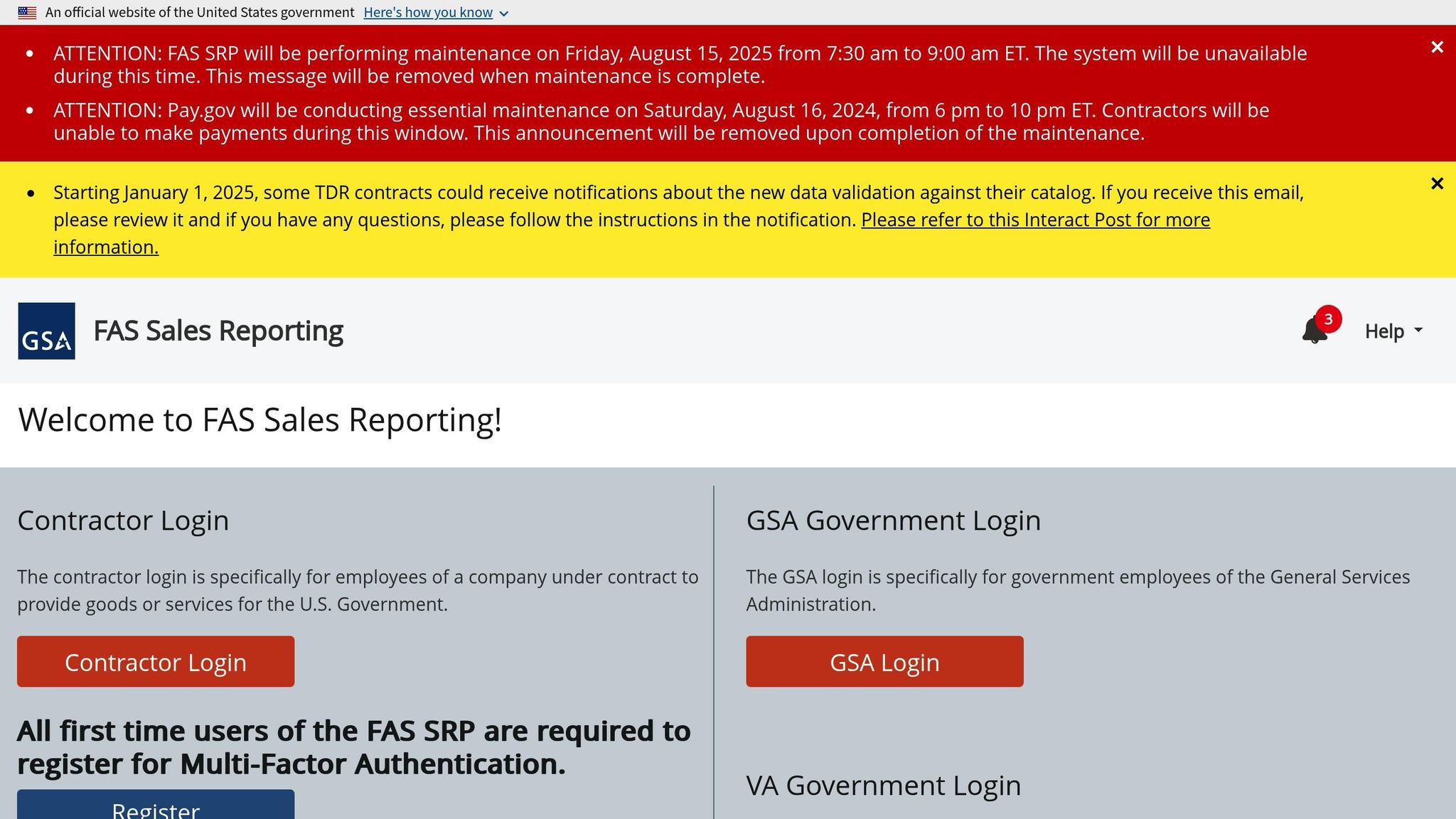
Whether you’re submitting quarterly summaries or monthly detailed reports, the Federal Acquisition Service (FAS) Sales Reporting Portal simplifies the process. This portal serves as a centralized platform for reporting sales data and managing IFF payments.
For contractors using the traditional quarterly reporting method, you’ll enter total aggregate sales figures for each SIN, and the portal will calculate the IFF for you. For those under TDR, you’ll need to provide detailed transaction data for every sale. Even if you have no sales during a reporting period, you’re still required to submit a zero-sales report to stay compliant. This consistent reporting not only meets compliance standards but also makes audits more straightforward.
Accurate and timely submissions through the FAS portal are essential for maintaining compliance and ensuring you’re prepared for any audits that may arise.
2GIT FAS Sales Reporting Portal (SRP) Training for Quarterly Reporting – 5/25/2021
sbb-itb-8737801
Audit Preparation and Recordkeeping
GSA audits are designed to ensure contractors provide their best pricing and honor the lowest price commitments under their GSA Schedule contracts. These audits primarily focus on companies using traditional Commercial Sales Practices (CSP) GSA Schedule contracts, which require contractors to validate pricing by showing past commercial sales. Failure to comply with these requirements can lead to penalties or legal consequences.
Required Documentation for GSA Audits
Thorough documentation is the backbone of a successful GSA audit. Your accounting system plays a key role here – it must demonstrate the proper classification of Order-Level Materials (OLMs) as GSA items, monitor the 33.33% order limit, and support accuracy checks through detailed sales reports and sample orders.
Sales data is another vital element. It’s crucial to separate open market items from GSA sales and regularly flag any inconsistencies to ensure accurate audit results.
You’ll also need Standard Operating Procedures (SOPs) that outline how OLMs are identified as GSA items, assign responsibilities, and define processes for retrieving quotes. These procedures must include guidelines for retaining records of OLMs that exceed the Simplified Acquisition Threshold (SAT). Additionally, sales and contract management teams should be well-trained and adhere consistently to these SOPs.
Invoice documentation is equally important. Clearly identify OLMs on invoices and maintain organized records of order types, quotes, market research, and compliance documentation.
Other essential records include market research documentation that supports Contracting Officer price reasonableness determinations. Keep your Authorized Federal Supply Schedule (FSS) price list up to date and maintain compliance records that demonstrate adherence to the Trade Agreements Act (TAA) and Multiple Award Schedule (MAS) standards.
Finally, ensure that sales reporting records correctly reflect OLM sales under the appropriate Special Item Number (SIN).
Best Practices for Maintaining Compliance
Keep your documentation organized and easily accessible. Schedule monthly updates to log every transaction and adjustment accurately. This proactive approach helps you avoid the last-minute rush when an audit notification arrives.
Consider using contract management software to automate audit reminders. These tools reduce administrative workload and ensure nothing is overlooked. Regularly review and update your SOPs, and provide ongoing training for your team to reduce compliance risks.
Establish clear processes for retrieving quotes and retaining records, especially for OLMs exceeding the SAT. By maintaining a systematic and consistent recordkeeping process, you’ll simplify audits and minimize potential issues.
How GSA Focus Supports Small Businesses
For many small businesses, managing GSA reporting requirements can feel like an uphill battle. Between tracking sales, handling IFF payments, preparing for audits, and staying on top of compliance documentation, the workload can quickly overwhelm even the most organized business owner. That’s why so many turn to experienced partners like GSA Focus to help them navigate these challenges and keep their GSA Schedule contracts on track.
Full-Service GSA Contract Management
GSA Focus takes a done-for-you approach to GSA contract management, offering end-to-end support that covers everything from acquiring a GSA contract to maintaining compliance. With their help, small business owners can avoid the steep learning curve of becoming GSA experts themselves and instead focus on what they do best – running their businesses.
Their services include everything from preparing necessary documents and staying on top of compliance updates to providing negotiation support. Whether it’s during the initial contract acquisition or when modifications and reporting issues arise, GSA Focus steps in to communicate directly with government officials, ensuring concerns are resolved efficiently.
Additionally, GSA Focus offers a secure online platform that simplifies the process of uploading and managing required documents. This not only saves time but also ensures that sensitive business information is handled in accordance with government data security standards.
Benefits of Partnering with GSA Focus
The biggest win for small businesses partnering with GSA Focus? Time. By outsourcing tasks like sales reporting, IFF payment calculations, and audit preparation, business owners can shift their energy toward growing their operations instead of getting bogged down in administrative details.
GSA Focus boasts an impressive 98% success rate in securing GSA contracts, a testament to their expertise. They even back their services with a refund guarantee, offering small businesses peace of mind by reducing the financial risk of entering the federal contracting space.
But their support doesn’t stop at compliance. GSA Focus provides ongoing strategic guidance to help businesses maximize their federal contracting opportunities. They also offer marketing services tailored specifically for GSA contractors, helping businesses showcase their capabilities and win more contracts.
With a combination of deep expertise, reliable systems, and continuous support, GSA Focus proves to be a trusted partner for small businesses looking to succeed in the federal marketplace – without the need to build in-house GSA expertise.
Conclusion and Key Takeaways
Navigating GSA reporting requirements is a critical responsibility for every GSA Schedule contract holder. The consequences of non-compliance – whether it’s with sales tracking, IFF payments, or audit obligations – are serious and could lead to contract suspension or even termination. This means losing access to lucrative federal contracting opportunities.
To stay on track, focus on the essentials: maintain accurate sales records, ensure on-time quarterly IFF payments through the FAS Sales Reporting Portal, and prepare detailed documentation for audits. Remember, only properly categorized GSA sales contribute to meeting minimum thresholds, but all federal transactions must still be tracked.
For those using Transactional Data Reporting (TDR), the stakes are even higher. TDR demands detailed transaction-level data and precise recordkeeping, which can be overwhelming without expert guidance.
Managing compliance can be especially challenging for small businesses with limited resources. That’s where GSA Focus comes in, offering a solution backed by a 98% success rate. Their services help simplify compliance management, giving you the tools to focus on growing your federal contracts.
Whether you handle reporting in-house or partner with experts like GSA Focus, the key is consistency and accuracy. By adopting efficient reporting practices, you can protect your federal contracting opportunities and set your business up for long-term success.
FAQs
What happens if I don’t meet GSA reporting requirements?
Failing to meet GSA reporting requirements can lead to some serious headaches. We’re talking about the potential termination of your GSA Schedule Contract, hefty financial penalties, and even suspension or debarment from federal contracting opportunities. On top of that, missing the mark on specific obligations – like transactional data reporting or staying compliant with the Trade Agreements Act (TAA) – could result in legal troubles and harm to your business’s reputation.
The stakes are high, but the solution is simple: stay on top of your reporting duties. This means keeping accurate sales records, paying the Industrial Funding Fee (IFF) on time, and being fully prepared for audits. Feeling overwhelmed? Partnering with experts like GSA Focus can make all the difference. They’ll help you navigate the requirements and safeguard your federal contracting opportunities.
How can small businesses manage GSA reporting and compliance without internal expertise?
Small businesses looking to navigate GSA reporting and compliance can benefit greatly from teaming up with professional services that focus on managing GSA Schedules. These specialists streamline the entire process, helping businesses meet reporting requirements and maintain compliance without unnecessary stress.
On top of that, tapping into resources like GSA’s Small Business Support Programs and official compliance guides can be a game-changer. Staying informed about obligations through these tools not only reduces common mistakes but also ensures that operations remain in line with federal contracting standards.
How can I accurately track GSA sales and prepare for audits?
To properly track GSA sales and stay audit-ready, it’s crucial to establish systems that clearly separate GSA transactions from your regular commercial sales. This makes it easier to monitor compliance and ensures you’re always prepared for scrutiny.
Make it a habit to keep detailed, well-organized records of all sales. Train your team thoroughly on GSA compliance policies so everyone is on the same page. Additionally, schedule periodic internal reviews to catch and resolve any potential issues before they grow into larger problems. These proactive steps can help you stay compliant and confidently navigate any GSA audit.
Related posts
- How to Track GSA Contract Compliance
- How to Track Federal Sales with GSA Tools
- Top 5 Compliance Issues in GSA Contracts
- Ultimate Guide to GSA Compliance Standards