

The GSA Multiple Award Schedule (MAS) is a long-term government-wide contract vehicle administered by the General Services Administration that pre-negotiates pricing, terms, and conditions with commercial vendors. Federal agencies then buy directly from approved vendors without running a full procurement competition each time. The program facilitates over $50 billion in annual federal sales, making it one of the largest and most accessible contracting vehicles available to small and medium-sized businesses. If you sell products or services that the government buys, a MAS contract puts you on the approved vendors list and opens the door to thousands of federal buyers.
What are the benefits of a GSA Multiple Award Schedule contract?
A MAS contract gives your business direct access to the federal marketplace without competing in a full open-market solicitation every time an agency needs something. That is a significant structural advantage. Federal contracting officers can place orders directly from your schedule, which cuts weeks or months off the typical procurement cycle.
The core benefits for small and medium-sized businesses include:
- Pre-negotiated pricing and terms. GSA reviews and approves your rates upfront. Agencies trust those rates, which removes the back-and-forth of individual negotiations.
- Reduced competition burden. For orders under $250,000, a contracting officer can place an order with a single MAS holder after reviewing the schedule. You do not need to win a full competitive bid every time.
- Credibility with federal buyers. Being on the GSA vendors list signals that your business has passed a federal vetting process. Agencies treat that as a trust signal.
- Faster order cycles. Agencies can issue task orders against your contract within days, not months.
- Marketing visibility. Your offerings appear on GSA Advantage, a federal e-commerce platform where agencies actively search for vendors.
The schedule also works well for businesses targeting specific agency categories. IT firms, professional service providers, security companies, and office supply vendors all find active demand on the schedule.
Pro Tip: Register your business in SAM.gov before starting your MAS application. An active SAM.gov registration is a hard requirement, and lapses will stall your offer.

How do you qualify and apply for a GSA Multiple Award Schedule contract?
Eligibility for a MAS contract centers on two core requirements: your business must be financially responsible, and it must have at least two years of operating history. GSA reviews financial statements, past performance references, and pricing data to confirm both. Newer businesses are not automatically excluded. The Startup Springboard program allows qualifying startups to demonstrate financial responsibility through alternative documentation, bypassing the standard two-year rule.
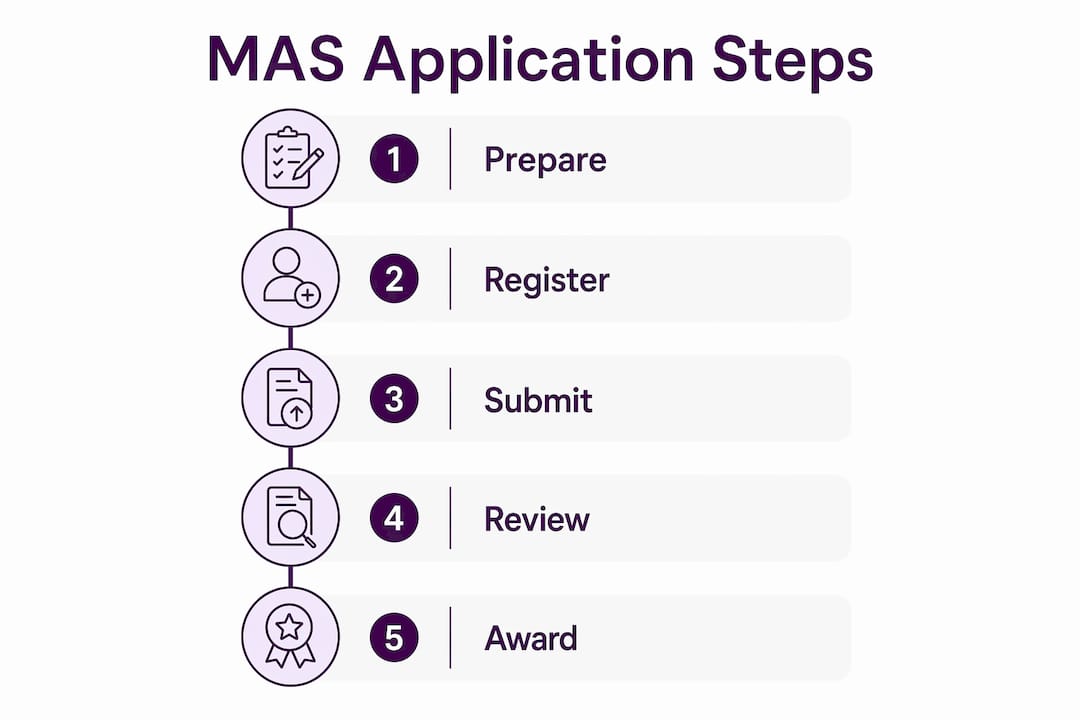
The application process follows a clear sequence:
- Complete “Pathways to Success” training. This mandatory GSA course takes 3–4 hours and covers MAS program rules, compliance expectations, and ordering procedures. You cannot submit an offer without completing it.
- Select your Special Item Numbers (SINs). SINs are the specific product or service categories under which you will sell. Choosing the right SINs is one of the most consequential decisions in the application. Too broad and GSA may push back; too narrow and you limit your market.
- Prepare your offer package. This includes commercial price lists, financial statements, past performance references, and a Technical Proposal. Each SIN has specific documentation requirements.
- Submit via GSA eOffer. The eOffer portal is the official submission system. You upload all documents there and track your offer status.
- Negotiate with your Contracting Officer. GSA will review your pricing and may request adjustments before awarding the contract.
- Receive your award. The typical timeline from submission to award runs 4–6 months. Complex offers with many SINs can take longer.
Pro Tip: Pricing is the most common reason GSA rejects or delays offers. Document every price you submit with commercial invoices, published price lists, or market data. Unsupported pricing triggers lengthy back-and-forth with your Contracting Officer.
If you provide professional services, the GSA professional service schedule application has specific documentation requirements worth reviewing before you start.
What is the structure of a GSA MAS contract and how does ordering work?
A MAS contract is not a single purchase order. It is a master agreement between your business and GSA that authorizes federal agencies to place orders against it. Understanding the structure helps you manage it correctly after award.
Key contract components
The contract includes a base period of five years, with three five-year option periods available. That gives you up to 20 years of potential contract life if GSA exercises all options. Your approved SINs, pricing, and terms all live within this master contract. The MAS covers more than 30 Large Categories including information technology, professional services, security, and office furniture. Each Large Category contains multiple SINs that define what you are authorized to sell.
How agencies place orders
GSA itself does not purchase products or services. Federal agencies are the actual buyers. They issue task orders or delivery orders directly against your MAS contract. For orders above $250,000, agencies must conduct a fair opportunity mini-competition among MAS holders with relevant SINs. This is sometimes called the “Rule of Three,” where at least three qualified vendors receive consideration. Agencies use GSA eBuy, a request-for-quote platform, to solicit responses from schedule holders.
Two ordering flexibilities expand what you can offer:
- Order-Level Materials (OLM). OLM allows you to include incidental materials not on your schedule when fulfilling a task order. This prevents you from losing a contract because a small ancillary item is not on your approved list.
- Contractor Team Arrangements (CTAs). CTAs let two or more MAS holders team up to fulfill an order that neither could handle alone. These flexibilities make the schedule competitive with larger prime contractors.
Pro Tip: Monitor GSA eBuy daily once your contract is active. Agencies post RFQs with short response windows, sometimes 48–72 hours. Missing them means missing revenue.
How to manage and market your GSA Schedule contract after award
Winning the contract is not the finish line. Active sales effort and compliance are what turn a MAS contract into actual revenue. Many businesses receive their award and then wait for orders that never come. That is the most common mistake in federal contracting.
Effective post-award management requires attention to several areas:
- Keep your GSA Advantage listings current. Agencies search GSA Advantage when looking for vendors. Outdated pricing or product descriptions make you invisible or, worse, non-compliant.
- Submit quarterly sales reports and pay the Industrial Funding Fee (IFF). These are mandatory compliance obligations. The IFF is a small percentage of your MAS sales that funds GSA operations. Missing reports can trigger contract termination.
- Respond to every relevant RFQ on GSA eBuy. Even if you do not win, responding builds your past performance record and puts your name in front of contracting officers.
- File contract modifications when needed. Modifications are routine and cover adding SINs, updating pricing, or refreshing contract terms. Staying current keeps you competitive and compliant.
- Build agency relationships. Contracting officers remember vendors who respond quickly, deliver well, and communicate clearly. Repeat task orders follow strong relationships.
For contractors looking to grow federal revenue, proven MAS sales strategies go well beyond simply holding a contract. Proactive outreach, capability statements, and agency-specific marketing all drive results.
Pro Tip: Pair your MAS marketing with a structured outreach plan. A marketing automation checklist built for small businesses can help you stay consistent with agency follow-ups without burning out your team.
Key Takeaways
A GSA Multiple Award Schedule contract gives small and medium-sized businesses a pre-approved pathway into the federal marketplace, but only active management, accurate pricing, and consistent marketing convert that access into real revenue.
| Point | Details |
|---|---|
| MAS scale and access | The program drives over $50 billion in annual federal sales across thousands of vendors. |
| Application timeline | Plan for a 4–6 month process from offer submission to contract award. |
| SIN selection matters | Choosing the right Special Item Numbers defines your market reach and affects approval speed. |
| Compliance is non-negotiable | Quarterly sales reports, IFF payments, and accurate listings are required to keep your contract active. |
| Active marketing drives revenue | Holding a MAS contract does not guarantee orders. Responding to RFQs and building agency relationships does. |
Why I think most businesses misread the GSA schedule
Most contractors treat the MAS contract like a lottery ticket. They spend months on the application, get the award, and then assume federal agencies will find them. That is not how it works. I have seen businesses with excellent offerings sit on dormant contracts for years because they never built a real outreach plan.
The schedule is a permission slip, not a pipeline. The permission slip matters enormously. Without it, you cannot even respond to most federal RFQs. But the pipeline requires work that has nothing to do with the contract itself. It requires knowing which agencies buy what you sell, when their fiscal year budgets flush, and which contracting officers handle your category.
The compliance side also trips people up more than they expect. Pricing mistakes are the most common issue. If your commercial prices drop and you do not update your MAS rates, you can end up in a Most Favored Customer pricing dispute with GSA. That is a serious problem. The fix is simple: treat your contract like a living document and review it quarterly.
The businesses I have seen succeed on the schedule share one trait. They treat their MAS contract as a sales channel that requires the same attention as any other channel, not a credential to frame on the wall.
— Josh
How Gsascheduleservices helps you get on and stay on the schedule
Gsascheduleservices works with small and medium-sized businesses at every stage of the MAS process, from readiness assessments and offer preparation to post-award compliance and agency marketing. The team handles the documentation, pricing support, and negotiation prep that slow most first-time applicants down. If you already hold a contract and need help with modifications, sales reporting, or growing your federal pipeline, Gsascheduleservices covers that too. Visit the GSA discovery page to talk through where your business stands and what it would take to move forward.
FAQ
What is a GSA Multiple Award Schedule contract?
A GSA Multiple Award Schedule is a long-term government-wide contract vehicle that pre-negotiates pricing and terms between GSA and commercial vendors, allowing federal agencies to purchase directly without a full competition.
How long does it take to get a GSA schedule?
The process from offer submission to contract award typically takes 4–6 months, though complex offers with multiple SINs can take longer.
Can a startup qualify for a MAS contract?
Yes. The Startup Springboard program allows newer businesses to qualify before meeting the standard two-year operating history requirement by demonstrating financial responsibility through alternative documentation.
What is the Industrial Funding Fee?
The Industrial Funding Fee (IFF) is a small percentage of MAS sales that contractors remit to GSA quarterly. It funds the administration of the MAS program and is a mandatory compliance requirement.
Do agencies have to compete orders under the MAS?
For orders above $250,000, agencies must give fair opportunity to multiple MAS holders through a mini-competition. For smaller orders, a contracting officer can place an order with a single schedule holder after reviewing available options.
Recommended
- Government Contract Opportunities 2026: SME Guide
- News: GSA’s Multiple Award Schedule Program | GSA Focus Blog
- GSA Schedule Contracts: Your Guide to Success
- GSA Contract Eligibility Criteria – Quick Guide