

The GSA FSS, formally known as the Federal Supply Schedule, is a long-term pre-negotiated contracting vehicle that allows approved businesses to sell products and services directly to federal agencies at set prices without a full competitive procurement each time. Managed by the General Services Administration (GSA), the program gives small and medium-sized businesses a direct path into federal procurement. The Federal Supply Schedule covers thousands of commercial products and services across dozens of categories, making it one of the broadest contracting tools available to government vendors today.
What are the eligibility requirements for a GSA FSS contract?
Qualifying for a GSA FSS contract requires meeting several mandatory criteria before you submit a single page of paperwork. The GSA does not accept applications from businesses that cannot demonstrate financial stability, relevant experience, and regulatory compliance. Getting these foundations right before you apply saves weeks of back-and-forth with the contracting office.
The core eligibility requirements are:
- Two years of operation. Businesses need at least 2 years of financial documentation, including balance sheets and income statements, to qualify. This requirement exists because the GSA needs proof that your company can sustain a long-term federal contract.
- SAM.gov registration. Every applicant must hold an active registration in the System for Award Management before submitting a GSA Schedule offer. Without it, your application cannot be processed.
- Pathways to Success training. GSA requires all new applicants to complete this online training course. It covers your obligations as a Schedule contractor and takes roughly two hours to finish.
- Past performance references. You need documented evidence of delivering similar products or services to commercial or government customers. Strong references reduce the risk of a contracting officer rejecting your offer.
- Trade Agreements Act (TAA) compliance. Products offered on the Schedule must be manufactured or substantially transformed in a TAA-designated country. This rule applies to physical goods, not services.
- Special Item Number (SIN) selection. Each SIN requires specific documentation and defines the scope of what you can sell under your contract. Choosing the wrong SINs limits your reach and can delay approval.
Newer companies that do not yet meet the two-year requirement have one option worth knowing: the GSA Startup Springboard program. This pathway allows qualifying firms to apply with less than two years of history, provided they meet alternative financial and performance criteria. Gsascheduleservices covers the Startup Springboard program in detail for businesses that fall into this category.
Pro Tip: Before you begin your application, pull together two full years of tax returns, financial statements, and at least three customer references. Having these documents ready cuts your preparation time significantly.

How does pricing and ordering work under GSA FSS contracts?
GSA Schedule pricing follows a “fair and reasonable” standard, meaning your offered prices must align with what your best commercial customers pay. The GSA reviews pricing through market research and transactional data submitted during the application process. As of 2026, the Price Reduction Clause was removed, which gives vendors more flexibility in managing commercial pricing changes without triggering automatic Schedule price adjustments.
The ordering process works in three distinct tiers, governed by FAR Part 8:
- Orders under $10,000. The contracting officer can place an order with any Schedule contractor without soliciting multiple quotes. This is the simplest and fastest ordering mechanism.
- Orders between $10,000 and $250,000. FAR Part 8 requires quotes from multiple Schedule contractors at this level. The agency must review at least three quotes before awarding an order.
- Orders above $250,000. A mini-competition among Schedule holders is required. The agency posts a Request for Quotation (RFQ) and evaluates responses before selecting a vendor.
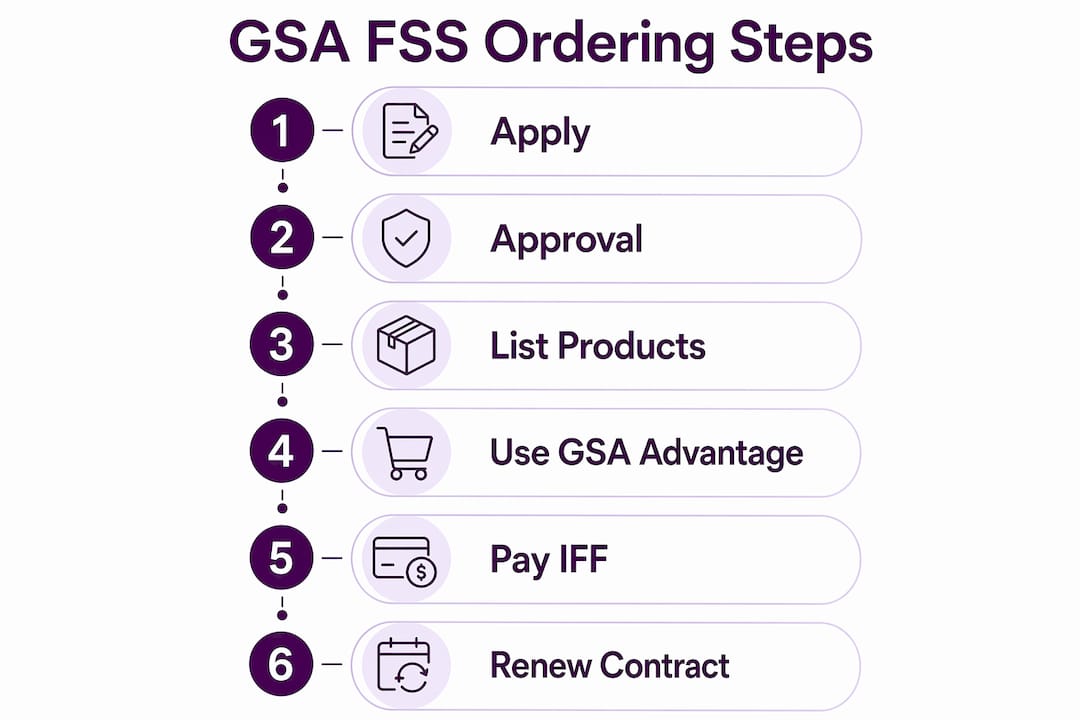
Two platforms drive most Schedule ordering activity. GSA Advantage is the primary catalog for products, where agencies browse and purchase directly. GSA eBuy handles services and larger, more complex orders through a formal RFQ process. Monitoring GSA eBuy activity daily is one of the most direct ways to find active procurement opportunities in your category.
Every Schedule contractor also pays an Industrial Funding Fee (IFF) of 0.75% on all sales made through the Schedule. The IFF is collected quarterly and reported through the GSA’s 72A Reporting System. This fee funds the GSA’s administration of the Schedule program, and failing to report sales accurately is one of the most common compliance violations contractors face.
What are best practices for managing a GSA FSS contract?
Holding a Schedule contract is not the same as generating revenue from it. The GSA Schedule is a marketing tool, not a guaranteed revenue source. Contractors who treat it as a passive listing consistently underperform against those who actively work the contract.
The practices that separate high-performing Schedule holders from low-performing ones include:
- Keep your GSA Advantage listings current. Outdated pricing, discontinued products, or missing descriptions make your listings invisible in agency searches. Review your catalog at least quarterly.
- Respond to every relevant eBuy RFQ. Agencies post RFQs with tight deadlines. Missing a response window means missing the opportunity entirely. Set up eBuy email alerts for your SIN categories.
- Report sales and pay IFF on time. Late or inaccurate reporting triggers audits and can put your contract at risk. The 72A Reporting System is straightforward once you build a quarterly reporting habit.
- File contract modifications when your offerings change. Adding new products, adjusting prices, or updating labor categories all require a formal modification. Selling items not listed on your contract is a compliance violation.
- Use subcontracting to expand your reach. Small business set-asides and subcontracting can be used within Schedule orders to meet federal small business goals. Partnering with a larger prime contractor is a proven way to build past performance while your own contract gains traction.
The GSA Schedule contract period includes a base year plus four option years, with renewals possible up to 20 years total. That long runway rewards contractors who invest consistently in contract maintenance and federal relationship building.
Pro Tip: Assign one person internally to own your Schedule contract. Divided responsibility is the leading cause of missed RFQs, late IFF payments, and lapsed modifications.
How does the GSA FSS compare to other federal contracting vehicles?
The Federal Supply Schedule is a broad commercial item contracting vehicle. It covers products and services across virtually every category a federal agency might need, from office supplies to professional consulting. That breadth makes it the right starting point for most small and medium-sized businesses entering federal contracting.
Government-Wide Acquisition Contracts (GWACs) are the main alternative worth understanding. GWACs focus specifically on IT products and services and use a different procurement process that typically requires a separate, competitive application. Agencies use GWACs when they need IT solutions at scale and want a vehicle purpose-built for technology procurement. The GSA Schedule works better for businesses offering a mix of commercial products and services that do not fit neatly into an IT-only category.
Set-aside rules give small businesses a concrete advantage within the Schedule program. Contracting officers can restrict orders to small or disadvantaged businesses, meaning your size status can become a competitive asset rather than a liability. Certifications like 8(a), HUBZone, WOSB, and SDVOSB all apply within the Schedule ordering process. Pairing a Schedule contract with one of these certifications significantly increases your visibility to agencies with set-aside spending goals.
The GSA Schedule also fits well alongside a broader federal marketing strategy, since visibility in federal procurement often mirrors visibility in commercial markets. Agencies search for vendors the same way buyers do: they look for clear offerings, credible references, and competitive pricing.
Key Takeaways
The GSA Federal Supply Schedule is a pre-negotiated contracting vehicle that requires active management, accurate pricing, and consistent marketing to generate real federal revenue.
| Point | Details |
|---|---|
| Eligibility baseline | Businesses need two years of financials, SAM.gov registration, and TAA-compliant offerings to qualify. |
| Pricing standard | GSA pricing must be fair and reasonable, with a 0.75% IFF paid quarterly on all Schedule sales. |
| Ordering thresholds | FAR Part 8 governs orders: quotes from multiple vendors are required for orders above $10,000. |
| Active marketing required | Monitoring eBuy and responding to RFQs is the primary driver of Schedule sales, not passive listing. |
| Contract longevity | The Schedule runs up to 20 years total, rewarding contractors who invest in long-term compliance and growth. |
The uncomfortable truth about GSA Schedule success
Most businesses that struggle with their GSA Schedule share one misconception: they believed the contract would bring buyers to them. It does not work that way. The Schedule is a permission slip, not a pipeline.
What I have seen consistently is that the contractors who win orders are the ones treating their Schedule like a sales territory. They log into eBuy every morning. They update their GSA Advantage listings before agencies start their fiscal year spending in september and october. They know their SIN categories well enough to spot an RFQ that fits them before their competitors do.
The FAR Part 8 ordering thresholds matter more than most new contractors realize. The $10,000 to $250,000 range is where most small business Schedule orders land. That means an agency buyer can award you a contract with just three quotes. You do not need to be the cheapest. You need to be visible, responsive, and credible when the RFQ lands.
The other thing worth saying plainly: GSA Schedule compliance is not optional and it is not light work. The IFF, the modification process, the sales reporting, the catalog maintenance. These tasks add up. Businesses that underestimate the administrative load either fall out of compliance or let their contract go dormant. Neither outcome is recoverable quickly.
My honest advice is to treat your first year on the Schedule as an investment period. Build your eBuy response process. Get your catalog right. Establish your reporting rhythm. The revenue follows contractors who do the work.
— Josh
How Gsascheduleservices helps you succeed with GSA FSS contracts
Getting a GSA Schedule contract approved is only the beginning. Gsascheduleservices works with small and medium-sized businesses at every stage of the process, from initial eligibility assessments and SIN selection through application preparation, pricing negotiation, and ongoing compliance support. The team handles the paperwork-heavy parts of the process so you can focus on building federal relationships and responding to opportunities.
If you are unsure whether your business qualifies, or you want expert guidance before committing to the application process, the GSA readiness assessment is the right starting point. Gsascheduleservices has helped businesses cut application timelines and avoid the compliance mistakes that put contracts at risk.
FAQ
What is a GSA FSS contract?
A GSA FSS contract is a pre-negotiated agreement between a business and the federal government that allows federal agencies to purchase products or services at approved prices without running a full competitive procurement each time.
How long does it take to get a GSA Schedule?
The application and review process typically takes several months, depending on the completeness of your submission and the volume of applications the GSA is processing at the time.
What is the Industrial Funding Fee?
The Industrial Funding Fee (IFF) is a 0.75% fee that Schedule contractors pay quarterly on all sales made through the GSA Schedule. It funds the GSA’s administration of the program.
Do I need SAM.gov registration to apply for a GSA FSS contract?
Yes. Active SAM.gov registration is a mandatory requirement before submitting a GSA Schedule offer. Your registration must remain active for the life of your contract.
Can newer businesses apply for a GSA Schedule?
Yes. The GSA Startup Springboard program provides an alternative pathway for businesses that do not yet meet the standard two-year operating history requirement, subject to additional financial and performance criteria.
Recommended
- Government Contract Opportunities 2026: SME Guide
- GSA Contracts for Dummies
- GSA Contract Eligibility Criteria – Quick Guide
- GSA Contract Eligibility Criteria – Quick Guide