
The GSA Disaster Purchasing program lets eligible state and local governments buy directly from GSA Multiple Award Schedule contracts under 40 U.S.C. 502(d) whenever a disaster hits. It covers preparedness, response, and recovery work, including recovery from a presidentially declared Stafford Act disaster or a terrorism, nuclear, biological, chemical, or radiological attack. For contractors, it means schedule holders can serve buyers they’d never reach through a standard federal task order.
TL;DR:
- Disaster Purchasing only applies to Multiple Award Schedule contracts and specific Blanket Purchase Agreements, excluding GWACs and open-market buys.
- Eligibility depends on a valid Stafford Act disaster declaration, and buyers must confirm their jurisdiction’s approval and documentation before ordering.
- Contractors must update their eLibrary profiles, prepare order templates, and train staff to recognize and process disaster orders promptly.
- Orders must state the statutory basis, disaster name, declaration number, and buyer eligibility, with proper documentation retained for audit purposes.
- Preparation, including profile updates and clear procedures, avoids missed opportunities during crises, as most contractors lose orders due to unpreparedness, not pricing.
Table of Contents
- What Legal Authority Backs GSA Disaster Purchasing?
- Who Can Use Disaster Purchasing and When?
- What Can Agencies Buy, and Which Tools Help?
- How Do Contractors Enable Disaster Purchasing?
- What Order Language and Compliance Steps Are Required?
- What Are the Benefits and Limits of Disaster Purchasing?
- Where Should Buyers and Contractors Start Right Now?
- What I’ve Learned Watching Contractors Miss This Opportunity
- How Gsascheduleservices Helps Contractors Get Disaster-Ready
- Sources
- FAQ
What Legal Authority Backs GSA Disaster Purchasing?
Two statutes make this program work. 40 U.S.C. 502(d) gives GSA the power to authorize state and local governments to use federal supply schedules for disaster needs, and Section 833 of the John Warner National Defense Authorization Act for Fiscal Year 2007 extended that access further. A 2016 Federal Register final rule folded these authorities, along with the Federal Supply Schedule Usage Act of 2010, into the General Services Administration Acquisition Regulation.
Here’s the part contractors sometimes miss: Disaster Purchasing only reaches Multiple Award Schedule contracts and specific Blanket Purchase Agreements built on top of them. It doesn’t touch GWACs, other indefinite delivery vehicles, or open-market purchases. The Department of Homeland Security and GSA guidance confirms that once a contractor holds a MAS award, all products and services on that schedule become eligible for Disaster Purchasing orders, not just a narrow disaster-specific subset.
Who Can Use Disaster Purchasing and When?
Eligibility runs through the same definitions GSAM uses for state and local government access: states, territories, cities, counties, and certain other qualified organizations authorized to act on their behalf. The American National Red Cross, operating under its federal charter, is one recognized example, and organizations coordinating through voluntary disaster networks may qualify when GSA guidance extends access to them.
The primary trigger is a presidential disaster declaration under the Stafford Act, which FEMA tracks and manages. Some public health emergencies also open the door where separate authority allows it. What doesn’t change is the buyer’s own obligation to confirm the purchase fits the disaster purpose and their jurisdiction’s procurement rules.
Buyer responsibilities include:
- Confirming an active Stafford Act declaration or another qualifying emergency actually covers the purchase.
- Checking state or local procurement law for any added approval steps or spending caps.
- Documenting that the item or service supports preparedness, response, or recovery, not routine operations.
- Verifying the vendor’s MAS contract actually covers the item being ordered.
GSA has been direct on one point worth repeating: a contractor can’t extend its own eligibility to a buyer. The buyer verifies eligibility, not the seller.
What Can Agencies Buy, and Which Tools Help?
Any product or service on a contractor’s Multiple Award Schedule qualifies for Disaster Purchasing, according to GSA’s own program guidance. That’s a broader scope than many buyers assume. It’s not a curated disaster catalog. It’s the entire schedule.
In practice, recurring categories show up again and again in GSA’s Protecting What Matters brochure:
- Temporary housing units and modular structures
- Generators, portable power, and fuel-handling equipment
- Debris removal, cleanup, and remediation services
- Water purification and bottled water supply
- Security services and professional consulting support
Three e-tools carry the workflow. GSAAdvantage works like a federal storefront for researching what’s available and at what price. GSA eLibrary lets a buyer confirm whether a specific contractor participates in Disaster Purchasing, marked by a dedicated icon on the contractor’s schedule listing. eBuy handles requests for quotes when a buyer wants competition among multiple schedule holders before committing.
Pro Tip: Don’t assume GSAAdvantage lets you check out directly for every purchase. Many state and local buyers still have to route the order through their own procurement system even after finding the item on GSAAdvantage, so confirm your agency’s internal process before you start shopping.
How Do Contractors Enable Disaster Purchasing?
Accepting Disaster Purchasing orders isn’t automatic. It’s a choice, and it needs to show up in the right places for buyers to find you.
- Decide your participation level. Some contractors accept Disaster Purchasing orders contract-wide; others evaluate case by case. Either is allowed, since participation stays voluntary on the vendor side.
- Update your eLibrary profile. This step triggers the Disaster Purchasing icon buyers search for. A schedule holder that skips this step is functionally invisible during a disaster response window, even with a fully active contract.
- Draft your order-language templates now, not during a crisis. Have wording ready that confirms the order falls under 40 U.S.C. 502(d) and references the applicable disaster declaration.
- Train your sales and contracts staff to recognize a Disaster Purchasing request and know the acceptance or decline process cold.
- Review your Fourth Step registration settings to make sure your GSAAdvantage and eBuy listings match your current eLibrary profile.
Pro Tip: A vague eLibrary profile is the single biggest reason contractors miss disaster orders. Buyers under time pressure skip vendors whose listed capabilities don’t clearly match what they need. Specific product descriptions beat generic category tags every time.
What Order Language and Compliance Steps Are Required?
Every Disaster Purchasing order should state the statutory basis, the disaster declaration it responds to, and the buyer’s eligibility category. Sample language buyers can adapt: “This order is issued under the authority of 40 U.S.C. 502(d) in response to [disaster name/declaration number] for the purpose of disaster [preparedness/response/recovery].” Place that line in the order’s terms section or cover memo, not buried in an attachment.
Contractors retain the right to decline an order, and GSA guidance is explicit that nothing compels a schedule holder to fill every Disaster Purchasing request. Document any decline in writing with a brief reason, and document any acceptance the same way.
Compliance basics worth building into your standard process:
- Keep a copy of the disaster declaration or emergency authorization referenced on every order.
- Save written confirmation of the buyer’s eligibility determination.
- Retain order acceptance or decline correspondence for the same period as other MAS contract records.
- Route unusual or high-dollar requests to your compliance lead before confirming.
Buyers facing ambiguous eligibility questions should loop in procurement counsel early. Waiting until after the purchase creates far more paperwork than a five-minute call-up front.
What Are the Benefits and Limits of Disaster Purchasing?
The upside is real: negotiated MAS pricing, less time spent on a new solicitation, and the option to buy ahead of a disaster rather than scrambling during one. A public works department stocking generators before hurricane season, for instance, can use Disaster Purchasing preemptively rather than waiting for a declaration.
The limits matter just as much. Participation is voluntary on both sides, the scope stops at MAS contracts and authorized BPAs, and state or local procurement law can add restrictions GSA doesn’t control. One structural distinction is easy to miss: Disaster Purchasing opens the entire MAS catalog for qualifying uses, while Cooperative Purchasing, a separate GSA program, restricts state and local access to specific schedule categories like IT and law enforcement equipment. Confusing the two leads to rejected orders.
Where Should Buyers and Contractors Start Right Now?
Buyers: confirm the disaster declaration applies to your purchase, check eLibrary for vendors carrying the Disaster Purchasing icon, and clear the order with procurement counsel if the eligibility picture is unclear.
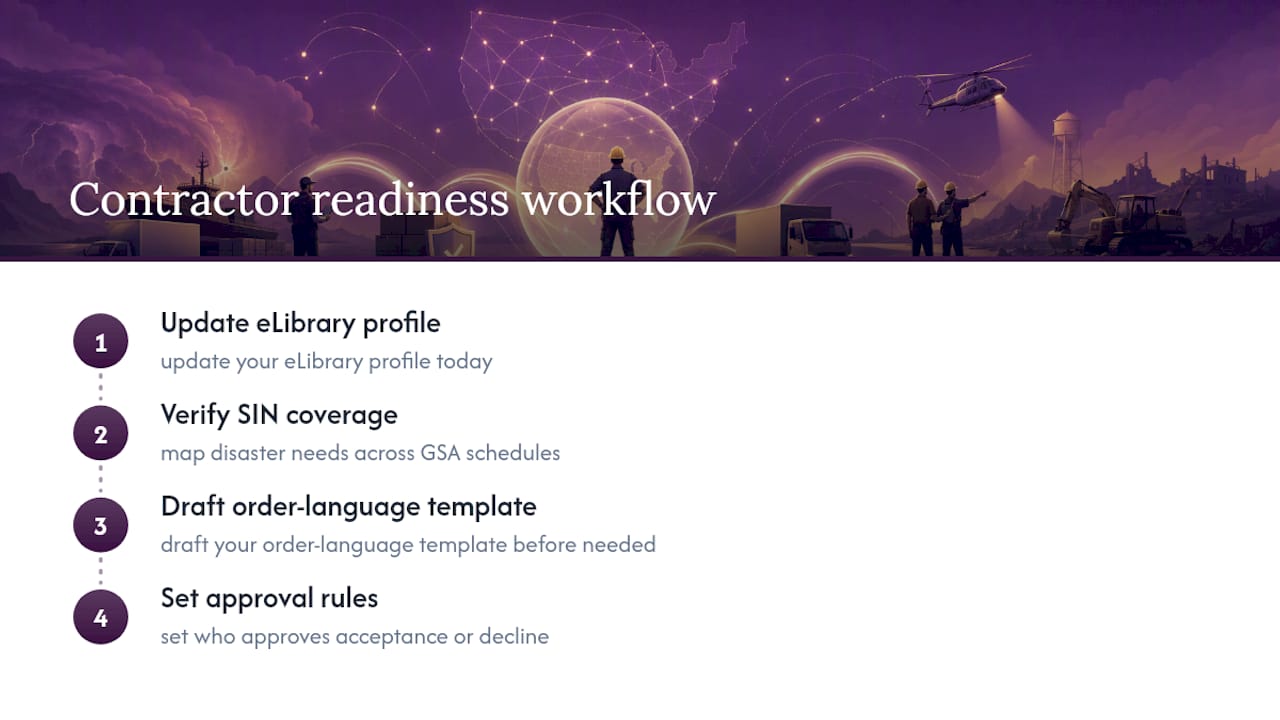
Contractors: update your eLibrary profile today, draft your order-language template before you need it, and set internal rules for who approves acceptance or decline. Review how disaster recovery needs map across GSA schedules if you’re unsure whether your current SINs qualify.
What I’ve Learned Watching Contractors Miss This Opportunity
The contractors who lose out on Disaster Purchasing orders almost never lose because their pricing was wrong. They lose because their eLibrary profile was outdated, or because nobody on staff knew whether to accept or decline an order that landed on a Friday afternoon during a hurricane response.
Preparation beats improvisation here every time. A contractor with a ready order-language template and a current profile responds in minutes. One without either loses the order to a competitor who was simply ready first. Build the checklist before the disaster, not during it.
— Josh
How Gsascheduleservices Helps Contractors Get Disaster-Ready
Most contractors treat Disaster Purchasing readiness as an afterthought, something to figure out after a hurricane warning goes up. That’s backward, and it’s exactly where expert consulting services step in to handle the groundwork, eLibrary profile updates, SIN-level readiness checks, and order-language templates, so schedules are visible and ready when a state or local buyer searches for a vendor mid-crisis.
If your MAS contract already exists but your Disaster Purchasing status is unclear, or you’re still working toward your first schedule award, a quick discovery call will tell you exactly where the gaps are and what it takes to close them before the next declared disaster, not after.
Sources
- Learn about Disaster Purchasing | GSA
- Federal Register: Final rule implementing access for non-federal entities (2016)
- Acquisition
- Protecting What Matters brochure (GSA Advantage PDF)
FAQ
Where Can I Find GSA Contracts for Disaster Purchasing?
Search GSA eLibrary for contractors displaying the Disaster Purchasing icon, then confirm pricing and availability through GSAAdvantage or a formal eBuy request for quote.
Who Can Buy off of a GSA Schedule Under This Program?
Eligible state and local governments, plus certain other qualified organizations like the American National Red Cross under its federal charter, may buy directly from MAS contracts for disaster preparedness, response, or recovery.
What Triggers Eligibility for GSA Disaster Purchasing?
A presidential disaster declaration under the Stafford Act is the primary trigger, though certain authorized public health emergencies can qualify as well; FEMA manages the list of active declarations.
Can a GSA Contractor Refuse a Disaster Purchasing Order?
Yes. Participation is voluntary for schedule holders, and a contractor may decline a Disaster Purchasing order, though documenting the decline in writing protects both parties.
Does Disaster Purchasing Cover Every GSA Schedule?
No. It applies only to Multiple Award Schedule contracts and authorized Blanket Purchase Agreements built on them, not to GWACs or other federal contract vehicles.
Recommended
- Disaster Recovery/Preparedness Now Across All GSA Schedules
- GSA eOffer process guide: Steps to secure your schedule contract
- Complete Guide to GSA Market Research | GSA Contract Holder
- GSA Contract Eligibility Criteria – Quick Guide