

Breaking into federal sales feels like trying to enter a locked building without a key. You know the opportunity is massive — GSA Schedules enable small businesses to sell directly to federal agencies through pre-approved contracts, opening access to a $600 billion-plus procurement market — but the application process is riddled with jargon, paperwork, and bureaucratic delays that stop most small and medium-sized businesses (SMBs) before they even start. This guide cuts through the confusion and gives you a practical, step-by-step strategy for preparing, applying, staying compliant, and growing real federal revenue.
Table of Contents
- What you need before you start: Prerequisites for federal sales success
- A step-by-step guide to winning your first GSA Schedule
- Avoiding costly mistakes: Compliance and common pitfalls
- Maximizing your contract: Post-award marketing and growth strategies
- Why proactive federal sales strategy beats ‘wait and hope’
- Accelerate your GSA sales journey with expert support
- Frequently asked questions
Key Takeaways
| Point | Details |
|---|---|
| Understand GSA basics | Qualifying for a GSA Schedule requires U.S. operations, financial stability, and registrations. |
| Follow a proven application process | Prepare documents, choose the right SIN, and expect a 3–6 month negotiation period. |
| Avoid compliance pitfalls | Mistakes like pricing errors or missed documentation can cause costly setbacks or audits. |
| Commit to active post-award sales | Sustained marketing and relationship-building are critical to turn a contract into real revenue. |
| Consultants can accelerate success | Expert help can reduce errors and cut time to approval, often leading to higher sales outcomes. |
What you need before you start: Prerequisites for federal sales success
Before you write a single word of your application, you need to confirm that your business actually qualifies. Many companies invest weeks of effort only to discover they’re missing a basic requirement. Checking the prerequisites first saves you time, money, and frustration.
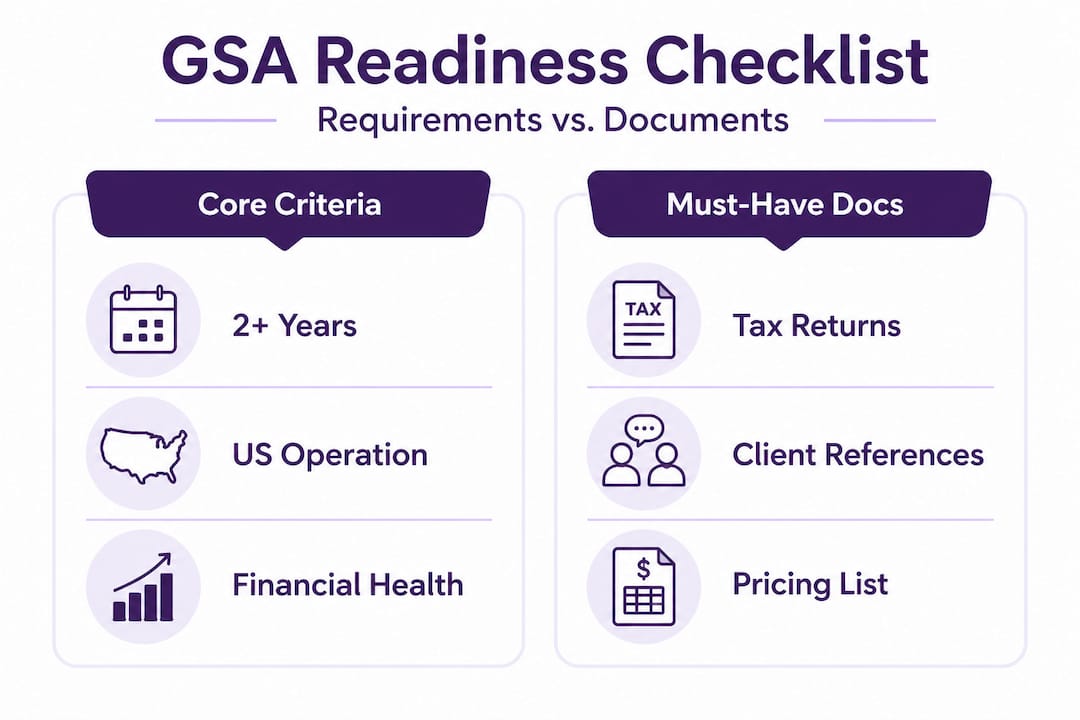
Core eligibility requirements
To qualify for a GSA Schedule, your business must meet several non-negotiable criteria. According to GSA’s official roadmap, you need at least two years of continuous operations, demonstrated financial stability, a physical U.S. office presence, for-profit status, active SAM.gov registration, and Trade Agreements Act (TAA) compliance for any products you sell. TAA compliance means your products must be manufactured or substantially transformed in the U.S. or a designated country.
Here’s a quick snapshot of what you need before applying:
| Requirement | Details |
|---|---|
| Business age | Minimum 2 years in operation |
| Financial health | Positive financials, no bankruptcy |
| U.S. presence | Physical office in the United States |
| SAM.gov registration | Active registration required |
| TAA compliance | Products from approved countries only |
| Business type | For-profit entities only |
Documents you must gather
Beyond eligibility, the GSA application demands a specific set of documents. Missing even one can trigger a clarification request that adds weeks to your timeline. Here’s what you need to prepare:
- Past performance references: At least two or three client references that demonstrate relevant experience, ideally with government or large commercial clients
- Financial statements: Two years of audited or reviewed financial statements showing revenue, expenses, and profitability
- Commercial Sales Practices (CSP) form: A detailed breakdown of your pricing structure and the discounts you offer your most favored commercial customer
- Product or service catalog: A complete list of what you’re offering under each Special Item Number (SIN), which is the category code used to classify your offerings
- Relevant certifications: Any industry certifications, quality standards (ISO, CMMI), or small business designations (8(a), HUBZone, WOSB)
Review your GSA Schedule eligibility status carefully before you start gathering documents. Knowing exactly where you stand helps you prioritize what to fix first.
Pro Tip: Create a shared digital folder with all your documents organized by category before you begin. Incomplete document packages are one of the top reasons applications stall. Being organized from day one can shave weeks off your approval timeline.
A step-by-step guide to winning your first GSA Schedule
Once prerequisites are met, you’re ready to start the application journey. Here’s how successful SMBs do it, in the right order.

The application process, step by step
The GSA application process follows a defined sequence: register on SAM.gov, select your SINs, prepare your full documentation package including financials, past performance, pricing, and your CSP form, submit through the eOffer system (GSA’s online application portal), and then enter the negotiation phase with a GSA contracting officer. The typical timeline with professional help runs three to six months. On your own, expect six to twelve months.
Here’s the step-by-step breakdown:
- Register on SAM.gov and confirm your registration is active and accurate
- Select your SINs carefully, matching your actual offerings to the right category codes
- Build your documentation package including all financials, past performance write-ups, and your CSP form
- Submit through eOffer, GSA’s secure online application portal
- Respond to clarification requests from your assigned contracting officer promptly and completely
- Negotiate pricing and terms with the contracting officer until both sides agree
- Receive your contract award and begin the post-award setup process
DIY vs. hiring a consultant
One of the most important decisions you’ll make is whether to navigate this process alone or bring in a consultant. Both paths have real trade-offs.
| Factor | DIY approach | With a consultant |
|---|---|---|
| Cost | Lower upfront | Higher upfront, faster ROI |
| Timeline | 6-12 months typical | 3-6 months typical |
| Error risk | Higher, especially for pricing | Significantly lower |
| Negotiation strength | Limited without experience | Expert-led, better outcomes |
| Learning curve | Steep | Minimal for the business owner |
If your team has the bandwidth and someone with federal procurement knowledge, DIY is possible. But for most SMBs, the GSA Schedule application process is complex enough that a consultant pays for itself in time saved and mistakes avoided. You might also be surprised to learn that you don’t need a legal team for GSA contracts — a specialized consulting firm handles the heavy lifting without the legal overhead.
“The GSA Schedule is not a shortcut — it’s a structured pathway. Businesses that treat it like a checkbox exercise consistently underperform those that invest in getting it right from the start.”
Pro Tip: When selecting your SINs, less is often more. Choosing too many SINs without strong past performance to back each one invites scrutiny and slows down approval. Start focused, then expand your offerings after award.
Avoiding costly mistakes: Compliance and common pitfalls
Even with a solid process, many SMBs stumble on details that can derail their efforts. Here’s what to watch for before, during, and after your application.
The most common application errors
Wrong SIN selection, pricing inconsistencies, TAA non-compliance, and incomplete financial submissions are the leading causes of clarification requests and outright rejections. Each one adds time and can signal to the contracting officer that your business isn’t ready for a federal contract.
Here are the pitfalls that trip up the most applicants:
- Mismatched SINs: Applying under a SIN that doesn’t align with your actual services or products
- Pricing inconsistencies: Offering different prices in different parts of your application without explanation
- TAA non-compliance: Including products from non-designated countries without realizing it
- Weak past performance: Submitting references that don’t clearly demonstrate relevant, successful work
- Outdated catalogs: Failing to update your GSA Advantage catalog after award, which can lead to contract removal
The Price Reduction Clause: A compliance trap you can’t ignore
One of the most misunderstood requirements in the entire GSA contract is the Price Reduction Clause (PRC). The PRC requires you to notify GSA within 15 days if you offer a better commercial discount to your Most Favored Customer (MFC) than what you offered GSA. Violating this triggers audits, mandatory refunds, and in serious cases, contract termination.
You also need to include the 0.75% Industrial Funding Fee (IFF) in your pricing. The IFF is a small fee GSA charges to fund the Schedule program, and it must be built into your prices, not added on top. Many first-time applicants miss this entirely.
Consulting resources on preventing GSA application issues before you apply is smart. And if you’ve heard that GSA contracts are too risky or complicated for small businesses, it’s worth reading up on GSA contract myths before you let fear make the decision for you.
Pro Tip: Set a calendar reminder every quarter to review your commercial pricing and compare it against your GSA pricing. Staying proactive about PRC compliance is far easier than dealing with an audit after the fact.
Maximizing your contract: Post-award marketing and growth strategies
After winning your GSA Schedule, the journey isn’t over. Now you need to turn it into real growth and sustained revenue.
Where federal buyers actually shop
Your GSA Schedule is essentially a license to sell. But federal buyers won’t find you unless you show up where they look. The primary federal e-marketplaces include GSA Advantage (the government’s online shopping portal), eBuy (for submitting quotes on Requests for Quotation), and SAM.gov for broader contract opportunities. Industry days and agency-specific outreach events are also critical for building relationships with contracting officers who make buying decisions.
Here’s a breakdown of the major post-award marketing channels:
- GSA Advantage: Upload and maintain a complete, accurate catalog so buyers can find and purchase directly
- eBuy: Respond to RFQs (Requests for Quotation) quickly and competitively
- SAM.gov: Monitor for new contract opportunities and set up targeted alerts
- Industry days and trade shows: Meet contracting officers face-to-face and get on their radar
- Agency-specific outreach: Target specific agencies whose missions align with your offerings
Learn more about how to use GSA Advantage and eBuy effectively to generate consistent leads and sales.
The numbers that prove certifications matter
In FY2024, GSA MAS small business sales totaled $18.2 billion, representing 35% of all MAS sales, with an average of $1.5 million per small business contractor across roughly 12,300 active small business holders. GSA exceeded its small business goals and earned an A+ scorecard for the 15th consecutive year.
But averages can be misleading. Certifications move the needle significantly:
| Certification | Average IT contract revenue |
|---|---|
| HUBZone certified | $4.5 million |
| Non-certified | $2.9 million |
That’s a 55% revenue premium for HUBZone-certified businesses in IT alone. 8(a) certification, Women-Owned Small Business (WOSB) status, and Service-Disabled Veteran-Owned Small Business (SDVOSB) designations all create set-aside opportunities that non-certified competitors simply can’t access. Pursuing the right certifications alongside your GSA Schedule is one of the highest-ROI moves you can make.
Why proactive federal sales strategy beats ‘wait and hope’
Here’s the uncomfortable truth most GSA guides won’t tell you: getting the contract is the easy part. Turning it into consistent federal revenue is where most SMBs fall short.
We’ve seen businesses invest months and thousands of dollars into their GSA Schedule, then sit back and wait for the phone to ring. It doesn’t work that way. GSA prioritizes small businesses and sets goals of 23% or more of federal awards going to small businesses, but the government doesn’t hand out contracts just because you have a Schedule. You have to earn every sale.
The businesses that consistently outperform their peers do three things differently. First, they treat federal sales like a dedicated sales function with real resources behind it, not a side project someone manages part-time. Second, they stay obsessively compliant, because PRC audits and compliance failures can erase months of margin in a single event. Third, they invest in relationships, not just transactions. Contracting officers have discretion, and they work with vendors they trust.
The DIY-versus-consultant debate is real, but it’s often framed wrong. The question isn’t whether you can get a GSA contract on your own. You probably can. The real question is what that time costs you. If your team spends eight months navigating the application while missing sales opportunities, a consultant who gets you approved in four months with a stronger pricing structure has already paid for itself. Businesses that work with experienced consultants report 30 to 40% higher success rates in the application phase and faster ramp-up to meaningful federal revenue.
The mindset shift that matters most: stop thinking of your GSA Schedule as a destination and start treating it as a platform. Build on it continuously. Update your catalog. Respond to eBuy RFQs. Show up at industry days. Chase the set-asides your certifications unlock. The SMBs that do this consistently are the ones generating $1.5 million-plus annually from their contracts.
Accelerate your GSA sales journey with expert support
Navigating the GSA Schedule process while running a business is genuinely hard. The documentation, pricing compliance, SIN selection, and post-award marketing all require specialized knowledge that most business owners don’t have time to develop from scratch.
At GSA Schedule Services, we specialize in helping SMBs move through the entire process faster and with far fewer errors. From your initial readiness assessment through application, negotiation, and post-award marketing strategy, our team handles the complexity so you can focus on delivering results to your federal clients. Whether you’re just starting to explore the opportunity or you’re ready to submit, visit gsascheduleservices.com to get personalized guidance and start building your federal revenue stream today.
Frequently asked questions
How long does it take to get a GSA Schedule contract?
With all documents prepared and professional support, approval typically takes three to six months. Doing it yourself without prior experience usually extends the timeline to six to twelve months.
What is the minimum annual revenue required to keep a GSA Schedule?
You must generate at least $25,000 in annual sales through your GSA contract each year to keep it active. Falling below this threshold can result in contract cancellation.
What are common reasons GSA Schedule applications are rejected?
The most frequent causes are wrong SIN selection, incomplete documents, and pricing or TAA compliance errors. Each of these is avoidable with proper preparation and document review before submission.
Does getting a GSA contract guarantee government sales?
No. A GSA contract makes it easier for agencies to buy from you, but active marketing is essential since the contract itself does not generate sales automatically. You must consistently pursue buyers through GSA Advantage, eBuy, and direct agency outreach.
Recommended
- Learn the Secret to Tap Into Billions with a GSA Contract
- Utilizing the Federal GSA Process in Your Business
- Free GSA Training, Learn How to Grow Revenue Through GSA Contracts
- GSA Compliance: Don’t Get Lost | GSA Focus
Article generated by BabyLoveGrowth