

The federal contract option exercise process is the formal method by which government agencies extend existing contracts through predefined option periods, typically executed via unilateral written modifications that cite the option clause as authority under FAR 17.207. For GSA Schedule holders, understanding this process is not optional knowledge. It is the mechanism that determines whether your contract keeps generating revenue or expires quietly while a competitor steps in. The contracting officer drives the decision, but your performance record, pricing structure, and proactive communication shape the outcome before the paperwork ever gets signed.
What prerequisites must be met before a federal contract option can be exercised?
Before any option year in a government contract gets activated, the contracting officer must clear three mandatory checkpoints. The government must verify continuing agency need, satisfactory contractor performance, and available funding. For non-MAS federal service contracts, this review typically begins 60 to 90 days before contract expiration. That window is your warning signal, and missing it on your end means arriving unprepared when the agency is already making its decision.
Satisfactory performance is not a soft standard. Good CPARS ratings correlate strongly with option exercise likelihood, and marginal ratings can halt exercises entirely. CPARS, the Contractor Performance Assessment Reporting System, is the federal government’s official record of how well you delivered. A single “Marginal” rating in a key performance area can give a contracting officer legal cover to decline the option without further explanation.

Funding availability is equally non-negotiable. Even when performance is strong and the agency wants to continue, the option cannot be exercised without confirmed appropriations. This is especially relevant at the start of a new fiscal year, when continuing resolutions can delay funding confirmation and compress the notice window.
Pricing must also be fixed or determinable at award. The government cannot exercise an option that requires renegotiating price from scratch. If your contract includes economic price adjustment clauses, those formulas govern any rate changes. Anything outside those formulas is a new negotiation, which legally invalidates the option exercise.
Key prerequisites at a glance:
- Confirmed continuing need for the goods or services
- Satisfactory CPARS or past performance documentation
- Verified and available funding for the option period
- Option pricing fixed or formula-driven at contract award
- Written determination by the contracting officer per FAR 17.207
- Compliance with contract-specified notice periods (typically 60 to 90 days)
Pro Tip: Review your contract’s option clause language at least 90 days before each option period ends. Identify the exact notice window required and confirm your CPARS record reflects your actual delivery quality. Disputes about performance ratings are far easier to resolve before an option decision than after.
How does the federal contract option exercise process work step-by-step?
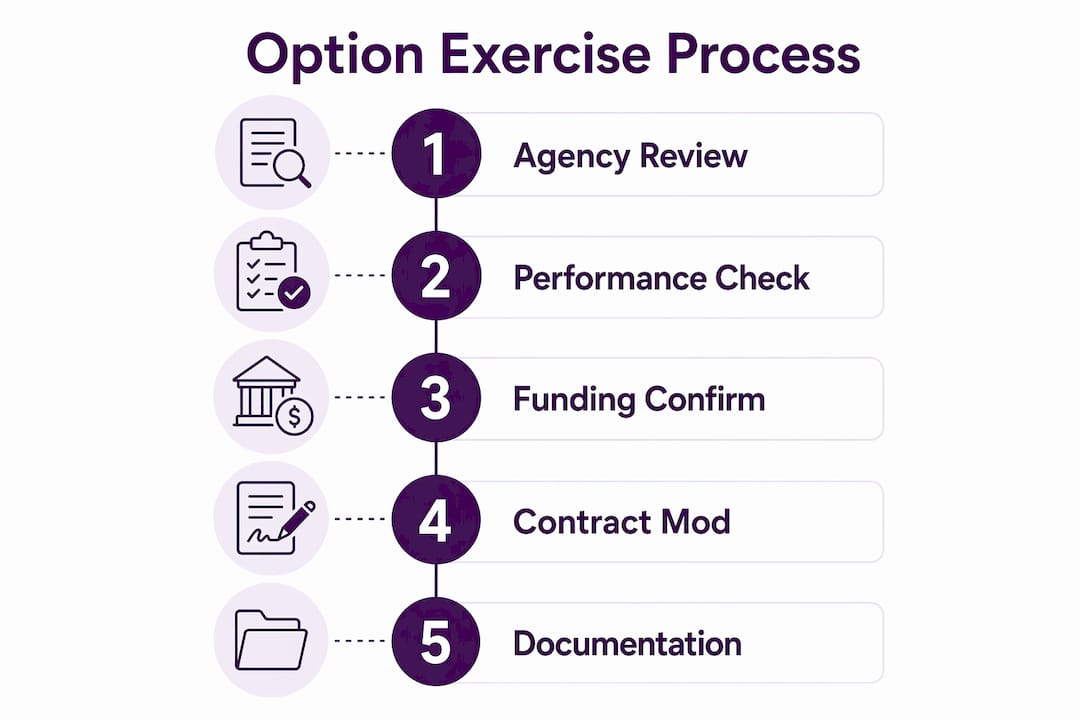
The formal sequence for exercising a contract option follows a defined path under FAR 17.207. Each step has legal weight, and skipping or reordering them creates procurement risk for both the agency and the contractor.
- Agency review begins. The contracting officer initiates a review of contractor performance, funding status, and continued mission need within the notice window specified in the contract.
- Written determination is prepared. The contracting officer drafts a formal written determination for the contract file confirming that all prerequisites are met. This document is not optional. It is a legal requirement under FAR 17.207.
- Written notice of intent is issued. The government provides the contractor with official written notice of its intent to exercise the option within the contract-specified timeframe.
- Contract modification is executed. The contracting officer issues a unilateral modification citing the option clause as authority. This is the formal act that activates the option period.
- Price reasonableness is confirmed. The contracting officer verifies that the option price remains fair and reasonable. Economic price adjustment clauses handle rate changes within pre-agreed formulas, keeping the exercise valid.
- Contractor acknowledges and implements. The contractor confirms receipt of the modification and begins performance under the new option period terms.
One point that trips up many contractors: the government cannot renegotiate pricing during this process. A valid option exercise requires pricing that was fixed or formula-driven at the original contract award. Attempting to negotiate new rates at this stage does not just delay the process. It legally invalidates the option.
| Step | Action | Responsible Party |
|---|---|---|
| 1. Agency review | Assess need, performance, and funding | Contracting officer |
| 2. Written determination | Document all prerequisites met | Contracting officer |
| 3. Notice of intent | Formal written notice to contractor | Contracting officer |
| 4. Contract modification | Unilateral mod citing option clause | Contracting officer |
| 5. Price confirmation | Verify reasonableness via adjustment clause | Contracting officer |
| 6. Contractor acknowledgment | Confirm receipt and begin performance | Contractor |
Pro Tip: Request a copy of the contract modification immediately upon receipt and verify that it correctly cites the option clause, the option period dates, and the applicable pricing. Errors in the modification document can create billing and compliance problems months later.
What are common challenges and legal risks in exercising federal contract options?
The most consequential risk in the option exercise process is a missed deadline. Late or missed option exercise notices render the exercise invalid. The contractor can legally refuse to perform work under an invalid option exercise, and any work performed without a valid modification is considered voluntary and non-payable. That is not a technicality. It means your company absorbs the cost of that work with no legal path to reimbursement.
Courts have consistently ruled that continued contractor performance after a late exercise is treated as a waiver of the contractor’s right to challenge the invalid exercise. This creates a trap: if you keep working because you assume the paperwork will catch up, you may lose your legal standing to dispute the situation later. The safest position is to stop work and formally notify the contracting officer in writing when you identify a missed notice window.
“If a contracting officer misses the deadline, the option exercise is invalid and cannot be retroactively applied without risking procurement irregularities and contractor refusal.” — FAR 17.202
Other significant risks include:
- Unsatisfactory performance ratings. A documented performance issue gives the contracting officer grounds to decline the option, even if the agency still needs the service. Ratings in CPARS are difficult to reverse after the fact.
- Confusing option exercise with contract extension. An option exercise activates a predefined period. A contract extension is a separate mechanism with different legal requirements. Extending a contract past its maximum period without exercising an option requires a new contracting action such as a bridge contract or recompete. Modifications after expiration are invalid.
- Scope creep during the option period. Some contractors attempt to expand deliverables or renegotiate terms when an option is exercised. This is legally problematic and can expose both parties to protest risk.
- Funding gaps at fiscal year transitions. Continuing resolutions can delay funding confirmation, compressing the notice window and creating uncertainty about whether the option will be exercised at all.
Strict adherence to FAR 17.207 is the single most effective way to avoid these risks. The regulation is not ambiguous. It specifies what must happen, in what order, and within what timeframe.
How can contractors prepare strategically for option exercises on GSA Schedule contracts?
Proactive preparation is what separates contractors who consistently get their options exercised from those who are surprised when a contract ends. Contractors who track option windows and maintain strong communication with contracting officers improve their chances of option exercise measurably. This is not about lobbying. It is about making the contracting officer’s job easier by being organized, compliant, and responsive.
Start by mapping every option period and notice window onto a contract management calendar. Mark the 90-day, 60-day, and 30-day points before each option decision date. These are your action triggers, not passive reminders. At 90 days, review your CPARS record and address any open performance concerns. At 60 days, confirm funding status informally with your contracting officer point of contact. At 30 days, prepare your option support package.
An option support package is a document you prepare proactively. It summarizes your performance metrics, confirms your pricing remains competitive under the contract’s adjustment clauses, and outlines your plan for the upcoming option period. Contracting officers are not required to request this, but providing it demonstrates professionalism and reduces the administrative burden on their end. You can find practical frameworks for this in GSA contract lifecycle guidance.
| Preparation approach | Reactive contractor | Proactive contractor |
|---|---|---|
| Option window awareness | Learns about expiration from CO notice | Tracks all option dates independently |
| CPARS management | Responds to ratings after issuance | Reviews and disputes ratings in real time |
| Pricing readiness | Waits for modification to check rates | Confirms adjustment clause applicability in advance |
| Communication with CO | Responds to inquiries only | Schedules periodic check-ins proactively |
| Contingency planning | No plan if option is not exercised | Bridge contract or recompete strategy prepared |
If the option is not exercised, you have two primary paths. A bridge contract provides short-term continuity while a recompete is prepared. A recompete means the work goes back to open competition. Neither outcome is ideal, but both are manageable if you have prepared. Contractors who leverage GSA contract opportunities strategically treat every option decision as a business development event, not just an administrative milestone.
Pro Tip: Avoid common federal bidding mistakes by treating your option support package as a mini-proposal. Include measurable outcomes from the current period, not just a list of deliverables completed. Contracting officers respond to evidence of impact.
Key takeaways
Mastering the federal contract option exercise process requires proactive tracking, strong performance documentation, and strict compliance with FAR 17.207 at every stage.
| Point | Details |
|---|---|
| Prerequisites are non-negotiable | Verify need, CPARS ratings, and funding at least 90 days before option expiration. |
| Pricing cannot be renegotiated | Option pricing must be fixed or formula-driven at award; new negotiations invalidate the exercise. |
| Missed deadlines carry legal risk | A late notice renders the option invalid and can eliminate your right to payment for work performed. |
| Proactive preparation wins | Contractors who track windows and communicate early are far more likely to have options exercised. |
| Know your alternatives | If an option is not exercised, a bridge contract or recompete is the only valid path forward. |
What I’ve learned from watching contractors lose options they should have kept
I have seen contractors with genuinely strong performance records lose option exercises because they treated the process as the government’s responsibility. They delivered excellent work, assumed the contracting officer would handle the rest, and then received a notice of non-exercise with 30 days left on the contract. By that point, there was nothing to do.
The uncomfortable truth about option years in government contracts is that the government’s decision is shaped by factors you can influence long before the formal process begins. Your CPARS record, your responsiveness to the contracting officer, and your ability to demonstrate continued value all feed into a decision that looks administrative on paper but is actually relational in practice. FAR 17.207 sets the legal floor. Your relationship with the agency determines whether you clear it comfortably or scrape by.
I also think contractors underestimate how much the federal procurement guidelines actually protect them when followed correctly. The same rules that require the government to act within notice windows also give you the right to refuse work and demand proper documentation when those windows are missed. Most contractors never use that leverage because they do not know it exists. Knowing the rules in detail is not just compliance. It is a negotiating asset.
For GSA Schedule holders specifically, the option exercise process is where multi-year contract value is either captured or lost. A five-year GSA Schedule with four option years is only worth its full potential if all four options get exercised. That outcome is not automatic. It is earned through consistent performance, proactive communication, and a clear understanding of what the contracting officer needs to say yes.
— Josh
Maximize your GSA Schedule contract lifecycle with expert support
Managing option year timelines, CPARS documentation, and contract modification procedures across multiple federal contracts is a full-time job on its own. Gsascheduleservices specializes in helping small and medium-sized businesses stay ahead of every option decision point, from tracking notice windows to preparing the documentation contracting officers need to say yes. Whether you are approaching your first option exercise or managing a portfolio of GSA Schedule contracts, the team at Gsascheduleservices provides hands-on support to protect your contract revenue and position you for long-term growth. Explore your options and find out how professional guidance can extend your contract lifecycle and expand your federal footprint.
FAQ
What is the federal contract option exercise process?
The federal contract option exercise process is the formal procedure by which a government agency activates a predefined option period in an existing contract, typically through a unilateral written modification citing the option clause under FAR 17.207.
How much notice is required before exercising a contract option?
Notice requirements are specified in the contract itself, but for non-MAS federal service contracts, the review and notice process typically begins 60 to 90 days before contract expiration.
Can the government renegotiate pricing when exercising an option?
No. Option pricing must be fixed or formula-driven at the time of contract award. Renegotiating price during the option exercise process legally invalidates the option under FAR 17.207.
What happens if the government misses the option exercise deadline?
A missed deadline renders the option exercise invalid. Any work performed after an invalid exercise is considered voluntary and non-payable, and the contractor has the right to refuse performance.
What should a contractor do if an option is not exercised?
If an option is not exercised, the contractor should immediately assess whether a bridge contract is available for short-term continuity or prepare for a recompete. Continuing work without a valid modification or bridge contract creates significant legal and financial risk.
Recommended
- Government Contract Opportunities 2026: SME Guide
- Navigating GSA Contract Vehicles: Your Guide
- Navigating GSA Contract Vehicles: Your Guide
- GSA eOffer process guide: Steps to secure your schedule contract