

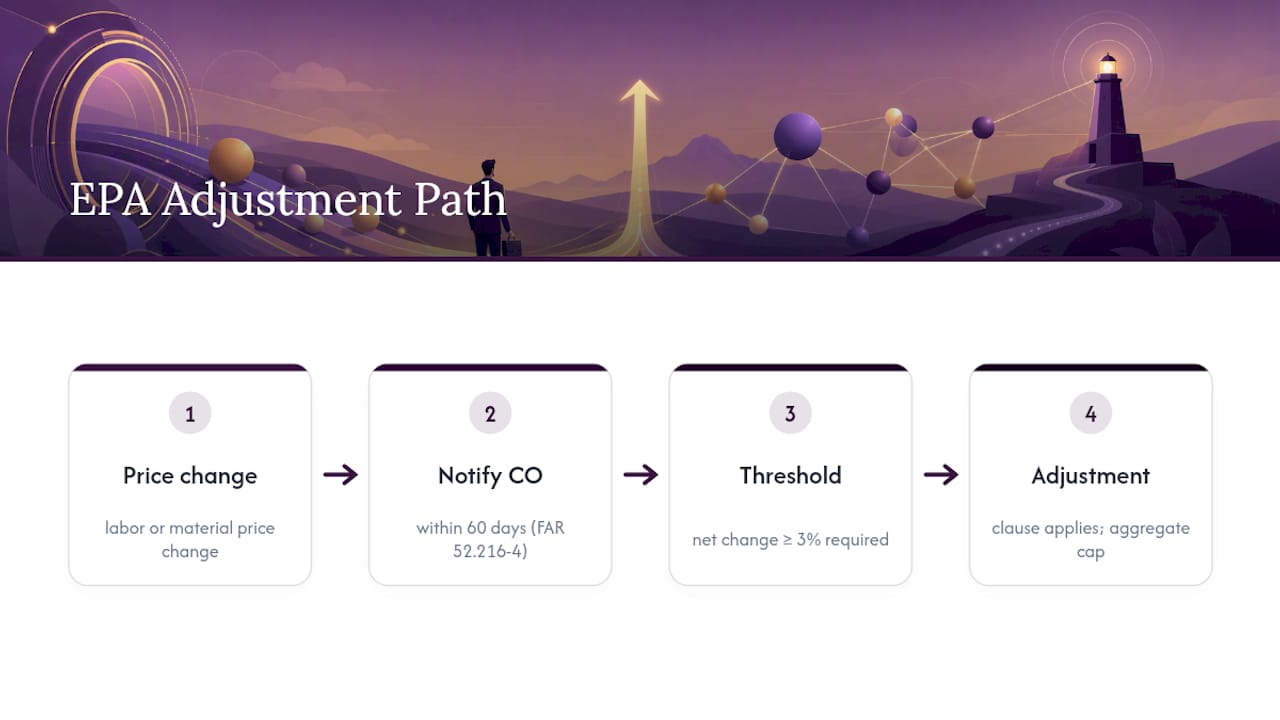
An economic price adjustment (EPA) is a contract clause under FAR 16.203 that revises a fixed price up or down based on defined cost or index changes. The moment your labor or material costs shift, you have one job: notify the Contracting Officer in writing, generally within 60 days, and start tracking whether the net change crosses the 3% threshold that FAR 52.216-4 uses to trigger a review. Keep performing while that negotiation plays out.
TL;DR:
- Contractors must notify the Contracting Officer within 60 days of a cost change and provide documentation to qualify for adjustments when net changes exceed 3 percent, or they risk losing the right entirely.
- EPA clauses typically apply only to external, uncontrollable cost changes and are most effective when negotiated upfront, with clear baseline, index choice, and ceiling provisions.
- Most disputes arise from missed notice deadlines, ambiguous index application, or claiming cost changes that result from internal factors rather than market-driven shifts.
- Proper documentation, consistent data sources, and early clause negotiations increase the likelihood of successful EPA claims and prevent delays or denials.
- GSA Schedule contractors should review their specific EPA clauses and consider outside expertise for complex or index-based situations to protect their rights during contract changes.
Table of Contents
- What Is Economic Price Adjustment and Why Does the 60-Day Clock Matter?
- What Should You Do the Moment Costs Change?
- What Are the Three Types of EPA Clauses?
- How Do the FAR Clauses Actually Work?
- How Should You Negotiate EPA Language Before You Sign?
- How Do You File an EPA Request?
- How Does GSA Clause 552.238-120 Change the Process?
- What Does DoD’s 2022 Guidance Change for Contractors?
- What Templates Help You Prepare an EPA Request?
- What Do Legal Disputes Over EPA Clauses Usually Involve?
- How Do EPAs Affect Contract Budgeting and Forecasting?
- What Negotiation Mistakes Do Contractors Make With EPA Clauses?
- When Should You Bring in a GSA Schedule Consultant?
- Ready to Get Hands-On Help With Your GSA Schedule Pricing?
- Sources
- FAQ
What Is Economic Price Adjustment and Why Does the 60-Day Clock Matter?
An EPA clause exists because fixed-price contracts are risky over long periods. Nobody can predict steel prices or union wage scales three years out, so the government builds a revision mechanism directly into the contract instead of forcing either side to eat unpredictable swings.
The mechanism only works if you use it on time. Under FAR 52.216-4, you must notify the Contracting Officer within 60 days of a cost change in labor rates or material unit prices, and the clause won’t act on anything below a 3% net change. Miss that window and you may lose your shot at an adjustment for that period entirely. The clause also caps aggregate increases, a detail worth flagging now and unpacking fully once you understand which clause variant governs your contract.
What Should You Do the Moment Costs Change?
The window between “my supplier just raised prices” and “I’ve lost my adjustment rights” is short. Move through this sequence as soon as you spot a cost shift:
- Pull your contract’s EPA clause and confirm which type governs (established price, actual cost, or index-based).
- Calculate the net change against your base price to see if it clears the 3% threshold FAR 52.216-4 requires.
- Gather documentation immediately: payroll records, vendor invoices, supplier price notices, and any published index figures you’re relying on.
- Draft and submit written notice to the CO well inside the 60-day window, even if your paperwork isn’t fully assembled yet.
- Keep performing the contract at the current price while the CO reviews and negotiates.
- Retain every record tied to the claim. Audit exposure runs for years, not months.
Pro Tip: Start a running cost log the day you win the contract, not the day prices spike. A dated paper trail showing your baseline labor rate or material cost makes the 3% calculation almost automatic when you actually need it.
What Are the Three Types of EPA Clauses?
- Established prices (FAR 52.216-2): tied to a published catalog or recognized market price. Best when a reliable, independent price benchmark already exists, like a manufacturer’s list price. The burden of proof is light because the price standard is public.
- Actual costs of labor or material (FAR 52.216-4): tied to your own documented cost changes. This carries more administrative weight since you must prove the cost increase happened and wasn’t within your control.
- Cost indexes: tied to a published index (a wage index or commodity index) rather than either party’s own numbers. This removes a lot of the “prove it” burden but requires both sides to agree upfront on which index applies.
Contracting officers tend to reach for established-price clauses on standard commercial supplies, actual-cost clauses on labor-heavy services, and index-based clauses on long multi-year contracts where market volatility is the whole point of including EPA in the first place. Short contracts under six months rarely get an EPA clause at all, since there’s little time for costs to move enough to matter.
How Do the FAR Clauses Actually Work?
Each EPA clause is triggered by a specific prescription. Subpart 16.2 tells contracting officers when EPA provisions belong in a solicitation, and that prescription is what decides which clause number ends up in your contract.
Here’s the mechanical core of the two you’ll see most often. FAR 52.216-4 (actual costs of labor and material) requires 60-day written notice of a cost change, applies only once the net change clears 3%, and lets the CO verify your numbers against your books. FAR 52.216-2 (established prices) works off a published catalog or market price instead of your internal costs, and caps aggregate price increases at 10% of the original unit price. There is no equivalent cap on decreases, and the government expects you to pass those along.
Contracting officers are directed to limit EPA relief to contingencies beyond a contractor’s control, and to avoid letting a contractor collect twice for the same risk, once through a padded base price and again through the EPA clause itself.
FAR clause mechanics at a glance:
| Element | Requirement |
|---|---|
| Notice period | 60 days from cost change |
| Adjustment threshold | 3% net change (FAR 52.216-4) |
| Aggregate increase cap | 10% of original unit price (FAR 52.216-2) |
| Decrease cap | None |
| Audit window | Up to 3 years after final payment |
The CO’s audit rights extend to your books and records related to the claimed cost, and that access can run until three years after final payment. “Established price” in this context means a price the public can actually verify. If your catalog price isn’t genuinely public, you’re likely in actual-cost territory whether you meant to be or not.
How Should You Negotiate EPA Language Before You Sign?
The best time to fix EPA problems is before award, not after costs spike and you’re stuck with vague clause language. A few negotiable elements make an enormous difference later:
- Base level and effective date: document the exact wage rate, material price, or index value in effect at contract signing. Ambiguity here is where most disputes start.
- Index selection: if you’re proposing a cost-index method, pick an index that’s published on a predictable schedule and genuinely tracks your cost driver, not just a convenient national average.
- Ceilings and floors: negotiate a cap on how far the price can move in either direction. This protects the government from runaway increases and protects you from a clause that only helps when prices rise.
- Aggregation rules: clarify whether multiple small cost changes accumulate toward the 3% threshold or reset each period.
- No double-counting: make sure your base price doesn’t already build in a cushion for the same inflation risk the EPA clause is supposed to cover.
Pro Tip: If your proposal already padded the price for anticipated inflation, say so during negotiations and strip it out before agreeing to an EPA clause. Carrying both a padded base price and an EPA clause is exactly what contracting officers are trained to catch.
Start your documentation habits on day one of performance. A CO who sees a clean, dated cost history moves faster than one wading through reconstructed records six months after the fact.
How Do You File an EPA Request?
Filing well is mostly a documentation exercise, not a legal one.
- Assemble your notice package: written notification of the cost change, the specific FAR clause you’re invoking, your calculation of the net change against baseline, and supporting evidence (invoices, payroll, index publications).
- Submit within 60 days of the qualifying cost change under FAR 52.216-4, even if some supporting data is still coming together.
- Expect the CO to potentially wait. Contracting officers can delay formal negotiation until cumulative changes clearly clear the 3% threshold, so don’t assume silence means denial.
- Clarify treatment of undelivered quantities. The effective date of an approved adjustment usually applies going forward, not retroactively to units already delivered.
- Retain everything. Your records need to survive CO review for up to three years after final payment, so treat this like a standing audit file, not a one-time submission.
How Does GSA Clause 552.238-120 Change the Process?
GSA Multiple Award Schedule (MAS) contracts don’t use the standard FAR EPA clauses the same way. Most schedule holders operate under clause 552.238-120, which ties adjustments to a pre-agreed methodology rather than an ad hoc cost demonstration.
- Process differs from FAR 52.216 clauses: GSA typically requires you to follow the specific EPA method negotiated at the time of your original schedule award, not whatever method feels convenient later.
- Catalog definitions matter more: because MAS pricing is built around your published price list, “established price” on a schedule contract usually means your commercial catalog, not an internal cost calculation.
- Mass modifications are the delivery mechanism: when a GSA-wide price adjustment applies, it often arrives through a mass modification rather than a one-off negotiation, so schedule holders need to watch for those notices actively.
If you’re managing an active schedule, review how your pricing was structured after award and revisit your contract modification process before you need it under time pressure.
What Does DoD’s 2022 Guidance Change for Contractors?
The Department of Defense issued guidance in May 2022 recommending that EPA clauses include ceilings and floors and use the same index that established the original price for later adjustments. The rationale is straightforward: a well-built EPA clause lets contractors bid realistically instead of padding every fixed-price proposal against worst-case inflation.
That shift cuts both ways. Government offices get less bloated bids, and contractors get a legitimate outlet for adjustment when costs genuinely move. The catch is timing: if your contract doesn’t have an EPA clause at all, claiming inflation relief through a request for equitable adjustment is a long shot absent a CO-directed change. The clause has to exist before you need it.
What Templates Help You Prepare an EPA Request?
A clean, ready-made file structure saves you time exactly when you have the least of it. Build a folder before you need one, organized around what a CO will actually ask for.
- Baseline documentation: original labor rates, material prices, or index value at contract signing.
- A running log of vendor invoices and payroll records dated as they occur.
- Snapshots of the published index, if your clause is index-based, taken at each reporting interval.
- A short cover memo tying your calculated net change to the specific FAR threshold you’re invoking.
When you’re drafting proposed EPA language as an offeror, keep it simple: define your base date clearly, name the index or cost category precisely, and spell out documentation expectations up front. These are starting points, not legal language, and every contract’s specifics should get reviewed against your own clause text. For a deeper look at how pricing gets structured on schedule contracts, see demystifying GSA pricing, and if you’re actively raising prices, review the steps in price escalation on your GSA contract.
What Do Legal Disputes Over EPA Clauses Usually Involve?
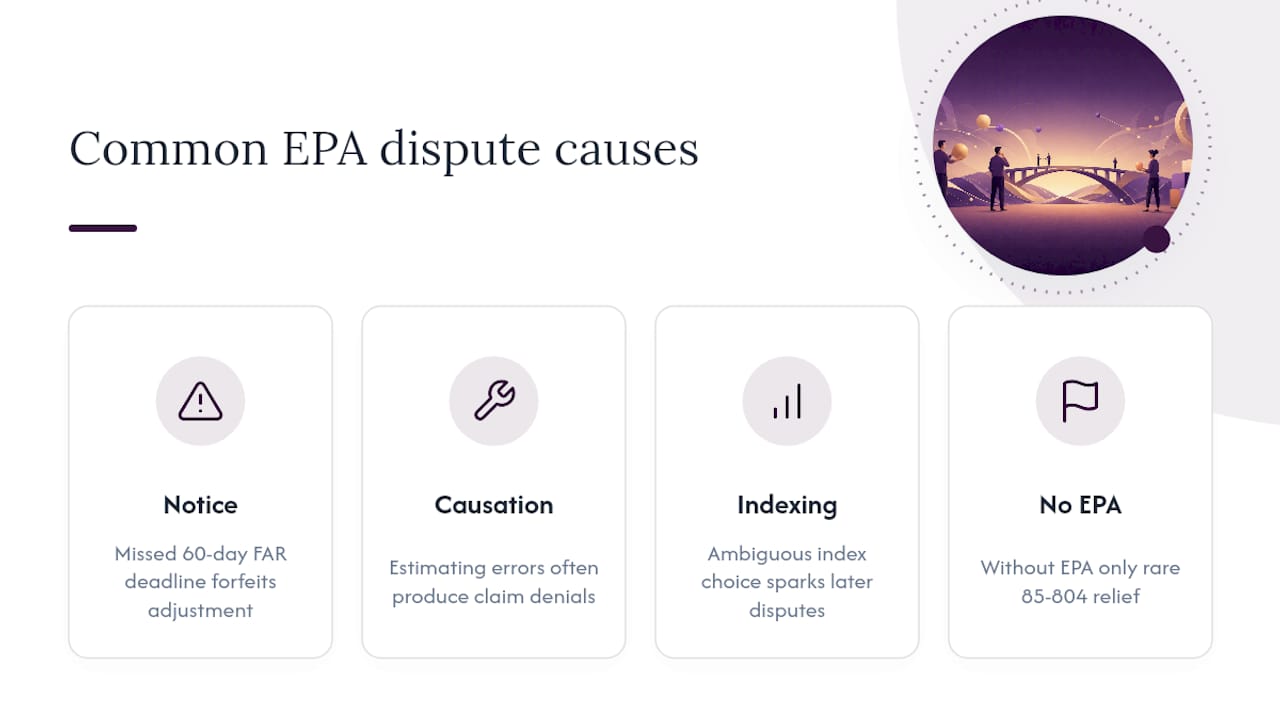
Most EPA-related disputes come down to one of three failure points: missed notice deadlines, disagreement over whether a cost change was truly “beyond the contractor’s control,” and disputes over which index or baseline applies.
Boards of contract appeals and the Court of Federal Claims have repeatedly enforced strict reading of notice periods. If a contractor misses the 60-day window under FAR 52.216-4, the government’s position is generally that the adjustment right for that period is forfeited, regardless of how legitimate the underlying cost increase was. This is why documentation timing matters more than documentation quality in most disputes: a well-supported claim filed late loses to a thin claim filed on time.
The second common friction point is causation. EPA clauses are meant to cover contingencies outside a contractor’s control, like a documented wage index jump or a published commodity price spike, not routine business inefficiency or poor initial bidding. Contracting officers push back hard when a claimed cost increase looks like it stems from the contractor’s own estimating error rather than external market movement. Contractors who blur that line in their notice invite denial or prolonged negotiation.
The third pattern involves index selection disputes on cost-index EPA clauses, particularly when a contract doesn’t clearly specify which published index governs or how frequently it updates. Ambiguous index language written into the original contract tends to resurface as a formal dispute years later, when the parties disagree over which data series actually applies. This is precisely why negotiating precise index language at the outset, rather than leaving it general, heads off years of later argument. Contractors without an EPA clause at all have essentially no path to inflation relief short of an extraordinary Public Law 85-804 request, a process reserved for exceptional cases and not a realistic routine fallback.
How Do EPAs Affect Contract Budgeting and Forecasting?
An EPA clause changes how you should model a contract’s financial life from the first day of performance, not just when costs eventually move.
Without an EPA clause, your fixed price is exactly that: fixed. Every forecasting model you build treats the contract as a flat revenue line with margin risk sitting entirely on your side. With an EPA clause in place, your forecasting needs a second layer: a probability-weighted adjustment scenario tied to whatever index or cost category the clause references. If your labor-heavy service contract runs on a wage index, your budget should track that index’s historical volatility, not just its current value, because that volatility is what determines how often you’ll actually see an adjustment trigger.
This matters most on multi-year contracts. A three-year fixed-price contract with no EPA clause forces you to either pad your original bid heavily (a bad look competitively) or absorb real risk if material costs move against you. A contract with a well-drafted EPA clause lets you bid closer to your actual expected cost, because you have a legitimate mechanism to true up later. That’s the entire policy logic behind the DoD’s 2022 guidance: tighter bids up front, in exchange for a working adjustment mechanism.
The budgeting discipline that pays off is building your EPA threshold math into monthly cost tracking, not annual reviews. Contractors who track cost inputs monthly against their contractual baseline almost always file cleaner, faster EPA requests than those who reconstruct the math retroactively.
What Negotiation Mistakes Do Contractors Make With EPA Clauses?
The most common mistake is silence. Contractors notice a cost increase, decide to “wait and see” if it’s temporary, and let the 60-day window close before filing anything. Even a preliminary notice, filed conservatively, preserves your position far better than waiting for certainty that may never come.
The second mistake is filing without index or cost consistency. If your original price was built using one wage survey or one supplier quote, and your EPA claim suddenly relies on a different, more favorable data source, expect the CO to push back and slow the negotiation considerably. Consistency between your baseline and your claim data is what makes verification fast.
Some contractors assume they should always negotiate up to the maximum allowed increase. Contracting officers notice that pattern across a contractor’s portfolio, and it can color how skeptically future claims from the same contractor get reviewed.
Finally, many contractors negotiate EPA language reactively, only thinking through ceilings, floors, and index selection after a cost spike forces the issue. By then, you’re negotiating from a position of need rather than from a position of mutual planning, and the CO knows it. The contractors who get the smoothest EPA outcomes are the ones who treat clause language as a first-year priority, not a crisis-response document.
When Should You Bring in a GSA Schedule Consultant?
Complex or index-driven EPA situations, or a schedule modification tangled up in mass-mod timing, are where outside expertise earns its keep fast. Gsascheduleservices supports contractors through EPA preparation, negotiation, and modification work on active GSA schedules.
— Josh
Ready to Get Hands-On Help With Your GSA Schedule Pricing?
Most contractors lose EPA rights not because their claim is weak, but because the paperwork missed the 60-day window or the clause language was too vague to enforce cleanly. Gsascheduleservices builds the documentation systems and clause language that hold up under CO review, whether you’re negotiating an EPA method into a new schedule award or preparing a modification for one you already hold. Unlike piecing together guidance from scattered FAR text and generic templates, you get direct support matched to your specific schedule and SIN codes. If you’re staring at a cost increase and an unclear path forward, schedule a discovery call and get a straight answer on what your contract actually allows before your notice window closes.
Sources
- 52.216-4 Economic Price Adjustment-Labor and Material.
- 52.216-2 Economic Price Adjustment-Standard Supplies.
- Implement the new economic price adjustment clause (GSA guidance).
- Recovering For Inflation On Federal Contracts: Recent DOD Guidance On Economic Price Adjustment Clauses.
FAQ
What Is Economic Price Adjustment?
An economic price adjustment is a contract clause that revises a fixed price upward or downward based on defined cost changes, published indexes, or established market prices, as outlined in FAR 16.203.
Can I Get a Refund if the Price Drops After Purchase?
That question typically applies to consumer retail purchases, not federal contracting; in a federal EPA context, there’s no cap on downward price adjustments, and a decrease flows through the same clause mechanics as an increase.
What Is the Difference Between FFP and FFP LoE?
Firm-fixed-price (FFP) sets one price for a defined deliverable regardless of the contractor’s actual cost, while firm-fixed-price level of effort (FFP LoE) pays a fixed price for a specified level of labor effort over a period rather than for a completed product; neither type includes automatic EPA adjustment unless the clause is added separately.
What Are the Easiest Government Contracts to Get?
There’s no universally “easiest” contract type, but simplified acquisitions under the micro-purchase and simplified acquisition thresholds, along with well-structured GSA Schedule contracts, tend to have lower entry barriers than large, complex procurements for small and medium businesses working with a firm like Gsascheduleservices.
Recommended
- Changing Your GSA Contract Pricing
- An Essential Checklist to Maintain Your GSA Schedule Contract
- Mastering Price Negotiation on GSA Schedule
- Raising Prices On Your GSA Contract