

GSA schedule renewal is not automatic. The government exercises your option through the OPEN system, and you must respond in eMod before the deadline or risk expiration. Before anything else, confirm your authorized negotiator and digital certificate are current and that no mass modifications sit unsigned. Then find your option letter in eMod or the Vendor Support Center and start gathering documents.
TL;DR:
- Contractors must respond to the 210-day GSA schedule renewal letter within 45 days through eMod, ensuring all documentation and disclosures are current and complete.
- Unsigned mass modifications block the entire renewal process, including submitting the option response, and must be signed before GSA processes any renewal actions.
- Sales activity, accurate commercial pricing disclosures, and current subcontracting plans are critical factors influencing contract renewal decisions.
- Contract exclusions typically result from issues like unsigned mass mods, expired certificates, outdated contacts, or poor sales performance, requiring prompt resolution.
- Preparing renewal packages early, verifying system access, and addressing compliance issues six to twelve months before expiration can prevent last-minute failures.
Table of Contents
- How OPEN Works and the Official Timelines You Need to Track
- Responding to the 210-Day Option Letter: What eMod Requires
- Why Unsigned Mass Mods Can Block Your Renewal
- Checking Your Contract’s Health Before the Option Letter Arrives
- What Happens If GSA Excludes Your Contract From an Option
- A 12-Month-to-45-Day Checklist for a Clean Renewal
- What We See Go Wrong, and When It’s Worth Getting Help
- Get Ahead of Your Next GSA Option Letter
- Official GSA Resources to Consult Now
- Sources
- FAQ
How OPEN Works and the Official Timelines You Need to Track
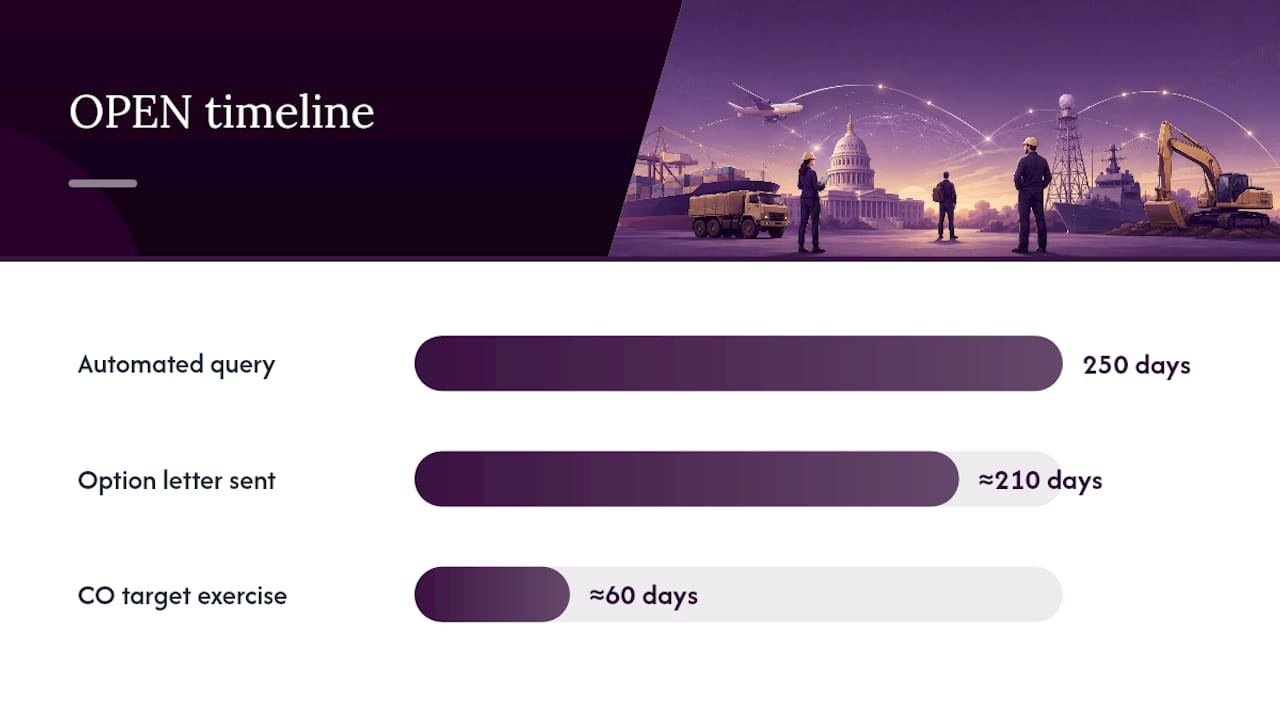
GSA’s Option Process Ensuring iNtegrity, known as OPEN, runs an automated query every time a contract crosses the 250-day mark before expiration. That query triggers one of two outcomes: either your contract gets flagged for exclusion, or you receive a formal option letter roughly 210 days before your current period ends.
You can check your own expiration date anytime through GSA eLibrary, which lists every active schedule contract and its term dates. Waiting for the letter to find out when your contract expires is a mistake plenty of contractors make.
The government aims to exercise options by a target date approximately two months before contract expiration, though that goal bends when contract records are messy, sales numbers look thin, or paperwork is incomplete.
A few things worth knowing about the OPEN cycle:
- The 250-day query is fully automated. No human reviews your file at that stage.
- The 210-day option letter is your formal notice and starting gun.
- The 60-day timeliness goal is a target for the contracting officer, not a guarantee, and delays on your end push it further out.
- Contracts run in five-year blocks, with a base period and up to three five-year options, for a maximum of 20 years total under the Multiple Award Schedule program.
Responding to the 210-Day Option Letter: What eMod Requires
The option letter asks you to affirm, in writing, that nothing material has changed since your last modification. Specifically, you’re confirming there have been no changes to your Commercial Sales Practices format (CSP-1), no shifts in the pricing relationships covered by the Price Reduction Clause, and no alterations to your terms and conditions. If any of that has changed, you disclose it now rather than let a contracting officer find it later.
Here’s the practical sequence for submitting your response:
- Log into eMod using your digital certificate and confirm your authorized negotiator is listed correctly.
- Draft a corporate letter on company letterhead affirming no material changes (or disclosing what changed).
- Attach a current pricelist reflecting your latest awarded rates.
- Include a business size recertification if your size status has shifted since the last option.
- Attach a revised subcontracting plan if your contract carries that requirement and anything has changed.
- Submit the full package through eMod before the 45-day response window closes.
Once submitted, the contracting officer reviews the package against your contract file. If you genuinely can’t hit the 45-day deadline, contact the contracting officer directly and ask for an extension before the clock runs out, not after.
Pro Tip: Draft your corporate affirmation letter the week you get the 210-day notice, even before you’ve pulled every attachment together. Having the letter ready removes one variable while you chase down subcontracting or pricing updates.
Why Unsigned Mass Mods Can Block Your Renewal
Mass modifications are bulk contract changes GSA issues across an entire schedule category, usually tied to a solicitation refresh that updates clauses, terms, or reporting requirements. They land in your eMod queue whether you asked for them or not, and ignoring them doesn’t make them go away.
You’re expected to sign mass mods within the window GSA specifies, and GSA’s own modification guidance is direct about the consequence of skipping that step: the system will not process new modification requests, including option responses, until outstanding mass mods are cleared.
One overdue mass mod can freeze your entire modification queue, including the option letter you need to submit to keep your contract alive.
What tends to happen if contractors delay:
- Unsigned mass mods often get rolled into the next solicitation refresh, stacking on top of whatever’s already pending.
- Every subsequent mod request, including price changes and administrative updates, sits blocked behind the unsigned mod.
- The MAS Modification Guide confirms outstanding mass mods must be acted on before GSA will process any new modification, option responses included.
Check your mass mod status through the Mass Mod Compliance Monitor before you do anything else. If you find a backlog, clear the oldest ones first. Each one you leave sitting compounds the delay on the next.
Checking Your Contract’s Health Before the Option Letter Arrives
Contracting officers look at more than paperwork when deciding whether to exercise your option. Sales activity matters. A contract with little or no reported sales sends a signal that the schedule isn’t being used, and that can factor into whether the CO sees renewal as worthwhile. GSA’s guidance on contract modifications treats sales performance and the absence of material changes as central to the renewal review.
Your CSP-1 disclosure and Price Reduction Clause relationships get checked too. If your best commercial customer now gets a better deal than the government, that’s a PRC violation waiting to surface, and it typically requires a bilateral mod to fix before renewal moves forward. Subcontracting plan compliance gets the same scrutiny if your contract carries that clause.
Run this self-check before the 210-day letter lands:
- Are your reported sales current and reasonably active?
- Does your CSP-1 still match your actual commercial pricing practices?
- Have you given any commercial customer better terms than the government gets?
- Is your subcontracting plan current, if one applies?
Pro Tip: Pull your GSA sales report and compare it against your commercial invoices from the same period. Discrepancies here are one of the most common reasons a renewal gets extra scrutiny.
What Happens If GSA Excludes Your Contract From an Option
Exclusion usually traces back to something fixable: outstanding mass mods, an expired digital certificate, an incorrect point of contact on file, or sales and compliance numbers that don’t meet expectations.
GSA communicates exclusion through one of two notification types, and both give you a path to respond. You can dispute the determination or ask for clarification by contacting your contracting officer, contract specialist, or Industrial Operations Analyst directly.
Common reasons contracts get excluded:
- Unsigned mass modifications sitting in the queue.
- An expired or mismatched digital certificate.
- Outdated contact information tied to the contract record.
- Sales or compliance figures that fall short of what the CO expects to see.
If you don’t resolve the exclusion and the contract runs past its expiration date, it cannot be reinstated. You’d need to submit an entirely new offer and start the solicitation process from scratch, which typically takes far longer than fixing whatever triggered the exclusion in the first place.
A 12-Month-to-45-Day Checklist for a Clean Renewal
Build your renewal prep around a rolling timeline instead of waiting for the 210-day letter to force your hand.
- 12 months out: Verify your authorized negotiator is correctly listed, confirm your digital certificate hasn’t lapsed, and check that your SAM.gov registration is current.
- 6 months out: Update your pricelist, review your CSP-1 for accuracy, and refresh your subcontracting plan if one applies.
- 250 to 210 days out: Watch for the OPEN notification and start assembling your documents so you’re not scrambling once the letter arrives.
- On receipt of the letter: Submit your full package through eMod within the 45-day window, or contact the contracting officer immediately if you need more time.
For system access problems, technical certificate issues, or eMod errors, contact the Vendor Support Center. For anything involving contract terms, pricing, or the substance of your option, that’s a conversation for your contracting officer or contract specialist, not VSC.
| Timing | Action | Who to contact if stuck |
|---|---|---|
| 12 months out | Verify negotiator, certificate, SAM.gov | Vendor Support Center |
| 6 months out | Update pricelist, CSP-1, subcontracting plan | Contract specialist |
| 250 to 210 days | Monitor OPEN, assemble documents | Vendor Support Center |
| Letter received | Submit via eMod within 45 days | Contracting officer |
If you get an exclusion notice instead of an option letter, don’t panic and don’t ignore it. Check your mass mod status first, confirm your certificate is valid, and contact your CO the same week to find out exactly what triggered it.
What We See Go Wrong, and When It’s Worth Getting Help
Most renewal failures we encounter at Gsascheduleservices trace back to something small: an expired digital certificate, a backlog of unsigned mass mods, or a corporate letter that missed a required affirmation. None of that is complicated once someone points it out, but it’s exactly the kind of detail a busy owner misses while running the actual business.
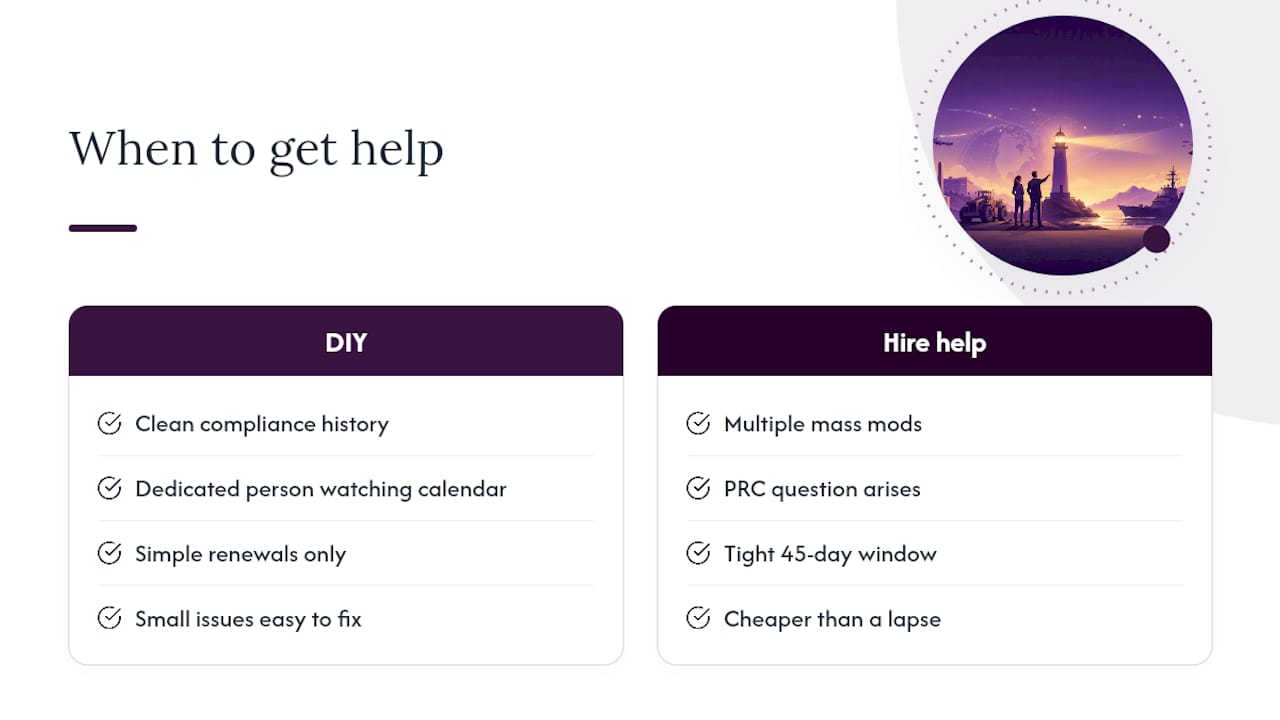
DIY renewal works fine for contractors with a clean compliance history and someone dedicated to watching the calendar. Once you’re juggling multiple mass mods, a PRC question, or a tight 45-day window, bringing in support stops being a luxury and starts being cheaper than a lapse.
— Josh
Get Ahead of Your Next GSA Option Letter
Specialized consulting services can help you avoid scrambling through eMod alone when the 210-day letter shows up by handling readiness assessments, clearing mass mod backlogs before they freeze your queue, and assisting with authorized negotiator and digital certificate issues long before OPEN sends its next automated query. If you’ve read this far and started counting how many of these boxes you can actually check right now, that’s the signal to get a second set of eyes on your contract file. Start with a discovery call and walk through your renewal timeline before the next deadline sneaks up on you. It’s a faster fix now than a re-offer after expiration.
Official GSA Resources to Consult Now
- OPEN Contractor FAQ for eMod and certificate questions.
- MAS Modification Guide for templates and mass mod rules.
- Modification guidance for signing requirements.
Open the OPEN FAQ first if your option letter just arrived. For a broader refresher on maintenance steps, see our checklist for maintaining a GSA schedule contract.
Sources
- OPEN (Option Process Ensuring iNtegrity) – Options/Contract Renewal Process
- MULTIPLE AWARD SCHEDULE (MAS) MODIFICATION GUIDE (April/June 2026)
- Modification and mass modification guidance | GSA
- Handle contract modifications | GSA
- OPEN Contractor FAQ’s (Vendor Support Center)
FAQ
Can States Use GSA Schedules?
State and local governments generally cannot buy directly off standard GSA Schedules; those are federal purchasing vehicles, though some cooperative purchasing programs exist for specific categories like disaster recovery and IT security.
What Is GSA Schedule 70?
GSA formerly designated its IT products and services contracts separately before consolidating schedules into the single Multiple Award Schedule program, which now covers IT alongside other categories under one contract vehicle.
What Is the GSA Schedule Program?
The GSA Schedule program, formally the Multiple Award Schedule, is a set of long-term government contracts that let federal agencies buy commercial products and services at pre-negotiated prices without a separate solicitation for each purchase.
How Do You Get a GSA Schedule?
Getting a GSA Schedule contract means submitting an offer through eOffer that documents your commercial sales practices, pricing, and past performance; Gsascheduleservices handles the readiness assessment and paperwork for businesses that want expert support through that process.
What Happens if I Miss the 45-Day Response Window?
Missing the 45-day window without contacting your contracting officer risks having your option excluded, and if the contract expires, it cannot be reinstated. You’d need to submit an entirely new offer.
Recommended
- An Essential Checklist to Maintain Your GSA Schedule Contract
- GSA Government Contracts: 7 Effective Steps to Maintain and Renew It.
- GSA eOffer process guide: Steps to secure your schedule contract
- Don’t Lose Your GSA Contract | GSA Contract Cancellation