

A well-crafted Sources Sought response is a short piece of official market-research evidence that increases the odds your requirement becomes a small-business set-aside under the Rule of Two. Yes, you should respond when the notice fits your NAICS code and capabilities. A good response is a tight, tailored document, usually a few pages, plus a capability statement, mapped directly to the agency’s questions and submitted before the deadline listed in the notice.
TL;DR:
- Responding to a Sources Sought notice with a tailored, concise document signals your small-business status and capabilities, influencing the eventual set-aside decision.
- Include clear company identification, socioeconomic status, NAICS confirmation, relevant past performance, and directly answer all agency questions in the correct order.
- Track and set up alerts for notices using SAM.gov filters and spreadsheets, and respond within a one-to-two-week window for maximum impact.
- Most responses are three to six pages in PDF format, with a focus on specific, verifiable examples and matching questions to agency requirements.
- After submission, log the notice details, follow up politely, and use responses to prepare for the actual RFP or shape agency requirements.
Table of Contents
- What Is a Sources Sought Response and Why Does It Matter?
- Exactly What to Include in a Sources Sought Response
- How to Prepare, Tailor, and Submit Your Response
- Where to Find Sources Sought Notices Before Your Competitors Do
- What Deadlines, Length, and Format Rules Should You Follow?
- A Two-Page Checklist and Template Headings You Can Reuse
- When to Bring in Expert Help for a Sources Sought Response
- Common Pitfalls That Sink an Otherwise Strong Response
- How Contracting Officers Actually Use These Responses
- What to Do After You Submit a Sources Sought Response
- What a Strong Sources Sought Response Actually Looks Like
- The One Habit That Actually Moves the Needle
- Get a Discovery Review Before Your Next Sources Sought Deadline
- Where to Verify the Rules Yourself
- Sources
- FAQ
What Is a Sources Sought Response and Why Does It Matter?
A Sources Sought notice is market research, not a solicitation. Contracting officers post it on SAM.gov before writing a solicitation to gauge who can actually perform the work, and FAR 5.201 describes this synopsis as a required step in that market-research process. Nobody wins a contract by answering one, but plenty of small businesses lose the chance at a set-aside by ignoring one.
The confusion usually starts with acronyms. Here’s how the pre-solicitation notices actually differ:
- Sources Sought — market research only, no proposal requested, used to shape acquisition strategy.
- RFI (Request for Information) — broader information gathering, sometimes technical, not tied to a specific upcoming buy.
- RFQ (Request for Quote) — a real pricing request, typically for simpler or commercial-item purchases.
- RFP (Request for Proposal) — the formal solicitation where you submit a binding, evaluated offer.
Under FAR 19.502-2, the Rule of Two, a contracting officer must set aside the acquisition for small business if at least two responsible small businesses are reasonably expected to submit competitive offers. Your Sources Sought response is often the only evidence the officer has to make that call.
Exactly What to Include in a Sources Sought Response
Contracting officers skim dozens of these. Give them what they need, in the order they expect it.
- Company identification — legal business name, Unique Entity ID (UEI), CAGE code if you have one, and a single point of contact with phone and email.
- Socioeconomic status — a plain statement of your size status (small business, WOSB, SDVOSB, 8(a), HUBZone) verified against current SBA size standards for the stated NAICS code.
- NAICS confirmation — state the primary NAICS code from the notice and confirm you meet its size standard; flag it if you don’t.
- Past performance — two to three relevant contracts with agency name, contract number or dollar value, scope, and your role (prime or sub).
- Capability statement excerpt and direct answers — a short paragraph mapped to the notice’s requirements, followed by numbered answers to every question the agency asked.
Pro Tip: Never answer questions in a different order than the agency posted them. Contracting officers often compare responses side by side, and a response that doesn’t mirror their numbering gets skimmed, not read.
How to Prepare, Tailor, and Submit Your Response
Treat every notice like a small, fast-moving project with a hard deadline. Here’s the workflow that keeps you from missing something.
- Triage on receipt. Note the response deadline, submission method (email or SAM.gov upload), required section headings, NAICS code, and any stated page limit. Ten minutes here saves an hour later.
- Mirror the agency’s numbering. Copy their question list into your draft and answer each one directly underneath it. Don’t make the reader hunt for your answer.
- Assemble the document. Aim for three to six pages plus a capability statement. Skip pricing details and skip a full technical proposal. This isn’t the place for either.
- Run a compliance pass. Check UEI and CAGE numbers, confirm your size-status language matches the SBA standard for the listed NAICS code, and convert to PDF with a clean filename like “CompanyName_NoticeID_SourcesSought.pdf.”
- Submit and log it. Use the exact submission method requested. If email, use a clear subject line referencing the notice number. Then log the notice ID, agency, response date, and expected RFP timeframe in a tracker.
Pro Tip: Build a reusable master document with your standard company facts, certifications, and two or three past-performance write-ups already formatted. Tailoring a response then takes an hour instead of a full day.
Where to Find Sources Sought Notices Before Your Competitors Do
The notices live on Sam, where filtering by notice type “r” isolates Sources Sought postings specifically, separate from full solicitations. Combine that filter with your NAICS code and relevant keywords to cut through the noise.
A few habits make this sustainable instead of a daily scramble:
- Set up daily email or API alerts tied to your NAICS codes so notices land in your inbox instead of getting missed in a manual search.
- Keep a simple tracker spreadsheet with notice ID, agency, deadline, and response status. You’ll need it for follow-up later anyway.
- Check agency long-range acquisition forecasts and your local Procurement Technical Assistance Center (PTAC) for early signals before a notice even posts, using SBA federal contracting resources as a starting point.
What Deadlines, Length, and Format Rules Should You Follow?
Most Sources Sought windows run about one to two weeks, which is short enough that a delayed start often means missing it entirely.
- Length: three to six pages plus a capability statement when no page limit is stated; anything over ten pages usually gets skimmed, not read.
- Format: PDF is the standard expectation, with a clear filename and email subject line matching the notice number.
- Confidentiality: responses can be treated as proprietary under FAR 15.207, so mark sensitive pricing or technical detail accordingly if you include it.
Practitioner guidance consistently points to that two-to-six-page range with a capability statement as the sweet spot contracting officers actually read in full.
A Two-Page Checklist and Template Headings You Can Reuse
- Company snapshot (legal name, UEI, CAGE, point of contact)
- Socioeconomic status and size-standard statement
- NAICS confirmation
- Past performance (two to three entries)
- Capability statement mapped to the notice
- Direct, numbered answers to the agency’s questions
Pro Tip: A strong capability line reads like this: “Company X has delivered IT help-desk support under three federal contracts totaling over $2 million, including a 24-month task order for [Agency] covering Tier 1-3 support for 500+ end users.” Specific numbers beat vague adjectives every time.
When to Bring in Expert Help for a Sources Sought Response
Some businesses have everything they need in house: formatted past-performance write-ups, a person who understands NAICS mapping, and someone available to review the response before it goes out. If that’s you, do it yourself and save the fee.
If you’re missing pieces, that’s where outside help earns its cost. Gsascheduleservices works with small and medium businesses on exactly the documentation gaps that trip up a Sources Sought response:
- Readiness assessments that flag missing certifications or size-standard mismatches before you submit
- Capability statement drafting that maps directly to an agency’s stated requirements
- NAICS and SIN code mapping so your size-status claims hold up under scrutiny
- Document packaging and formatting so the final PDF looks like it came from a company that’s done this before
Hire help when you lack a properly formatted past-performance library, when NAICS mapping is unclear, or when the deadline is closer than your internal bandwidth allows.
Common Pitfalls That Sink an Otherwise Strong Response
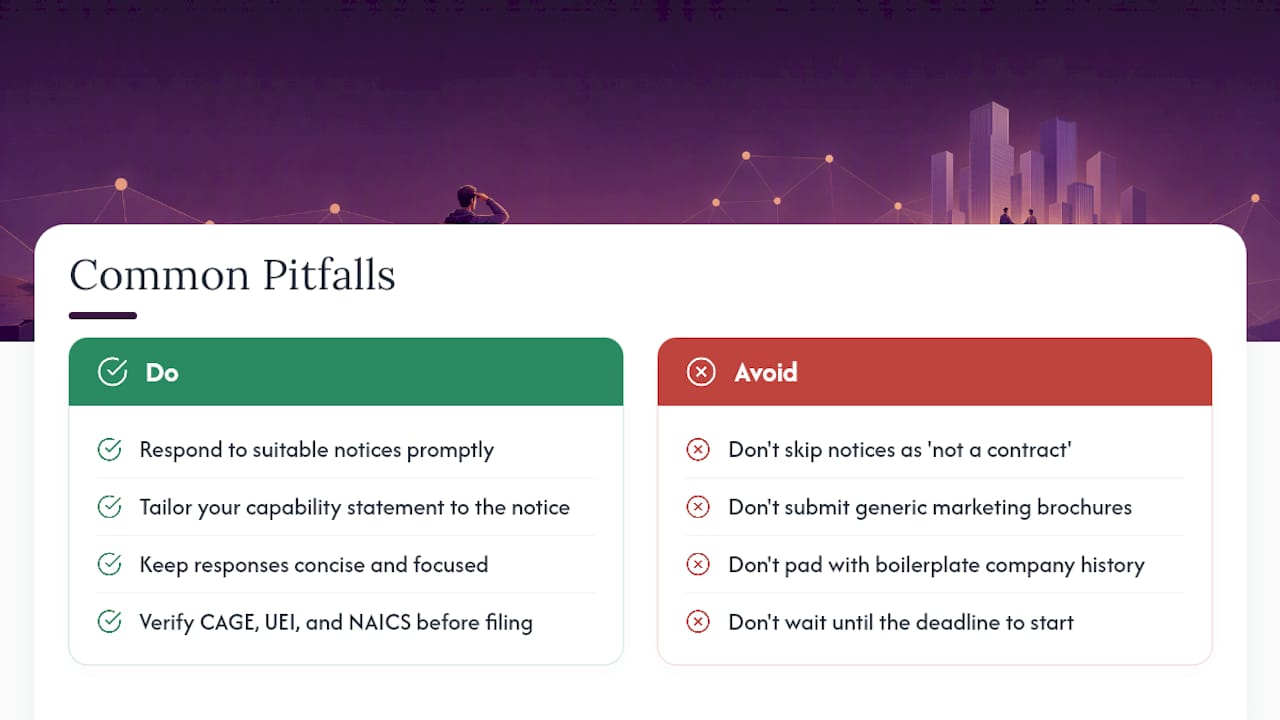
The biggest mistake isn’t a bad answer. It’s silence. Businesses that could win the work skip the notice entirely because it “isn’t a real contract,” then wonder why a competitor’s set-aside request got approved and theirs never had a chance.
The second most common mistake is submitting a generic capability statement instead of a tailored response. A contracting officer can tell within a paragraph whether you read the notice or copy-pasted a marketing brochure. Answers that dodge the specific questions asked, or that bury the size-status statement three pages deep instead of stating it up front, get set aside themselves, just not in the way you wanted.
Padding also backfires. A twelve-page response with boilerplate company history doesn’t read as thorough. It reads as unfocused, and it competes against three-page responses from businesses that clearly understood the assignment. Missing identifiers, an expired CAGE code, or a UEI typo can get a response discarded before anyone reads your capability statement at all.
Timing mistakes are just as costly. Waiting until the deadline’s final day to start drafting means no time for a compliance check, and a rushed response with an inconsistent NAICS claim or an unclear size-status line undermines your credibility with a contracting officer you may deal with again on the actual solicitation.
Finally, some businesses treat every Sources Sought the same way, submitting a form-letter response regardless of fit. Selectivity matters. A response to a notice you’re genuinely qualified for carries more weight than five generic responses to notices you’re stretching to match.
How Contracting Officers Actually Use These Responses
Eligibility isn’t the only thing a contracting officer is measuring. Sources Sought responses shape the entire acquisition strategy before a solicitation ever gets written.
Officers use response volume and quality to decide the vehicle itself: full and open competition, a small-business set-aside, or a specific socioeconomic set-aside like 8(a) or WOSB. GSA guidance on pre-award notices treats a response’s explicit recommendation, something like “we recommend this be set aside for small business,” as usable input in that acquisition strategy decision, not just a data point buried in a file.
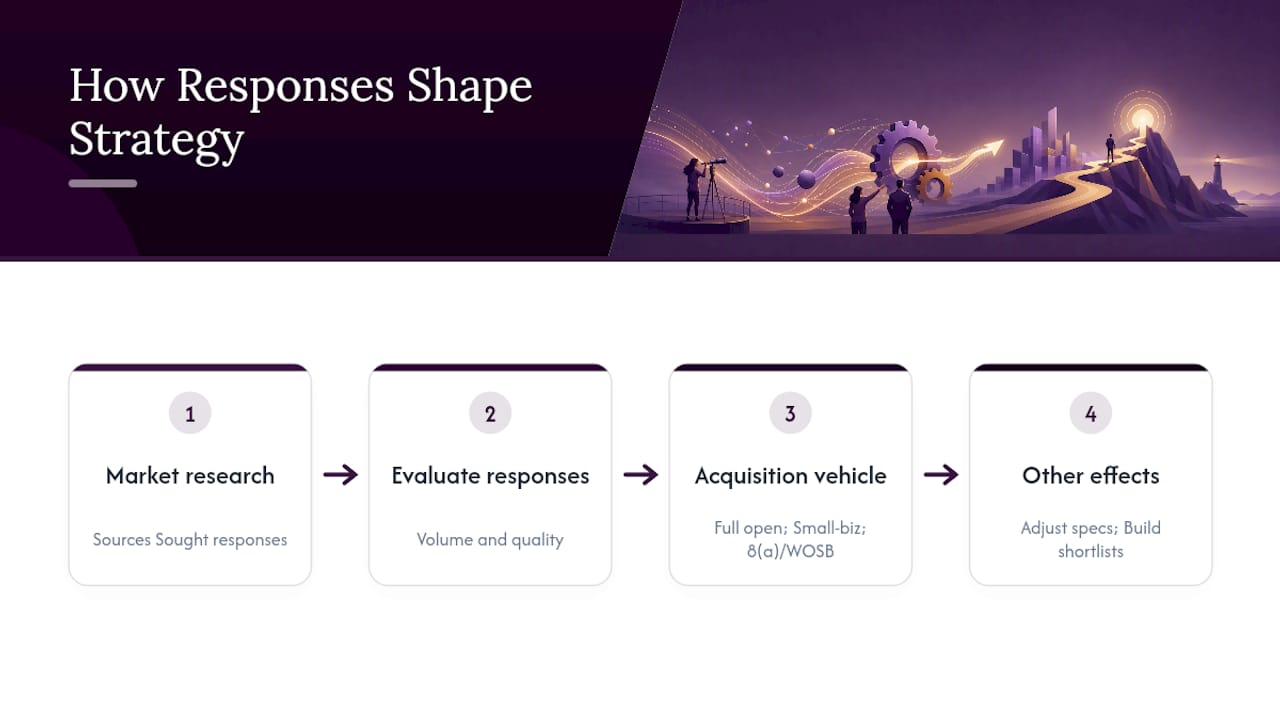
Responses also inform the requirements themselves. If several respondents flag an unrealistic delivery timeline or an overly narrow technical specification, agencies sometimes adjust the solicitation before it’s released. Your response is a chance to shape the fight, not just enter it.
Contracting officers also build informal shortlists from strong responses. A capability statement that clearly matches the requirement puts your company on the radar for outreach even before the formal RFP drops, and past-performance details that name real contract numbers and dollar values carry more weight than a company that only lists services offered.
Weak responses do the opposite. If the pool of respondents looks thin or unqualified, that pushes the officer toward full and open competition, since the Rule of Two threshold isn’t met. Every response, strong or weak, becomes part of that math.
What to Do After You Submit a Sources Sought Response
Submitting isn’t the finish line. Log the notice ID, the agency, your submission date, and the NAICS code in your tracker immediately, while the details are fresh.
Most notices don’t require a confirmation, but a short, polite follow-up email a few business days later confirming receipt is reasonable and rarely unwelcome. Don’t call repeatedly or push for a response on evaluation status. Contracting officers generally won’t disclose how your submission compares to others, and pressing for that answer wastes goodwill you’ll want later.
Watch SAM.gov for the follow-up solicitation tied to that notice ID. Sources Sought responses typically precede an RFP by weeks to a few months, and missing the actual solicitation after doing the work to respond to the market-research phase is its own kind of waste.
Use the gap productively. If your response flagged a capability gap, a missing certification, or a past-performance hole, that’s your window to fix it before the real solicitation lands. Check agency forecasts again for the same requirement category, since agencies often reissue or split large requirements into multiple smaller notices over time.
Build relationships where the notice invites contact. Some agencies allow or even encourage a follow-up call or meeting during market research. That conversation, more than the written response itself, is often what puts a name in a contracting officer’s memory when the RFP finally posts.
What a Strong Sources Sought Response Actually Looks Like
Structure beats prose here. A response that opens with a clean header block, “RE: Sources Sought Notice [Number], [Title], NAICS [Code],” immediately signals organization before the officer reads a single sentence of content.
A strong capability statement excerpt reads specific, not aspirational: “Company X provides logistics support services and has performed similar scope under a three-year IDIQ with the Department of Veterans Affairs, managing inventory for 12 regional warehouses with 99.2% on-time fulfillment.” Compare that to a weak version: “Company X is a leader in logistics with a proven track record of excellence,” which says nothing a contracting officer can verify or use.
Past-performance entries work best in a short, consistent format: agency name, contract number or value, period of performance, scope in one sentence, and your role. Three entries like that beat one long paragraph of unstructured history.
When answering the agency’s numbered questions, match their exact phrasing back to you before answering. If question 3 asks about small-business teaming, your answer should open with “Regarding small-business teaming arrangements,” not a generic transition. That mirroring is what makes a response scannable at 11 p.m. when an officer is working through a stack of them.
Close with a one-line recommendation when it’s genuinely warranted: “Based on the requirements described, we believe this acquisition is well suited for a small-business set-aside.” It’s a small sentence that does real work in shaping the acquisition strategy.
The One Habit That Actually Moves the Needle
Most businesses treat Sources Sought responses as a once-in-a-while scramble, and that’s exactly why they lose to competitors who don’t. A daily SAM.gov check paired with a 30-minute weekly triage session, deciding what fits, what doesn’t, and what needs a template update, turns this from a fire drill into a system.
Only a small percentage of the notices you respond to will lead directly to a contract. That’s fine. The ones that do often carry disproportionate ROI, because you’re influencing the acquisition strategy before competitors even know the opportunity exists. Systematize it, and the math works in your favor over time.
— Josh
Get a Discovery Review Before Your Next Sources Sought Deadline
Every response you send is only as strong as the documentation behind it, and that’s usually where small businesses lose time they don’t have during a 10 to 14 day window. A discovery review from Gsascheduleservices checks your GSA readiness, maps your NAICS and SIN codes against real notice requirements, and flags missing certifications or documentation gaps before they cost you a submission.
Instead of rebuilding your capability statement and past-performance write-ups from scratch every time a notice lands, a discovery review gets that foundation organized once, so tailoring the next response takes an hour, not a weekend. If you’re spending more time chasing paperwork than answering the agency’s actual questions, start with a discovery review and get your documentation ready before the next deadline hits.
Where to Verify the Rules Yourself
Check FAR 5.201 for the market-research requirement, FAR 19.502-2 for the Rule of Two, GSA’s pre-award notices guide for practical tips, and SAM.gov for live postings. For a deeper walkthrough of using SAM.gov’s filters, see this government contracting guide. Businesses exploring AI-assisted opportunity monitoring can also review this look at AI in contractor engagement.
Sources
Both gather information, but a Sources Sought notice is tied to a specific upcoming acquisition and directly informs a set-aside decision under the Rule of Two, while an RFI is often broader and not always linked to an imminent buy. GSA’s own guidance treats them as related but distinct tools in the pre-award process.
- FAR 19.502-2 (Rule of Two) — Legal Information Institute
- Acquisition
- Pre-Award Notices — GSA
- Sam
- Sources Sought Notices: A Small-Business Guide to Pre-Solicitation on SAM.gov | The Contract Wire
FAQ
What Are Sources Sought Notices in Government Contracting?
A Sources Sought notice is a pre-solicitation market-research tool agencies post on SAM.gov to identify capable businesses before writing a formal solicitation. It’s not a contract opportunity you can win directly, but your response can shape whether the eventual contract becomes a small-business set-aside.
What Is the Easiest Federal Contract to Get?
There’s no universally “easiest” contract, but small-dollar set-asides and simplified acquisitions under a specific NAICS code where you have strong past performance tend to have less competition than large full-and-open awards. Responding early to Sources Sought notices in your niche, paired with a maintained GSA Schedule, improves your odds more than chasing any single “easy” contract type.
Who Typically Issues RFPs?
Federal contracting officers within the procuring agency issue RFPs, usually after reviewing responses to an earlier Sources Sought notice or RFI to shape the acquisition strategy. The same office that posted the market-research notice generally issues the follow-up solicitation, often weeks to a few months later.
Recommended
- Knowing the FAR – Some resources for Small Businesses
- Woman Owned Small Business Federal Contract Program
- Using a GSA BPA to grow your Small Business
- 5 Useful Roles of a GSA Schedule for Small Business